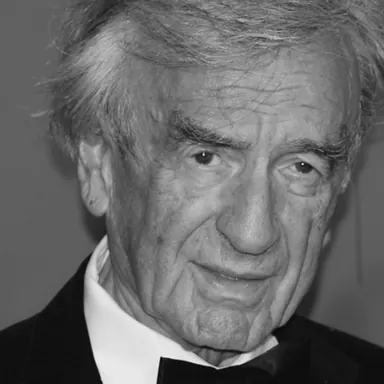
Elie Wiesel: Faith, Protest and Memory in the Shadow of the Rupture
14 min read2,716 words
Summary
The text surveys the theological and educational teaching of Elie Wiesel, examining his passage from the world of Hasidism and Kabbalah of his childhood to a position of "wounded faith" in the wake of the events of the Holocaust. It traces his spiritual development through the influences of figures such as Rav Mordechai Shushani and the Lubavitcher Rebbe, who gave him tools for expressing religious protest and "holy chutzpah" in the face of God's silence. The author stresses Wiesel's unique interpretive method, which brought biblical figures to life as partners in human suffering, and his conception of testimony and story as a supreme moral duty. Ultimately, the article presents a Jewish model in which the question and memory become anchors of identity, allowing the believer to continue the dialogue with God precisely out of the rupture and the destruction.
The Torah Teaching and Theological Thought of Elie Wiesel: Faith, Protest and Memory in the Shadow of the Rupture
The thought of Elie Wiesel, a figure who became a symbol of testimony and memory in the twentieth century, cannot be summed up as a mere catalogue of historical experiences. Over decades of creative work Wiesel developed a complex Torah and theological teaching, which draws its vitality from the world of Hasidism and Kabbalah of his childhood, collides forcefully with the horrors of the Holocaust, and tries to build a bridge of "wounded faith" for the generations to come. His figure as a "witness" is not confined to describing the physical atrocities, but extends to a reinterpretation of the classical Jewish sources – the Bible, the Talmud and the Midrash – through the eyes of one who saw the utter collapse of humanity and the resounding silence of God.[1, 2, 3]
Roots in Sighet: Kabbalah and Talmud as the Pillars of Early Consciousness
Understanding Wiesel's Torah work requires a dive into the religious matrix in which he was shaped in his youth in Transylvania. Wiesel grew up in a Hasidic home in Sighet, a place where the Torah was not only an object of intellectual study but a total existential space. Already in his youth he stood out as a boy thirsty for knowledge, who sought to break through the boundaries of the revealed and to delve into the mysteries of the hidden.[4]
The Study of Kabbalah and the Search for the Absolute
Even before the war, Wiesel immersed himself in the world of Jewish mysticism under the guidance of a "teacher of mysteries" whom he met every evening. He described these experiences as a bold attempt "to enter the Pardes" – that orchard of hidden knowledge from which other sages emerged harmed or as heretics. Together with a handful of friends, he engaged in ascetic practices, such as fasting on Mondays and Thursdays, and staying in the study hall until midnight studying 'Sefer Yetzirah' and the writings of Rabbi Chaim Vital, the foremost disciple of the Ari.[4]
The influence of Lurianic Kabbalah on his worldview was decisive. Concepts such as "the shattering of the vessels," "sparks" and "contraction" (tzimtzum) gave him a religious language through which he understood the complexity of a creation that contains within it a potential for destruction. The questions that occupied him then – how God can be freed from being "a prisoner of Himself and of our deeds" – would later become the central theological questions he would direct toward heaven after the war.[4]
The Talmud as an Intellectual Anchor
Alongside his engagement with mysteries, Wiesel received a classical Orthodox education dominated by the study of the Talmud. He testified that had the war not cut short the course of his life, his aspiration was to become a teacher of Talmud.[4] Talmudic study gave him the dialectical tools that found expression in his writing: the ability to see many facets in a single truth, respect for the question that remains open ("teiku"), and the understanding that the text is a space of living encounter between the generations.[5, 6]
Rav Mordechai Shushani: The Revolution of the "Lithuanian Genius"
The period after the war, which Wiesel spent in France, marked a dramatic turn in his intellectual and Torah development thanks to his encounter with Rav Mordechai Shushani. The figure of Shushani, a mysterious wanderer of phenomenal knowledge who mastered 30 languages and quoted the entire Talmud and Zohar by heart, became a compass for Wiesel.[4]
Wiesel credited Shushani with his constant drive to ask questions and with "the pursuit of the mystery hidden within knowledge." Shushani taught him that everything he thought he knew about Judaism and about God was superficial, and demanded that he understand that "he understands nothing."[4] This approach, which dismantles certainties, allowed Wiesel to approach the sacred texts not only as a source of authority, but as an arena of sharp moral and theological struggle. Shushani's influence is evident in Wiesel's refusal to provide easy answers to the question of evil in the world and in his emphasis on "the darkness hidden within the light."[4]
A Theology of Wounded Faith: God Inside and Outside Auschwitz
The heart of Wiesel's Torah teaching deals with the paradox of faith after the Holocaust. Wiesel does not accept atheism as a solution, but neither is he willing to reconcile himself with a traditional theology that justifies the divine judgment (theodicy). He defines his position as "wounded faith."[1, 8]
Rebellion as Prayer and Prayer as Protest
Wiesel describes two possible ways of bearing the rupture of faith. The first is rebellion – a deliberate cessation of the observance of the commandments and of prayer as an expression of an inner cry. He stresses that this is not heresy (atheism), but the rebellion of a believer. For Wiesel, the atheist removes himself from the dialogue with God, whereas the rebel remains within the space of faith and uses his silence as a weapon against God's silence.[9]
The second way is the way of protest and defiance within prayer itself. Wiesel describes how in the camps there were Jews who continued to pray, but the direction of prayer changed. Prayer became an attempt to "force" God to resemble the attributes ascribed to Him – merciful and gracious – precisely when it seemed that they had been lost. The believer says "Ahava Rabba" (With Great Love) not out of theological confidence, but as defiance against cruel reality.[9]
"To Believe in God in Spite of God"
One of Wiesel's formative statements is: "I believe in God, in spite of God."[8] This position reflects a rejection of any attempt to provide a rational or religious explanation for the Holocaust. Wiesel argued that if God were to give him an answer about Auschwitz, he would reject it, since there is no answer that can justify the suffering of the murdered. His faith does not rest on understanding, but on a commitment to continue the dialogue with God even when He seems absent or a partner to the silence.[8, 10]
Elie Wiesel and the Lubavitcher Rebbe: The Dialogue on "Holy Chutzpah"
The relationship between Wiesel and Rabbi Menachem Mendel Schneerson of Chabad offers a rare glimpse into his Torah grappling with the question of faith. In their conversations, Wiesel posed the piercing difficulty: "How is it possible to believe in God after Auschwitz?" The Rebbe, instead of providing a philosophical answer, challenged Wiesel to understand the root of his anger.[10]
The Rebbe argued that Wiesel's anger stemmed from a great love of God and from the expectation of absolute justice from Him. "In order to put God on trial, you must believe that God is there," the Rebbe explained. He saw Wiesel's protest as an expression of "holy chutzpah" – a traditional Jewish stance of prophets such as Abraham and Moses, who demanded that the Judge of all the earth do justice. Wiesel adopted this conception, and understood that his rage does not take him out of the tradition, but places him in one line with Rabbi Levi Yitzchak of Berditchev and other tzaddikim who "put God on trial."[10]
The Midrashic Methodology: Bringing Exemplary Figures to Life
Wiesel's Torah work found clear expression in his lecture series and in his books devoted to portraits of biblical and Talmudic figures. At institutions such as the 92nd Street Y in New York, Wiesel did not merely teach texts, but "brought to life" the figures for the modern audience.[3, 7, 11]
The Method of "Masks and Layers"
Wiesel developed a unique hermeneutical method of the "untying of words." He believed that beneath every biblical story another story is hidden, and beneath every mask there are further masks. In his classes, he used to "begin from the end" – for example, in analyzing the story of Noah he focused on the apocalypse of the Flood in order to understand the human failure that preceded it.[3]
He used philological tools to distinguish between terms such as "ketz" (a violent ending) and "sof" (end), and argued that the tone of the biblical narrative is often the tone of "a prophecy that will be fulfilled at any cost." In his approach, the biblical figures are not distant mythical figures but human beings "condemned to be free," struggling with questions of suffering, guilt and hope that are ever relevant after the Holocaust.[3, 12]
The Key Figures in Wiesel's Eyes
- Job: Wiesel saw Job as a key figure for understanding the human condition after the Holocaust. In contrast to the traditional interpretation that tries to find sin in Job, Wiesel stressed his complete innocence. For him, Job is the model of a believer who did not keep silent; he rediscovered his faith within his rebellion and protest.[13, 14]
- Abraham versus Noah: Wiesel expressed criticism of Noah, whom he called "a survivor who kept silent" and did not protest against the destruction of humanity. By contrast, he admired Abraham for his courage in bargaining with God for the rescue of Sodom. Abraham represents the ideal of social commitment that does not surrender to the decree of fate.[3]
- Rashi: In his book "Rashi: A Portrait," Wiesel examined how the climate of persecution of the Crusades influenced Rashi's interpretation. He saw in Rashi a model of "proto-Zionism" and of a rabbi connected to his people in time of trouble, who sought to find consolation in the text for a persecuted generation.[15]
The Influence of Midrashic Criticism on Theology
Wiesel, although rooted in tradition, was also influenced by critical approaches and academic study of the Bible. Nevertheless, he used these tools for theological and existential purposes and not only for historical research.
The Modern "Maggid": Storytelling as a Religious and Ethical Act
One of the central aspects of Wiesel's work is his adoption of the role of the "maggid" – the wandering Jewish storyteller who conveys moral messages through tales. Wiesel believed that God created man because "God loves stories." In his eyes, the story is the only tool that can bridge the gap of years and transmit the experience of the Holocaust without reducing it to dry facts.[17, 18]
The Ethics of Testimony
For Wiesel, "whoever listens to a witness becomes a witness himself." This is a Torah conception of the transmission of responsibility. The Jewish story is not only a memory of the past, but the creation of a covenant of commitment between the teller and the listener. In this way he made the memory of the Holocaust part of the "Oral Torah" of the present generation, a Torah intended to prevent indifference and future evil.[8, 17]
He saw indifference as the gravest sin, since it cancels the humanity of the victim even before the physical murder. His moral teaching connects the uniqueness of Jewish suffering with the universal commitment to fight for human rights everywhere in the world, from Rwanda to Cambodia.[13, 19]
Memory and Identity: The "Broken Tablets" of the Jewish People
Wiesel's teaching emphasizes the importance of memory as a constitutive component of Jewish identity. Rabbi Jonathan Sacks, in his eulogy for Wiesel, compared his mission to carrying the bones of Joseph and the broken tablets in the wilderness. Just as the Children of Israel carried with them the fragments of the first tablets alongside the new tablets, so Wiesel carried the broken lives of six million Jews to every place he went.[19]
The Importance of Literacy and the Book
Wiesel stressed that the Jewish people is "the people of the book" not only in the sense of reading texts, but in the sense that life itself is perceived as a book. Jewish literacy is the source of human dignity, since it allows every person to resemble the Creator through creativity and study. For him, study is a supreme value that surpasses even prayer, since in study a person meets God through the intellect and tradition.[5]
Summary and Conclusions: Faith After the "Eclipse of the Luminaries"
The work and Torah teaching of Elie Wiesel constitute an uncompromising religious and existential response to an event that should have destroyed faith. Wiesel did not choose the easy path of heresy, but neither did he choose the comforting path of blind faith. He proposed a model of "wounded faith" that lives within the constant tension between the love of God and protest against Him.
The main conclusions of his teaching include:
- The question as a religious value: in post-Holocaust Judaism, the question is more important than the answer. Protest toward heaven is a legitimate, and perhaps even necessary, form of the service of God.[9, 10]
- Fidelity above understanding: when theology collapses, fidelity to the chain of generations and to the tradition of one's parents is the anchor that makes the continuation of Jewish existence possible.[9]
- The responsibility of the survivor: the role of the survivor is not only to remember, but to turn memory into an active tool for fighting indifference and advancing global justice.[19, 20]
- Bringing the Bible to life: the Jewish sources must be read through the prism of contemporary historical experience. The biblical figures are partners in the journey of suffering and hope of the Jewish people.[3, 12]
Elie Wiesel succeeded in turning God's silence and man's cry into a new chapter in Jewish thought. He left behind him a Torah legacy that does not seek to quiet the conscience, but to awaken it, while maintaining a deep bond, wounded but determined, with the Master of the Universe and with the destiny of the Jewish people.[17, 18, 21]
Sources21
- 1.מסע אל קצה הלילה: האמונה הפצועה של אלי ויזל בעקבות השואה - בית אבי חי, bac.org.il/blog/?postID=14596
- 2.Faculty Publications | Elie Wiesel Center for Jewish Studies - Boston University, bu.edu/jewishstudies/research/publications/
- 3.1 Elie Wiesel_ In the Bible: Noah 92nd Street Y Elie Wiesel Archive ..., 92ny.org/92StreetY/media/img/OnDemand/EW Archive/EW Archive Transcripts/1982_10_14_Elie_Wiesel_92Y.pdf
- 4.Elie Wiesel: the man and his legacy - OpenBU - Boston University, open.bu.edu/bitstreams/f993b637-195e-432c-8250-91a3e70fc623/download
- 5.The Home of the Book for the People of the Book | Video | The Rabbi Sacks Legacy, rabbisacks.org/videos/home-book-people-book/
- 6.Faith Lectures: Judaism, Justice, and Tragedy (2) | The Rabbi Sacks Legacy, rabbisacks.org/archive/faith-lectures-judaism-justice-and-tragedy-confronting-the-problem-of-evil/
- 7.Sages and dreamers : biblical, talmudic, and hasidic portraits and legends : Wiesel, Elie, 1928-2016 : Free Download, Borrow, and Streaming - Internet Archive, archive.org/details/sagesdreamersbib0000wies
- 8.Elie Wiesel's “Wounded Faith” | Washington Monthly, washingtonmonthly.com/2025/12/08/elie-wiesels-wounded-faith/
- 9.איך מתפללים אחרי שבר? הפיתרון של העמדה המסורתית - מכון הרטמן, heb.hartman.org.il/prayer-after-disaster-yaffa-bnaya/
- 10.“I Shall Teach You to Sing!” - The night Elie Wiesel met the Rebbe - Chabad.org, chabad.org/library/article_cdo/aid/3372829/jewish/I-Shall-Teach-You-to-Sing.htm
- 11.Wise Men And Their Tales; Portraits Of Biblical, Talmudic, And ..., bookstellyouwhy.com/pages/books/29855/elie-wiesel/wise-men-and-their-tales-portraits-of-biblical-talmudic-and-hasidic-masters-1st-edition-1st
- 12.Five Biblical Portraits by Elie Wiesel - Goodreads, goodreads.com/book/show/123024987-five-biblical-portraits
- 13.Elie Wiesel on Memory, Prayer, Protest, Suffering, and God | Dr. Philip Irving Mitchell, dbu.edu/mitchell/modern-resources/wieselquotes.html
- 14.Biblical criticism in the service of Jewish theology: A case study in post-Holocaust biblical exegesis, journals.co.za/doi/pdf/10.10520/EJC85671
- 15.Reflecting on a Rabbi's Legacy | Harvard Divinity Bulletin, bulletin.hds.harvard.edu/reflecting-on-a-rabbis-legacy/
- 16.Elie Wiesel, “Five Biblical Portraits” - Mere Pensees, merepensees.com/2017/10/elie-wiesel-five-biblical-portraits/
- 17.The Ethics of Elie Wiesel`s Storytelling as a New Theoretical Approach in Representing the Holocaust - ResearchGate, researchgate.net/publication/357809585_The_Ethics_of_Elie_Wiesels_Storytelling_as_a_New_Theoretical_Approach_in_Representing_the_Holocaust
- 18.Telling the Story | Bo | Covenant & Conversation | The Rabbi Sacks Legacy, rabbisacks.org/covenant-conversation/bo/telling-the-story/
- 19.Reviews | Elie Wiesel: An Extraordinary Life and Legacy - Moment Magazine, momentmag.com/reviews-elie-wiesel-an-extraordinary-life-and-legacy/
- 20.Elie Wiesel: First Person Singular . A Biblical Life | PBS, pbs.org/eliewiesel/life/dershowitz.html
- 21.Ethics, Meaning, and the Absurd in Elie Wiesel's The Trial of God and Albert Camus's The Plague - Brill, brill.com/display/book/edcoll/9789004292697/B9789004292697_017.pdf