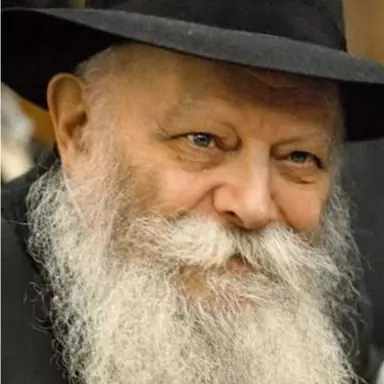
Making the world "a dwelling place in the lower realms" through mission and action.
Biography
The seventh leader of Chabad Hasidism, who built a worldwide network of emissaries and turned responsibility for every Jew into a universal vision.
The Road to Sinai
The archive doesn’t yet record an unbroken road from The Lubavitcher Rebbe to the chain of transmission: the trail reaches back to Rabbi Dovber Schneuri and stops there.
The text presented is an in-depth survey of the life and intellectual legacy of the Lubavitcher Rebbe, Menachem Mendel Schneerson, emphasizing his unique ability to combine strict adherence to the Torah with a deep understanding of modern science and geopolitics. The source describes in detail his path from a brilliant scholar who received an engineering education in Europe to a spiritual leader who created a global network of emissaries and initiated large-scale campaigns for the revival of Jewish traditions. Particular attention is paid to his methodology in the "Likkutei Sichos," where theological abstractions are turned into concrete guidance for life that demands full self-realization of a person. The text also sheds light on his uncompromising position on the integrity of the Land of Israel and his central role in spreading the belief in the nearness of the era of Mashiach (the Messiah), which remains the driving force of the Chabad movement today. Thus the document serves as a systematic introduction to the worldview of a leader who strove to turn the whole material world into a dwelling place for the Divine Presence.
The Chain of the Generations, Thought and Action: The Torah Teaching and Work of Rabbi Menachem Mendel Schneerson of Lubavitch
Introduction: Portrait of a Leader and Thinker
Rabbi Menachem Mendel Schneerson, the seventh Rebbe in the dynasty of Chabad-Lubavitch Hasidism, represents an extraordinary leadership figure in modern Jewish history.[1, 2] He succeeded in combining, in a phenomenal manner, profound traditional Torah scholarship with a sober and realistic understanding of global and political reality.[2] Key figures in Israeli leadership, among them Yitzhak Rabin, Ariel Sharon, Shimon Peres and Benjamin Netanyahu, took note of this uniqueness in their meetings with him.[2] Rabin described him as a man living in a world of Torah alongside a sober and practical view of reality [2], while Sharon and Peres emphasized his ability to look to the future with exceptional clarity and to foresee complex geopolitical and security processes.[2] His figure, characterized by an iron will and a gaze that combined power with comfort, set in motion a worldwide spiritual movement that changed the face of the Torah world and of Jewish education after the Holocaust.[1, 2, 3]
Chapter 1: Biography and Intellectual Development
Rabbi Menachem Mendel Schneerson was born on the 11th of Nisan 5662 (18 April 1902) in the port city of Nikolayev in the Russian Empire (today in Ukraine).[1, 4] His father, Rabbi Levi Yitzchak Schneerson, was a great kabbalist and a prominent halakhic authority, and his mother was the Rebbetzin Chana, née Yanovsky.[1, 4] In 1907 the family moved to Yekaterinoslav (today Dnipro), where the father was appointed chief rabbi of the city.[1, 4] The Rebbe had two younger brothers: Dov Ber, who was brutally murdered by Nazi collaborators in 1944, and Yisrael Aryeh Leib, who died in 1952 while completing his doctoral studies at the University of Liverpool.[1]
The Rebbe's early education was conducted in a private framework under the guidance of the tutor Rabbi Zalman Vilenkin between 1909 and 1913.[1] At the age of 11 Vilenkin informed the father that he had nothing more to teach the boy, and from then on his father began to teach him Talmud, the literature of the decisors and Kabbalah systematically.[1] The Rebbe revealed himself as an exceptional prodigy, and by the age of 17 he had absolute mastery of the entire expanse of the Babylonian Talmud—about 5,422 pages—together with its early and later commentators.[1] Alongside his Torah studies, he sat for examinations as an external student at the local Russian school.[1]
Already in his youth the Rebbe was actively involved in the affairs of his father's office and even served as an intermediary and interpreter between the Jewish community and the Russian authorities.[1] His father's fearlessness in the face of the Soviet regime shaped the worldview of his son.[1] Later the Rebbe expressed himself about this period: "I have the upbringing of the eldest son of the rabbi of Yekaterinoslav. When it comes to saving lives, I speak in a loud voice, and it does not matter what others say."[1] He received rabbinic ordination from the Rogatchover Gaon (Rabbi Yosef Rosen) and from the author of "Seridei Esh," Rabbi Yechiel Yaakov Weinberg.[1] In 5683 (1923) he met for the first time the sixth Rebbe of Chabad, Rabbi Yosef Yitzchak Schneerson (the Rayatz), and began to work with him to preserve Judaism in Russia.[4] In 5687 (1927), when the Rayatz was arrested by the Bolsheviks, the Rebbe was among the leading activists working for his rescue, and after their release he left Russia with him for Riga.[4]
After his marriage to the Rebbetzin Chaya Mushka in 1928, the couple moved to Berlin.[3, 5] There the Rebbe studied mathematics, physics and philosophy at the University of Berlin as an auditing student, alongside studies at the rabbinical seminary in Berlin.[3] With the rise of the Nazis to power in 1933, they fled to Paris, where he completed studies in electrical engineering at the Special School of Public Works (ESTP) and received an engineering degree in 1937.[3, 5] He then enrolled for studies in mathematics, physics and the exact sciences at the Sorbonne.[3, 4] In Paris he devoted himself to Torah study with great perseverance and in privacy, alongside assisting the activity of his father-in-law.[4, 5] These academic studies in France served at that time as the main instrument for obtaining a residence permit.[3]
This academic training produced in the Rebbe a distinctly scientific-systematic approach [6], but at the same time he held a sharply conservative position opposing the study of his Hasidim in colleges.[7] The Rebbe based this opposition on the claim that the academic atmosphere is saturated with denial of the Creator and of His individual providence.[7] Nevertheless, he made judicious use of the engineering and physical knowledge he had acquired in order to decide complex halakhic-technological questions that were brought to his door during the years of his leadership.[7]
Chapter 2: The Bibliographic Editorial Enterprise as a Basis for Consolidating His Leadership
Before assuming the leadership of Chabad in 5711 (1951), the Rebbe served as deputy to his father-in-law and engaged in extensive bibliographic and publishing-editorial activity.[1, 4, 8] This editorial work was characterized by scholarly precision, systematic organization, and the making accessible of the manuscripts of the previous Rebbes of Chabad with the addition of footnotes, indexes and detailed sources.[8, 9] This early work laid the methodological foundations for the immense Torah canon that he later published as Rebbe.[4, 6]
This editorial work reveals the Rebbe's mastery of research methodology and comparative interpretation.[9] In the Passover Haggadah, for example, the Rebbe traces precise changes of wording and explains in a rational manner why the author of the Tanya preferred a particular version over other versions.[9] This work served as a direct antechamber to the editing of his own talks, which he reviewed with care and uncompromising exactness.[6, 10]
Chapter 3: Interpretive and Theological Method in "Likkutei Sichos"
The book series "Likkutei Sichos," numbering between 39 and 41 volumes, constitutes the crowning achievement of the Rebbe's Torah teaching.[6, 10] These talks, delivered over the forty years of his leadership, were edited by the "Committee for the Dissemination of Talks" and were carefully reviewed by the Rebbe himself, who devoted many working hours to this.[10] The series is built in the format of nine books divided into volumes according to the order of the weekly Torah portions and the festivals.[10] The first part of the series (Volumes 1–4) is arranged in a unique way in which Volume 1 gathers talks on Genesis, Exodus and Leviticus, Volume 2 on Numbers and Deuteronomy, and Volumes 3 and 4 follow the same pattern, so that every five books of the Torah make up one book out of the nine.[10]
Beginning with Volume 15, special "Supplements" gathering letters and excerpts of talks were incorporated into the book.[10] These parts constituted the first published setting for the Rebbe's letters, many years before the printing of the series "Igrot Kodesh" began.[10]
The interpretive methodology in "Likkutei Sichos" presents an original and profound approach to Jewish thought and to halakha.[6] Each essay opens by posing comprehensive questions and a critical survey of the views of the commentators on Scripture and of the decisors.[6] After the discussion apparently reaches exhaustion, the Rebbe proposes an entirely new point of view—a surprising intellectual turn that illuminates the topic in a different light and resolves all the perplexities at once.[6] The Rebbe insists that every theoretical pilpul must have a practical directive and a concrete implication for the human soul and for daily life.[6]
A prominent example of this approach appears in Volume 28, in which the Rebbe analyzes the offering of the tribal princes for the Tabernacle: "Six covered wagons… a wagon for every two of the princes."[6] The Rebbe asks why two princes were required to bring one wagon jointly, and explains that this wagon was loaded with an extremely heavy burden to the very limit of its carrying capacity.[6] From this the Rebbe derives a comprehensive existential insight: a wagon that is not loaded to the brim and that uses only part of its carrying potential does not fulfill its purpose.[6] To God's Tabernacle one must not bring wasted materials or abilities that have not been fully realized.[6]
This conception entirely rejects the idea of seclusion and flight from reality.[6] The Rebbe demanded of his Hasidim and of every person that they strive for full self-fulfillment.[6] He turned to artists, writers, scientists and musicians and encouraged them to use their special talent for holy purposes, saying that a person who secludes himself and neglects his talents presents to God "a half-empty wagon" and wastes the gifts given to him from heaven.[6]
Chapter 4: His Attitude toward Science, Technology and Modernity
The Rebbe's thought does not posit a dichotomy between science and Torah, but sees them as complementary systems, on condition that science recognizes its empirical limitations.[5, 11] The Rebbe emphasized that science by its very nature deals with probabilities, hypotheses and provisional theories open to refutation, and not with absolute truths.[11] From this, the Rebbe firmly rejected the scientific claims regarding the age of the universe as billions of years, as well as the theory of evolution.[12] He used his deep knowledge of mathematics and physics to criticize the methods of dating fossils, arguing that they rest on unfounded extrapolations and on assumptions that cannot be proven.[12]
Nevertheless, he emphasized that the duty of the believing scientist is to continue investigating the laws of nature without placing artificial limits on the Creator's ability.[5, 11] When asked about the possibility of life on other planets (such as Mars), the Rebbe replied that to determine that there is no life outside the Earth is to place a limit on what God can do, which no one is authorized to do, and therefore scientists should continue to search.[11]
With regard to technology, the Rebbe presented an optimistic and active teaching.[6] He based this on the principle of the Baal Shem Tov that everything a Jew sees or hears is directed by individual providence in order to bring him closer to the service of the Creator.[11] Since nothing in the world was created in vain, every technological invention was created fundamentally for a spiritual purpose.[6] Radio waves, for example, were created in order to spread the words of Torah to the most distant places, just as gold was originally created for the Temple.[6] This approach constituted the spiritual engine that drove Chabad Hasidim to embrace technological innovations, from the radio broadcasts of Tanya lessons in New York in the 1950s to the use of satellites and advanced computing to spread Judaism.[6]
Chapter 5: The Shluchim Enterprise, the Ten Mitzvah Campaigns and Spiritual Activism
In order to turn the idea of a "dwelling place in the lower realms" (dirah ba-tachtonim) into a tangible reality, the Rebbe established the enterprise of the shluchim (emissaries) and the Chabad Houses throughout the world.[3, 13, 14] The Rebbe saw the outward spreading of the wellsprings of Hasidism as the main task of the seventh generation, and made it a commandment about which one must be especially careful.[4] He sent young families to establish centers of activity in remote places, beginning with Morocco and Brazil in the early 1950s and reaching thousands of centers today.[4]
The shluchim disseminated the ten mitzvah campaigns that the Rebbe conceived in order to awaken the Jewish point in every person.[15] These campaigns served as instruments of spiritual and physical protection for the people of Israel.[15]
The campaigns were aimed in part at specific target audiences.[15] The campaigns of Shabbat candles (Nesh"k), kashrut and family purity were intended primarily for women, out of the conception that they raise the trunk and the tree of the next generation.[15, 17]
Within the framework of the Torah campaign, the Rebbe presented a profound teaching based on the words of the Alter Rebbe in "Likkutei Torah."[16] The Rebbe explained that the study of Torah in this world, while the soul is in the body (the revealed Torah), constitutes the "vessel" through which a person will be able to study the inner dimension of the Torah in the Garden of Eden and at the coming of the Messiah.[16] According to the saying of the Sages, "Happy is he who comes here with his learning in his hand," it is required that the learning be engraved in the soul of the learner.[16] The study of the inner dimension of the Torah today is in the nature of "its tasters"—a taste of the new Torah that will be revealed in the future to come.[16] Adding a Torah lesson for a Jew, even a single verse or a single halakha with understanding and comprehension, effects in him a spiritual wholeness that takes him out of bondage into true freedom.[16]
The Rebbe's deep attachment to the Hasidic dynasty and to self-sacrifice found symbolic and precious expression in the Rebbe's Torah scroll.[18] This tiny Torah scroll (the height of its parchment is only 19 centimeters) is attributed to the printer brothers of Slavita, Rabbi Shmuel Abba and Rabbi Pinchas Shapira, who sat for many years in the tsarist prison for printing Hasidic books.[18] The scroll was written under harsh conditions of imprisonment, and upon their release it was bound into a single unit.[18] The Rebbe used to hold this Torah scroll to his bosom on the days of the Torah reading, during the Kol Nidre prayer, during the hakafot of Shemini Atzeret and Simchat Torah, and during the maftir aliyah on the festivals.[18] In preparation for the 11th of Nisan 5732, a splendid crown made of two ancient crowns was acquired for the scroll.[18] Many Hasidim customarily pass along a special route in the study hall in order to kiss this ancient Torah scroll, which symbolizes the eternity of the Chabad tradition.[18]
Chapter 6: His Political Teaching—The Wholeness of the Land and the Security of the People
The campaign for the wholeness of the Land constituted a central pillar of the Rebbe's public activity since the Six-Day War.[19] The Rebbe expressed fierce and resolute opposition to any territorial concession or handing over of territories of the Land of Israel to foreign parties, a conception that he rejected utterly.[19] He spoke out of deep pain and genuine concern for the welfare of the people and the Land, arguing that withdrawals lead to a severe security catastrophe.[20, 21]
The Rebbe presented a resolute position regarding our right to the Land and rejected the use of secular diplomatic arguments.[19] He opposed basing ownership on UN resolutions or the Balfour Declaration, since the nations of the world have no authority to hand over something that does not belong to them.[19] He likewise rejected the argument of "historical right" alone, comparing it to the Indians in the United States, who cannot claim present ownership of the country merely because they once dwelled in it.[19] He rejected the Arabs' claim of inheritance as descendants of Ishmael, both because the Arabs today are not his descendants, and because according to the Torah Ishmael was sent away from the people of Abraham and does not inherit the Land.[19]
The only explanatory argument that will be accepted in the world, in the Rebbe's view, is Rashi's commentary on the first verse in the Torah: the Holy One, blessed be He, created the world; by His will He took it from the seven nations and by His will He gave it to the people of Israel, and therefore this is not robbery but the liberation of the promised land.[19]
With regard to settlement in the liberated territories, the Rebbe demanded acting quickly and all at once.[19] He opposed slow and gradual settlement, which conveys a lack of resolve and creates sustained international pressure.[19] He called for bringing "a million settlers" at once and settling all the territories quietly, resolutely and without public announcements that would draw condemnations.[19] As a successful example of this policy he cited the construction of the nuclear reactor in Israel, which was carried out without public declarations and was received by the world as a fait accompli.[19]
Chapter 7: The Theology of the End of Days—Refinements, "Yechi" and the Revelation of the Messiah
The Rebbe's burning aspiration for hastening the redemption was the compass for all his ideas and deeds.[3, 22] According to Chabad teaching, the period of exile is intended for the work of refinements (birurim)—the refinement of the 288 sparks of holiness scattered in the physical world.[4, 13] The Rebbe explained that when these refinements are completed, the Messiah will come speedily.[13]
In 5751 (1991), the Rebbe made a dramatic historic declaration: the work of refinement had been completely finished, and there was no longer any spiritual obstacle to the coming of the redemption.[4] Therefore, the only task that remains is to prepare the people of the generation and the world for receiving the Messiah.[4]
In that same year, the belief in the Rebbe as King Messiah received broad public expression.[4] The Rebbe encouraged the Hasidim's singing in his presence: "Long live our master, our teacher and our Rabbi, King Messiah, forever and ever," and even approved publicizing his identity as the Messiah on a worldwide scale.[4] He authorized the Hasid R. Yitzchak Springer to print giant advertisements in "The New York Times" with his picture under the headline "Long Live the King Messiah."[4] A peak event took place on the 10th of Shevat 5753 (1993), at the worldwide ceremony of the acceptance of kingship, broadcast live on the world's leading television networks, in which the Rebbe encouraged the singing of the "Yechi" from the balcony of his room.[4] His talks from those years were printed in the book series "Devar Malchus," which deals mainly with matters of redemption and the Messiah and the progress of the generation toward the end of days.[9]
Even after his physical passing on the 3rd of Tammuz 5754 (1994), many of his Hasidim believe that he continues to lead the generation as before and that he lives physically an eternal life.[1, 4] The writing of letters to the Rebbe continues actively, with the answers and guidance received by opening volumes of "Igrot Kodesh" at random, and many petitioners report blessings, wonders and precise advice for problems of health, livelihood and domestic harmony revealed in the pages that were opened.[4, 23, 24]
Summary and Conclusions
The teaching and work of Rabbi Menachem Mendel Schneerson of Lubavitch present a comprehensive theological and leadership model, combining uncompromising halakhic conservatism with applied and daring modernism.[4, 6] The Rebbe refused to accept the confinement of Judaism's influence to the private or narrow communal sphere.[6] Through "Likkutei Sichos" and the worldwide network of shluchim, he presented an active and proud Judaism that does not shrink from the blows of the times but storms reality in order to repair it and illuminate it with the light of redemption.[4, 6]
The bibliographic, mathematical and engineering tools that he acquired in his youth served him in shaping an orderly, encyclopedic and rational teaching, enabling the modern person to find an answer to his existential perplexities and to harness all his powers and material assets for the sake of a lofty and divine purpose.[6, 11] His legacy continues to be an enormous source of inspiration and a central axis in shaping the face of the Jewish world for generations.[2, 4]
23.אגרות קודש - תשובה מיידית מהרבי מלך המשיח, igrot.com/
24.חיפוש מהיר באגרות קודש – גלו את תורתו של הרבי מליובאוויטש לפי נושאים, daatharabi.org/page/3/
Document 2/2
Rabbi Menachem Mendel Schneerson of Lubavitch
19 min read·3,706 words
Summary
This article surveys the multifaceted figure and the vast legacy of Rabbi Menachem Mendel Schneerson, the seventh Rebbe of Chabad Hasidism, emphasizing his decisive contribution to the revival of modern Judaism. The text sketches the portrait of the Rebbe as one who brought about a worldwide revolution through a rare combination of profound Torah scholarship and scientific and technological education, tools that served him in spreading divine unity in physical reality. The article details the foundations of his teaching, foremost the concept of "a dwelling place in the lower realms" and the advancement of the vision of complete redemption, alongside a methodological survey of his monumental Torah writings and his public enterprises such as the network of shluchim and the "Ten Mitzvah Campaigns." Ultimately, the source seeks to present the Rebbe as a spiritual architect who succeeded in bridging the sacred and the secular and in turning Hasidism into an activist movement influencing the entire Jewish people and the global public sphere.
The Spiritual Architecture and Revolutionary Leadership: The Work and Torah Teaching of Rabbi Menachem Mendel Schneerson of Lubavitch
The figure of Rabbi Menachem Mendel Schneerson, the seventh Rebbe of Chabad-Lubavitch Hasidism, is perceived in modern Jewish historiography as a decisive turning point that reshaped the face of post-Holocaust Judaism. His leadership, which began officially in 5711 (1951), was not confined to managing a closed Hasidic community but developed into a worldwide movement with broad political, social and halakhic influence.[1, 2] The revolution wrought by the Lubavitcher Rebbe was based on a rare synthesis between classical Torah scholarship at the highest levels and a deep understanding of modern, technological and scientific reality.[3, 4] His Torah teaching, spread over hundreds of volumes, offers a worldview that unites the revealed and the hidden into a single operative teaching whose ultimate goal is preparing the world for complete redemption.[5, 6]
The Roots of Leadership and the Shaping of Personality in the European Period
The process of the Rebbe's formation as a spiritual leader began even before he took upon himself the yoke of leadership. He was born on the 11th of Nisan 5662 (1902) in the city of Nikolayev in Ukraine, to his parents Rabbi Levi Yitzchak and the Rebbetzin Chana Schneerson.[7, 8] His father, who was a scion of the family of the Rebbes of Chabad and a brilliant kabbalist, served as chief rabbi of Yekaterinoslav and was the first and most significant model for his son in uncompromising devotion to the principles of Judaism in the face of a hostile regime.[7, 8] Already at a very young age a phenomenal intellectual talent was evident in the Rebbe; he left the customary framework of the "cheder" since he caught up with his peers within a short time, and continued with independent study under his father's guidance, displaying astonishing mastery in all parts of the Torah—Scripture, Talmud, halakha and Kabbalistic books.[2, 7]
The years that the Rebbe spent in Berlin and Paris (1928–1941) constitute a critical layer for understanding his later ability to bridge worlds. In Berlin he enrolled for academic studies in mathematics and philosophy, and afterwards in Paris he continued engineering studies at the Sorbonne and at a local engineering school, where he qualified as a naval engineer.[4] These scientific studies, which were conducted in modesty and in seclusion, did not come at the expense of his Torah diligence; eyewitnesses and his personal notes from that period attest that his mind was immersed in clarifying halakhic and Kabbalistic topics even during academic lectures.[4, 9] This combination gave the Rebbe the methodological tools to analyze physical reality with the tools of Torah, a conception that later became a cornerstone of his teaching—that science and technology are nothing but tools for revealing divine unity in Creation.[3, 10]
The Paradigm of "a Dwelling Place in the Lower Realms" and the Seventh Generation
With the passing of his father-in-law, the Rebbe, the Rayatz (Rabbi Yosef Yitzchak Schneerson), in 5710, a period of uncertainty began in Chabad Hasidism. The Rebbe at first refused to accept the leadership upon himself, but public pressure prevailed.[2, 9] In his first address, the discourse "Bati LeGani" delivered on the 11th of Shevat 5711, the Rebbe laid the metaphysical foundations for his leadership.[9, 11] He explained that Jewish history is divided into seven generations of Rebbes of Chabad, the present generation being "the seventh generation," which parallels the generation of Moses our teacher, who merited to bring down the Divine Presence to earth at the giving of the Torah.[11]
The central concept that the Rebbe developed is "a dwelling place in the lower realms"—the divine will that the Holy One, blessed be He, be revealed precisely in this physical and lowly world, and not only in the higher spiritual worlds.[6] According to the Rebbe, the spiritual work of previous generations was the refinement of the soul, but the task of the seventh generation is to turn material reality itself into a "dwelling place" for the Divinity.[6] This insight changed the Hasidic approach from asceticism and withdrawal from the world to active involvement in it; every physical object, every technology and every social interaction becomes a means of fulfilling a commandment and of drawing down divine light.[3, 6]
From this also derives the conception of the absolute unity of God. If everything is meant to be a dwelling place for God, then there is no sphere in life that is "neutral." The Rebbe emphasized that even going to work, eating and using a computer should be done with the intention of "In all your ways know Him."[3] This view abolished the accepted dichotomy between the sacred and the secular, and created a holistic Judaism in which physics and metaphysics complement one another.[3, 10]
The Architecture of the Torah Corpus: Method and Methodology
The Rebbe's teaching is characterized by an exceptional systematic quality that unifies all parts of the Torah into one organic unit. The scope of his writing and talks is unprecedented in Jewish history, and it encompasses all the layers: peshat, remez, derash and sod.[2, 12]
Likkutei Sichos: The Revolution in the Interpretation of Rashi and in Halakha
The monumental work "Likkutei Sichos" (39–41 volumes) constitutes the showcase of the Rebbe's study methodology.[12, 13] In these talks the Rebbe developed an innovative approach to Rashi's commentary on the Torah, based on the assumption that Rashi operates according to strict logical rules of the "plain sense of Scripture."[13] The Rebbe would raise difficulties on Rashi's words that seemed to contradict one another or to be superfluous, and by means of philological and logical precision would uncover a deeper layer in the commentary.[13] At the conclusion of every talk, the Rebbe would connect the plain-sense explanation with the foundations of Hasidic teaching, and thereby showed how the "peshat" and the "sod" are two sides of the same coin.[13, 14]
Igrot Kodesh: Medicine, Politics and Theology
The letter series "Igrot Kodesh" (over 40 volumes) is a living testimony to the Rebbe's connection with the world.[12, 15] The letters are not merely technical correspondence, but theological and halakhic documents answering the questions of scientists, statesmen, rabbis and simple people.[13] One can see in the letters how the Rebbe applies his teaching to the most complex problems of life: medical advice (from the approach that one must heed expert physicians as part of the Torah's command "and shall surely heal"), guidance in marital matters, political guidance for the leaders of Israel, and the resolution of conflicts between religion and science.[13]
The Series of Gatherings and the Book of Discourses
Whereas "Likkutei Sichos" was carefully reviewed by the Rebbe, the series "Torat Menachem – Hitva'aduyot" (over 120 volumes) documents his words as they were spoken orally during Sabbaths and festivals.[15, 16] In this series one finds the "Hasidic discourses" (Da"ch), which constitute the profound Kabbalistic side of his teaching. The discourses deal with the structure of the worlds (Atzilut, Beriah, Yetzirah, Asiyah), with the ways of the soul's service, and with explaining abstract concepts such as "tzimtzum," "Or Ein Sof" and "tohu and tikkun."[15, 16] The Rebbe's uniqueness lay in his ability to turn these abstract concepts into psychological and behavioral tools accessible to every person.[14]
The Shluchim Enterprise and the Transformation of Hasidism into an Activist Movement
The most prominent practical application of the Rebbe's teaching is the shluchim enterprise. The Rebbe was not content that his Hasidim be "sons of Torah" sitting in study halls, but demanded that they go out to every place where a Jew is found, out of the belief that within every Jew there is a "divine spark" that can be awakened.[2, 5, 17] The shaliach, according to Chabad, is an extension of the Rebbe's hands and thought, and his task is to establish a Jewish center that will provide a spiritual and physical response alike.[2, 17]
Today, thousands of Chabad Houses are scattered across the world, serving as Jewish "embassies."[2, 17] The activity of the shluchim is characterized by a non-judgmental approach toward Jews of all streams, with the aim of strengthening the unity of Israel and bringing about the fulfillment of practical commandments.[5, 18] The Rebbe emphasized that material help to a Jew (giving food, lodging, emergency assistance) sometimes takes precedence over spiritual help, and thereby redefined the role of the religious leader as a spiritual social worker.[17]
The influence of the shluchim goes beyond the religious plane. In many cities around the world, the Chabad House is the only Jewish institution providing Jewish education, a mikveh and kosher food.[17, 18] The shluchim work to instill Jewish identity among students on campuses, backpackers in the Far East and South America, and businesspeople in financial centers.[17, 19] This model became a standard that many other Jewish organizations try to emulate, but it remains unique in its totality and in the lifelong commitment of the shluchim to the place of their mission.[17]
The Ten Mitzvah Campaigns: Making Holiness Accessible in the Public Sphere
During the 1960s and 1970s, the Rebbe initiated "the Ten Mitzvah Campaigns"—focused campaigns to promote specific commandments among the general public.[18] These campaigns were intended not only to bring Jews back to full repentance, but were based on the conception that every single commandment has eternal value and can tip the scales in favor of the redemption of the entire world.[18]
These campaigns wrought a revolution in the visibility of Judaism in the public sphere. The appearance of the "Mitzvah mobiles" (the "tanks") in city centers became a symbol of proud Jewish presence.[18] The Rebbe saw in these campaigns an instrument for protecting the people of Israel; for example, the tefillin campaign was announced on the eve of the Six-Day War relying on the verse "And all the peoples of the earth shall see that the name of the Lord is called upon you—and they shall fear you," with the Rebbe interpreting that the tefillin worn on the head instill fear in the enemy.[18]
Science, Technology and Modernity: The Refinement of Sparks in the Information Age
One of the most fascinating aspects of the Rebbe's teaching is his attitude toward progress. Unlike other Haredi currents that saw modernity as a threat against which one must fortify oneself, the Rebbe saw in it an unprecedented opportunity for spreading holiness.[3, 10] His scientific education enabled him to speak the language of science and to demonstrate that there is no real contradiction between faith and objective research.[3]
The Rebbe argued that as science advances, it reveals more and more the wondrous unity of the universe, which leads to the recognition of one Creator.[3] In one of his talks he explained that the discoveries in modern physics, showing that matter and energy are different expressions of the same essence, accord with the Hasidic conception of "there is none besides Him."[3, 10] At the same time, he warned against turning science into a new religion, and emphasized that scientific theories are provisional and changing, whereas the Torah is eternal truth.[3]
In the technological sphere, Chabad Hasidism was a pioneer in the use of radio, television (for sacred broadcasts), satellites and the internet.[3] The Rebbe explained that every technological invention was in fact created in order to serve as a tool for the service of God. For example, the ability to transmit sound from one end of the world to the other was intended so that words of Torah would be heard everywhere.[3] This approach made Chabad the most powerful Jewish media organization in the world. At the same time, the Rebbe set clear boundaries: technology is a tool, and its use must be done carefully in order to prevent exposure to negative content that harms morality and modesty.[3]
Another subject in which the Rebbe displayed a modern and groundbreaking approach is the attitude toward old age and retirement. The Rebbe firmly opposed the concept of retirement, arguing that it runs counter to the spirit of the Torah, which demands that a person grow until his last day.[3] He saw forced retirement as an injury to human dignity and vitality, and encouraged the elderly to continue to act, to study and to contribute to society.[3]
The Unification of the People around the Daily Study of the Rambam
In 5744 (1984), the Rebbe initiated a new and ambitious ordinance: the daily study of the Rambam's "Yad HaChazakah."[20, 21] The goal was to unite the entire people of Israel around shared halakhic study encompassing the entire Oral Torah.[20, 22] The Rambam was chosen because his book is the only halakhic code that includes not only the commandments applicable in our times, but also the laws of the Temple, the sacrifices and the kings—subjects that will be relevant with the coming of the Messiah.[20, 21]
The Rebbe proposed three tracks so as to enable every Jew to take part, regardless of his level of learning:
Three chapters a day: a track enabling one to complete all 14 books of the Rambam in less than a year.[20, 21]
One chapter a day: a track intended for busier people, completing the cycle in about 3 years.[20, 21]
Sefer HaMitzvot: daily study of the commandments corresponding to the chapters studied in the first track, a track intended mainly for women and children.[20, 21]
The ordinance won sweeping support from the leading Torah authorities of Israel from all circles, and became one of the largest study enterprises in the Jewish world.[22] The Rebbe saw in this study a special remedy for unity, for when thousands of Jews study the same subject on the same day, a spiritual and intellectual bond is created that bridges physical distances.[21, 22]
His Positions on the Land of Israel and the Security of the People
Although the Rebbe lived in New York and had not visited the Land of Israel since his accession to leadership, his influence on what took place there was enormous.[1, 19] He maintained continuous contact with prime ministers, defense ministers and senior IDF officers.[1, 5] His positions on matters of the Land of Israel were resolute and were based on the principle of "the wholeness of the Land" and "the wholeness of the people."[5]
The Rebbe firmly opposed any territorial concession, not out of nationalist ideology but on the basis of a halakhic ruling in the Shulchan Arukh (siman 329) which holds that handing over territories adjacent to the border to gentiles constitutes "danger to life" (pikuach nefesh) for the whole community.[5] He argued that military withdrawals weaken deterrence and invite further pressures, and therefore the Torah position must be firm and uncompromising.[5]
In addition, the Rebbe fought over the issue of "Who is a Jew," demanding that the law in the State of Israel define as a Jew only one who was born to a Jewish mother or who converted in accordance with halakha.[19] He saw a conversion that is not according to halakha as an existential danger to the wholeness of the Jewish people and feared assimilation and the disintegration of national identity.[19] This activity brought him at times into confrontations with the political establishment, but he did not shrink from expressing his opinion out of absolute commitment to the Torah truth as he saw it.[3]
Relations with the Leading Sages of the Generation and Halakhic Influence
The Lubavitcher Rebbe was highly esteemed by the leading decisors of his generation, who saw in him a supreme Torah authority.[5, 23] His correspondence with Rabbi Moshe Feinstein, one of the greatest decisors in the United States, reveals deep mutual esteem and scholarly discussion of complex halakhic issues.[23, 24] Rabbi Ovadia Yosef, the Chief Rabbi of Israel, also maintained contact with the Rebbe and consulted with him on public and halakhic matters.[23]
One of the distinctive features of the Rebbe as a decisor was his ability to combine dry halakha with the inner dimension of the Torah.[13] He did not see halakha merely as a collection of laws, but as an expression of the divine will reflected in every detail of Creation.[13, 14] An example of this is the effort he invested in encouraging the laying of Rabbenu Tam tefillin even among young men, a practice that in the past was reserved only for select individuals, out of the conception that the present generation needs maximal spiritual protection.[23, 24]
The Vision of Redemption and the Expectation of the Messiah
The central motif that sealed the years of the Rebbe's leadership, and to a large extent defines Chabad Hasidism to this day, is the immediate expectation of the coming of the Messiah.[5, 25] The Rebbe declared that we are living in the period of "the footsteps of the Messiah" and that all the spiritual work required to bring about the redemption has already been completed.[11, 25] He called upon every Jew to increase good deeds and the study of matters of the Messiah and redemption in order to "open the eyes" and see that the redemption is already here.[26]
On the 28th of Nisan 5751 (1991), the Rebbe delivered a dramatic and shaking talk in which he said to his Hasidim: "I have done my part… do everything in your power to actually bring about our righteous Messiah."[26] This sentence became the main motivation of Chabad's activity in recent decades. The Rebbe turned the subject of the Messiah from a theoretical dream into an operative goal, and argued that preparing the world for redemption must be done by spreading goodness and kindness, and by turning the world into a fitting dwelling place for God.[5, 26]
Even after his passing on the 3rd of Tammuz 5754 (1994), the Chabad movement continues to grow and expand, out of the belief that his legacy and spiritual presence continue to guide the shluchim and the Hasidim.[25, 27] For many, the Rebbe remains the living leader who shapes the character of Judaism in the 21st century, a guide who combines absolute loyalty to the tradition with a bold and optimistic view of the future.[1, 5]
Summary and Conclusions: The Architect of the Revival of Judaism
The work and teaching of the Lubavitcher Rebbe constitute a unique phenomenology of Jewish leadership. He succeeded in turning a Hasidic movement that had been weakened in the wake of Communist persecution and the Holocaust into the most influential spiritual force in the contemporary Jewish world.[2, 17] The central conclusion arising from an analysis of his work is that Chabad's success stems not only from organizational capabilities but from a deep combination of a radical theological vision with a pragmatic and modern application.[3, 17]
Integration of worlds: The Rebbe demonstrated that one can be an educated engineer and an immense Torah scholar at the same time, and that there is no contradiction between scientific research and religious faith, but on the contrary—they complement one another.[3, 4]
Global responsibility: The conception of mission that he developed abolished the sectoral Jewish approach; every Jew, in every place and in every situation, is the responsibility of the leader.[2, 17]
Living halakha: His rulings and Torah novellae showed how halakha can respond to technological and social changes without losing its ancient roots.[3, 13]
The vision of redemption: By making the Messiah an everyday and accessible concept, the Rebbe gave hope and meaning to millions of Jews, and turned Judaism from a religion of memory into a religion of expectation and activism.[5, 25]
The Rebbe's legacy continues to resonate through the tens of thousands of shluchim, the millions of pages he wrote, and his indelible influence on Jewish thought, politics and society.[1, 17] He remains an exemplary figure of a leader who saw beyond the horizon, and who dedicated his life to turning this world into a radiant and holy "dwelling place" for the Creator and for all humanity.[6]