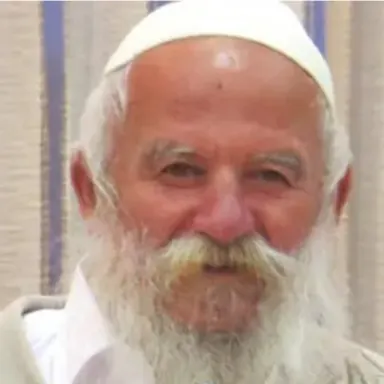
A rare combination of worlds: mystical service of God alongside a fighting ethos and public mission.
Biography
A fighter and commander in elite reconnaissance units alongside a life of Kabbalah and prayer. A figure who joins heroism, national responsibility and an awareness of redemption.
includes 4 inspiration linksThe generations follow the Rambam’s introduction to the Mishneh Torah. A dashed line is inspiration, not direct transmission.
Illuminating the Depths: The Figure, Torah Teaching and Public Work of Chacham Yeshua Ben-Shushan of Blessed Memory
10 min read·2,007 words
Summary
This article surveys the life and teaching of Chacham Yeshua Ben-Shushan, an exceptional figure who joined the conservative Sephardi-Jerusalem world of Kabbalah to the messianic activism of Religious Zionism. The text presents him as a synthesis of "the book and the sword" (sifra ve-sayfa), from his spiritual roots among the great kabbalists, through his service as a daring combat officer, to his ideological involvement in the Jewish Underground and in attempts to bring the redemption nearer. By detailing his social work and his stringent halakhic practices, the source seeks to commemorate a model of the "warrior tzaddik" who sees military and political action in the State of Israel as a direct continuation of mystical divine service.
The figure of Chacham Yeshua Ben-Shushan (1945–2018) is a unique phenomenon in the history of Jewish thought and of religious activism in the State of Israel in the 20th century and the beginning of the 21st. In his personality he embodied a rare, almost paradoxical synthesis between the mysterious world of conservative Jerusalem Sephardi Kabbalah and the messianic-activist fervour of modern Religious Zionism.[1] Ben-Shushan was not merely a theoretician of redemption; he was a man of action who translated metaphysical insights into deeds on the battlefield, in the shadows of the underground, and in energetic social activity to save individuals and the whole of Israel.[1, 2]
Spiritual Roots and Growth in the Gardens of the Kabbalists
Yeshua Ben-Shushan was born in Jerusalem on 26 December 1945 (22 Tevet 5706), in the twilight of the British Mandate and at the start of the national revival.[1] Growing up within the traditional Jerusalem milieu exposed him from a very young age to the world of Kabbalah, a field that in those years was preserved as the heritage of a select few alone. He was not content with superficial Torah study, but plunged into the depths of the esoteric teaching under the guidance of the great Sephardi kabbalists of his generation.
The list of Ben-Shushan's teachers reads like a "who's who" of the Jerusalem world of the esoteric. He studied with Chacham Shalom Yaish, Rabbi Mordechai Attia, Rabbi David Zion Laniado and the renowned kabbalist Rabbi Mordechai Sharabi.[1, 3] A decisive influence on the shaping of his character was also exerted by Rabbi Meir Yehuda Getz, the rabbi of the Western Wall and a kabbalist who shared his aspirations for the building of the Temple.[1, 4] His companionship and joint study with figures such as Rabbi David Batzri and Rabbi Yaakov Moshe Hillel attest that he was an inseparable part of the intellectual and spiritual core of the kabbalist yeshivot "Nahar Shalom" and "Beit El".[3]
His early Torah teaching was marked by absolute devotion to the tradition received from generation to generation. He regarded the slightest change in the text of the prayers or in the chanting of the cantillation marks as damage to the delicate spiritual structure of the upper worlds.[4] This view, which combines phenomenological precision with belief in the cosmic influence of the religious act, accompanied him at every station of his life.
Table 1: Map of Torah and Spiritual Training
"The Book and the Sword": The Military Ethos as an Expression of Holiness
One of the features that set Chacham Yeshua apart was his long combat military service, something extremely rare among Jerusalem kabbalists of his generation. In 1966, on the eve of the Six-Day War, he volunteered for the Shaked reconnaissance unit under the command of Binyamin Ben-Eliezer ("Fuad").[3] His service as a fighter and officer in an elite unit was not for him a "pause" from the life of the spirit, but its direct continuation. He saw the Israeli army as a divine instrument for realising the vision of the prophets.
At a time when a religious presence in the reconnaissance units was unusual, Ben-Shushan was seen as an exemplary figure who observed light and weighty commandments alike even in the most complex operational situations.[5] He used to go out on ambushes and patrols wearing tefillin beneath his combat gear, out of the conviction that defending the Land is a religious act that demands maximal spiritual devotion.[4]
In the Yom Kippur War he served as an officer in the paratroopers and was seriously wounded in face-to-face combat against an Egyptian commando.[4] This wound left many fragments of shrapnel in his body that caused him chronic suffering until the day he died. His conduct following the injury became a legend among his disciples: despite the severe pain and the danger to his health, he refused to give up daily immersion in the mikveh before studying Kabbalah, accepting bodily suffering as part of the service of God in purity.[4]
Table 2: Military Chronology and Key Events
The Ideology of the "Jewish Underground": Between Kabbalah and Reality
Chacham Yeshua's part in the "Jewish Underground" in the 1980s cannot be understood without delving into his teaching on the Temple and the Temple Mount. In his eyes, the Muslim presence on the Temple Mount was not merely a political problem or a question of sovereignty, but "the root of the corruptions in the people of Israel".[1] He believed that the rule of Islam over the site of the Temple gives its believers a "source of spiritual nourishment" from which they draw their strength to fight Israel.[1]
Together with Yehuda Etzion and Menachem Livni, Ben-Shushan planned the blowing up of the Dome of the Rock. The motive was not revenge, but an attempt to carry out a spiritual "rectification" (tikkun) that would remove the "abomination" and allow the Divine Presence to be revealed in full.[1, 2] He saw this act as one of self-sacrifice intended to halt the withdrawal from Sinai and to awaken the redemption.[2] After the underground was exposed he was sentenced to four and a half years' imprisonment, where he continued his studies and his devotion to the vision of the Temple, with a picture of the Chosen House (the Temple) always lying under his pillow in prison.[2, 4]
His involvement in the underground traced a thin boundary line between classical halakhic ruling and radical kabbalistic conceptions. The judges at his trial, despite convicting him, recognised the depth of his personality and his devotion to the state, describing him as a hero of Israel's wars who acted from pure ideological motives, even if mistaken and dangerous from the standpoint of the law.[2]
Torah Teaching and Sacred Practices
Chacham Yeshua's teaching was marked by a combination of Talmudic authority and kabbalistic depth. He took care not to invent new practices, but to cleave to the tradition of his fathers. At the same time, where the needs of the hour demanded, he knew how to apply ancient sources in original ways.
Prayer Practices and Leading the Congregation in Prayer
Ben-Shushan was considered an exemplary prayer leader (shaliach tzibbur). He believed that a prayer leader cannot be faithful unless he believes in the merit of Israel and nullifies every accusation against them.[4] He insisted on absolute precision in the chanting and in the text. On one occasion he remarked to a Torah reader who had shortened the chanting of the "trei ta'amei" (double cantillation) in Parashat Shemini, and explained to him that according to the esoteric teaching this cantillation must be drawn out in order to create the proper spiritual connection.[4]
He opposed changes in the text of the prayers based on personal reasoning, even when they came from famous rabbis, and always preferred the custom received in the old Sephardi synagogues of Jerusalem.[4] His position was that explicit statements of the Sages in the Talmud and Midrash should be preferred over statements by kabbalists that are not explicit in the writings of the Ari or the Rashash.[4]
Table 3: Principles of Conduct and Halakhic Ruling
Public Activity: "Beit Din Geula" and the "Achoteinu" Organisation
In his later years Chacham Yeshua became a source of spiritual authority for many, including prominent rabbis such as Rabbi Mordechai Eliyahu. Together they founded "Beit Din Geula" (the Redemption Court), a semi-secret body that dealt with spiritual rulings concerning the fate of the nation.[1] The court's most famous ruling determined that the people of Israel are worthy of redemption through mercy, and this ruling was physically placed in Rabbi Eliyahu's grave so that it would serve as a "reminder" in the heavenly court.[4]
His activity on behalf of the daughters of Israel was a further expression of his activism. Together with Yaakov Novick he founded the "Achoteinu" ("Our Sister") organisation, which worked to rescue Jewish girls who had become trapped in Arab villages.[1] Ben-Shushan was not content with running the organisation; he used his military skills and his courage to enter hostile villages and rescue the girls personally, sometimes at real risk to his life in the face of local residents.[4]
In the field of practical commandments he served as an expert mohel. Here too his humility and his concern for others found expression. When asked whether it is permitted to take money for a circumcision, he ruled that one who has no fixed income may take a fee, but he himself in many cases waived payment so as not to burden the families.[4]
Spiritual and Literary Legacy
Chacham Yeshua did not leave behind thick volumes of responsa, but his legacy has been commemorated in booklets and books that collect his stories, practices and oral teachings. These publications have become cherished classics among religious soldiers and students of the hesder yeshivot.
"Yeshua le-Amkha" ("Salvation for Your People"): a booklet of stories emphasising his figure as an officer and a tzaddik, published by the Tzalash association (Tzava le-Shem Shamayim, "An Army for the Sake of Heaven").[5]
"Metzapeh li-Yeshua" ("Awaiting Salvation"): a family memorial booklet gathering his private and public practices.[1]
"Matzmiach Keren Yeshua" ("Causing the Horn of Salvation to Flourish"): an e-book containing wondrous deeds and sacred practices, distributed among his disciples.[1]
"Ve-Ha'er Eineinu" ("Enlighten Our Eyes"): a daily study in faith influenced by his spirit, edited by Rabbi Reuven Sasson.[6]
Chacham Yeshua's sons continue his path in the world of Torah and education. Rabbi Chaim Ben-Shushan serves as a ram (yeshiva instructor) at the Beit El and Ro'eh Yisrael yeshivot, and Rabbi Shalom Ben-Shushan is an educator in Neria.[1] His family, linked by marriage to prominent rabbinic families (such as that of Rabbi Avihu Schwartz), forms a bridge between the Sephardi Torah world and the central yeshivot of Religious Zionism.[1]
Conclusion: The Figure of the "Warrior Tzaddik" in the Modern Era
Chacham Yeshua Ben-Shushan passed away on the eve of Rosh Hashanah 5778 (September 2018) after a struggle with a serious illness.[2, 3] His last words, "I go as an atonement for the people of Israel", express the consciousness of mission that accompanied him from the day he was born in Jerusalem until the day of his death.[4]
He left behind a unique religious model: a man able to hold a violin (he used to play to gladden bridegrooms) and a rifle, the Book of the Zohar and a military operations map.[2, 4] His historical importance lies in his having shown that Sephardi Kabbalah need not be closed off and cut off from national life, but can be the spiritual engine behind the most daring actions for the sovereignty and redemption of Israel. His figure continues to radiate onto the generation of religious fighters of our day, who see in him the embodiment of the vision of "the book and the sword" in all its glory.
6.מאד מחזק! הרב ישועה בן שושן זצ"ל • מסרים של אמונה ועוצמה לעת הזאת וסיפור אישי על ניסי מלחמת יום כפור - YouTube, youtube.com/watch?v=C4RFlPwOdZM
Document 2/2
The Book and the Sword in the Secret of Redemption: The Work, Torah Teaching and Figure of Chacham Yeshua Ben-Shushan
20 min read·4,034 words
Summary
The text before us draws a comprehensive, multidimensional portrait of Chacham Yeshua Ben-Shushan, a unique Jerusalem figure who embodied the fusion of the world of the esoteric and Kabbalah with national activism and military pioneering. The survey opens with a detailed account of his family roots and the social and Torah network that shaped him, and goes on to describe his service as a decorated officer representing a "sword of holiness" out of deep halakhic commitment even on the battlefield. The heart of the article examines his revolutionary metaphysical conception, which led him to membership in the Jewish Underground out of a desire to hasten the redemption and the establishment of the Temple, alongside his activity in setting up "Beit Din Geula", which sought to influence divine providence through the power of Torah. The content reveals the fascinating tension between extreme halakhic conservatism with regard to the tradition of prayer and circumcision and an uncompromising social and spiritual daring, and closes with a description of his last days and the commemoration of his legacy as a model of "the book and the sword" devoted wholly to the people of Israel and its Land.
Biographical Background, Family Roots and the Social and Torah Network in Jerusalem
Chacham Yeshua Ben-Shushan was born in Jerusalem on 22 Tevet 5706 (26 December 1945) and died on 27 Elul 5778 (7 September 2018), at the close of his 72nd year, at the Shaare Zedek Medical Center in Jerusalem.[1] He was buried in the Perushim plot of the ancient Jewish cemetery on the Mount of Olives.[1] His family lineage linked him directly to a distinguished dynasty of eight generations in Jerusalem on the side of his father, Yaakov Ben-Shushan, an eminent Torah scholar at the Porat Yosef Yeshiva who was the regular study partner (chavruta) of Rabbi Ovadia Yosef.[1] His mother, Ora, was the daughter of the Jerusalem kabbalist Rabbi Shalma Yaish, while Yaakov's father was the kabbalist R. Mordechai Ben-Shushan, who served as the historic secretary of the "Beit El" kabbalist yeshiva in the Old City.[1]
The family and spiritual environment in which he grew up shaped his early inclination towards the world of the esoteric. He began his basic schooling at the Moriah state-religious school, and from there went on to the "Doresh Zion" Talmud Torah, the Himmelfarb High School and the Lifshitz Teachers' Seminary.[1] Already in his youth he began to study Kabbalah directly from his two kabbalist grandfathers.[1] Later he deepened his study of the esoteric teaching with the giants of Jerusalem Kabbalah of the previous generation: Rabbi Mordechai Attia, Rabbi David Zion Laniado, Rabbi Meir Yehuda Getz and Rabbi Mordechai Sharabi.[1, 2] During this period he studied in one circle with the renowned kabbalists Rabbi David Batzri and Rabbi Yaakov Moshe Hillel, with whom he maintained a close connection over the years.[1, 3] After his discharge from military service he continued his Torah studies at the two leading spiritual centres of Jerusalem at the time: the national-Zionist Merkaz HaRav Yeshiva and the Haredi-Sephardi Porat Yosef Yeshiva.[1] This fusion of Sephardi esoteric teaching with the active redemption doctrine of the Merkaz HaRav Yeshiva formed the ideological foundation of all his public and spiritual work later in life.
In 5732 (1972) he married Yael, née Freihan, and with her raised a family of ten children, most of whom went on to study at the Merkaz HaRav Yeshiva and became part of the world of the rabbinate and education.[1] These family ties extended Chacham Yeshua's Torah influence into the yeshiva world of Religious Zionism, as illustrated by the details of his family presented below:
A Sword of Holiness: Military Heroism, Miraculous Survival and Devotion to Purity
In the eyes of Chacham Yeshua Ben-Shushan, military service and the defence of the people of Israel in its Land were not merely a civic duty but a clear expression of a religious commandment and a holy war to remove evil from the world, free of all politics or personal interest.[2] A year before the outbreak of the Six-Day War he volunteered for the Shaked reconnaissance unit, under the command of Binyamin Ben-Eliezer ("Fuad"), and served there as a fighter and an officer.[1, 2, 3] In those days the presence of religious soldiers, and certainly of officers with a Torah appearance, in elite units was an extremely rare phenomenon; his unusualness and exceptional personality were later documented in the booklet "Yeshua le-Amkha", published by the Tzalash association (Tzava le-Shem Shamayim, "An Army for the Sake of Heaven") to serve as a spiritual example for religious soldiers in the IDF.[1, 4]
During the fighting he prepared himself anew every morning to give up his life for the sanctification of God's name.[2] He used to wash and clean himself every day, saying: "If today is the day, I am ready".[2] His comrades in the unit saw him as a protective figure and kept close eye contact with him on patrols, believing that his holiness was a spiritual shield for them.[2] In one engagement, when an order came over the radio at the last moment to cancel the demolition of a terrorist's house, he instructed his soldiers to report over the radio that the building had already collapsed, and destroyed the house out of a resolute operational conception.[2] Chacham Yeshua observed the laws of the military camp in practice even in the hardest conditions: he prevented his soldiers from eating pitas baked by a local Arab woman because of the prohibition of "pat akum" (bread of non-Jews), even though Rabbi Mordechai Eliyahu had ruled for him that, under the laws of saving life in wartime, it is permitted to eat even pork; the soldiers accepted his authority and preferred to make do with combat rations.[2] He likewise took care to cover the camp's waste himself by digging, in order to fulfil the verse "therefore shall thy camp be holy".[2] In his view it was this care that saved their lives immediately afterwards, when Egyptian MiG aircraft bombed the camp but the bombs missed and went on past.[2]
In the Yom Kippur War he served in a paratroop battalion.[1] During the fighting west of the Suez Canal he led a group of 400 Egyptian prisoners from a commando compound.[1] Noticing that there were no officers among them, he interrogated the prisoners and discovered that the officers were hiding in an underground bunker.[1] He led a force to storm the bunker, and in the course of the battle was seriously wounded face to face with an Egyptian soldier, but went on fighting while wounded until the mission was completed.[1, 2] This wound required hospitalisation and rehabilitation that lasted several months.[1] He later documented his experiences and lessons from this war in a detailed 47-minute recorded lecture entitled "More Stories" (delivered on 6 Iyar 5774 and available on the "Yeshiva" website).[5] During his military service he was miraculously saved on eight different occasions when his vehicle drove over mines; every year, on the exact dates of these events, he used to hold a thanksgiving meal and tell of the miracles that had been done for him.[2] After his rehabilitation he returned to career service as a regional defence officer (HAGMAR) in Judea and Samaria.[1]
The wound left many fragments of shrapnel in his body that could not be removed.[2] These fragments prevented him from immersing in hot or cold water without excruciating pain, since the movement of the body in the water shifted the fragments and put him at risk of fainting.[2] Chacham Yeshua turned to Rabbi Mordechai Eliyahu and explained that he wished to study Kabbalah in purity, but that immersion in the mikveh involved unbearable physical suffering.[2] Rabbi Eliyahu ruled that he should immerse only in the presence of another person who would watch over him in case he lost consciousness.[2] Chacham Yeshua adopted this ruling scrupulously and continued to study the esoteric teaching in complete purity together with his study partner, the head of the Shalom Yeshiva, Rabbi David Batzri.[2]
The Metaphysical Struggle for the Land of Israel and the Temple Mount, and His Membership in the Jewish Underground
Chacham Yeshua Ben-Shushan saw the settlement of the Land and its defence as necessary stages in the general process of redemption. In July 1974 he took an active part in the ascent of the Elon Moreh settlement group to Shechem, and expressed bitter disappointment with the hesitant policy of the Israeli government, which in his words stemmed from an unjustified fear of the reaction of the nations of the world and contradicted the Zionist vision.[1]
In the 1980s he joined the members of the "Jewish Underground".[1] His private home served as the operational base from which the reprisal action and shooting at the Islamic College in Hebron was carried out.[1] Together with Yehuda Etzion and Menachem Livni, Chacham Yeshua devised a complex plan to blow up the Dome of the Rock mosque on the Temple Mount.[1, 6] This plan did not stem from political-tactical motives but from a deep theological-metaphysical conception: Chacham Yeshua believed that Muslim rule over the Temple Mount is the spiritual root that feeds the vitality of Islam in the Land of Israel, and that it is the source of all the troubles, terror attacks and territorial withdrawals of the people of Israel.[1] He judged that removing the mosques and the "abomination" from the Temple Mount would bring an immediate halt to political processes of giving up parts of the homeland, such as the withdrawal from the Sinai Peninsula in those days, and would open the gate to the building of the Third Temple.[1]
The plan was uncovered by the security services before it was carried out.[1] At his trial Chacham Yeshua was convicted and sentenced to actual imprisonment (different sources give sentences of two years or of four and a half years).[1, 2] During the proceedings one of his judges described him as a figure of "the book and the sword, a hero of Israel's wars".[1] He was released from prison in May 1986 after the President of the State commuted the remainder of his sentence to a suspended sentence.[1]
His unique character and his total dedication to the idea of the Temple were expressed in two central stories from the period of his imprisonment:
The picture of the Temple under the pillow: the former Prisoner of Zion Yosef Mendelevich, who visited the underground prisoners in jail, related that while one of the prisoners proudly showed him the picture of his family that he kept under his pillow, Chacham Yeshua lifted his pillow and showed him that he kept a picture of the Temple there: testimony that his personal world was entirely nullified before the aspiration for the revelation of the Divine Presence.[2]
Preventing regret from the kabbalistic point of view: the head of the "Ahavat Shalom" yeshiva, Rabbi Yaakov Moshe Hillel, related that Chacham Yeshua was brought to visit him accompanied by police officers from the Russian Compound.[2] Chacham Yeshua expressed to him deep concern lest some of the underground members regret their deeds because of the sufferings of imprisonment and public pressure.[2] From a kabbalistic point of view, such regret could have damaged the lofty idea of their deeds and halted the flow of the "itaruta de-letata" (the arousal from below) needed to bring the redemption.[2] For this reason Chacham Yeshua sought to deliver a halakhic "moda'ah" (declaration), similar to the annulment of vows, that would retroactively cancel any thought of regret that might arise in their hearts, while completely ignoring his own difficult legal and personal situation.[2]
His senior commanders from the army, among them Meir Dagan, Ariel Sharon and Binyamin Ben-Eliezer, maintained warm contact with him even after his imprisonment.[2] "Fuad" even expressed immense admiration for him, saying that he esteemed him so highly that in his car or his wallet he kept Yeshua's picture in place of his wife's.[2]
Alongside these efforts, Chacham Yeshua founded together with Yaakov Novick the "Achoteinu" organisation, which acted in daring ways to rescue Jewish girls from Arab villages.[1] On one occasion he himself entered a hostile Arab village, seized a girl by her belt and pulled her into his car in front of a local crowd that recoiled before his extraordinary boldness.[2] In another case, after he had several times rescued an economist from a secular family who kept returning to an Arab partner, he brought her a special amulet that he had received from the kabbalist Rabbi Yitzhak Kaduri; after she drank the water in which the amulet had been dissolved, the relationship was completely severed.[2] In the period before the Disengagement Plan he invested tremendous spiritual efforts to stop the evacuation of Gush Katif by holding mass prayers in Zion Square and on the roads leading to the Gaza Strip, and even conducted a special kabbalistic prayer from a helicopter in the skies over the area.[1]
His Torah Teaching: "Beit Din Geula", Liturgy and Lessons in Faith
The teaching of Chacham Yeshua Ben-Shushan was marked by a combination of strict practical halakha with metaphysical kabbalistic practice aimed at acting upon the upper worlds.[1, 2] He was very close to the Chief Rabbi, Rabbi Mordechai Eliyahu, and together with him and other rabbis whose names have remained confidential he founded "Beit Din Geula".[1]
The aim of this secret court was to use the power of halakha as decided in this world in order to compel, as it were, a change in divine providence.[2] Chacham Yeshua convened ten judges expert in the laws of Choshen Mishpat to consider whether the people of Israel are innocent or guilty in the heavenly judgement.[2] The court formally ruled that the people of Israel are entirely innocent, and that therefore the Messiah and the redemption must come at once and without any calamities or sufferings.[2] Chacham Yeshua took care to renew and validate this ruling every year anew, and when Rabbi Mordechai Eliyahu died he placed a copy of the ruling in the rabbi's grave so that it would serve as a positive prosecutor and an advocate in Heaven to hasten the redemption.[2]
His liturgical practices and the prayer journeys he conducted throughout the country rested on two kabbalistic cornerstones:
The order of the Seven Covenant-Makers: special prayers directed towards the seven fathers and spiritual shepherds of the people of Israel (Abraham, Isaac, Jacob, Moses, Aaron, Joseph and David), who represent the seven sefirot of the "building" in Kabbalah.[1]
The order of Pitum HaKetoret (the compounding of the incense): reciting the passage of the incense with precise kabbalistic intentions aimed at subduing the forces of impurity and the kelipot (husks) that prevent the revelation of the divine light in the Land.[1]
These journeys were held at ancient graves and at holy sites of spiritual and historical significance, such as the Western Wall, the Cave of the Patriarchs, Joseph's Tomb in Shechem, the tomb of Rashbi (Rabbi Shimon bar Yochai) in Meron, the tomb of the Ari in Safed, the tombs of the Ten Martyrs and the site of Nabi Musa.[1] Chacham Yeshua believed that the role of the prayer leader (shaliach tzibbur) demands absolute loyalty to the people of Israel, expressed in a halakhic duty to plead only in their favour and to work unceasingly to cancel every accusation against the people.[2]
His Torah teaching, written and oral, was delivered in varied lessons, some of which were recorded and uploaded to the internet for the benefit of his disciples.[5, 7] His prominent lessons that have survived in digital media are presented in the following table:
Halakhic Conduct: The Laws of Circumcision, Medicine and the Preservation of the Jerusalem Tradition
Alongside his engagement in Kabbalah and public activity, Chacham Yeshua served as an expert mohel and held a unique halakhic approach combining supreme medical caution with blind loyalty to the tradition of the generations.[1, 2]
Extra Stringency in the Laws of Neonatal Jaundice
Chacham Yeshua was known as extremely stringent regarding jaundice levels in infants.[2] He refrained entirely from performing a circumcision when the bilirubin level in the infant's blood was borderline or showed values of 11 or 12 mg/dL, even though other mohels were accustomed to be lenient at these values.[2] Even in cases where he had come specially to the banquet hall, and particularly on Shabbat when the public inconvenience is great, if the slightest concern for the infant's health arose in his heart he firmly refused to circumcise.[2] He used to reassure the disappointed parents by saying that the prepared meal should be held with great joy, since it is a festive meal of a commandment, fulfilling the biblical law "take ye therefore good heed unto yourselves".[2]
The validity of this approach was proven in practice in 5778, when a young mohel consulted him about an infant who showed borderline medical indicators (low weight, a slight heart murmur and mild jaundice), even though senior paediatricians had approved holding the circumcision.[2] Chacham Yeshua and the mohel decided together to postpone the circumcision, and during the night it became clear that the infant suffered from a very serious heart defect, so that had he been circumcised it could have ended in disaster.[2] Following this case Chacham Yeshua sharply criticised doctors and mohels who make light of these questions, as well as parents who press for the circumcision to take place on the eighth day "at any price".[2] Out of this outlook he ruled that if it is clear that the circumcision will be postponed for a long time (beyond the slight delay of ordinary jaundice days), the infant should be named at once and not wait for the circumcision, so as to allow the public to pray for his recovery by his full name.[2] He likewise refused entirely to accept any payment for his work as a mohel; when he discovered a 200 NIS note that the baby's father had hidden in his bag at the Cave of the Patriarchs, he expressed great disgust and ordered it returned at once.[2]
Strictness in the Text of the Prayers and in the Reading of the Torah
Chacham Yeshua held a firm conservative position on preserving the tradition of pronunciation and chanting of the elders of Jerusalem.[2] He opposed any change, even the slightest, in the customs of reading and prayer.[2] On one occasion, when he was a guest on Shabbat Parashat Shemini in Kiryat Arba and took part in the sunrise (netz ha-hamah) prayer at the "Achuzat Avraham" synagogue, a Torah reader went up and hurried his reading of the verse "which He had not commanded them", joining the words in the chant of the "trei ta'amei".[2] Chacham Yeshua hastened to remark to him about it and instructed him not to change anything in the traditional manner of reading of the elders.[2]
This practice of Chacham Yeshua won immense esteem from the great figures of the generation: the kabbalist Chacham Shmuel Darzi held a similar custom, and Rabbi Mordechai Eliyahu followed a unique practice of mutual respect: when he prayed in the presence of Chacham Yeshua he read according to Chacham Yeshua's custom, and when he prayed in the presence of Rabbi Darzi he read according to Rabbi Darzi's custom.[2]
His Faith in the Days of His Illness, His Passing and His Commemoration in Torah Literature
The personality of Chacham Yeshua Ben-Shushan combined exceptional gentleness in daily life with firmness of ideas on the issues of the day.[2] For some three decades he lived in the Mekor Baruch neighbourhood of Jerusalem, where thanks to his training as a medic he served as the first address for every injured and needy person, and he even used to play the violin, which he had learned in prison, to gladden bridegrooms and brides in the neighbourhood.[2]
When he fell ill with cancer and his children learned how grave his condition was, he found in himself the strength to encourage them.[2, 3] He reminded them of how he had stood against the Egyptian tanks in the war and said: "Thou shalt not be afraid of them, for the Lord thy God is with thee! And you, my children, what are you afraid of?!"[2] Even in his last days, when he suffered excruciating pain that morphine could not dull, he declared again and again that he accepted his sufferings with love and with a cheerful countenance.[2]
On Friday, 27 Elul 5778 (7 September 2018), a few hours before the onset of Shabbat and Rosh Hashanah, his condition deteriorated severely at the Shaare Zedek hospital.[1, 3] His family, who had hoped that he would be discharged home for Shabbat, were called to his bedside.[3] Chacham Yeshua managed to recite the Shema and the confession (viduy) with them, and after them he spoke three last sentences that constituted his spiritual testament: "I go as an atonement for the family, for the people of Israel, and may it be His will that the Temple be built speedily in our days, amen".[2] A few seconds later he passed away.[2, 3]
His legacy, stories and practices have been commemorated in a number of Torah works and memorial books published after his death:
Seven days after his death, on 7 Tishrei 5779, a central memorial gathering was held in his memory at the "Ro'eh Yisrael" yeshiva in Yitzhar, at which his son, Rabbi Chaim Ben-Shushan, delivered a comprehensive hour-long address describing the Torah and social figure of his father as a model of "the book and the sword", bound with every fibre of his soul to the Land of Israel, to the esoteric teaching and to the building of the Temple.[1]
Summary and Conclusions: The Metaphysical Foundations of Chacham Yeshua's Teaching
Chacham Yeshua Ben-Shushan left behind an ordered spiritual teaching that combines worlds which at first glance seem to contradict one another. An analysis of his work and practices leads to three central theological conclusions that characterise his figure:
Abolishing the partitions between the physical and the metaphysical: for Chacham Yeshua, military, settlement and legal actions in this world had a direct meaning in the upper worlds.[1, 2] Whether it was blowing up a mosque on the Temple Mount in order to cut off the spiritual nourishment of Islam, or convening a halakhic court to rule that the people of Israel are worthy of redemption, material reality was seen by him as a reflection of spiritual forces upon which one must act with every available tool.[1, 2]
Absolute advocacy as a liturgical duty: his conception of the role of the prayer leader as one wholly obliged to plead in Israel's favour and to prevent accusation against the people of Israel, together with his last words in which he offered himself as an atonement for the community, emphasise that he regarded love of Israel as a supreme metaphysical value.[2] Despite his firm and radical positions on matters of nation and Temple, his inner world was suffused with compassion and a desire to serve as a shield and advocate for every Jew wherever he may be.[2]
Extreme halakhic conservatism versus revolutionary activism: while in his public and national activity he acted in revolutionary and extraordinary ways (membership in the underground, rescuing girls and using amulets), in his halakhic rulings and in his order of prayer he showed extreme conservatism and an absolute refusal to change a hair's breadth of the tradition of the generations of the elders of Jerusalem.[2] This combination teaches that his revolutionism did not stem from a desire to break boundaries but, on the contrary, from a deep and absolute commitment to the divine command and to the historic vision of the Temple of the Jewish people.[1, 2]