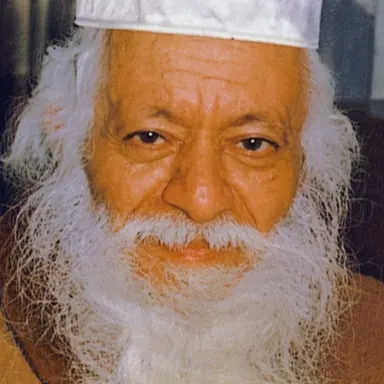
The service of God as humility and service: lofty kavanot alongside complete accessibility to every person.
Biography
A kabbalist and leader who founded the Nahar Shalom yeshiva to preserve the tradition of kavanot after the destruction of Beit El; he lived simply and radiated love of Israel and rare humility.
includes 5 inspiration linksThe generations follow the Rambam’s introduction to the Mishneh Torah. A dashed line is inspiration, not direct transmission.
This source surveys the life and teaching of Rabbi Mordechai Sharabi, an exemplary figure who bridged the Kabbalistic traditions of Yemenite Jewry and the hidden world of Jerusalem in the twentieth century. The text describes the course of his personal life, from his early orphanhood in Yemen until he became the elder of the kabbalists and founder of the "Nahar Shalom" yeshiva in Jerusalem, stressing his spiritual leadership, which combined abstinence and asceticism with deep social involvement and concern for the needy. Alongside the biographical description, the source details his practical Kabbalistic method, based on the kavvanot of the Rashash, his emphatic opposition to practical Kabbalah, and his literary legacy, which includes innovative prayer books and books of segulot. The aim of the work is to illuminate the Rabbi's decisive influence on Israeli public life and his work in making the wisdom of the hidden accessible to all strata of the people as a tool for spiritual repair and redemption.
The Flame of the Hidden in Jerusalem: The Kabbalistic Teaching, Public Work and Spiritual Leadership of the Kabbalist Rabbi Mordechai Sharabi
The Dawn of His Life in Yemen and the Foundations of His Education
The figure of the Yemenite kabbalist Rabbi Mordechai Yehuda Yafet Sharabi (known to all as Rabbi Mordechai Sharabi) is one of the most splendid bridges of the spirit that connected the esoteric traditions of Yemenite Jewry with the world of the Jerusalem kabbalists in the twentieth century.[1, 2] The year of Rabbi Sharabi's birth in the city of Taiz in Yemen is subject to a slight historical dispute, with the sources ranging between 5668 (approximately 1908) and 5672 (approximately 1912).[1, 3] The dawn of his childhood was steeped in extremely harsh family tragedies, which left him an orphan of both parents at a tender age.[4, 5] His father, Rabbi Yehuda, passed away on the seventh day of Passover before his son came into the world, and only two years later, also on the seventh day of Passover, his mother, Mrs. Miriam, died.[4, 5]
The orphaned child grew up and was educated under the patronage of his paternal grandfather, the kabbalist Rabbi Avraham Yafet Taizi, who served as head of the rabbinical court in the city of Taiz.[6, 7] The grandfather, who discerned in his grandson sparks of exceptional genius, decided to remove him from his regular studies with the "Mari" (the local teacher of young children) and began to devote long hours each day to intensive Torah study with him.[2, 8] As a sign of supreme protection and of success in his studies, the grandfather gave him a holy silver plate on which holy names were engraved.[4]
After the grandfather's death, the youth went to study with the renowned righteous men of Yemen of that time.[2, 5] The kabbalist Rabbi Chaim Yichya Sinwani, head of the rabbinical court in the nearby city of Sinwan, adopted the youth, raised him and imparted to him the foundations of the study of the revealed and the hidden.[2, 5, 7] Afterwards the youth deepened his knowledge with the head of the rabbinical court in Sharab, Rabbi Salim Said.[2, 7]
Already at the age of fourteen the young man was compelled to serve as a "Mari" himself in the city of Jabal Habashi in order to support himself, but he did not cease to study.[2, 7] Later he moved to the port city of Aden, where he was taken into the yeshiva of the head of the kabbalists of Aden, Rabbi Meshumar Nissim.[1, 2] At the age of only fifteen the Rabbi successfully passed comprehensive and grueling examinations in the Gemara, in the books of Maimonides (Rambam), in the Tur and in the Shulchan Arukh, and was formally ordained to the rabbinate.[1, 5]
When he reached maturity, he married Rebbetzin Leah.[1, 2] Immediately after their marriage, the two made a joint and exceptional decision to dedicate their lives solely to the pursuit of Torah, abstaining completely from any engagement in "the reckonings of men," that is, livelihood and the affairs of this world.[2, 7] The couple settled in the isolated village of Atchuyha, where Rabbi Sharabi deepened his study of Kabbalah, and his name began to spread throughout the region as a holy man and a performer of wonders.[2, 7]
✦
The Immigration to the Land of Israel and the Settling in Jerusalem
In 5691 (1931) or 5692 (1932) Rabbi Sharabi decided to immigrate to the Land of Israel.[1, 2] The beginning of his path in the Land was accompanied by severe physical difficulties of absorption.[2, 7] He arrived first at the port of Jaffa and from there continued to the city of Rehovot.[2, 3] In Rehovot he was compelled to do grueling manual labor in the citrus groves—hard physical work to which he had never been accustomed in Yemen and which severely impaired his ability to concentrate on Torah study.[2, 7]
Out of a desire to connect with the Torah center of the Holy Land, he decided to move to Jerusalem.[2, 7] In Jerusalem there was a significant turning point in his economic and Torah life when he received regular financial support from Dr. Moshe Wallach, the legendary director of the Shaare Zedek hospital.[2, 7] This support freed Rabbi Sharabi from the worries of livelihood and enabled him to immerse himself completely in the study of the revealed and the hidden.[2, 7]
In Jerusalem he chose to replace his original family name "Yafet" with the name "Sharabi," both after the city of Sharab, where he had acquired his wisdom in Yemen, and because this name carried a deep spiritual meaning, as a play on words and as an acronym of the verse: "Peace be upon Israel" (shalom rav al benei Yisrael).[2, 6, 8]
Rabbi Sharabi's integration into the Jerusalem community of kabbalists was extremely rapid.[2, 7] He began to study at the famous kabbalists' yeshiva "Beit El," where he was drawn exceptionally close by the head of the yeshiva, Rabbi Shalom Hadaya (father of Rabbi Ovadia Hadaya).[2, 7] At the same time, he forged close ties with the head of the kabbalists of Jerusalem at that time, Rabbi Shaul Dweck HaKohen, and studied with the Jerusalem kabbalist Rabbi Yaakov Lopes.[2, 6]
By virtue of his extraordinary mastery, Rabbi Sharabi began to serve in official teaching positions: he taught Gemara at the "Shaarei Rachamim" yeshiva and the hidden Torah at the "Shaarei Zion" yeshiva, which was established by the Rishon LeZion, Rabbi Ben-Zion Meir Chai Uziel.[1, 2]
After the War of Independence and the fall of the Jewish Quarter in 5708 (1948), the historic "Beit El" yeshiva was forced to move its activity to the Mekor Baruch neighborhood.[2, 7] Rabbi Sharabi was asked by the heads of the community to continue delivering the central Kabbalah lessons there.[2, 7]
✦
His Kabbalistic Teaching and Torah Thought
Rabbi Mordechai Sharabi's Torah teaching rested on a harmonious and precise synthesis between the world of halakha and the hidden world, with total adherence to the system of prayer kavvanot of Rabbi Shalom Mizrachi Sharabi (the holy Rashash).[4, 9] In his view, the study of Kabbalah was not a detached theoretical science but a practical system of spiritual service whose purpose is to bring about the supernal cosmic rectification, the raising of the sparks of holiness and the unification of the upper worlds through the letters and words of the prayer.[9, 10]
His Daily Schedule and Spiritual Work
Rabbi Sharabi's daily schedule was demanding and extremely meticulous, and was intended to bring body and soul to constant elevation and purification:
Before dawn: delivering deep and complex lessons in the hidden Torah to the elite group of kabbalists.[4]
Morning prayer: a long and strenuous prayer at sunrise, recited word for word with careful intention on all the unifications of names and sefirot that appear in the Rashash's prayer book.[4]
After the prayer: a fixed and ordered regimen of study intended to connect the hidden with the practical revealed; the study included reading and analysis of the books of Maimonides (Rambam), of the Tur with the commentary of the "Beit Yosef," and of the daily study cycle of "Chok le-Yisrael."[4]
Afternoon hours: delivering a second, comprehensive lesson in the hidden Torah.[4]
Midnight: holding the "Tikkun Chatzot" (midnight vigil) with weeping and tremendous supplications.[11, 12] The Rabbi used to sit at the entrance of his home, weeping in bitterness of soul over the exile of the Divine Presence, over the destruction of the Temple and over the troubles, collective and individual, of the people of Israel, while delivering homilies full of longing for the complete redemption.[12]
Rabbi Sharabi was known for an inconceivable, phenomenal memory; he had absolute command of the whole breadth of the Torah, and was astonishingly versed not only in Kabbalah but also in physiognomy, reincarnation, astronomy and medicine.[4] His disciples related that any intricate difficulty that arose in the course of study he knew how to resolve orally and instantly.[4] Only in exceptional cases did he ask that the Zohar be brought before him, and by pointing to a short, specific passage in it he would settle and explain deep difficulties in the words of the Arizal.[4]
The Rabbi was extremely careful about matters of purity, and sharply opposed those who prevented or delayed their students from daily immersion in the mikveh.[4] In his last years, when he was compelled to obey the doctors' instructions and refrain from immersion for health reasons, he was scrupulous to observe in his home the ordinance of the Arizal—washing the hands 40 times in succession with the intention of special Kabbalistic unifications and combinations intended to achieve the same level of purity as the mikveh.[4]
Rabbi Sharabi emphatically opposed engagement in practical Kabbalah.[4] He spoke sharply against people who use holy names, write amulets based on the adjuration of angels, or try to compel physical reality by magical means.[4] He believed that salvations should come solely through pure prayer, the acceptance of the yoke of the kingdom of heaven, charity, and the performance of a pure redemption of the soul (pidyon nefesh) according to the kavvanot of the Rashash.[13, 14]
His pedagogical and spiritual vision was expressed in an encounter with a young married student who was studying Kabbalah and asked to know where the most appropriate place was to delve deeply into the books of the hidden.[4] Rabbi Sharabi instructed him to go to Breslov Hasidism, and explained this by saying: "That is your place; there you can be truly God-fearing and learn Kabbalah in the right way."[4] This statement shows his view that the study of Kabbalah requires, first and foremost, a stable inner foundation of fear of heaven, sincerity and arousal of the heart—qualities that are well developed in Breslov thought.
The Prayer of the Rashash and the Opposition to Leaving the Land of Israel
An integral part of the spiritual teaching that Rabbi Sharabi imparted to his disciples was devotion to a special prayer composed by the holy Rashash.[15] In this prayer the kabbalist describes, with great emotion and weeping, the sorrow of the Divine Presence in her exile.[15] The essence of the prayer is a moving request to the Creator to merit a good settlement in the Land of Israel, to study the Torah for its own sake without disturbances, and above all—a request not to leave the Land of Israel for the Diaspora, and not even to leave the bounds of Jerusalem for outside Jerusalem.[15, 16] The kabbalists who follow Rabbi Sharabi's path were careful, in accordance with his words and this instruction of his, not to leave the borders of the Land under any circumstances.[15]
Teachers and Spiritual Influences in Rabbi Sharabi's Life Journey
✦
The "Nahar Shalom" Yeshiva and Its Chain of Transmission
In 5722 (1962) Rabbi Sharabi established the kabbalists' yeshiva "Nahar Shalom" in Jerusalem, named after the divine kabbalist Rabbi Shalom Sharabi (the Rashash) and after his famous work.[1, 2, 7] The yeshiva was set up in the heart of the Nachlaot neighborhood (at the intersection of Shilo and Zikaron Tuvia streets), and quickly became one of the leading and most important centers in the world for the study of the wisdom of Kabbalah.[17, 18, 19]
The founding of the yeshiva was accompanied by various local stories.[20] One of the best known is connected with the construction of the adjacent "Eini Building," which was intended to be a multistory building.[20] According to the local tradition, Rabbi Sharabi discovered that the tall structure was going to block the sunlight from the yeshiva building and harm the spiritual atmosphere, and he placed a stern censure upon it; since then the building has been regarded by the neighborhood's residents as "cursed" because of the many delays and troubles that befell its builders and tenants.[20]
After Rabbi Sharabi's passing on 20 Cheshvan 5744 (1983), the leadership of the yeshiva passed to the kabbalist Rabbi Shalom Aharon Shmueli, who was one of the Rabbi's foremost disciples.[6, 19] Today the yeshiva is headed by his son, the kabbalist Rabbi Binyahu Shmueli, who continues to lead the yeshiva's institutions, to hold lessons there and the Friday-night midnight study, and to conduct the historic pidyon nefesh rectifications.[11, 21, 22]
The "Rechovot HaNahar" Prayer Book Project
One of the most significant contributions of the "Nahar Shalom" yeshiva to the modern world of Kabbalah is the editing and printing of the kavvanot prayer book "Rechovot HaNahar."[23] This project, led by the current head of the yeshiva, Rabbi Binyahu Shmueli, together with a team of Torah scholars from the yeshiva, brought about a genuine revolution in the accessibility of prayer with kavvanot.[23]
Kabbalistic prayer books based on the system of the Rashash were traditionally written only in manuscript, since the old printing was unable to cope with the visual complexity of the prayer book.[23] These prayer books make frequent use of special signs: half letters, inverted letters, letters interwoven within one another, and more.[23] The printing of the first printed prayer book in 5670 (1909) was full of serious errors; the printer, who did not understand the meaning of the broken and halved letters (which were entirely intentional), corrected them artificially and turned them into whole letters, such as, for example, the letter aleph in the word "Tzevaot," which is supposed to be halved, thereby impairing the intention of the Name.[23]
The transition to modern word processors enabled the yeshiva's editors to reproduce precisely all the strange and halved letters, and to integrate the prayer kavvanot and unifications directly within the sequence of the words of the prayer.[23] In the old printed prayer books, the Amidah appeared only once, and the worshiper was compelled to keep turning pages to other sources in order to find the kavvanot for the Sabbath or the festival.[23] The use of a word processor made it possible to duplicate the prayer so that each prayer book would contain the full prayer in its proper order without any need to turn pages.[23] The only drawback of this method is the breakup of the historic prayer book (which contained only 4 volumes) into a huge set of about 25 separate volumes covering all the prayers of the year.[23]
The Kabbalistic Color System in the "Rechovot HaNahar" Prayer Book
✦
His Social Leadership and Public Work
Rabbi Mordechai Sharabi was not a detached kabbalist sitting in his narrow room; his figure was deeply involved in the lives of ordinary people.[3, 6] His modest home on Shilo Street in the Mahane Yehuda neighborhood was wide open at all hours of the day and night to every downtrodden person, sick person, or seeker of advice and blessing.[3, 5, 6]
Love of Israel's Children and Concern for Their Future
A central and moving dimension of Rabbi Sharabi's personality was his immense love for the children of Israel and for the marginalized youth of Jerusalem.[1, 6] The Rabbi, who did not merit offspring of his own, saw these children as his spiritual sons.[19, 20] He devoted of his time to teaching children and youths Torah, Mishnah and halakhot without receiving any payment.[6]
In addition, the Rabbi used to distribute money and pocket money to the youths from the funds that flowed to his home from donations.[1] He did this out of deep educational wisdom, in order to draw their hearts to Torah study and to prevent them from wandering idly in the streets of Jerusalem.[1]
Rebbetzin Leah Sharabi: A Full Partner in the Leadership
At the Rabbi's side stood his wife, Rebbetzin Leah Sharabi, who was a full partner in his ascetic and simple way of life.[1, 3] Rebbetzin Leah was an independent figure, a social activist and a well-known preacher among the women of Jerusalem.[1] She managed the open home and helped the Rabbi distribute charity funds to the needy.[1, 3]
The Rebbetzin passed away on 21 Shevat 5738 (1978) [7] (or in the year 5739, 1979).[1] Her passing caused Rabbi Sharabi deep sorrow, and from then on there was a severe and marked deterioration in his state of health, until his passing on 20 Cheshvan 5744 (1983).[1, 7]
Wonders, Pidyon Nefesh and Ties with the Great Figures of the Generation
Rabbi Sharabi was known as a wonder-worker whose blessings and prayers brought about physical changes among the gravely ill and the hopeless.[1, 3] Among dozens of stories, one case is documented in which a Jew came to him with X-ray films ahead of a complicated operation.[5] The Rabbi looked at the films and instructed him to donate 12,000 lirot to charity, promising that he would not need the operation.[5] The patient immediately wrote the check, and when he returned to the hospital for pre-operative tests, the doctors were astounded to discover that the medical findings had disappeared completely.[5]
One of the central instruments that Rabbi Sharabi used to bring about salvations was the secret of the pidyon nefesh of the Rashash.[13, 14, 21] This redemption was regarded as the ultimate Kabbalistic remedy for any trouble, illness or harsh decree befalling the community or the individual.[13, 14]
The foundations of the pidyon are rooted in the writings of the Ari and Rabbi Chaim Vital in "Shaar HaKavvanot," according to which one who performs this pidyon on the eve of Rosh Hashanah and on the eve of Yom Kippur is assured that he will complete his year.[13, 14] The holy Rashash refined the rectification and established that it should be performed by means of a donation of 160 perutot of pure silver.[14] The number 160 was chosen because it equals the numerical value of the words "tzelem" (image) and "etz" (tree) (alluding to the verse "for man is the tree of the field").[14] The pure metals and the holy names intended during the counting of the perutot act to sweeten the severities and judgments at their supernal root.[13, 14] Rabbi Sharabi held the exact tradition for performing this pidyon, and this merit continues to this day at the "Nahar Shalom" yeshiva through his disciples.[13, 21]
The esteem of the Rishon LeZion, Maran Rabbi Ovadia Yosef, for Rabbi Sharabi was immense.[5, 12] Rabbi Ovadia, who studied with him, defined him in these words: "He was the greatest of the generation, and there was none like him in Kabbalah."[5, 12] A unique spiritual bond also existed between him and the divine Moroccan kabbalist Rabbi Israel Abuhatzeira (the Baba Sali).[12] At one of their meetings the Baba Sali asked Rabbi Sharabi to reveal to him the root of his soul.[12] After Rabbi Sharabi performed a Kabbalistic "dream inquiry" (sheelat chalom), he informed the Baba Sali at their second meeting that the root of his soul had been emanated from the soul of Hezekiah, king of Judah.[12]
Prominent Disciples and Continuers of Rabbi Sharabi's Path
✦
Rabbi Sharabi's Literary Legacy
Rabbi Sharabi's literary legacy is divided into two main channels that reflect the two faces of his study hall: the world of the revealed and popular leadership on the one hand, and the world of the hidden and practical kavvanot on the other.[23, 25]
The Rabbi's central work, which was published in three volumes (comprising about 980 pages), is called "Tefilla le-Moshe."[25, 26] This book is a unique encyclopedia that gathers a comprehensive anthology of tales of the righteous, prayers of the ancients, tested medical segulot, practical advice and ethical guidance that illuminate a person's path.[25, 26, 27] Among other things, the book contains unique prayers composed by Rabbi Sharabi himself or gathered from the writings of the ancients, such as a prayer for the success of one's business, a prayer for success in lawsuits, and prayers focused on the healing of various parts of the body.[27] The book is regarded as a useful aid in every Jewish home seeking spiritual help and comfort in time of trouble.[28]
At the same time, the "Nahar Shalom" yeshiva, under the presidency of Rabbi Binyahu Shmueli, continues to publish the revolutionary kavvanot prayer book "Rechovot HaNahar" and the edition of the "Annotated Daily Zohar" (comprising dozens of volumes).[21, 23] These literary undertakings constitute the realization of Rabbi Sharabi's great vision—making the wisdom of the hidden and the study of the Zohar accessible to all strata of the people, with the aim of bringing the complete redemption near with mercy and without suffering.[10, 21]
✦
Conclusion: The Legacy of the Elder of the Kabbalists
The findings of the review and historical analysis of the figure of Rabbi Mordechai Sharabi point to a spiritual leadership type that is unique of its kind.[1, 6] The Rabbi succeeded in bridging immense cultural and sociological gaps: he brought up the Yemenite Kabbalistic heritage and fused it into the Sephardic-Jerusalem kabbalist tradition of the "Beit El" yeshiva, while enjoying total reverence both from Hasidic rebbes (such as the Belzer Rebbe) and from Sephardic giants of halakha (such as Maran Rabbi Ovadia Yosef).[1, 2, 19]
His personal life, which was filled with orphanhood, deprivation and the lack of children of his own, did not make him withdrawn or bitter.[4, 19] On the contrary—he and his wife, Rebbetzin Leah, translated their personal pain into immense love and paternal concern for every needy person, youth and child in Jerusalem, while living an ascetic way of life and forgoing any trace of personal material pleasure.[1, 3, 6]
His literary and institutional legacy, represented today by the kabbalists' yeshiva "Nahar Shalom," continues to operate at full strength.[21, 22] The project of printing the kavvanot prayer books with vowels and the dissemination of the Zohar to the masses constitutes the realization of the life vow of one who changed his name to "Sharabi" in order to carry on his narrow shoulders the prayer "Peace be upon Israel."[1, 6, 23]
The Journey of a Luminary: Stations in the Life and Legacy of Rabbi Mordechai Sharabi of Blessed Memory
48 min read·9,511 words
Summary
The figure of our teacher Mordechai Sharabi of blessed memory (5672–5744) stands as the pillar of fire before the camp, a wondrous spiritual bridge that connected the ancient esoteric traditions of Sharab in Yemen with the alleys of new Jerusalem. As the "Elder of the Kabbalists" and the "Head of the Mekavvenim," the Rabbi embodied a rare combination of modesty concealing infinite greatness, phenomenal mastery of the revealed and the hidden, and a love of Israel that broke through every partition. His journey is a story of rising above the limitations of matter and of turning personal orphanhood into spiritual fatherhood for an entire generation.
✦
1. Roots in Yemen: Between Orphanhood and Holiness (1912 - 1931)
The Rabbi was born in the city of Sharab in Yemen to Mrs. Miriam and Rabbi Yehuda Yafet-Taizi. The dawn of his life was darkened by a double tragedy: his father died before he was born, and his mother passed away when he was only about two years old. The tender child grew up in the home of his grandfather, Rabbi Avraham Yafet Taizi, who served as the av beit din of Sharab. The grandfather was a holy man who, according to the tradition, used "kefitzat haderekh" (miraculous shortening of the way) to visit Jerusalem, and precisely in this poor home, under the threat of the "Decree of the Orphans"—the cruel law of the kingdom that required the conversion of Jewish orphans to Islam—the young prodigy grew. The constant fear of forced conversion did not weaken his hands; on the contrary, it drove him to shut himself away in the sanctuary of Torah.
The tension between material poverty and the power of the spirit:
Study milestones in Yemen:
Age 8: appointed by the sages of his town as "Mari Dar'a," one who spreads Torah among the many.
Age 15: successfully passed comprehensive examinations on the entire Talmud, the four Turim and Maimonides' Mishneh Torah, and was ordained to the rabbinate.
Holy practices: despite being fastidious by nature, he was careful to immerse daily in broken mikvaot and fasted "hafsaka" fasts from the departure of the Sabbath until Sabbath night.
The spiritual baggage he accumulated in Yemen was like a gushing spring, but the early revelation of his greatness brought him into contact with figures who became cornerstones in the building of his spiritual stature.
✦
2. Formative Figures and the Beginning of the Spiritual Journey
The Rabbi's world was shaped under the guidance of the spiritual giants of Yemen. The formative encounter took place when the kabbalist Rabbi Chaim Sinwani saw the boy Mordechai leading a donkey for a merchant, holding a book and studying with immense concentration while walking. Rabbi Sinwani recognized the divine spark, "bought" the boy from the merchant and adopted him as a son and as a disciple.
The exemplary figures who built his world:
Rabbi Chaim Sinwani: the first guide, who brought him into the gates of the PaRDeS. He nurtured Rabbi Mordechai and imparted to him the foundations of the esoteric teaching with great depth.
Rabbi Salim Said: rabbi of the city of Sharab, who recognized the boy's greatness and took him to the city of Al-Hada so that he would serve at his side and absorb his ways of conduct.
Rabbi Meshumar Nissim: head of the kabbalists in the city of Aden, to whom the Rabbi moved in his youth. Under his patronage the Rabbi deepened his study of the kavvanot of the hidden before his immigration to the Land.
The decision to immigrate to the Land of Israel crystallized following a stormy event: the ruler in Yemen made a blood libel against the community because of money that had been stolen from him. The Rabbi used the "Goral Achitofel" and revealed the hiding place of the money, but immediately afterward fled to the Holy Land out of fear that the government would force him to use "practical Kabbalah" for its needs—a path from which the Rabbi recoiled utterly.
✦
3. The Journey to the Holy: From Aden to Jerusalem (1931-1932)
The journey to the Land of Israel was fraught with dangers. The Rabbi and his wife Leah fled secretly from Yemen to Aden, and from there sailed via Port Said in Egypt to the port of Jaffa. When he stepped onto the shore in 1931, the Rabbi prostrated himself on the soil of the Land and kissed its dust in tears.
In Jerusalem the Rabbi chose to change his family name to Sharabi. This was not only a remembrance of his native city of Sharab, but a spiritual declaration of intent in the form of an acronym: Shalom rav al benei Yisrael ("Peace be upon Israel").
After a brief period in which Rebbetzin Leah tried to support them so that the Rabbi could devote himself to his Torah, the couple settled in a poor and cramped room in the Mahane Yehuda neighborhood, a place that quickly became a focus of holiness.
✦
4. The Period of Establishment in Jerusalem: The "Beit El" Yeshiva and the Revelation of Greatness
At first the Rabbi lived in abject poverty in a small room in the "Rachamim" synagogue, where he delivered lessons to the public. He began to study at the kabbalists' yeshiva "Beit El," where he sat to the side as a simple Jew. His greatness was revealed in a "chance occurrence" at the "Mattei Yaakov" yeshiva: Rabbi Yaakov Lopez presented an enormous difficulty in the writings of the "Etz Chaim"; Rabbi Sharabi, discreetly, left a hidden note with the solution. When the note was discovered, the sages of Jerusalem understood that a giant of the spirit was hiding among them. The head of the yeshiva, Rabbi Shalom Adia of blessed memory, immediately adopted him as the continuer of the dynasty of the mekavvenim of the Rashash.
Holy practices and ascetic acts:
Little sleep: scrupulous observance of sleeping only 20 minutes a day on a simple cot.
Immersion and holiness: when he was prevented from immersing in a mikveh because of his health, he would perform the Ari's hand-washing 40 times with intention.
Fasts of hafsaka: a continuous fast from the departure of the Sabbath until Sabbath night for six years.
Midnight study: holding the Tikkun Chatzot and studying kavvanot every night in darkness and in tears.
His establishment as a supreme authority within the existing institutions qualified him to establish an independent dwelling for the hidden Torah, especially after the destruction of the Old City in 5708.
✦
5. The Founding of the "Nahar Shalom" Yeshiva and the Leadership of the "Head of the Mekavvenim"
In 1962 the Rabbi founded the kabbalists' yeshiva "Nahar Shalom" in Nachlaot. The Rabbi feared that the chain of the mekavvenim according to the Rashash's prayer book would be severed, and he turned the yeshiva into the world center for the dissemination of Kabbalah in its purity. The Rabbi completely nullified his own ego and demanded the same of his disciples, while opening the gates of study to the younger generation as well.
Characteristics of the method:
Nullification of the ego: the study of Kabbalah as an instrument for refining character traits and not for attaining honor.
Accessibility with reverence: making Kabbalah accessible to all who are prepared to labor in purity, out of a desire to hasten the redemption.
The prayer "Shem Kol Yisrael": emphasis on the fact that every spiritual act is performed in the name of the entire nation.
The spiritual order of the day at the yeshiva:
His figure as Head of the Mekavvenim did not disconnect him from the people; on the contrary, he became the "Eastern Wall" of all the Jews of the Land.
✦
6. The Leader of Everyone: Kindness, Simplicity and Wonders
Rabbi Sharabi recoiled from all ceremony of honor and luxuries. When the Belz Hasidim offered him to move to a spacious home, he refused firmly. For him, physical luxury was a barrier and partition against the spiritual concentration required of a mekavven. He advocated the way of "darkhei noam" (ways of pleasantness) and preferred the path of Rabbi Kook over extreme zealotry, saying: "Rabbi Kook brought the distant near, and this is our way!"
Wonders of drawing near and spiritual heroism:
The motorcycle on the Sabbath: when a secular young man rode beside him publicly, the Rabbi said with compassion: "The motorcycle is to blame, not the young man." After the motorcycle gave up the ghost, the Rabbi invited the young man to a Sabbath meal, and from then on the motorcycle (and its owner) began to observe the Sabbath.
The spiritual "Chief of Staff": his disciples called him this because of his devotion to the well-being of the soldiers of the IDF. He saw the physical defense of the Land as a direct result of the spiritual "war" waged with the kavvanot of prayer.
The pilot's vision: in the daring "Irene" operation, a helicopter pilot related that he saw the figure of an old man encouraging him to keep flying despite the weight of the stolen Egyptian radar; the pilot later identified the figure of Rabbi Sharabi as the figure he had seen in his vision.
"Before everything he does or studies he should say: 'I hereby study in the name of all Israel.' Through this he makes a tremendous rectification and raises the Divine Presence, and rectifies the clarification in all the worlds." (from Hanhagot Rabbenu)
✦
7. Conclusion: The Eternal Legacy (1983 Onward)
The Rabbi ascended to heaven in a whirlwind on 20 Cheshvan 5744. His funeral was one of the largest Jerusalem had ever known, and symbolized the unity of the people around him. The Baba Sali of blessed memory testified that Rabbi Sharabi sacrificed his life as an atonement for the generation in order to annul a harsh decree that he sensed through his holy spirit.
Provisions for the Road: Life Insights from the Legacy of Rabbi Sharabi:
Humility as a vessel: true greatness does not need grand halls. The simplicity of the home is the key to the cleanliness of thought.
Unconditional love of Israel: to see in every Jew, even the most distant, a "lofty soul" whose light matter merely conceals.
A person's toil: mastery is not a miracle but the fruit of endless repetition and devotion to the goal.
General mission: every private act of a person should be done "in the name of all Israel" in order to give it eternal meaning.
May his memory be blessed, and may his merit protect us, amen.
The Architecture of Spiritual Leadership: A Strategic Analysis of the Figure of Rabbi Mordechai Sharabi
1. Introduction: The Dual Model of Leadership and Socio-Spiritual Synthesis
The figure of Rabbi Mordechai Sharabi of blessed memory is not merely a splendid chapter in the historiography of Yemenite Jewry, but constitutes a critical "case study" for analyzing the architecture of spiritual leadership in the modern age. For professionals in the fields of the rabbinate and the community, Rabbi Sharabi offers a unique model of socio-spiritual synthesis: the ability to convert abstract Kabbalistic insights and ascetic abstinence into concrete social action at the very heart of Israeli reality.
As the "Elder of the Kabbalists" and "Head of the Congregation of Mekavvenim," Rabbi Sharabi was not content with preserving the tradition of the past. His leadership strategy began with an ontological declaration of intent—the changing of his family name to Sharabi, an acronym of "Shalom rav al benei Yisrael." In this way he defined the purpose of the leader's existence: not the accumulation of power or honor, but turning the spiritual being into an instrument of service for bringing peace to the nation. His roots in the Yemenite sphere, which sprang from a double orphanhood and deprivation, laid the foundation for an inner strength that enabled him to move from personal survival under harsh decrees to large-scale community building in the Land of Israel.
✦
2. The Roots of Growth: "Goral Achitofel" and Metaphysical Responsibility
Rabbi Sharabi's leadership was shaped in the crucible of the Yemenite exile. His early orphanhood (his father, R. Yehuda, died before his birth; his mother, Miriam, died when he was two years old) and his upbringing under the threat of the "Decree of the Orphans" created in him a rare psychological resilience. The formative encounter with Rabbi Chaim Sinwani revealed an "architecture of concentration": a boy leading a donkey in the desert, holding a book in one hand and studying amid the jolts of the road.
The strategic turning point that hastened his immigration to the Land (1931) was the event of the "Goral Achitofel." When an accusation of theft was cast upon the Jewish community by the local ruler, the Rabbi used Kabbalistic tools to expose the thieves and save the nation. However, as a leader who understood the danger inherent in the use of "practical Kabbalah," the Rabbi chose to flee to the Land of Israel to prevent a situation in which he would be compelled to use these powers again for the needs of the hour. This act demonstrates metaphysical responsibility: the leader identifies the boundary between a miracle and a need, and chooses emigration as a tool for protecting the purity of his spiritual role.
✦
3. The Holy Work as the Backbone of Authority: The Architecture of the Night
The Rabbi's public authority did not stem from an official appointment but from an "architecture of holiness"—extreme self-discipline that made him a focus of power. His daily schedule included only 20 minutes of sleep (22:00-22:20), study from midnight, and "hafsaka" fasts that lasted six consecutive years. The "why" behind the ascetic acts was clear: the refinement of the leadership vessel. The leader mortifies his body in order to expand his capacity for containing the public's sorrow.
The core of nightly study—the nine foundational books: every night the Rabbi studied nine basic books that shaped his consciousness: Divrei Shalom, the Zohar, the Tur, the Beit Yosef, Maimonides' Mishneh Torah, Etz Chaim, Pele Yoetz, the Shulchan Arukh, and Shaar Ruach HaKodesh (or Tikkunei Zohar).
✦
4. The "Nahar Shalom" Yeshiva: Strategic Preservation of the Mekavvenim Dynasty
The founding of the "Nahar Shalom" yeshiva in the Nachlaot neighborhood was not merely a religious act but a strategic move to preserve tradition. After the destruction of the "Beit El" yeshiva in the Old City in 1948, the Rabbi identified the danger of the severance of the Rashash's dynasty of mekavvenim. The yeshiva became a "power station" that radiated onto the entire surroundings.
The economic architecture of the kabbalist's court: the Rabbi implemented a unique economic model: "zero personal profit." He never demanded payment for his blessings, and in cases where he received donations, these were immediately spent on supporting Torah scholars, assisting the needy and giving "advance payments" (gemach) to youths for studying Psalms and Mishnah. The leader acts as a "terminal for the transfer of resources"—he does not accumulate capital but channels it into avenues of social building.
✦
5. The Leader as Systemic Mediator: The Depersonalization of Sin and Spiritual Healing
Rabbi Sharabi's leadership capacity stood out in his psychological-spiritual approach to resolving conflicts.
The strategy of depersonalization: in the famous story about the youth and the motorcycle on the Sabbath, the Rabbi ruled: "He is not to blame, the motorcycle is to blame." In strategic analysis, this is a move of separating the sin from the sinner. By placing the blame on the object, the Rabbi removed the youth's inner resistance and enabled him a way of return in repentance out of love.
Systemic healing: the use of "remedies" such as bananas, or the story of "the doves in the hospital" (the jaundice cure of R. Yehuda Mutzafi), is not simple magic. It is an understanding of the spiritual roots of physical diseases. The leader acts as a "systems engineer" who performs a repair on the hidden level in order to achieve a result on the manifest level.
Sublimation of fatherhood: the Rabbi and his wife Leah were childless for about fifty years. Instead of turning inward, the Rabbi sublimated the feeling of fatherhood and became the "father of the generation." His infinite concern for orphans and youths was an expression of the leader's ability to rise above his personal lack and turn it into an engine of nationwide giving.
✦
6. The National Interface: The "Eastern Wall" of the Nation
Rabbi Sharabi held an active national outlook, clearly choosing the "darkhei noam" method of Rabbi Kook. He ruled that Rabbi Kook brought the distant near, and that this is the way one must go.
Practical and spiritual Zionism: an Irgun arms cache (slik) was hidden in his home, and he was scrupulous about prayers for the well-being of the State and the soldiers of the IDF. The testimony about his weeping at night over the well-being of the soldiers at the front reveals a leader who feels total responsibility for the physical security of the State.
A crossroads of leaders: his relationship with the "Baba Sali" (who asked the Rabbi to inquire into the root of his soul and received the answer: King Hezekiah) and the esteem of Rabbi Ovadia Yosef (who testified that he was the "greatest of the generation" in Kabbalah) position him as the "Eastern Wall"—a place where all the streams meet.
✦
7. Summary: Core Principles of Leadership (Strategic Takeaways)
From the analysis of Rabbi Sharabi's figure arise five "directives" for professional spiritual leadership:
Ego-nullification as the basis of authority: public authority is built out of extreme self-refinement (Ego-Nullification).
Strategic preservation of tradition: identifying historical moments of crisis (such as 1948) and establishing institutions as a cultural "Noah's ark."
Leadership without coercion (the "motorcycle" strategy): using darkhei noam and detaching blame from the person in order to enable inner change.
Metaphysical responsibility as atonement (Atonement): the leader sees himself as an "atonement" for the generation. The story in which he "gave his life" to annul a decree that the Baba Sali sensed is the peak of the architecture of leadership—the leader as human/spiritual shield.
Unity through accessibility: turning the home and the yeshiva into an open space without partitions between streams (the "Eastern Wall").
True leadership is not measured by authority, but by the ability to turn personal holiness into a social address. Rabbi Mordechai Sharabi proved that the depth of the hidden is the engine of bringing near in the manifest. We, as community leaders, should adopt the model that combines unceasing diligence with unconditional love of Israel, in order to ensure that the voice of the "shalom rav" continues to resound over all the children of Israel.
Institutional Impact Report: The "Nahar Shalom" Yeshiva—Between Yeshiva Kabbalah and Social Leadership
1. Introduction: The Transition from Yemen to Jerusalem and the Laying of the Spiritual Cornerstone
The establishment of the "Nahar Shalom" yeshiva in Jerusalem constitutes a formative chapter in the sociology of Sephardic Jewry in the twentieth century, since it represents a transition from passive preservation of tradition in Yemen to active institutional entrenchment in the heart of the Israeli sphere. The yeshiva was founded as a strategic bridge intended to preserve the legacy of the kabbalist the Rashash (Rabbi Shalom Sharabi), while dynamically adapting it to the needs of the developing Jerusalem neighborhoods, and thereby ensured the vitality of the esoteric teaching as a living component of communal identity.
Analysis of the roots: the founder, Rabbi Mordechai Sharabi, was born in Yemen as Mordechai Yafet-Taizi (around 1912). The course of his life, from his early orphanhood and his studies with Rabbi Chaim Sinwani—who identified his singular diligence while he was leading donkeys in the desert—to his ordination at the age of 15 by Rabbi Meshumar Nissim, shaped a figure combining phenomenal mastery of the revealed and the hidden. His arrival in Jerusalem in 1932 marked the beginning of an institutional transformation: from spiritual seclusion to public leadership.
The institutional vision: the choice of the name "Nahar Shalom" (after the Rashash's work) and the change of the family name to "Sharabi" were not merely symbolic steps but an institutional rebranding. The name Sharabi was interpreted as an acronym expressing a social mission: "Shalom rav al benei Yisrael." In this way the institution defined its purpose as a center intended to influence the broad public sphere and not only the elite group of scholars.
Connectivity: this process turned the yeshiva from yet another neighborhood study hall in Nachlaot into a countrywide focus of attraction, in which the founder's charismatic personality was translated into a stable institutional structure.
2. The Spiritual Architecture of the "Nahar Shalom" Yeshiva
"Nahar Shalom" functioned as a unique center for applied Kabbalah (kavvanot), a model regarded as innovative and groundbreaking in its time. Whereas other kabbalists' yeshivas tended toward insularity, the institution led a process of "democratization of the esoteric," making the complex esoteric teaching accessible to the wider public.
The core of the research-religious activity: the institution established a rigorous study discipline based on the Rashash's prayer book and the book "Etz Chaim." The flagship project—the editing and dissemination of the "Rechovot HaNahar" prayer books—turned the Rashash's kavvanot from hidden manuscripts into a standard and accessible institutional "product." Rabbi Sharabi functioned as a living database; his disciples testified that he knew how to correct their precise pronunciation of the kavvanot from memory alone, without any need for a book, thereby ensuring the accuracy of the oral tradition in an era of transition to the printed text.
The institutional daily schedule as a model of discipline:
Midnight: the start of the activity with the "Tikkun Chatzot" and special kavvanot.
Pre-dawn study: Kabbalah lessons before dawn.
Vatikin: the morning prayer at sunrise with the Rashash's kavvanot.
Layers of study: lessons in Maimonides (Rambam) and the Tur that constitute a solid halakhic foundation.
Sociological implications: the yeshiva's economic model—a sweeping abstention from collecting payment for blessings or spiritual services—created a "spiritual meritocracy." This decoupling (severance) between spiritual acts and material incentives entrenched the yeshiva's institutional legitimacy among all sectors, from Belz Hasidim to the secular public, and set it apart from other institutions that drew criticism for the commercialization of religion.
3. The Institution as a Social Anchor: Gemach and the Integration of Marginalized Youth
The yeshiva functioned as a community safety net, adopting an integrative approach that sought to prevent social alienation among young Sephardim in a secularizing Jerusalem.
Mechanisms of economic support: the yeshiva operated a significant aid network, which included gemach loans for the purchase of apartments (in amounts of about 1,000 dollars in the values of that period) and covert support for hidden righteous men. The yeshiva served as a junction for the distribution of wealth, in which donations were directed straight to solving problems of housing and subsistence in the community.
Rehabilitation and integration (the "socio-religious bypass"): unlike separatist Lithuanian-Ashkenazi models, "Nahar Shalom" operated positive reinforcement mechanisms to preserve the identity of youth in distress:
Strategic analysis: the famous story about the motorcycle rider on the Sabbath ("He is not to blame, the motorcycle is to blame") illustrates a strategy of separating the agent (the person) from his actions. This inclusive approach enabled the yeshiva to serve as an effective agent of social change that prevented a generational and communal rift.
4. The Yeshiva on the Front Line: Contribution to the Security of the State and Risk Management
The institution's involvement in the security of the State illustrates a bold "institutional risk management" that combines national loyalty with spiritual vision.
Risk management vis-à-vis the Mandate: the yeshiva served as an arms "cache" (slik) for the Irgun. The decision was based on a strategic assessment that the British would not suspect a kabbalists' synagogue. This was the taking of a heavy institutional risk for the sake of the national struggle.
Institutional tension and service in the IDF: the institution's stance toward conscription was characterized by an inherent tension. The story of the beard's changing color to white overnight (following his wife's consent) so as to look like an elderly man and prevent forced conscription underscores the institution's view that its decisive contribution lies in the spiritual preservation of the nation. Nevertheless, the institution functioned as a "spiritual headquarters" during the wars, with the Rabbi holding "shofar rectifications" and prayers for the well-being of the soldiers.
Applied Kabbalah at the national level: the yeshiva provided a response to physical afflictions through Kabbalah (such as the "rectification of the doves" for jaundice or the "bananas" recommendation to the wounded soldier), thereby turning Kabbalah into a tool of social resilience and public health in times of crisis.
5. Outlook and Ideology: The "Its Ways Are Ways of Pleasantness" Model
The yeshiva's ideology served as a moderating and unifying factor in Israeli society, preferring the approach of drawing near of Rabbi Kook (the Re'iyah) over the separatism of Rabbi Sonnenfeld.
National-religious bridge: the choice of the approach of "Its ways are ways of pleasantness" was a conscious institutional decision. The yeshiva regularly held prayers for the well-being of the State and the soldiers of the IDF, thereby creating a distinctive Sephardic identity that combines halakhic strictness with spiritual Zionism.
Cross-sectoral junction: the yeshiva functioned as a rare meeting point in the Jerusalem sphere. Rabbi Sharabi's standing was so high that the Baba Sali himself asked him to conduct a "heavenly inquiry" about the root of his soul (and was answered that he was the soul of King Hezekiah). This recognition from other leaders turned "Nahar Shalom" into a junction bringing together Belz Hasidim, Ashkenazim, Sephardim and secular people around the common denominator of Kabbalah.
6. Summary: Continuing Legacy and Long-Term Influence
The survival of the "Nahar Shalom" yeshiva after the founder's death in 1983 constitutes a rare case study of a successful transition from "charismatic leadership" to a stable "institutional-bureaucratic structure." Under the leadership of his successor, Rabbi Binyahu Shmueli, the institution has maintained its standing as a community anchor in Nachlaot while expanding its nationwide influence.
Components of the institutional impact:
Preservation of kavvanot technology: making the Kabbalah of the Rashash accessible through the standardization of texts and study methods.
Social stability: creating relief mechanisms (gemach) that strengthened the economic resilience of the Nachlaot community.
Formation of a religious-national identity: offering a moderate and unifying alternative that prevented sectoral and communal polarization.
In summary, the "Nahar Shalom" yeshiva is not merely a study institution but a socio-religious organization that functioned as a central axis in shaping modern Jerusalem, turning esoteric Kabbalah into a tool of national and social cohesion.
Introduction for the Learner: The Holy Paths of Rabbi Mordechai Sharabi of Blessed Memory
Welcome to a learning journey in the footsteps of one of the most wondrous and influential figures in the world of Kabbalah in recent generations. This study sheet will introduce you to Rabbi Mordechai Sharabi, a figure who combined divine depths with simple human humility, and who served as a spiritual bridge for the entire people of Israel.
✦
1.The Spiritual Compass: Who Was Rabbi Mordechai Sharabi?
Rabbi Mordechai Yehuda Yafet Sharabi was born in Yemen (around 1908) into a reality of early orphanhood from both parents. His roots are planted in a lineage of holiness; his grandfather, Rabbi Avraham Yafet-Taizi, was a dayan and a wondrous man of whom it is told that he used "kefitzat haderekh" to travel from Yemen to judge in Jerusalem.
Already at the age of 9, as an orphan wandering between villages and teaching Torah, he met the kabbalist Rabbi Chaim Sinwani. Rabbi Sinwani was astonished to see a small boy leading a donkey with one hand and holding a study book in the other, completely absorbed in study. He "bought" the boy from the man who accompanied him and became his preeminent teacher.
"The Rabbi was not only a Torah scholar; he was an 'angel of the Lord of Hosts,' the 'Eastern Wall of the people of Israel' and a shining light in the heart of a bewildered generation. His figure radiated extreme humility and total nullification of the 'I' for the sake of the holiness of the community."
Insight for the learner: the Rabbi's life teaches us that spiritual greatness does not depend on the material starting point. The little orphan who led a donkey became the "Chief of Staff of the prayers," proving that the power of will and devotion to Torah can break through any difficulty.
✦
2. The Secret of the Name and the Lineage: "Peace Be upon Israel"
The Rabbi saw himself as a link in the lineage of the divine kabbalist the Rashash (Rabbi Shalom Sharabi). Upon his immigration to the Land in 1932, he chose to change his family name to "Sharabi," not only as a connection to his city but as a spiritual declaration of intent.
For reflection: for the kabbalist, a name is a work plan. Consider: how do the identity you carry or the name by which you are called serve a purpose that goes beyond your personal needs?
✦
3. The World of the Kavvanot and the "Rechovot HaNahar" Prayer Book
At the "Nahar Shalom" yeshiva that he established in Jerusalem, the Rabbi not only taught Kabbalah but set out on a national rescue mission. After the destruction of the Old City and the dispersal of the "Beit El" yeshiva, the Rabbi feared that the chain of the "mekavvenim" (those who know how to perform unifications in prayer) would be severed. His yeshiva became a stronghold that preserved the "spiritual technology" of the Rashash's kavvanot.
Definition of kavvanah: the ability to unify holy names and specific thoughts that activate the upper worlds.
The memory of the "Scanner": the Rabbi had a phenomenal memory; he knew the entire Zohar, Maimonides (Rambam) and the Shulchan Arukh by heart. He would correct students who erred in complex kavvanot in the "Rechovot HaNahar" prayer book without looking at the book at all.
Making the secret accessible: the yeshiva edited and published accurate prayer books, out of a belief that spreading the "light" is the key to redemption.
Insight for the learner: kavvanot turn prayer from a "request" into an "action." The Rabbi taught that every word has weight in heaven, and that spiritual precision is necessary for repairing the world.
✦
4. Rites of Rectification: Rising Above the Physical
The Rabbi's way of life was above ordinary human nature, as part of a cycle of constant rectification:
The cycle of sleep and rectification: the Rabbi used to sleep only 20 minutes at night. He would rise at midnight for the "Tikkun Chatzot"—weeping and prayer over the destruction of the Divine Presence and the suffering of the people of Israel—and from there continue to uninterrupted study until sunrise.
Fast of speech: every Friday and in the month of Shevat, the Rabbi refrained from mundane speech. He believed that silence purifies the soul and strengthens the power of speech as a creator of worlds.
The "fastidious one" and purity: the Rabbi was extremely sensitive about purity (istenis). When he was prevented from immersing in a mikveh because of his health, he was scrupulous about washing his hands 40 times (the ordinance of the Ari), out of an understanding that water cleanses not only the body but the spiritual channels.
✦
5. "In the Name of All Israel": Practices of Unity and Mutual Responsibility
The Rabbi did not see himself as an individual but as a "collective." Before every action he said "in the name of all Israel." His approach to the public was one of "darkhei noam"—he admired the path of Rabbi Kook and preferred it over separatist approaches.
The exemplary story—Shimon's motorcycle: one Sabbath a young man named Shimon passed by riding a motorcycle and brazenly honked next to the Rabbi. The disciples were alarmed, but the Rabbi said calmly: "It is not he who is to blame, the motorcycle is to blame." After the Sabbath the motorcycle would not start. The frustrated Shimon came to the Rabbi, who received him with a cheerful countenance, invited him to the Sabbath meals and said to him: "Your motorcycle keeps the Sabbath." From then on, the motorcycle gave up the ghost every Sabbath, which led Shimon to complete repentance and to become a Torah scholar.
The national angle: the Rabbi kept in his home an Irgun cache (slik) during the Mandate period and prayed in tears for the soldiers at the front, being called by his disciples the "spiritual Chief of Staff."
✦
6. The Life of Holiness in Daily Life: A Model for Learning
When the Sabbath Queen entered, the Rabbi's figure changed completely. His disciples described a supernatural sight:
"He was dressed in gleaming white garments, his face shone with a wondrous light, and his eyes were as if blazing with fire—as though he were photographing the soul of the one standing before him."
List of practices (Checklist):
[ ] Absolute humility: he refused to accept a villa from the Belz Hasidim and preferred to live in a simple two-meter apartment.
[ ] Attachment to the righteous: he performed "dream inquiries" for the Baba Sali (and discovered that he was the soul of King Hezekiah).
[ ] Education through kindness: distributing lirot and perutot to children after the reading of Psalms in order to draw their hearts to Torah.
[ ] Divesting oneself of the physical: eating little (mainly fenugreek (chilba) as a segula) and total abstention from the pleasures of this world.
Summary and legacy: the legacy of Rabbi Mordechai Sharabi is a call to responsibility. He proved that it is possible to be a giant in the hidden parts of the Torah and at the same time to be attentive to the pain of every Jew in the Mahane Yehuda market. He taught us that Torah is not only knowledge but a life force intended to bring great peace upon the children of Israel.
Rabbi Mordechai Sharabi: A Life of Humility, Wisdom, and Divine Service
Introduction: The Luminary of Jerusalem
Rabbi Mordechai Sharabi was a pivotal luminary in the world of 20th-century Kabbalah, a spiritual giant whose life bridged the ancient traditions of Yemen with the sacred heart of Jerusalem. His existence was a testament to the profound power of unwavering dedication to Torah, boundless compassion, and an extraordinary connection to the divine. Characterized by a profound and pervasive humility, he became a revered spiritual guide, counselor, and miracle-worker for the Jewish people, yet he lived a life of utmost simplicity. This biography charts his remarkable journey from an orphaned prodigy in a remote Yemeni village to one of the most venerated Kabbalists of his time, exploring the making of a sage whose wisdom and kindness left an indelible mark on Jewish history.
✦
1. The Formative Years in Yemen (c. 1908–1932)
The Jewish community of early 20th-century Yemen was a world steeped in profound spiritual tradition yet marked by immense material hardship and external pressures. This environment was the crucible that forged Rabbi Sharabi's character, instilling in him a relentless pursuit of Torah knowledge and a deep-seated spiritual fortitude. It was here, amidst poverty and the constant threat to his community's identity, that the foundations of his future greatness were laid.
1.1. An Orphaned Prodigy in Shar'ab
Born Mordechai Yefet-Taizi in Shar'ab, Yemen, around the year 1908 or 1909, his life began with tragedy. His father, Yehuda, passed away before he was born, and his mother, Miriam, died when he was just two years old. He and his sister were raised in the home of their paternal grandfather, Rabbi Avraham Yefet Taizi, a holy man who served as a rabbinic judge in the city.
His childhood unfolded under the constant shadow of the "Orphans' Decree," a governmental edict that mandated the forced conversion of any Jewish orphan to Islam. Despite these perilous and impoverished conditions, the young Mordechai's intellectual and spiritual gifts were immediately apparent. He was a prodigy with a burning desire for Torah, known for his practice of reviewing each lesson over sixty times. His dedication was so remarkable that by the age of eight, the sages of his city had appointed him a Mari—a teacher of Torah to the community.
1.2. Mentorship and Spiritual Ascent
A pivotal encounter shaped his spiritual trajectory. While traveling between villages leading a horse with one hand and reading a book with the other, he was discovered by the renowned Kabbalist Rabbi Chaim Sinwane. Captivated by the boy's innate passion for learning, Rabbi Sinwane took the young orphan under his wing, becoming his primary teacher and guiding him into the esoteric depths of Kabbalah. Throughout his youth, he also learned from other great Yemeni sages:
Rabbi Salim Sa'id: The chief rabbi of Shar'ab, who first recognized his greatness.
Rabbi Yosef Daoud: A respected teacher in the city of Jibla Habashi.
Rabbi Mashumar Shmuel Nissim: The esteemed head of the Kabbalists in the city of Aden.
His mastery of Jewish law was phenomenal. At the age of fifteen, he was tested on his comprehensive mastery of the Arba'ah Turim and Rambam's Mishneh Torah and was successfully ordained as a rabbi. This period was also marked by intense spiritual discipline; for six consecutive years, he fasted from the conclusion of one Shabbat to the beginning of the next, dedicating himself entirely to the study of both the revealed and hidden Torah. This rigorous self-denial culminated in a divine promise, and from then on, whatever he decreed was fulfilled, in the manner of "A righteous man decrees, and the Holy One, Blessed be He, fulfills." This profound spiritual authority, forged in years of self-denial, would soon be tested, leading to an act of communal salvation that necessitated his departure for the Holy Land.
✦
2. A New Chapter in the Holy Land (1932–1948)
Rabbi Sharabi's Aliyah in 1932 was not merely a geographical relocation but a profound spiritual transition, the fulfillment of a lifelong yearning for the land of Israel. His arrival in Jerusalem marked the next stage of his life's mission, where he would immediately immerse himself in the city's elite Kabbalistic circles, humbly taking his place among the generation's greatest sages while his own unique light began to shine.
2.1. The Journey to Jerusalem
The catalyst for his departure from Yemen was a dramatic act of divine intervention. A local ruler falsely accused the Jewish community of a major theft, placing them in grave danger. To save his brethren, Rabbi Sharabi reluctantly used sacred knowledge from a text known as goral ha'achitofel to reveal where the stolen money was hidden, thereby exonerating the Jews. Fearing that he would be compelled to use these sacred powers again for worldly matters, he resolved to leave for the Holy Land.
He and his wife, Rabbanit Leah, departed secretly, traveling from Yemen through Port Said in Egypt and eventually arriving by ship in Jaffa. Upon setting foot on the holy soil, he fell to the ground in overwhelming emotion and kissed the earth. The couple's initial years were marked by great poverty, first in Jaffa and then in Jerusalem, where they eventually settled in a modest dwelling in the Machane Yehuda neighborhood.
2.2. Immersing in the City of Kabbalah
In Jerusalem, Rabbi Sharabi sought out the city's great centers of Kabbalistic learning. Despite his immense knowledge, he conducted himself with characteristic humility, sitting quietly in the corners of the great study halls. However, his greatness could not be concealed for long and was quickly recognized by the leading sages of the era.
Yeshivat Beit El: The legendary center for Kabbalists, where he was embraced by Rosh Yeshiva Rabbi Shalom Adia as a worthy successor to the tradition.
Yeshivat Rechovot Hanahar: Learned from the great Kabbalist Rabbi Chizkiahu HaCohen, known as "HaSadeh" (an acronym of his name, השד"ה).
Yeshivat Sha'arei Tzion: Studied under the Rishon LeTzion (Sephardic Chief Rabbi), Rabbi Ben-Zion Meir Hai Uziel.
His time was dedicated to absorbing the sacred traditions of Jerusalem, but historical events would soon compel him to transition from a humble student to a leader responsible for preserving those very traditions.
✦
3. The Legacy of Nahar Shalom
The founding of Yeshivat HaMekubalim Nahar Shalom was a pivotal moment in the history of Kabbalistic study in Jerusalem. It was born not of ambition, but of spiritual necessity. The destruction of the historic Beit El Yeshiva during the 1948 War of Independence created a profound spiritual vacuum, threatening to extinguish the unique prayer traditions of the Rashash (Rabbi Shalom Sharabi). Rabbi Sharabi's establishment of Nahar Shalom was a direct and decisive response to this crisis, a testament to his commitment to preserving this sacred lineage, from which he himself was descended.
3.1. Founding a Spiritual Haven
During the 1948 War of Independence, the Old City of Jerusalem fell, and the ancient Beit El Yeshiva was destroyed. Rabbi Sharabi feared that this would bring an end to the tradition of the Mekhavnim—the select group of Kabbalists who prayed with the specific mystical intentions (kavanot) outlined by the Rashash. To ensure this sacred tradition would continue, he founded Yeshivat HaMekubalim Nahar Shalom in the Nachlaot neighborhood of Jerusalem. He named the yeshiva in honor of his great ancestor, Rabbi Shalom Sharabi, whose name he also adopted as his own surname, explaining it as an acronym for Shalom Rav Al Bnei Israel (Great Peace Upon the Children of Israel).
3.2. A Teacher to a Generation
As Rosh Yeshiva, Rabbi Sharabi cultivated a new generation of Kabbalists. His teaching methodology was legendary, underscored by a phenomenal memory. He could teach exceedingly complex texts, such as the Arizal's Etz Chaim, entirely by heart, often correcting his students who were reading directly from the printed page. His students included some of the most prominent rabbinic figures of the next generation.
Among his many disciples were Rabbi Benayahu Shmueli, his designated successor; Rabbi Meir Yehuda Getz, who would later become the Rabbi of the Western Wall; and Rabbi Ovadia Yosef, who studied with him for a period. A critical part of the yeshiva's preservation mission was making Kabbalistic texts more accessible. This was achieved through the meticulous publication of the Rechovot HaNahar series of siddurim (prayer books), which presented the esoteric kavanot of the Rashash, ensuring their survival for a new generation beyond the yeshiva's walls.
His leadership at the yeshiva was the public expression of a deeply personal spiritual life, one defined by an unwavering commitment to humility and divine service.
✦
4. The Essence of a Tzaddik: Character and Spiritual Practice
Beyond his role as a scholar and leader, Rabbi Sharabi's public deeds were rooted in a profound inner character defined by extraordinary humility, deep compassion, and a rigorous daily regimen of spiritual service. His greatness was not merely intellectual; it was a holistic state of being, where every action, word, and thought was consecrated to a higher purpose.
4.1. A Life of Humility and Compassion
Rabbi Sharabi's humility was legendary. He lived his entire life in a small, simple home in the Machane Yehuda neighborhood. In a famous anecdote, the Belz Hasidim, recognizing his greatness, offered to provide him with a spacious, beautiful house, but he graciously refused, stating he was content in his simple apartment. His principle of Ahavat Yisrael (love for all Jews) was all-encompassing. He judged every person favorably and treated simple folk and great rabbis with the same profound respect. He was a staunch supporter of the State of Israel and its soldiers, often praying tearfully for their safety. This support manifested in concrete action; on the eve of the War of Independence, he allowed members of the Etzel underground to hide a cache of weapons in his home. He expressed agreement with the path of Rabbi Abraham Isaac Kook, which emphasized bringing people closer to Judaism with love and gentle encouragement.
He shared this life of service with his first wife, Rabbanit Leah, for over 50 years. Though they were childless, their partnership was one of deep spiritual devotion. Rabbanit Leah was herself a community activist, giving lectures to women and dedicating her life to acts of kindness.
4.2. A Rigorous Regimen of Divine Service
His daily routine was a testament to his relentless spiritual diligence and was structured around near-constant study, prayer, and service.
Midnight Service: After sleeping for only about 20 minutes each night, he would awaken to recite Tikkun Chatzot, the traditional midnight lament for the destruction of the Temple.
Immersive Study: He would then learn sacred texts throughout the night until the sunrise prayer (netz). His nightly study included nine specific works: D'vrei Shalom, Zohar, Tur Beit Yosef, Rambam's Mishneh Torah, Etz Chaim, Pele Yoetz, Shulchan Aruch, Sha'ar Ruach HaKodesh, and Tikunei Zohar. During this entire period, he would not taste any food or even drink water.
Daily Mikvah: He would immerse in a ritual bath (mikvah) every single day. In his later years, when doctors forbade him from doing so due to his frailty, he performed an alternative ritual prescribed by the Arizal, which involved 40 ritual hand washings with specific mystical intentions.
Receiving the Public: After morning prayers and a brief meal, he would dedicate his mornings to the people. Countless individuals from all walks of life flocked to his home for blessings, counsel, and aid, and he received each one with warmth and patience.
Unceasing Prayer: He prayed with the deep Kabbalistic intentions of the Rashash and maintained the custom of wearing two pairs of tefillin (of Rashi and Rabbeinu Tam) simultaneously during prayer.
This intense inner spiritual life was the very source of the divine intervention and miraculous events that became synonymous with his name.
✦
5. A Conduit for Divine Blessing: Miracles and Counsel
For his countless followers and the broader public, Rabbi Mordechai Sharabi was widely regarded as a ba'al mofet—a master of miracles. These events were not arbitrary displays of power, but the natural, external manifestation of the intense inner holiness, humility, and self-negation detailed in the preceding section. He was seen as a pure conduit for divine energy, a holy man whose profound connection to God allowed him to act as a channel for blessings, healing, and supernatural insight. The following accounts are but a small representation of his spiritual power.
The Motorcycle on Shabbat One Shabbat, an irreligious young man brazenly rode his motorcycle near the rabbi, revving the engine and deliberately disturbing the sanctity of the day. Instead of reacting with anger, Rabbi Sharabi responded with profound compassion, remarking, "It's not his fault, but his motorcycle's." This response, which assigned blame to an inanimate object rather than a human soul, reflected his core principle of judging every Jew favorably and was the key that unlocked the young man's heart. When he later tried to start his vehicle, it would not turn on. Astonished, he returned to the Rabbi, who invited him for the Shabbat meals. The young man was so moved by the sage's kindness that it sparked a profound transformation, and he ultimately returned to a life of observance.
Healing and Foreknowledge A man came to the Rabbi deeply worried about his mother, who was suffering from intense pain. Without ever seeing the woman, Rabbi Sharabi precisely described her condition: she had kidney stones and, furthermore, a space between her vertebrae. He then performed a tikkun (a spiritual rectification) on her behalf. A week later, medical imaging confirmed that not only had the stones vanished, but the vertebrae had also repaired themselves. The Rabbi's supernatural insight and spiritual intervention had brought about a complete healing that doctors could not explain.
Vision in a Time of War During the 1948 siege of Jerusalem, a man who was trapped in the city became desperate for news of his family in Tel Aviv, as all communication had been cut off. He went to Rabbi Sharabi, who asked him if he had faith. When the man affirmed that he did, the Rabbi had him gaze into a basin of water. An image slowly formed, and the man was granted a clear, moving vision of his wife and children in their Tel Aviv home, safe, sound, and going about their daily activities. His heart was calmed, and days later, a letter arrived confirming that they were indeed well.
These events, and countless others like them, cemented his reputation as a true Tzaddik, whose life's work was continued through the many students he mentored.
✦
6. Final Years and Enduring Legacy
In his final years, Rabbi Mordechai Sharabi's physical body grew frail, but his spiritual influence only intensified. He became a living embodiment of holiness, a sage whose very presence radiated sanctity. His enduring legacy is not merely in the miracles he performed, but in the generation of disciples he cultivated, who continue to illuminate the path of Kabbalah.
His physical health declined significantly, and he became so weak that his students had to carry him from place to place on a chair. After the passing of his beloved wife, Rabbanit Leah, he remarried and was blessed with the birth of a son. On the 20th of Cheshvan 5744 (October 27, 1983), Rabbi Sharabi returned his soul to his Maker. He was buried at Har HaMenuchot in Jerusalem, where his resting place remains a site of pilgrimage.
His ultimate legacy is the continuation of his life's work. The sacred traditions of the Mekhavnim that he fought to preserve are carried on at the Nahar Shalom Yeshiva, now led by his devoted student, Rabbi Benayahu Shmueli. Through his students and his teachings, the light of Rabbi Mordechai Sharabi continues to shine. His life remains a powerful and enduring testament to the profound impact of a single, humble soul dedicated entirely and selflessly to the service of God and the Jewish people.