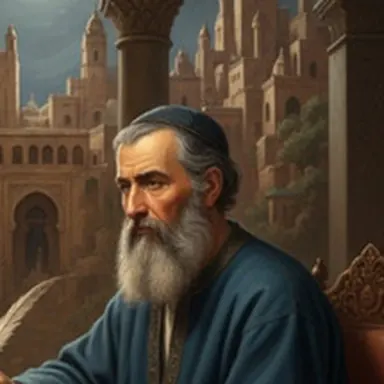
Rabbi Yonah ibn Janah (Ribag)
16 min read3,133 words
Summary
The text surveys the multifaceted figure of Rabbi Yonah ibn Janah (Ribag), who is considered the greatest grammarian of the Middle Ages and the architect of the philological revolution of the Golden Age in Spain. The author presents Ribag not only as a brilliant linguist who perfected the principle of the triliteral root, but also as a physician and a rationalist philosopher who saw the study of language as a religious duty and an indispensable tool for understanding the plain meaning of Scripture. The survey details his monumental work "Kitab al-Tanqih," which comprises "Sefer HaRikmah" and "Sefer HaShorashim," which laid a scientific and systematic foundation, the first of its kind, for Hebrew grammar and syntax. The text also dwells on the stormy polemics he conducted against his contemporaries, such as Shmuel HaNagid, and illustrates how his linguistic legacy influenced later biblical commentators and shaped modern linguistic research.
Architect of the Language: The Work, Teaching and Torah Contribution of Rabbi Yonah ibn Janah (Ribag)
Introduction: The Philological Revolution of the Golden Age in al-Andalus
The 11th century in Muslim Spain, known as the Golden Age of the Jewry of al-Andalus, produced one of the most influential figures in the history of Jewish and linguistic thought: Rabbi Yonah ibn Janah, known by his Arabic name Abu al-Walid Marwan ibn Janah.[1, 2] Ribag's work is not limited to a technical description of the rules of grammar; he was a spiritual architect who laid the scientific foundations for understanding Scripture, combining the tradition of Israel with the most advanced scientific methodologies of the world of Islam.[3, 4] Ribag was active in a period of momentous political and spiritual change, and in his work he reflected the aspiration of the Jewish intellectual of his time to set the holy tongue on a par with the leading scientific and cultural languages of the age.[5, 6]
The development of scientific Hebrew linguistics reached its peak in the hands of Ribag, who built another story on top of the discoveries of Rabbi Yehuda Hayyuj.[2, 3, 7] Whereas Hayyuj discovered the principle of the triliteral root, it was Ribag who turned this discovery into a complete, systematic and comprehensive system covering all aspects of the language, from phonology and morphology to syntax and lexicography.[3, 8] Precisely against this background, his figure should be examined not only as a grammarian, but as a physician, a philosopher of language and a rationalist biblical commentator.[8, 9, 10]
Chapter 1: Biography, between Córdoba and Saragossa
Rabbi Yonah ibn Janah was born in Córdoba, the capital of the Umayyad Caliphate, between 985 and 990.[7, 9, 11] The Córdoba of those days was the greatest cultural and scientific center in the West, and its Jewish community enjoyed an unprecedented flowering under the patronage of statesmen such as Hasdai ibn Shaprut.[6] In his childhood and youth, Ribag absorbed the intellectual atmosphere of the city, which was full of libraries and scientific discussions.[1, 7]
The Period of Study in Lucena
Ribag acquired most of his Torah and linguistic education in the town of Lucena (Alisana), a Torah center known for its excellent houses of study.[8, 9, 11] There he studied with two of the great men of the generation: Rabbi Yitzhak ibn Shaul (Sahl), who was an expert in poetry and rhetoric, and Rabbi Yitzhak ibn Gikatilla.[7, 8, 9] Ibn Gikatilla, a disciple of Menachem ben Saruq, was a key figure in shaping Ribag's world, since he was versed in both Hebrew and Arabic grammar, and gave Ribag his first comparative tools.[11, 12]
It is interesting to note that in his youth Ribag tried his hand at writing poetry, as was expected of every educated man in al-Andalus.[9, 12] However, with rare intellectual honesty, he testified about himself in his book "Sefer HaRikmah" that poetry is not his craft and that liturgical verse is not his concern.[8, 9, 12] This recognition led him to invest all his energy in philological and medical research, where he found his true calling.[3, 9]
The Destruction and the Exile to Saragossa
Ribag's life took a dramatic turn in 1012.[7, 12] A severe civil war broke out in Córdoba, and the city faced siege and destruction by the Berbers.[7, 12] The Jews of the city were badly hurt by the fighting, and many of them were forced to flee.[7, 12] Ribag, together with his learned friend Rabbi Shmuel HaNagid, left Córdoba and wandered northward.[2, 10, 11, 12]
While Shmuel HaNagid turned to Granada and became an eminent statesman there, Ribag settled in Saragossa (Saraqusta), which was then under the rule of the Banu Hud dynasty.[2, 9, 12] In Saragossa he established a circle of young scholars who were interested in linguistic questions, and there he wrote all his great scientific works.[2, 8, 10, 11] He was active in this city until his death in the first half of the 11th century, around the year 1055.[1, 2, 7, 9]
Chapter 2: The Physician and Scientist, "Kitab al-Talkhis"
For Ribag, science was not detached from holiness. He practiced medicine for his livelihood and was a famous and skilled physician, a title that accompanied his name in the writings of Arab and Jewish historians alike.[2, 3, 7, 11] The practice of medicine gave him the scientific tools of precise observation, careful classification of data and analytical thinking, tools that he later applied in his linguistic laboratory.[3]
His only surviving medical work, "Kitab al-Talkhis" (The Book of Explanation), was considered lost for many years until it was rediscovered in the Süleymaniye Library in Istanbul.[2] It is the earliest known monograph dealing with the terminology of simple drugs (basic medicinal substances).[2]
The book is arranged in alphabetical order (according to the Arabic alphabet, without the letter Za) and includes 1,099 entries.[2] Each entry gives the name of the drug, its properties, and the exact weights and measures required for medical use.[2, 9, 11] This achievement testifies to the breadth of his mind and to his mastery of the natural sciences, which earned him great respect among his Muslim colleagues as well.[2, 7, 9] Ribag saw science as a tool for clarifying the truth, and just as in medicine, where an error in dosage may cost a human life, so in grammar an error in understanding a word may lead to a mistaken understanding of the will of God.[10, 11]
Chapter 3: His Philosophical and Linguistic Teaching
Ribag was not merely a technician of words; he was a philosopher of language. His linguistic conception rested on a distinctly Aristotelian rationalism, rejecting abstract metaphysical speculations that have no grip on reality.[9, 10, 11] He believed that language is a lawful and orderly system, and that in order to understand the Holy Scriptures a person must master the laws of this system.[3, 10, 11]
Philology as Divine Service
In the famous introduction to "Sefer HaRikmah," Ribag sets out his credo. He argues that since the Holy Scriptures were transmitted in a human language, understanding them depends on knowledge of the laws of the language.[10, 11] He comes out against the sages of his generation who belittle grammar and regard it as a neglect of Torah or a secular pursuit.[5, 8, 11, 12] For Ribag, the study of language is a religious duty of the first order, since without precise grammar the commentator may attribute to God things He did not say.[10, 11]
He testifies about himself that he invested a superhuman effort in his studies: "I spent on oil for light in my nights twice as much as others spent on wine".[10, 11, 12] This statement is not merely an expression of personal pride, but a reflection of the Andalusian ethos that valued diligence, scientific inquiry and absolute devotion to the truth.[10, 11]
The Arabic Influence and Cross-Linguistic Comparison
Ribag lived in an environment in which Arabic linguistics had reached peaks of sophistication. The Arab grammarians developed in-depth methods of analysis for the Qur'an, and Ribag understood that these methods could and should be applied to Hebrew as well.[2, 7] He adopted the terms and categories of Arabic grammar (such as the division into noun, verb and particle) and adapted them to the unique structure of the holy tongue.[2, 8]
He was a pioneer of comparative linguistics. In "Sefer HaShorashim" he frequently brings parallels from Arabic and Aramaic in order to clarify the meaning of difficult biblical words.[2, 3, 7, 9] He justified the use of foreign languages for understanding the Torah by the fact that the Semitic languages are related to one another in their origin, and that already the Sages in the Talmud used foreign tongues to interpret verses.[2, 11]
Chapter 4: "Kitab al-Tanqih," the First Complete Book of Grammar
The crowning achievement of Ribag's oeuvre is the work "Kitab al-Tanqih" (The Book of Minute Examination), known in Hebrew in the translation of Yehuda ibn Tibbon as "Sefer HaDikduk" (The Book of Grammar).[2, 8, 11] It is the first work in the history of Israel that presents a complete and systematic picture of the Hebrew language in all its aspects.[2, 3, 7, 8]
The book is divided into two separate but complementary parts: "Sefer HaRikmah" (the grammatical part) and "Sefer HaShorashim" (the lexical part).[8, 10]
Sefer HaRikmah (Kitab al-Luma')
"Sefer HaRikmah" deals with the rules of the language and its structure. It comprises 46 chapters discussing a variety of subjects:
- Phonology: the pronunciation of the letters, the vowels and the accents.[8]
- Morphology: the inflection of nouns and verbs, noun patterns and verbal stems (binyanim).[8]
- Syntax: the structure of the sentence, the relations between words and the use of particles.[3, 8]
The special importance of "Sefer HaRikmah" lies in its in-depth treatment of syntax, a field his predecessors had hardly touched.[3] Ribag analyzed the ways in which language builds meaning through the order of words and the relations between them, and proposed rules that enable the commentator to distinguish between peshat (plain meaning) and derash (homiletic interpretation).[2]
Sefer HaShorashim (Kitab al-Usul)
"Sefer HaShorashim" is a complete dictionary of the biblical vocabulary, arranged by triliteral roots.[3, 8, 12, 13] Ribag perfected the method of Hayyuj and arranged all the words in Scripture (including words that seemed to have a two-letter root) under three-letter roots.[2, 7]
Ribag's dictionary became the basis for all the Hebrew dictionaries written after it, including those of the Radak, and it remains to this day a reference tool of the first rank for scholars of biblical language.[2, 7, 14]
Chapter 5: The Method of "Substitution" (al-Ta'wid) and the Controversy with Ibn Ezra
One of the most original and fascinating aspects of Ribag's teaching is the concept of "substitution" (in the original: al-ta'wid or al-niyaba).[2, 3] Ribag observed that in certain cases in Scripture the text uses one word where the context seemingly requires another word, or uses a certain letter instead of another.[2]
Instead of trying to resolve these difficulties by means of far-fetched homilies, Ribag proposed a linguistic solution: the Hebrew language allows the substitution of related words or similar letters.[3] A famous example is the use of the conjunctive vav ("and") in place of the particle "or" (for example, in the verse "He who strikes his father and his mother," whose meaning according to Ribag is his father or his mother).[15]
This method aroused fierce opposition on the part of Rabbi Abraham ibn Ezra.[2] Ibn Ezra, who was more conservative in his attitude to the sanctity of the text, saw the method of substitution as a kind of injury to the integrity of Scripture.[2] He argued that it is impossible that God would use one word when He means another, and that the explanation must be found within the laws of the language without assuming substitutions.[2] In his sharp words he called Ribag's view "madness" bordering on heresy.[2] Nevertheless, modern scholars see Ribag as a forerunner of textual criticism, who understood that the biblical language is alive and breathing and is not always bound by rigid rules.[3]
Chapter 6: The Great Polemic with Shmuel HaNagid
Ribag's figure cannot be understood without addressing the bitter and widely publicized struggle he waged against Rabbi Shmuel HaNagid and his circle.[2, 10, 11, 12] The root of the conflict lay in the publication of Ribag's first book, "Kitab al-Mustalhaq" (The Book of Criticism), in which he dared to criticize and supplement the teaching of Hayyuj.[2, 3, 10, 11]
For Shmuel HaNagid and the disciples of Hayyuj in Córdoba, Hayyuj was the supreme authority, and any criticism of him was perceived as rebellion.[2] HaNagid, who was then at the height of his political power in Granada, initiated a series of attacks against Ribag.[2, 10, 11, 12, 16] The exchanges were carried out by means of epistles and pamphlets that bore poetic names but whose content was extremely sharp.[2, 10, 11]
The Books Born of the Struggle
Ribag, who felt wounded by the disparagement of his professional competence, fought back fiercely. He wrote a number of works intended to defend his positions and to prove the errors of his opponents:
- Kitab al-Taswiya (The Book of Comparison): Written following an encounter with a "stranger from Granada" who confronted him with HaNagid's claims. In it Ribag refutes one by one the criticisms of his first book.[2, 10, 11, 12]
- Kitab al-Tanbih (The Book of Remark): A reasoned epistle clarifying disputed grammatical points.[2, 10, 11]
- Kitab al-Tashwir (The Book of Shaming): This is the sharpest of his books (also known as "The Book of Apology"). In it Ribag argues that his opponents are driven by envy and ignorance, and he "shames" them for their lack of understanding of the depth of the language.[2, 10, 11, 17]
Although most of these polemical writings were lost over the generations, the echoes of the debate were preserved within "Sefer HaRikmah," where Ribag uses HaNagid's claims as "straw" that he burns in the fire of his linguistic proofs.[10, 11] This struggle was not merely personal; it represented the clash between a conception of traditional authority and a conception of free scientific inquiry.[2]
Chapter 7: Ribag's Influence on the Following Generations
Despite the controversies of his lifetime, after his death Ribag became the "central pillar" of Hebrew grammar.[2, 7] His books reached all the centers of Judaism, and even those who disagreed with him could not ignore his immense contribution.[2, 7]
The Ibn Tibbon Family and the Dissemination of His Teaching
The main obstacle to the dissemination of Ribag's teaching outside al-Andalus was the Arabic language.[7] The Jews of northern France, Ashkenaz and Italy could not read his writings.[7] The great change came in the 12th century with the Ibn Tibbon family of translators.[5, 18, 19] Rabbi Yehuda ibn Tibbon translated "Kitab al-Tanqih" into Hebrew, and thereby opened the gates of the science of grammar to the entire world of Torah.[5, 7, 18, 19] The Hebrew translation (Sefer HaRikmah and Sefer HaShorashim) became a permanent asset in Jewish libraries.[5, 18, 19]
The Inheritance in the Hands of the Radak
The most famous grammarian of the Middle Ages, Rabbi David Kimchi (the Radak), owes the bulk of his fame to Ribag.[14, 20, 21] The Radak's book, the "Mikhlol" (which also comprises a grammatical part and a book of roots), is to a large extent a popular and accessible summary of Ribag's method.[14, 20, 21] The Radak testified that he came to gather from the grammarians who preceded him, foremost among them Ribag and Hayyuj.[14, 20, 21] Thanks to the Radak, Ribag's insights reached all the later biblical commentators and all Torah scholars.[14, 20]
Chapter 8: Ribag in the Eyes of Modern Scholarship
Modern linguists see Ribag as a brilliant figure who was ahead of his time.[3, 22] His methodology (the combination of philology, comparison of languages and logical analysis) is what stands at the basis of modern linguistic research.[22] His understanding of biblical syntax and of the ways in which language expresses nuances of tense, person and mood remained unrivaled for hundreds of years.[3, 22]
Scholars note the scientific integrity of Ribag, who did not shrink from disagreeing with exemplary figures or with exegetical traditions when he saw that they contradicted the facts of the language.[10, 11] This approach of his paved the way for the peshat exegesis of Spain, which preferred the logical and linguistic explanation over midrash and derash.[3]
Summary and Conclusions: The Figure of Ribag as Architect of the Language
Rabbi Yonah ibn Janah was much more than a grammarian; he was a polymath who connected the worlds of medicine, philosophy and Torah.[1, 2, 9, 11] In his monumental enterprise, "Kitab al-Tanqih," he gave the Jewish people the tools to understand its language anew, freeing it from the shackles of confusion and obscurity that had characterized early linguistics.[2, 3, 4]
Ribag's contribution to Jewish thought is immeasurable. He proved that it is possible to be faithful to tradition and at the same time entirely open to foreign methods of scientific research.[4] He set truth as the supreme value, and thanks to his persistence and diligence, Scripture received a deeper, more precise and more rational interpretation.[10, 11]
Ribag's legacy lives on in every page of a modern Hebrew dictionary, in every grammar lesson and in every biblical commentary that seeks to grasp the plain meaning of the text.[2, 7, 22] He remains "the winged one" (as his family name Janah, "wing," indicates), who soared above the petty controversies of his time and gave the following generations the ability to understand the "holy tongue" as it had never been understood before.[7, 9, 12]
Sources22
- 1.אבן ג'נאח, יונה (995?-1050?) - הספרייה הלאומית, nli.org.il/he/a-topic/987007262906505171
- 2.Jonah ibn Janah - Wikipedia, en.wikipedia.org/wiki/Jonah_ibn_Janah
- 3.Ibn Janāḥ | Hebrew Poet, Philosopher, Scholar - Britannica, britannica.com/biography/Ibn-Janah
- 4.Celebrating the Jewish Grammarians of Al-Andalus | by Blaise Webster - Medium, medium.com/@webproductions28/celebrating-the-jewish-grammarians-of-al-andalus-34fc4597443e
- 5.על שפתם וכתבם של יהודי ספרד כביטוי לזהותם הדתית והתרבותית, files.ybz.org.il/periodicals/peamim/132/Pe'amim_132 (2).pdf
- 6.Full text of "Middle East religious books" - Internet Archive, archive.org/stream/MEBooks/Islamic Culture Through Jewish - Esperanza Alfonso_djvu.txt
- 7.Jonah ibn Janah Facts for Kids, kids.kiddle.co/Jonah_ibn_Janah
- 8.Ibn Jan??, Jonah | Encyclopedia.com, encyclopedia.com/religion/encyclopedias-almanacs-transcripts-and-maps/ibn-janah-jonah
- 9.אנציקלופדיה יהודית דעת - יונה בן גנאח ;, daat.ac.il/encyclopedia/value.asp?id1=2221
- 10.IBN JANAḤ, ABU AL-WALID MERWAN - JewishEncyclopedia.com, jewishencyclopedia.com/articles/7998-ibn-janah-abu-al-walid-merwan
- 11.IBN JANAḤ, ABU AL-WALID MERWAN - JewishEncyclopedia.com, jewishencyclopedia.com/articles/8753-jonah-abu-al-walid-merwan-ibn-janah
- 12.רבי יונה אבן ג'נאח - ויקישיבה, yeshiva.org.il/wiki/index.php/רבי_יונה_אבן_ג'נאח
- 13.The Book of Hebrew Roots (Kitab al-Usul) by ABU L-WALID MARWAN IBN JANAH (Rabbi, abebooks.com/Book-Hebrew-Roots-Kitab-al-Usul-ABUL-WALID/22877708497/bd
- 14.David Kimhi - Wikipedia, en.wikipedia.org/wiki/David_Kimhi
- 15.Does the Biblical Hebrew Conjunction - Yeshiva University, repository.yu.edu/server/api/core/bitstreams/52a8f6db-0300-4b53-87b5-3a2c7c9f3658/content
- 16.Between Shemuel Ha-Nagid and the Poets of Zaragoza - HUJI OpenScholar, openscholar.huji.ac.il/sites/default/files/jstudies/files/_file_1502017654.pdf
- 17.The Kitāb al-Taswi'a or Book of Reprobation by Jonah ibn Janā. A revision of J. and H. Derenbourg's edition | Request PDF - ResearchGate, researchgate.net/publication/248724141_The_Kitab_al-Taswi'a_or_Book_of_Reprobation_by_Jonah_ibn_Jana_A_revision_of_J_and_H_Derenbourg's_edition
- 18.Sefer ha-Riqmah (Frankfurt, 1856), copy 2 : Jonah ibn Janah (c. 990 - Internet Archive, archive.org/details/sefer-ha-riqmah-frankfurt-1856-hb-6415-images/Sefer_ha-Riqmah_Frankfurt_1856_HB6415_images
- 19.IBN TIBBON - JewishEncyclopedia.com, jewishencyclopedia.com/articles/8026-ibn-tibbon
- 20.Kimchi - Brill Reference Works, referenceworks.brill.com/display/entries/RPPO/COM-11548.xml
- 21.R. David Kimhi (Radak), EJ 10:1001-1004. | Center for Online Judaic Studies, cojs.org/r-david_kimhi-radak-_ej_10-1001-1004/
- 22.New Interpreter's Dictionary of the Bible Volume 3: I-Ma page 694, ministrymatters.com/new_interpreter_s_dictionary_of_the_bible_volume_3_i-ma/694