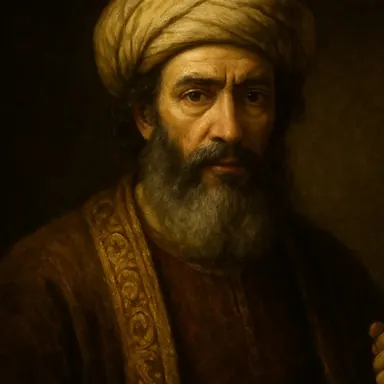
Leadership, Halakha and the Science of Language in the Middle Ages: The Multidimensional Teaching of Rabbi Shmuel HaNagid
19 min read3,716 words
Summary
The text surveys the multidimensional figure of Rabbi Shmuel HaNagid, a polymath who became one of the pillars of the Golden Age in Spain. The source sketches his work as a political and military leader in Muslim Granada, while highlighting his foundational contribution to the world of halakha and Talmud through fundamental works such as "Hilkheta Gavrata" and "Mevo HaTalmud" (Introduction to the Talmud). Alongside this, his activity as a groundbreaking linguist and poet is analyzed, one who combined in his works original images from the world of nature and science and conducted incisive controversies over the standards of the Hebrew language. The aim of the article is to show how his political power, religious scholarship and artistic talent merged into an intellectual harmony that shaped the face of Judaism for generations.
The Political and Religious Leadership of Rabbi Shmuel HaNagid in Muslim Spain
Rabbi Shmuel HaNagid represents one of the most complex and influential figures of the Golden Age of Spanish Jewry in the 11th century, a period in which the Jewish community of the Iberian Peninsula established itself as an independent spiritual and cultural center. HaNagid acted in the space between two worlds: on the one hand, he served as deputy to the king and as supreme military commander (deputy for war) of the army of the Muslim kingdom of Granada, a political and military position without precedent for a Jew at that time.[1] On the other hand, he led the Jewish community as "Nagid" and stood at the head of a large and central yeshiva in Granada.[2] HaNagid's academic and religious standing won wide recognition among his contemporaries; his yeshiva is mentioned in the writings of the grammarian and commentator Rabbi Yehuda ibn Bal'am, while the poet Rabbi Yosef ben Chasdai called him by the esteemed title "the head of the pleasant yeshiva".[2]
The leadership influence of Shmuel HaNagid extended far beyond the political borders of the kingdom of Granada. He became the chief patron of the world of Torah and learning in his generation, using his personal wealth and his many possessions to support all who sought to make Torah their profession.[2] This financial support reached students of Torah throughout Spain, passed through the communities of North Africa, and reached as far as the historic yeshivot of Babylonia and Jerusalem.[2] This cross-border philanthropic and educational activity established his standing as a supreme leader of the entire Jewish world, at a time when the traditional Torah centers in Babylonia had begun to decline, and the new centers in North Africa and Spain had begun to come to the fore.
"Hilkheta Gavrata" and the Laying of the Foundations of Sephardic Halakhic Decision
In the summer of the year 4809 (1049 CE) Shmuel HaNagid began writing his monumental halakhic work "Hilkheta Gavrata" (or "Hilkhata Gavrata").[2] This work is considered the first systematic book of halakha composed on Spanish soil, and it laid the foundation for the independent Sephardic tradition of halakhic decision.[2] The book, written in Hebrew and Aramaic, covered the whole Talmud, and in particular its practical parts that are in force in the present time.[2] The Meiri, one of the most important Talmud commentators of later generations, praised the work highly and determined that "he composed a book on the whole Talmud, and it is fit to be relied upon in most of its words".[2]
The methodology of decision in "Hilkheta Gavrata" reflects a scientific and meticulous approach, based on the systematic collection of the responsa of the Geonim and their citation in their original language.[2] HaNagid did not content himself with passively copying the words of his predecessors, but conducted an in-depth halakhic discussion with them – he analyzed their opinions, compared them with the rulings of his teachers, accepted or rejected their words on the basis of evidence, and in the end decided the practical law out of a systematic interpretation of the Talmudic discussions.[2]
HaNagid's motives in writing the work were both religious and political, as he details in the famous introductory poem he composed for the book.[2] In this poem he describes the chain of the tradition of the Oral Torah from Moses our teacher to the prophets, and from there to the sages of the Mishnah, while referring to the disputes of Beit Shammai and Beit Hillel and to the redaction of the Mishnah and the Talmud.[2] HaNagid explains that in the generations after the sealing of the Talmud, halakhic responsa spread that contradicted the plain sense of the Talmudic discussions, which led to spiritual confusion and to the rise of the "minim" (the Karaites), who sought to undermine the authority of the rabbinic tradition.[2] The work was therefore intended to restore order, to establish halakhic decision on solid Talmudic foundations, and to defend Orthodox Judaism against external attacks.[2]
Although the book has not survived in its entirety, its remnants remain scattered in the writings of the Rishonim, among them the Rif, Nahmanides (Ramban), the Meiri, Rabbi Yitzchak ibn Ghiyath, and also in "Sefer HaEshkol" and in "Sefer HaIttim," which was deeply and consistently influenced by HaNagid's writings.[2] Halakhic rulings from the work also found their way into the canonical code "Arba'ah Turim".[2] In modern times the scholar Mordechai Margaliot collected the remnants of the book from manuscripts and citations and published them in a scholarly edition.[2] This publication stood at the center of an academic controversy between Margaliot and the scholar Shraga Abramson; Margaliot included in his edition additional halakhic writings that he held did not belong to the original work, whereas Abramson disagreed with him and argued that they were integral parts of "Hilkheta Gavrata" itself.[2]
"Mevo HaTalmud": Hermeneutics and Rules of Decision
Shmuel HaNagid's greatest methodological contribution to the study of the Talmud is embodied in his famous work "Mevo HaTalmud" (also called "Mavo LaTalmud," Introduction to the Talmud).[3] The work, which is regularly printed at the end of Tractate Berakhot in the Vilna edition of the Shas, reflects the interpretive conception characteristic of the period of the Geonim, and regards the Talmud first and foremost as a hermeneutical commentary on the Mishnah.[3]
The work is built of two parts that chart a scientific path for analyzing the text [3]:
- The nature of Talmudic discourse: a rhetorical classification that breaks down the Talmudic discussion into twenty-one different structural patterns, thereby revealing the linguistic "code" of the Amoraim.[3]
- The rules of halakhic decision: the formulation of a systematic guide for extracting a halakhic ruling from the complex discussions of the Gemara.[3]
In this work HaNagid makes clear that the redactors of the Talmud used fixed key words to mark for the student the status of the various segments of the discourse.[3] These textual markers were added in the days of Ravina and Rav Ashi, as Rashi and HaNagid himself also attest, in order to make it easier to identify the Tannaitic sources incorporated in the body of the discussion.[3]
In "Mevo HaTalmud" HaNagid draws a detailed map of the Tannaitic literature created after the Mishnah, while defining its halakhic standing [3]:
In modern times these methodology and codes have been re-examined in the study of Rabbi Yehuda Froman, "HaTalmud Ke-Havayato" (The Talmud as It Is) (2004), in a chapter dealing with "the Talmudic code of Rabbi Shmuel HaNagid".[3] This study discusses, among other things, the practice of replacing the name of God with an epithet in Talmudic texts, and offers a modern and systematic reading of the rhetorical basic assumptions that HaNagid laid down in his introduction.[3]
Biblical Linguistics and the Great Controversy with Ibn Janach
Shmuel HaNagid was active in an era in which grammar and linguistics were perceived as sciences essential to understanding Scripture and to perfecting poetic creation. He composed in Arabic many grammatical works, the most prominent of which is "Kitab al-Istighna" (known in Hebrew as "Sefer HaOsher," The Book of Riches).[2] This book was an extremely detailed, rich and comprehensive dictionary of the language of the Bible.[2] Of this enormous work only a single Genizah fragment has survived, covering seven grammatical roots: אדו״ן, אד״ר, אה״ב, אמ״ל, אמ״ן, אמ״ץ and אמ״ר, which contain some forty entries in all.[2]
Shmuel HaNagid and his adversary, Rabbi Yonah ibn Janach, both studied with the father of scientific Hebrew grammar, Rabbi Yehuda Chayyuj.[4] Despite their common background, a sharp and passion-laden controversy developed between the two.[4] The spark of the controversy flew when Ibn Janach published "Kitab al-Mustalhaq" ("Sefer HaHasagah," The Book of Criticism, translated into Hebrew by Ovadiah the Sephardi), which contained critical and incisive strictures on the books of their common teacher Chayyuj.[4, 5] Shmuel HaNagid saw this criticism as an affront to Chayyuj's honor and came out in defense of his teaching in a series of pamphlets, which led to counter-responses by Ibn Janach, among others in his monumental work "Kitab al-Tanqih" ("Sefer HaDikduk," The Book of Grammar), which deals with matters of Hebrew syntax.[5]
Beyond the personal dimension and loyalty to their teacher, the controversy reflected utterly different aesthetic and theoretical worldviews regarding the essence of language:
- Shmuel HaNagid's lenient approach: his practical experience as a poet and composer of Hebrew poetry led him to a view that seeks to make allowances for poets.[4] HaNagid argued that for the sake of preserving the meters of poetry and the rhyme, poets are permitted to make certain grammatical deviations.[4]
- Yonah ibn Janach's conservative approach: as a pure linguist and theoretician, Ibn Janach refused to accept this leniency.[4] He demanded absolute subordination to the rules of biblical grammar and rejected poetic deviations that did not accord with his rigid scientific method.[4]
"Eloah Oz ve-El Kanna": The Poetry of War, Faith and Prayer
HaNagid's military career as deputy commander of Granada gave birth to one of the most impressive works of medieval Hebrew poetry – the poem of victory and thanksgiving "Eloah Oz ve-El Kanna" (Mighty God and Jealous God).[6] The poem, included in the collection "Ben Tehillim," was written as thanksgiving for his deliverance in the battle of Granada in 1038 CE, and it constitutes an extraordinary historical, religious and artistic document.[6]
The Political Conspiracy and the Incitement against HaNagid
In the second part of the poem (lines 12–39) HaNagid details the political background to the outbreak of the war, and paints a plot reminiscent of the story of the Scroll of Esther.[6] HaNagid's political enemy, called in the poem by the biblical epithet "Agag" (who dwells on the seashore), and his partner, called "Banu Abbas," were fiercely jealous of HaNagid's standing in the royal palace and of the fact that every matter of kingship and counsel was decided by his word ("and that every matter of kingship and counsel is decreed by me").[6]
Because of their jealousy they tried to depose him, using nationalist and religious arguments against the rule of a "foreign people" (the Jews) over their own people.[6] Banu Abbas wrote a letter full of sophisticated lies and spread it in the various lands in order to incite the people against Shmuel.[6] The aim of the plot was not merely personal harm, but the physical destruction of the entire Jewish community ("to cut off from God's congregation kin and offspring, the woman in childbirth and the woman with child").[6]
The sudden death of the old king, who had been Shmuel's patron, filled HaNagid with fear lest God was punishing him for his sins, and on the other hand aroused immense joy in his enemy, who celebrated the expected downfall of the Jewish vizier.[6] However, the son of the late king, called in the poem "lion of the peoples," came to power and firmly refused the enemy's demand to hand Shmuel over.[6] The enemy sent the young king a threatening letter claiming that leaving Shmuel in his post was a grave religious transgression, and that if he did not hand him over, the kings of the region would open a united war against him.[6] The king answered courageously: "If I do as you say, a curse will come upon me; and if I deliver my servant into the hands of his foes – my own soul will be delivered into the hands of my foes!".[6] This refusal led to the mustering of the army of the coalition of enemies, called in the poem "Amalek and Edom and the sons of Keturah," which advanced with tremendous speed "like a bird riding on the wing of the wind".[6]
Martial Realism in the Description of the Battle
In lines 40–69 of the poem HaNagid presents a detailed, dramatic martial description, full of original images, which departs entirely from the poetic conventions of his generation [6]:
- The atmosphere and noises of the battle: the earth trembles and turns over like "the overthrow of Gomorrah," the day of battle is dark and full of fog, and the sun looks black and frightening like the poet's anxious heart ("and the sun, like my heart, is black").[6] The faces of the warriors grow black as "the bottom of a pot" from anger and terror, and the roar of the multitude sounds like the breakers of the sea in a storm.[6]
- The weapons of destruction and the soldiers: the horses resemble vipers emerging from their dens; the hurled spears light up the air like lightning; the arrows fall like raindrops; the bows resemble snakes spewing deadly bees; and the sword is raised above the head like a torch of fire that darkens the light.[6]
- Death and bloodshed: the blood of the warriors flows on the ground like the blood of the sacrificed rams at the sides of the Temple court.[6] The warriors are weary of their lives and prefer death in battle, until they receive the fresh blows on their heads with joy and pride as though they were a crown of glory.[6]
- The death of the enemy: in the end the plot is foiled and the enemy suffers a crushing defeat.[6] HaNagid describes how his enemy was captured, put in prison and killed "as villains are killed" on the night of the rejoicing of the testimony of the Torah, comparing his downfall to the curse that links the counsel of Zeresh to Haman.[6]
The Theology of Trust and Prayer
In the heart of the storm of war HaNagid presents a firm theological position based on absolute trust in God and on the power of prayer [6]:
- The covenant of the forefathers: against the wicked covenants made by his enemies, HaNagid relies on a historic "covenant of the forefathers" that protects him from the sword.[6]
- Prayer in the face of bloodshed: at the climactic moments of the battle, when "there is no escape, no stay and no staff, and hope is uprooted," HaNagid chooses not to rely on human physical force.[6] While his enemies shed human blood like water, he chooses "to pour out supplication" before God, who humbles and casts down every evildoer into the pit he has dug.[6]
The Original Images of Shmuel HaNagid According to David Yellin
In David Yellin's esteemed literary study, "Shmuel HaNagid and His Original Images," HaNagid's unique ability to create original images out of deep observation of nature, of everyday life and of the realms of halakha and grammar is revealed.[6] Whereas most poets of his generation relied on stock images borrowed from Arabic poetry, HaNagid undermined these conventions and created a new figurative language.[6]
Yellin divides and analyzes HaNagid's original images into several central categories [6]:
General Images from Everyday Life and Nature
Far-sightedness (in a poem to Rabbi Chushiel): HaNagid likens a person who identifies distant problems but misses those closest to him to "a man's eye, which sees far off and does not see its own cheeks close by".[6]
The power of a soft tongue (in his work "Ben Mishlei"): a soft tongue that calms the anger of a king burning like fire is likened to a fine, slowly falling rain that stills the waves of the stormy sea.[6]
Measure in education and teaching (in "Ben Mishlei"): a teacher should teach and leave the student alone by turns, since a person's heart grows weary of listening continuously. He likens this to rain: rain at intervals revives the grass, but unceasing rain kills it.[6]
The need for toil in study (in "Ben Mishlei"): wisdom is not acquired easily but through effort. The attempt to be sated without toil is likened to one who tries to quench his thirst or be sated merely by licking his hand.[6]
A limit to kindness and the good (in "Ben Mishlei"): HaNagid warns against bestowing excessive good, and likens this to a lamp filled with pure oil up to its brim – which causes the wick to be spoiled and the light to go out.[6]
Renewal and light (in "Ben Tehillim"): following his dismissal from his post and his hope for future greatness, he likens the return of his honor to the pruning of a vineyard, which yields more fruit after pruning, and the light of his face, which will grow like "the light of a house when the torch is trimmed" (cutting the dying wick, which restores the great light).[6]
The movement of the moon and the clouds at night (in "Ben Tehillim"): the moon running among the clouds on a cloudy night is likened to a boat sailing swiftly on the sea; the raining cloud is likened to a maiden watering myrtles in a garden; and the dew of the cloud is likened to a girl shaking drops of water from her hair onto the earth.[6]
Images from the Realms of Halakha and Grammar
Spoiling the good (in "Ben Tehillim"): a person who takes the trouble to do a good deed but spoils it immediately afterward is likened, in a halakhic context, to one who takes the trouble to bring a lamb for the Passover offering but eats it raw (uncooked) within the Temple.[6]
Return to friendship and a letter of reconciliation (in "Ben Tehillim"): the resentment in the hearts of friends who quarreled and have come back to make peace is likened to a deep plague of leprosy, while the exchange of letters between them is likened to the two living birds used on the day of the leper's purification.[6]
Military victory and grammatical vocalization (in "Ben Tehillim"): in his confrontation with the grammarian Yonah ibn Janach, HaNagid weaves in an original grammatical image and likens the enemy dead he struck down (two against three) to the action of the vocalizer who writes a segol (three dots) and a tsere (two dots): "like a vocalizer who wrote a segol and a tsere".[6]
Images Connected with Biblical and Historical Allusions
Four allusions in a single verse (in the poem "Shirah"): celebrating his victory on the night of the eve of the festival of Sukkot, HaNagid compares the light that shone for him in the darkness to four miraculous biblical nights: the night of Abraham's war against the four kings, the night of the plague of the firstborn at the Exodus from Egypt, the halting of the sun in the days of Joshua, and the night of the Exodus from Egypt of the bearers of burdens.[6]
- The action of wine (in "Ben Tehillim"): the effect of the wine that puts its drinkers to sleep at evening is likened to the blow of Jael's hammer on the head of the stupefied Sisera.[6]
- Frightened and scattered thoughts (in a lament): his scattered thoughts, tossed this way and that in a moment of panic, are likened to Ahab's host scattered on the mountains, as seen in the vision of Micaiah son of Imlah.[6]
The pen and the pen-case (in "Ben Tehillim"): the pen inserted into the long inkwell is likened to the reed pen that grew among the streams of water and the reeds, which makes a sound like a yonah (the bird, a dove) and falls silent the moment it is swallowed inside the inkwell – just like Jonah (Yonah) the prophet who was swallowed in the belly of the fish (using a complete pun between "yonah" the bird and "Yonah" the prophet).[6]
A Comparative Synthesis of the Fields of Activity of Shmuel HaNagid
Below is a comparative analysis presenting the mutual connections, influences and methodologies that Shmuel HaNagid developed between the different realms in which he was active:
Summary
The life and work of Rabbi Shmuel HaNagid represent a unique intellectual and practical harmony, in which each field of activity nourished and enriched the other. His military and political career in the palace of Granada was not separated from his spiritual world; it gave his war poetry its intense realism and descriptive precision, and turned his trust in God and his prayer in the face of the fear of death into a tangible existential experience, anchored in a real historical context.[6] At the same time, his meticulous grammatical and linguistic learning served him not only for understanding Scripture and for precise lexicographical formulation, but also for perfecting his poetics, as can be seen in the sophisticated use of images from the world of language and vocalization.[2, 6]
On the religious and legal plane, HaNagid succeeded in combining a scientific method for interpreting the Talmud ("Mevo HaTalmud") with the writing of a pioneering code of decision ("Hilkheta Gavrata") intended to fortify the walls of the rabbinic tradition against external attacks.[2, 3] His broad financial support for students of Torah throughout the Jewish world turned Granada into an alternative spiritual center of gravity to declining Babylonia.[2] Rabbi Shmuel HaNagid thus stands in Jewish history as a model of "Torah and greatness in one place" – a bold military and political leader, an innovative halakhic decisor, a sharp grammarian and a groundbreaking poet, who with his own hands shaped the face of Spanish Jewry at the beginning of its Golden Age.
Sources6
- 1.ביטחון בשעת מלחמה - דמותו של רבי שמואל הנגיד | שיחה שבועית | רה"י הרב חיים סבתו - YouTube, youtube.com/watch?v=VEBHyRaFtmk
- 2.שמואל הנגיד - ויקיפדיה, he.wikipedia.org/wiki/שמואל_הנגיד
- 3.הצופן התלמודי של רבי שמואל הנגיד – ויקיטקסט, he.wikisource.org/wiki/הצופן_התלמודי_של_רבי_שמואל_הנגיד
- 4.יונה אבן ג'נאח - ויקיפדיה, he.wikipedia.org/wiki/יונה_אבן_ג'נאח
- 5.חנות האקדמיה - האקדמיה ללשון העברית -, hebrew-academy.org.il/topic/חנות-האקדמיה/
- 6.אלוה עז ואל קנא – ויקיפדיה, he.wikipedia.org/wiki/אלוה_עז_ואל_קנא