The Torah Teaching and Historical Work of Rabbi Yitzhak ha-Lavan: A Pioneer of the Tosafists in Bohemia and Shaper of the World of the Sages of Prague
16 min read3,118 words
Summary
This article surveys the wide-ranging figure of Rabbi Yitzhak ha-Lavan, one of the pioneers of the Tosafist movement in Bohemia in the 12th century, who laid the spiritual foundation for the glorious Torah centre in Prague. The text traces the life of R. Yitzhak ha-Lavan as a cultural and halakhic bridge who merged the French pilpul method of the study hall of Rabbenu Tam with the conservative Ashkenazi tradition into a unique synthesis. Beyond an analysis of his principal works on the tractates Ketubot and Yoma, the source emphasises the versatility of this sage as a decisor with international connections who knew the customs of Russia and England, as a liturgical poet (paytan), and perhaps even as a figure connected with the beginnings of the esoteric teaching. The aim of the article is to establish the standing of R. Yitzhak ha-Lavan as the shaper of the world of the sages of Prague and as a decisive link in the chain of transmission, who turned a peripheral community into an intellectual centre that influences the world of halakha to this day.
The Historical and Geographical Introduction: The Flowering of Torah in Bohemia in the 12th Century
The 12th century in Europe marked one of the most significant periods in the history of the development of halakha and Jewish thought, as the intellectual centre of gravity began to move from the traditional yeshivot of northern France and Ashkenaz towards new regions in the east and south. At the heart of this process stands the impressive and mysterious figure of Rabbi Yitzhak ben Yaakov, known by the epithet R. Yitzhak ha-Lavan. He was active in a period when the Tosafist movement was at the beginning of its flowering, and was one of the pioneers of the stream known as "the early Tosafists", a generation that laid the methodological foundation for everything that was to become the core of Talmud study in the European study halls.[1] R. Yitzhak ha-Lavan is not merely a local decisor or commentator; he represents the complex and fascinating connection between the study tradition of France, which took shape in the study hall of Rashi and his grandsons, and the awakening Torah centres in Germany and Bohemia, a region that gradually became a stronghold of Torah and knowledge.[2]
The historical processes that led to the emergence of the centre in Bohemia are closely connected with the Jewish migration eastwards, in search of security and a more stable economy after the persecutions of 4856 (1096) and the upheavals of the Crusades. Prague, R. Yitzhak ha-Lavan's main place of residence, began to establish itself as an important Jewish centre, and the figure of R. Yitzhak ha-Lavan gave it the Torah prestige needed to compete with long-established centres such as Mainz, Worms and that of Rashi. R. Yitzhak ha-Lavan's work in Bohemia was not only on the personal plane of writing novellae, but in establishing a study tradition that endured for many generations and influenced figures such as the "Or Zarua" and, later, the Maharal of Prague.[2, 3]
His Figure and Identity: "Ha-Lavan" (the White), between the Rivers of Europe and Personal Appearance
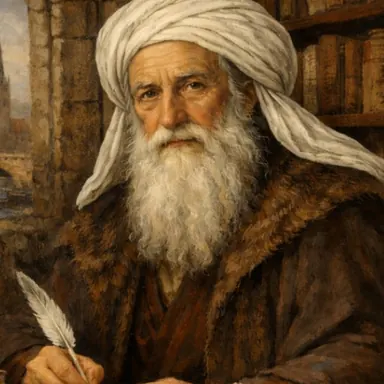
One of the subjects that has aroused great interest among historians of the Jewish people and bibliographers over the generations is the origin of the epithet "ha-Lavan" ("the White"). At first glance it seems to be a simple physical description, and indeed some scholars hold that R. Yitzhak ha-Lavan was so called because of his hair, which turned white prematurely, or because of his impressive beard.[2] However, a deeper analysis of the geographical and linguistic context of the period suggests a different and more convincing interpretation. Prague lies on the banks of the Vltava, but it is historically identified with the drainage basin of the river Elbe. In Latin and Old German the name of the river (Albis) derives from the word "white". Therefore many scholars, among them Ephraim Urbach and Zunz, hold that "ha-Lavan" is a Hebrew translation of the epithet "from the Elbe", which attests that he was identified entirely with the geographical region of Bohemia.[2]
This identification strengthens the perception of R. Yitzhak ha-Lavan as a spiritual leader deeply identified with the Bohemian territory, a fact that also earned him the epithets "Rabbi Yitzhak of Behem" (Bohemia) or "Rabbi Yitzhak of Prague".[2, 3] The multiplicity of epithets attests to the dynamism of his life; he was active not only in Bohemia but also in Germany and France, yet his roots remained planted in the soil of Bohemia. This duality in his identity, between an Ashkenazi sage and a Bohemian sage, enabled him to serve as a cultural and halakhic bridge between West and East.[2]
The Course of His Torah Training: Moving between the Torah Centres of France and Ashkenaz
R. Yitzhak ha-Lavan's spiritual growth passed through the key stations of the Torah world of Western Europe, a course typical of brilliant Torah scholars who sought to draw from the original sources of the Tosafist movement. He travelled to France to study in the yeshiva of the giant of the generation, Rabbenu Tam (Rabbi Yaakov ben Meir of Ramerupt), who was the most central and dominant figure in shaping the method of the Tosafot and Talmudic dialectic.[1, 3] Under Rabbenu Tam's guidance R. Yitzhak ha-Lavan adopted the deep analytical approach that seeks to reconcile contradictions between distant passages of the Talmud rather than being content with continuous, local commentary in the style of Rashi.[2, 4]
In addition to the decisive French influence of Rabbenu Tam, R. Yitzhak ha-Lavan studied in Ashkenaz with Rabbi Yitzhak ben Asher HaLevi (the Riva of Speyer), who was one of the first Tosafists in Germany and an outstanding disciple of the school of Rashi.[2, 3] This combination of the dynamic Torah of France (Rabbenu Tam) and the more conservative and meticulous Torah of Ashkenaz (the Riva) produced in R. Yitzhak ha-Lavan a unique synthesis. He succeeded in absorbing the French pilpul method into the Ashkenazi world of halakha, and was among the first to bring this method to Eastern Europe.[2] After his period of training he did not remain in the long-established centres, but returned to Bohemia and settled in Prague, where he began to spread his teaching and to establish a yeshiva of his own.[1, 4]
The Family of R. Yitzhak ha-Lavan: Between the Travels of Petachiah of Regensburg and the World of the Commentator
R. Yitzhak ha-Lavan's family background sheds further light on the breadth of his horizons and on the international connections of his study hall. He was the brother of the famous traveller Rabbi Petachiah of Regensburg, who documented his wondrous journeys among the Jewish communities of Babylonia, Persia, the Land of Israel and Russia.[1, 2] The connection between the wandering brother and the brother who dwelt in the tent of Torah was not only familial but intellectual. Through Petachiah, R. Yitzhak ha-Lavan was exposed to the customs and traditions of distant communities, a fact reflected in his halakhic writings, in which he sometimes cites rare customs.[3, 4]
This family, which probably originated in Regensburg (Ratisbon), was part of the social and spiritual elite of the Jewry of southern Germany and Bohemia. The fact that R. Yitzhak ha-Lavan himself served for a certain period as head of the yeshiva in Regensburg, a city that was a central junction of trade and movement towards the east, explains why he became the address for questions that arrived from distant regions such as Russia.[1] This family dynamic, one brother exploring the boundaries of the Jewish world and the other delving into the boundaries of the Talmud, created an exceptional Torah personality able to combine theory with a changing historical reality.[4]
The Literary Enterprise: Tosafot to the Tractates Ketubot and Yoma and Their Influence on the Generations
R. Yitzhak ha-Lavan's most central and enduring contribution to rabbinic literature is the writing of collections of "tosafot", glosses and novellae on the tractates of the Talmud. Unlike later Tosafists, whose words were edited and abridged into the "Tosafot" printed on the page of the Gemara, R. Yitzhak ha-Lavan's works have been preserved in their original and expansive form in manuscripts, which makes it possible to learn about his precise working method.[2, 3]
Tosafot to Tractate Ketubot
His work on Tractate Ketubot is considered one of the most important compositions of the period of the Rishonim in Ashkenaz. The manuscript of this work has been preserved in the Munich library (shelfmark 317) and was already referred to many times in the 13th century by Rabbi Yitzchak of Vienna in his book "Or Zarua".[1] The work was first printed in 5714 (1954) in London by Rabbi Pinchas Yaakov HaKohen. R. Yitzhak ha-Lavan's tosafot to Ketubot are distinguished by their exceptional length and by a tendency to analyse every passage from its foundations, bringing original opinions that sometimes stand in contrast to the tradition accepted in France.[3] The strength of the work lies in its ability to encompass all the parallel sources in the Talmud (Shas) and to build a harmonious halakhic system around the topics of marriage and money.
Tosafot to Tractate Yoma
Another significant work is the tosafot to Tractate Yoma, which deals with the service of the Day of Atonement. This work enjoyed a scholarly revival in the 20th century and was published in two different editions based on manuscripts: the edition of Dov Genachowski (1956) and the edition of P. Y. HaKohen (1960).[2] Genachowski's edition includes a comprehensive scholarly introduction that analyses the figure of R. Yitzhak ha-Lavan and establishes his standing as one of the founding fathers of the world of the Tosafot in Bohemia. In these tosafot one can see R. Yitzhak ha-Lavan's deep engagement with matters of the Temple and the sacrifices, subjects dear to the sages of Ashkenaz, who sought to preserve the memory of the Temple service as part of the life of the spirit.[2, 3]
His Method of Study and Ruling: An Analysis of the Distinctive Features of R. Yitzhak ha-Lavan
R. Yitzhak ha-Lavan's Torah teaching reflects the transition from Rashi's commentary, which focused on the verbal and substantive explanation of the text, to the method of the Tosafot, which sought to create system-wide coherence. In his works one can identify the buds of Ashkenazi "pilpul": an attempt to reconcile contradictions between distant passages and to extract abstract legal principles.[3] R. Yitzhak ha-Lavan did not hesitate to disagree with the great figures of his generation when his logical analysis led to a different conclusion, a fact that gave him the standing of an independent and daring decisor.[2]
One of the prominent features of his method is the relationship between the halakhic act and its legal definitions. For example, in passages concerning the writing of a bill of divorce (get) or the manumission of slaves, R. Yitzhak ha-Lavan discusses in depth what counts as "writing" as opposed to "engraving". His discussion of the concept "and he shall write, and not engrave" (ve-khatav ve-lo hakak) combines a meticulous analysis of the writing implements and techniques customary in his time (such as wax-coated tablets) with a comparison to the Talmudic reality.[5] This ability to combine realia with legal abstraction made his rulings an authoritative source for later generations, especially among the sages of Ashkenaz, who tended towards a practical and precise approach.[5]
His International Connections: The Customs of Russia and England in His Writings
R. Yitzhak ha-Lavan's authority went beyond the bounds of Prague and reached the eastern and western edges of Jewish settlement in Europe. This fact is well documented in his writings and in those of his contemporaries, which point to an extensive network of halakhic communication. One of the most fascinating testimonies is the approach of Rabbi Yitzhak ben Rabbi Dorbelo (one of the disciples of Rabbenu Tam) to R. Yitzhak ha-Lavan with a request for information on the customs of the Jews of Russia (Rusia).[3] At that time the communities in Russia were relatively isolated, and knowledge about them in the West was scant. The fact that R. Yitzhak ha-Lavan was regarded as an authority on this subject attests to his connections with merchants and sages who travelled along the trade route between Prague and Kiev.[3]
In addition to the eastern connection, R. Yitzhak ha-Lavan displayed personal familiarity with the Torah centre in England. In his responsa he uses the expression "and in the land of the island I heard" (u-ve-eretz ha-i shamati), which indicates that he visited the British Isles, or at least maintained a close exchange with the sages of London and the City.[3] Such a visit, if it indeed took place, highlights the mobility of the sages of the period and R. Yitzhak ha-Lavan's attempt to unite the world of Jewish custom under one halakhic umbrella. His ability to cite customs from England and from Russia in the same breath made him one of the first to see European Jewry as a single cultural space, despite the geographical distances.[3]
The Controversy over Engagement in the Esoteric Teaching and the Link with Nahmanides
A further aspect, and one disputed in modern scholarship, concerns R. Yitzhak ha-Lavan's possible connection with the world of early Kabbalah. According to the testimony of Rabbi Moshe of Burgos, one of the kabbalists of Spain in the 13th century, there was an exchange of letters between R. Yitzhak ha-Lavan and Nahmanides (Rabbi Moshe ben Nachman) on matters of mystery and the esoteric teaching.[3] If this testimony is accurate, then R. Yitzhak ha-Lavan was one of the pioneers of engagement in Kabbalah in Ashkenaz, even before the wide spread of Spanish Kabbalah, and took part in transmitting secret traditions from East to West.
However, prominent scholars such as Ephraim Urbach and Gershom Scholem have cast doubt on the reliability of this testimony.[3, 6] The main argument against this identification is the possibility that a scribal error occurred and the name of R. Yitzhak ha-Lavan was substituted for the name of another sage, Rabbi Yitzhak ben Yaakov HaKohen, who was active in Spain and was known for his Gnostic writings.[6] Nevertheless, the very existence of the report shows the reputation of R. Yitzhak ha-Lavan as a broad-minded personality whose name was associated with all fields of spiritual creativity, beyond the bounds of pure halakha. The connection between Prague, the future city of the Maharal, and early esoteric traditions adds a touch of depth to the figure of the spiritual founder of the community.[3]
R. Yitzhak ha-Lavan as Paytan: The Integration of Liturgical Creativity into the World of Halakha
As was the way of many of the sages of Ashkenaz and France in the Middle Ages, R. Yitzhak ha-Lavan did not confine his activity to the "four cubits of halakha", but was also a "paytan", a liturgical poet who composed prayers and supplications for the community. Yom-Tov Lipmann Zunz, the father of the modern study of the piyyut, identified a piyyut signed with the name "Yitzhak b. R. Yaakov" as a piyyut of R. Yitzhak ha-Lavan.[4] The piyyutim of that period were marked by rich biblical Hebrew and by the use of complex Talmudic allusions, which required of the worshipper a high level of learning in order to understand the depth of the poem.[1]
The combination of Talmudic learning and poetic creativity expressed the wholeness of the personality of the Jewish sage in Ashkenaz. For R. Yitzhak ha-Lavan, poetry was not merely ornament but an instrument for expressing religious feelings, frustration at exile and hope for redemption. The presence of R. Yitzhak ha-Lavan in the Ashkenazi festival prayer books and in the books of custom (such as Mahzor Vitry and Sefer HaRokeach) attests that his liturgical work was received with great affection in the communities of Europe and became an inseparable part of the religious daily order.[3]
Long-Term Influence: His Citations in the Books of the Decisors and Modern Scholarship
The figure of R. Yitzhak ha-Lavan continues to resonate in Torah literature to this very day. His rulings and interpretations are cited in hundreds of places in the literature of the Rishonim and the Acharonim, which attests to the vitality of his teaching. His importance grew especially in the 20th century with the discovery and publication of his manuscripts, which allowed students to approach his sources directly, without the mediation of later editors.[2, 3]
Modern scholarship, above all the work of Dov Genachowski, has succeeded in reconstructing a large part of his literary enterprise that had been lost. Genachowski's introduction to the tosafot on Yoma is considered a milestone in the study of the period of the Tosafists, since it combines manuscript analysis with historical comparison to other sources.[2, 3] This work revealed R. Yitzhak ha-Lavan not only as a commentator on the Gemara, but as a leader of his generation who was aware of the upheavals of the time and sought to give his community in Bohemia a firm spiritual backbone.[2]
Summary and Conclusions: The Place of R. Yitzhak ha-Lavan in the Chain of Transmission
Rabbi Yitzhak ha-Lavan of Prague stands as one of the pillars of Jewish creativity in Europe in the 12th century. He was the man who brought the message of the Tosafot from France to the East, adapting it to local reality and incorporating into it the ancient traditions of Ashkenaz. His multifaceted work as commentator, decisor, paytan and communal leader left an indelible mark on the Talmud and on the world of halakha.[3]
His Torah teaching is marked by a rare combination of intellectual openness and absolute loyalty to tradition. He knew how to draw customs from Russia and England, to explore the bounds of the Hebrew language in his poetry, and to analyse the passages of the Talmud with philosophical-legal depth.[2, 4] Thanks to him, Prague turned from a peripheral community into a world Torah centre, a standing it retained for many generations afterwards. For the modern student, the tosafot of R. Yitzhak ha-Lavan are a window onto a world of vibrant, inquiring and profound creativity, which reminds us that the Torah is a tree of life that puts forth new branches wherever it reaches, from the river Rhine to the banks of the Elbe.[2, 3]
Sources6
- 1.Isaac ben Jacob ha-Lavan - Wikipedia, en.wikipedia.org/wiki/Isaac_ben_Jacob_ha-Lavan
- 2.Isaac ben Jacob Ha-Lavan of Prague | Encyclopedia.com, encyclopedia.com/religion/encyclopedias-almanacs-transcripts-and-maps/isaac-ben-jacob-ha-lavan-prague
- 3.יצחק הלבן – ויקיפדיה, he.wikipedia.org/wiki/יצחק_הלבן
- 4.ISAAC BEN JACOB HA-LABAN - JewishEncyclopedia.com, jewishencyclopedia.com/articles/8177-isaac-ben-jacob-ha-laban
- 5.אור זרוע, חלק א תשט״ו | ספריית ספריא, sefaria.org.il/Ohr_Zarua,_Volume_I.715
- 6.Isaac ben Jacob Ha-Kohen | Encyclopedia.com, encyclopedia.com/religion/encyclopedias-almanacs-transcripts-and-maps/isaac-ben-jacob-ha-kohen