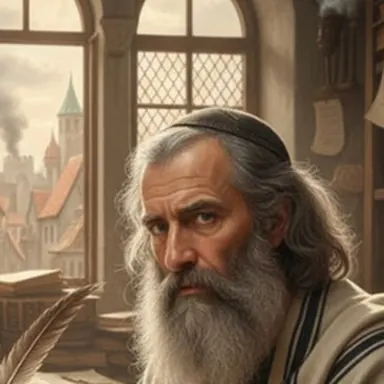
Rabbi Mordechai ben Hillel: The Mordechai as a Foundation of Ashkenazic Halakha
19 min read3,777 words
Summary
The article surveys the figure and influence of Rabbi Mordechai ben Hillel, one of the pioneers of halakhic codification in thirteenth-century Ashkenaz, whose monumental work "The Mordechai" serves as a cultural and Torah bridge between the dynamic Tosafist tradition and an ordered, binding halakhic ruling. The text stresses how his encyclopedic enterprise rescued hundreds of halakhic traditions from loss and served as the principal foundation of the glosses of the Rema on the Shulchan Arukh, thereby shaping the face of Ashkenazic halakha for generations. The author examines the textual complexity of the book, which comprises two different versions (the Austrian and the Rhenish), and the contribution of Rabbi Shmuel Schlettstadt to their final editing after Rabbi Mordechai was murdered as a martyr in the Rintfleisch massacres. Beyond the halakhic side, the article reveals the intellectual versatility of "the Mordechai," who also engaged in grammar and poetry, and the relevance of his rulings for understanding the social and economic structure of the Jewish community in the Middle Ages.
The Work and Torah Teaching of Rabbi Mordechai ben Hillel: The Mordechai as a Foundation of Ashkenazic Halakha
A Pillar of the Transition from the World of the Tosafot to the World of Codification
Rabbi Mordechai ben Hillel ha-Kohen, known to the generations as "the Mordechai," stands at a decisive historical and Torah crossroads in the development of Jewish halakha. He was active in the second half of the thirteenth century, a period that marked the twilight of the age of the Tosafists in Germany and France, and on the eve of the destruction of classical Ashkenazic Jewry in the Rintfleisch massacres.[1, 2] His Torah teaching is not merely a halakhic anthology but a mighty enterprise of preservation, which forms a vital bridge between the dynamic and dialectical method of study of the Ashkenazic yeshivot and the growing need for a clear and binding halakhic code. The importance of Rabbi Mordechai is measured not only by the content of his rulings but chiefly by the encyclopedic methodology he adopted, which enabled the survival of hundreds of halakhic traditions that would have been lost had they not been committed to writing in his monumental work.[2, 3, 4]
The book "The Mordechai" was accepted as one of the central pillars of instruction of Ashkenazic Jewry, to such a degree that Rabbi Moshe Isserles (the Rema) saw in it the main basis for his glosses on the Shulchan Arukh, "the Mappah" ("the Tablecloth").[5] The textual complexity of the book, which stems from the fact that its author was murdered as a martyr before he could carry out the final editing of his work, generated around it an extensive literature of commentary and glosses, which became an integral part of the study of the Gemara and of halakhic ruling over hundreds of years.[1, 3, 6]
Biographical Background and Family Ties: The Spiritual Aristocracy of Ashkenaz
Rabbi Mordechai was born around the year 1250 into a family deeply rooted in the most illustrious scholarly dynasties of Germany.[6, 7] On his mother's side he was the grandson of Hillel, who was the grandson of Rabbi Eliezer ben Yoel ha-Levi (the Ra'avia), who was himself the grandson of Rabbi Eliezer ben Natan (the Ra'avan).[2, 3] This link placed Rabbi Mordechai as a direct continuer of the early "sages of the Rhineland," who laid the foundations of the customs of Ashkenaz. This historical awareness is evident on every page of his book, in which he is careful to cite his elders and relatives with deep respect for the tradition of earlier generations.[6, 7]
In addition to this lineage, Rabbi Mordechai was a relative of Rabbi Asher ben Yechiel (the Rosh), one of the great halakhic authorities, who moved from Ashkenaz to Spain, and thus he is part of a social-scholarly network that connected all the Torah centers of Europe in the thirteenth century.[2, 6] His marriage to Zelda, the daughter of Rabbi Yechiel of Paris, deepened his connection with the French Torah world of the Tosafists.[2, 7] Rabbi Yechiel of Paris was a key figure in the defense of the Talmud in the famous Paris disputation, and his influence on his son-in-law is evident in the incorporation of many French traditions into "the Mordechai."[7]
Rabbi Mordechai's life moved among several centers. He was active in Goslar, where he became embroiled in a bitter dispute with a man named Moshe Taku (not the famous scholar, author of "Ketav Tamim"), a dispute concerning his residence rights in the city.[2, 7] Although the case was decided in his favor, the bitterness that resulted led him to move to Nuremberg in 1291.[2, 7] In the midst of this turbulent reality, he established a flourishing yeshiva in Nuremberg that drew students from all over Europe – France, Italy, Spain, Austria and Bohemia – a fact that attests to his name having spread far and wide as a supreme halakhic and scholarly authority.[6, 7]
His Teachers and the Influence of the Maharam of Rothenburg
The most dominant figure in shaping Rabbi Mordechai's Torah world was without doubt Rabbi Meir ben Baruch (the Maharam) of Rothenburg.[1, 2, 8] Rabbi Mordechai is regarded as one of his senior disciples, and the connection between them was so close that Rabbi Mordechai taught halakhot and decided independent rulings even in the lifetime of his teacher and in his presence.[3] The Book of the Mordechai is filled with hundreds of citations of the Maharam – not only from his formal writings and responsa, but also from his personal conversations, his private customs and his conduct in the yeshiva.[3, 4, 6]
Rabbi Mordechai was not content to study with the Maharam alone. As part of his aspiration to encyclopedic breadth, he wandered among the great yeshivot of his generation. His other teachers included eminent figures such as:
- Rabbi Peretz ben Eliyahu of Corbeil: author of the Semak (Sefer Mitzvot Katan), who imparted to Rabbi Mordechai the French method of summary and codification.[2]
- Rabbi Ephraim ben Natan: who supplied him with the fundamental Ashkenazic traditions.[2]
- Rabbi Avraham ben Baruch: the brother of the Maharam of Rothenburg, who took part in shaping his halakhic worldview.[2, 7]
- Rabbi Dan Ashkenazi: who symbolized the link between the Torah centers in Germany and Spain.[2]
The following table presents Rabbi Mordechai's network of study and the influence of his teachers on his book:
The Architecture of "The Book of the Mordechai": Structure, Sources and Method
The Book of the Mordechai is regarded as one of the most comprehensive and complex works in the literature of the Rishonim. Unlike the classic commentaries of the Tosafot, which focus on local pilpul on a passage of the Gemara, the Mordechai was meant to be a summarizing halakhic code.[1, 2, 9] Rabbi Mordechai's most significant methodological decision was to build his book according to the order of the "Halakhot of the Rif" (Rabbi Yitzchak Alfasi).[1, 6, 10]
This choice carries deep significance: the Rif was regarded as a "little Talmud" and served as the central basis of halakhic ruling in the Sephardic and Provençal world.[10] By attaching the teaching of Ashkenaz and France to the structure of the Rif, Rabbi Mordechai created a unique synthesis that enabled the Ashkenazic student to be exposed to ruled halakha in an organized format, and at the same time made the traditions of Ashkenaz accessible to the sages of Spain and Italy.[2, 6, 8]
The Scope of the Sources and Halakhic Encyclopedism
In his book Rabbi Mordechai cited about 350 different halakhic authorities.[2, 3, 6, 8] This is an unprecedented number for that period, which attests to the extensive library at his disposal and to a deliberate effort to gather every scrap of halakhic information.[4, 6] The importance of the Mordechai as a historical source is immense; for scholars and rabbis of our time, the Mordechai is the only surviving source for dozens of works and responsa of the sages of Ashkenaz and France that were lost during the riots and expulsions.[2, 5]
His method of writing is characterized by:
- Presenting the words of the Rif as an "anchor" (Catchwords), around which are gathered rulings of the Tosafot, responsa of the Geonim and local customs.[3]
- Summarizing long and complex discussions from the Tosafist literature into practical conclusions, while preserving the central halakhic reasoning.[2, 3]
- Incorporating a great deal of original material by the author himself, who decides between disputed opinions and reformulates sugyot in a synthetic and clear manner.[3]
Two Recensions: The Austrian Mordechai versus the Rhenish Mordechai
The fact that Rabbi Mordechai was murdered before he completed the editing of his book led to one of the most fascinating phenomena in the history of the Hebrew book: the formation of two essentially different editions (recensions), which developed independently in different communities.[1, 3, 7, 9]
The Austrian Mordechai
This edition is regarded as the original and most complete form of the work, as it left the hands of the author or his closest disciples.[1, 3] It was widespread mainly in the East – in Austria, Moravia, Bohemia, Hungary and Saxony.[3, 6]
- Length and scope: it is three times as long as the printed edition familiar to us today.[3]
- Content: it includes extensive citations from the Tosafist literature and many responsa of the sages of Austria, such as Rabbi Yitzchak, author of the "Or Zarua," and Rabbi Avigdor ha-Kohen.[3]
- Halakhic approach: the Austrian edition tends to present the range of opinions in detail, including lenient opinions and opinions that dissent from the accepted custom, and thus it preserves a greater fidelity to the original discussions in the yeshivot.[3]
The Rhenish Mordechai
This is the edition that served as the basis for the first printings and it is the one printed today in the Vilna Talmud and in most of the available editions.[1, 3, 6] It was widespread in the lands of the Rhine, France, Italy and Spain.[3]
- Reworking and abridgment: this edition underwent intensive editing that included significant abridgments and the omission of most of the references to the Rif.[2, 3]
- A stringent halakhic approach: the editors of the Rhenish edition tended to omit lenient opinions or opinions regarded as unauthoritative, giving preference to stringent rulings that conformed to the practices of the Rhenish communities.[3]
The comparison between the editions illustrates the development of halakha in different geographic regions:
Rabbi Shmuel Schlettstadt and the Mutual Guarantee of the Text
In the fourteenth century, about sixty years after the death of Rabbi Mordechai, Rabbi Shmuel ben Aharon Schlettstadt of Strasbourg was active, a key figure who shaped the final form of the book as it is known to us.[3, 5, 11] Schlettstadt recognized the problem in the fact that the abridged Rhenish edition had become widespread while the rich material of the Austrian edition was being lost.[3, 5]
In order to solve this, he created two literary enterprises:
The Glosses of the Mordechai (Haggahot Mordekai): Schlettstadt drew selected and important passages from the Austrian edition and added them as marginal notes (glosses) to the Rhenish edition.[3, 5] These glosses are embedded today within the body of the Book of the Mordechai or in its margins, and are usually marked with the word "Hagah" or "Hagahah."[12, 13]
The Abridgment of the Mordechai / the Small Mordechai: an independent work in which Schlettstadt abridged the Mordechai further for the purposes of quick study, while adding new halakhot of his own and at times even disagreeing with the rulings of the original Mordechai.[3, 5, 11]
This move of Schlettstadt's in effect rescued Rabbi Mordechai's rulings from oblivion, but it also created a certain confusion in the textual tradition, since later printers did not always distinguish between the words of the original Rabbi Mordechai and the glosses of Schlettstadt.[3]
The Linguistic and Poetic Teaching of Rabbi Mordechai
Beyond his halakhic genius, Rabbi Mordechai ben Hillel was an exceptional figure in the Ashkenazic landscape of the thirteenth century because of his deep interest in Hebrew grammar and poetry.[2, 3] While most of the sages of Ashkenaz focused almost exclusively on the Talmud, Rabbi Mordechai saw the Hebrew language and its rules as a sacred instrument that must be understood in depth.[2, 3]
- The poem on the vowel signs: Rabbi Mordechai composed a metrical poem (in meter) dealing with grammar and the Hebrew vowel signs.[3] The poem is described as "enigmatic" and somewhat obscure, since the author chose to use hints and riddles to describe the various vowels.[3] Despite the later literary criticism that claimed he had no natural poetic talent, the very attempt to formulate rules of grammar in poetry is evidence of the breadth of his horizons.[3]
- The laws of ritual slaughter in rhyme: his composition "Hilkhot Shechita u-Vedika ve-Hilkhot Issur ve-Heter" ("The Laws of Slaughter and Examination and the Laws of the Forbidden and the Permitted") was written in rhymes.[3] In contrast to the grammatical poem, the language in this composition is described as correct, flowing and fluent.[3] The use of rhymes was apparently intended to serve as a memory aid for the slaughterers and inspectors in the field, a demonstration of "Torah for the sake of practice" that combines aesthetics with practicality.[3]
- Selichot and piyyutim: Rabbi Mordechai composed a number of selichot, among them a selicha commemorating the martyrdom of a righteous convert (ger tzedek).[2, 3] These piyyutim reflect the tragic reality of his time and connect his halakhic world with his emotional-spiritual world as a communal liturgical poet.[6]
Analysis of His Rulings on Social and Economic Issues
The Book of the Mordechai does not discuss only ritual law, but is a first-rate source for understanding the social and economic structure of the Jewish community in Ashkenaz in the Middle Ages.[4]
The Power of the Community and Public Taxation
In tractate Bava Batra, the Mordechai discusses at length the authority of the community ("the townspeople") to compel one another.[12, 14]
- Charity and the redemption of captives: the Mordechai presents a fascinating discussion on the possibility of striking a person ("makat mardut," disciplinary flogging) in order to oblige him to give charity or to redeem captives.[14] He cites the Riva, who holds that courts are not penalized if they did not compel, but they must warn and pressure the individual to fulfill his communal obligation.[14]
- A new settlement: a ruling of Rabbi Eliezer (the Ra'avan) is cited, that the townspeople of a new town, who have not yet established customs in it, may compel one another to set up systems of relief, to host guests and to distribute charity, since these are the fundamental duties of every Jewish association.[14]
- Emigration and taxation: the Mordechai discusses the case of a man who leaves the city in order to ascend to the Land of Israel – whether he is exempt from the taxes imposed on him.[12] The Mordechai cites the ruling of the Geonim of France obligating him to pay the tax imposed on him before he leaves, so as not to cast an additional burden on those who remain, evidence of his sensitivity to socio-economic justice within the community.[12]
The Laws of Orphans and Guardianship
The Mordechai also deals with questions of social sensitivity toward the weak.[14] For example, he discusses whether a guardian of orphans may continue to give charity to poor relatives who were dependent on the table of the orphans' father.[14] The Mordechai cites an opinion that is lenient in this matter, since withholding the charity would cause "disgrace and blemish" to the orphans and to their family name, and thus he combines considerations of family honor and social welfare within technical halakhic ruling.[14]
The Destruction of Nuremberg and Death as a Martyr
The end of Rabbi Mordechai ben Hillel is among the harshest tragedies of the period of the Rishonim. In 1298 the "Rintfleisch massacres" broke out in Germany, in the wake of a blood libel concerning the desecration of the Christian "holy bread."[2, 7] A nobleman named Rintfleisch led an incited mob that massacred many communities in southern Germany.[7]
On the 22nd of Av 5058 (1 August 1298), the rioters reached Nuremberg.[2, 3] Rabbi Mordechai, who was then at the height of his work as head of a yeshiva and spiritual leader, was murdered together with his wife Zelda and their five children.[2, 3, 7, 8] This event was not only a personal disaster but a cultural destruction; with his death the lifework of editing the book was cut short, and it remained in a state of extensive "drafts" that his disciples had to collect and edit.[1, 7]
One may see in the sanctity of Rabbi Mordechai's life and death a reflection of the fate of all of Ashkenazic Jewry at that time: an immense spiritual and intellectual flourishing taking place in the constant shadow of death and destruction.[7] The Mordechai became an exemplary figure of a "sage and saint," and his book was sanctified in the eyes of later generations also because of the blood of the author mingled in its pages.[6, 7]
The Mordechai as the Principal Source of the Rema's "Mappah"
The importance of the Mordechai in shaping the halakhic world of the Acharonim cannot be overstated. When Rabbi Moshe Isserles (the Rema) set about writing his glosses on the Shulchan Arukh, he faced a difficulty: the Shulchan Arukh of Rabbi Yosef Karo was based chiefly on the Rif, Maimonides and the Rosh, clearly inclining toward Sephardic ruling and giving little weight to Ashkenazic custom.[5, 15]
The Rema saw in the Mordechai the greatest treasury of the rulings of the sages of Ashkenaz and France.[5] In his writings (such as the "Darkhei Moshe" and his responsa), the Rema cites the Mordechai hundreds of times, and in effect determines that the halakha follows his words wherever Ashkenazic custom differs from Sephardic ruling.[5] The connection between the Rema and the Mordechai was so deep that it has been argued that the Mordechai was one of the central factors that moved the Rema to write the "Mappah," in order to give fitting expression to the treasures of halakha that Rabbi Mordechai had gathered with such great toil.[5]
In addition, the Rema regularly taught the Book of the Mordechai in his yeshiva, and wrote his own glosses and explanations on it, which were printed in some editions under the name "The Glosses of the Rema on the Mordechai."[5] This standing of the Mordechai as the "foundation" on which the Rema's Mappah was built makes him the father of modern Ashkenazic halakha.[5]
The Mordechai in Print and in Modern Scholarship
With the invention of printing, the Mordechai became one of the first books to be printed. Already in the Soncino printing (1482), it was attached as an appendix to the Talmud.[2, 3, 6] This fact attests that already in the fifteenth century the Mordechai was regarded as an integral part of the study of the Gemara itself, and not merely as an external book of halakhic ruling.[2, 6]
The Scholarly Editions and the Torah Renewal
In the last hundred years, renewed interest in the Mordechai has arisen among scholars and rabbis, owing to the need to establish the original text and to separate it from the later additions.[16, 17]
The edition of Meir A. Rabinowitz (for tractate Gittin): an exemplary edition based on manuscripts and early printings, which includes explanatory, historical and linguistic notes.[16] It enables the student to trace Rabbi Mordechai's sources and to understand his editorial considerations.[16]
Mordechai ha-Shalem (Machon Yerushalayim): a monumental project that attempts to gather the entire Mordechai on the whole Talmud in a text corrected according to manuscripts, with many additions from the Austrian edition that have never been printed.[17] This edition also includes the "Shiltei ha-Gibborim ha-Hadash," which combines rulings and responsa of the Rishonim of Ashkenaz that were preserved in the margins of the manuscripts of the Mordechai.[17]
This work of restoration is essential, since the Mordechai printed in the Vilna Talmud is only "the tip of the iceberg" of the original work, and many of the passages missing from it are critical for understanding the development of halakha.[3]
Summary and Conclusions: His Figure for the Generations
The work and Torah teaching of Rabbi Mordechai ben Hillel Ashkenazi constitute one of the most important contributions to European Jewry. He was not merely a halakhic authority but a cultural preserver who worked under an existential threat and succeeded in rescuing an entire world of halakhic and customary knowledge.[2, 4, 5]
His teaching can be summarized in several central insights:
- Inter-center synthesis: the Mordechai succeeded in uniting the scholarly method of the Tosafists in France and Ashkenaz with the codifying structure of the Sephardic Rif.[2, 8, 10]
- Preservation of lost literature: the book serves as an archive of about 350 authorities, a large part of whom would have been entirely unknown to us without the work of Rabbi Mordechai.[2, 3, 6]
- Decisive influence on halakhic ruling: the Mordechai is the principal source of the Rema's glosses on the Shulchan Arukh, and thus he shapes to this day the way of life of Ashkenazic Jewry.[5, 18]
- Intellectual versatility: his interest in grammar, poetry and liturgical poetry proves that halakhic leadership in Ashkenaz could also encompass wide horizons of linguistic and aesthetic knowledge.[3]
His death as a martyr in Nuremberg closed a glorious chapter of creativity, but his book continued to live and to develop through his disciples, copyists and printers.[2, 7] Rabbi Mordechai ben Hillel remains to this day "the Mordechai" – with the definite article – as a symbol of the vitality of the Oral Torah, which is able to survive even the harshest of persecutions and to continue to illuminate the world of halakha for generations.[1, 6, 7]
Sources18
- 1.מרדכי | טקסטים ודפי מקורות מן התורה, התלמוד וספריית המקורות של ספריא., sefaria.org.il/topics/mordechai1
- 2.Mordechai ben Hillel - Wikipedia, en.wikipedia.org/wiki/Mordechai_ben_Hillel
- 3.MORDECAI B. HILLEL B. HILLEL - JewishEncyclopedia.com, jewishencyclopedia.com/articles/10991-mordecai-b-hillel-b-hillel
- 4.Rabbi Mordecai ben Hillel and His Work: A Study of Jewish Life in Medieval Germany, repository.upenn.edu/entities/publication/c13062cb-e184-4610-9468-1b9795b71023
- 5.ספר המרדכי - אידטיש, forum.yidtish.com/viewtopic.php?t=2207
- 6.Jewish Commentator: Mordecai Ben Hillel Ha Kohen Ashkenazi | Etz Hayim—"Tree of Life"", etz-hayim.com/commentators/commentator.php?id=mordecai-ben-hillel-ha-kohen-ashkenazi
- 7.Rabbi Mordechai Ben Hillel Ashkenazi - (circa 5010-5058; 1250-1298) - Chabad.org, chabad.org/library/article_cdo/aid/111920/jewish/Rabbi-Mordechai-Ben-Hillel-Ashkenazi.htm
- 8.Evolution of Torah: Germany - Jewish Theological Seminary, jtsa.edu/torah/eot-season-2-episode-5/
- 9.Mordechai | Texts & Source Sheets from Torah, Talmud and Sefaria's library of Jewish sources., sefaria.org/topics/mordechai1
- 10.Early Medieval Halachic Texts | My Jewish Learning, myjewishlearning.com/article/early-medieval-halakhic-texts/
- 11.שמואל שלטשטט – ויקיפדיה, he.wikipedia.org/wiki/שמואל_שלטשטט
- 12.מרדכי על בבא בתרא, הגהות מרדכי א׳, sefaria.org.il/Mordechai_on_Bava_Batra,_Hagahot_Mordechai.1
- 13.תוספתא כפשוטה על כתובות ב׳:א׳, sefaria.org.il/Tosefta_Kifshutah_on_Ketubot.2.1
- 14.דרכי משה/יורה דעה/רמח - אוצר הספרים היהודי השיתופי, wiki.jewishbooks.org.il/mediawiki/wiki/דרכי_משה/יורה_דעה/רמח
- 15.גדול עולם, מחשובי הפוסקים: הכירו את הרמ"א - הידברות, hidabroot.org/article/209705
- 16.ספר המרדכי למסכת גיטין – מכון שוקן למחקר היהדות – JTS, schocken-jts.org.il/product/ספר-המרדכי-למסכת-גיטין/
- 17.ספר מרדכי השלם - ספרי קודש, kodeshbook.co.il/product.asp?productid=8176
- 18.המפה - ויקיפדיה, he.wikipedia.org/wiki/המפה