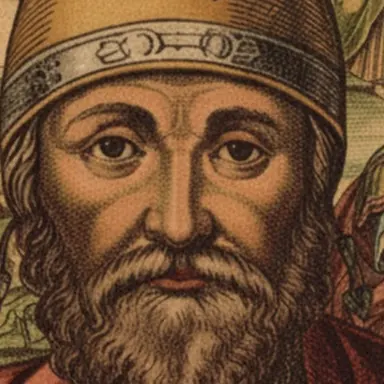
The Torah as a universal law of nature, and allegorical interpretation as a bridge between the commandments and wisdom.
Biography
A Hellenistic Jewish thinker who developed a systematic allegorical reading of Scripture and a synthesis with Greek philosophy; his influence flourished mainly among the Church Fathers.
Writings on Wikisource
Hebrew Wikisource, Wikipedia's free library, collects the texts of Philo of Alexandria on one author page.
The Work and Teaching of Philo of Alexandria: The Encounter of Jewish Thought and Hellenistic Philosophy
14 min read·2,897 words
Summary
This source surveys the life and the profound teaching of Philo of Alexandria, a Jewish thinker who lived in Roman Egypt and served as an intellectual bridge between the biblical tradition and Greek philosophy. The text details his innovative conceptions, foremost among them the doctrine of the Logos, which serves as a mediator between the transcendent God and the world, alongside his use of the method of allegorical interpretation to uncover philosophical truths in the narratives of the Torah. The author of the survey stresses that despite his broad Hellenistic education, Philo remained faithful to the observance of the practical commandments and acted as a political leader who defended the rights of his people. Finally, the source describes the transformations of his thought throughout history, from its influence on the Church Fathers and on Jewish Kabbalah to its reassessment in modern scholarship as the foundation of the philosophy of monotheistic religion.
The Historical and Cultural Background in Roman Alexandria
Philo of Alexandria, known in later Jewish tradition also as Yedidyah of Alexandria, was active in Roman Egypt in the first half of the first century CE, in a period of turbulent political changes and intense ethnic tensions in Alexandria.[1, 2] Although the years of his life cannot be fixed precisely, it is commonly assumed that he was born around 15–20 BCE and died between 45–50 CE.[1, 2] Alexandria of that time was a cultural and intellectual melting pot in which classical Greek philosophy, the Hellenistic religions and the biblical tradition met.[2, 3] Philo came from a wealthy and distinguished Jewish aristocratic family; his brother, Alexander the Alabarch, served as collector of customs on behalf of the Roman authorities and enjoyed high civic standing.[1, 2] Philo himself received a comprehensive Hellenistic education, which included a deep acquaintance with Greek literature, rhetoric and philosophy, and displayed a deep admiration for Plato, whom he called "the most holy Plato".[2, 3]
Philo's philosophical environment was shaped by Middle Platonism, which incorporated Stoic terminology and doctrines alongside elements of Aristotelian logic and ethics and Pythagorean ideas.[3, 4] This combination was much influenced by the activity of philosophers such as Antiochus of Ascalon and Eudorus of Alexandria.[3, 4] Alongside his broad general education, Philo studied and interpreted Scripture in the synagogues of Alexandria, which he described as "schools of virtue".[1] His public involvement reached its peak in 38 CE, following severe riots that broke out between the Greek and the Jewish populations of Alexandria.[2] The emperor Gaius Caligula sought to impose his personality cult, and the Greek mob exploited this to desecrate the synagogues and set up statues of the emperor in them.[2] The Jewish community, which firmly refused to recognize the emperor's divinity, chose Philo to head a diplomatic delegation to Rome to defend the religious and civil rights of the Jews, a mission that expressed his deep commitment to the defense of his people and of the laws of Moses.[1, 2]
✦
The Classification of Philo's Literary Work and the Modern Translation
Philo's many writings reflect a systematic attempt to show that the philosophical ideas of Greece are nothing but conclusions that follow from the verses of the Torah of Moses.[3, 5] His literary work underwent a distinct chronological development; his early works, foremost among them the Allegorical Commentary, were addressed mainly to an internal Jewish audience in Alexandria and engaged with Jewish colleagues who applied Homeric textual methods to Scripture.[4] At a later stage of his life, Philo adopted a distinctly Roman orientation and addressed a broad, non-Jewish audience through the series Exposition of the Law, with the aim of presenting Moses as the summit of universal philosophy.[3, 4]
In modern times, the Israel Academy of Sciences and Humanities, together with the Bialik Institute, published a monumental project translating all of Philo's writings into Hebrew in seven volumes.[6, 7] This project made Philo's thought accessible to the modern Hebrew reader through translations and notes by leading scholars.[6, 7]
✦
His Theological Teaching: Negative Theology, the Polemic against Atheism, and Cosmology
The central axis of Philonic thought revolves around the development of negative theology, a field in which Philo is considered one of the principal founders in the history of monotheistic faith.[1] Philo assumes that God is a simple and absolute unity, lying beyond every human definition, corporealization or description.[1] The essence of God remains unattainable for the human intellect; man is able to prove and know only the fact of God's existence and of His action in the world, but never His very essence.[1, 8, 9] To indicate the sublimity of God, Philo lays out three limited human ways: the absolute negation of corporeal attributes (viae negationis), the recognition that all good originates in God (eminentiae), and the use of profound metaphorical analogies such as the sun or kingship (analogiae).[1]
Alongside establishing the transcendence of God, Philo conducts a trenchant polemic against the atheism and pantheism of his time.[10] In his writings, the terms "atheist" (atheos) or "atheism" (atheotes) serve to describe a heretical opinion, moral impurity and corrupt rationalism, which Philo regards as "the greatest of all sins" and the source of all social wrongdoing.[10] In his work on the migration of Abraham he attacks both those who deny God and those who worship idols in their multiplicity: "He who worships no god is barren, and he who worships many deities is the son of a harlot".[10] In his work on the Ten Commandments he states categorically that atheism is the beginning of all wickedness.[10]
In the field of cosmology, Philo proposes a model of creation based on Plato's dialogue Timaeus, but rewrites it in the face of the competing schools.[2, 3, 4] In his work on the eternity of the world, Philo presents an innovative contribution to Platonism when he confronts the Aristotelian conception of the eternity of the world and, on the other hand, rejects the Stoic conception of the periodic cosmic destruction by fire (conflagration).[4] Against these views he insists on a literal interpretation of the Platonic creation myth, and states that the world was created by a free divine initiative, and that the laws of nature reflect the direct will of the Creator and not blind physical necessity.[1, 3, 4] Moses, Philo argues, preceded Plato in identifying the two fundamental principles of creation: the active cause (the divine intellect) and the passive cause (matter devoid of qualities and order).[3]
✦
The Doctrine of the Logos and the Powers of God as Connecting Links
To bridge the ontological gap between the transcendent and simple God and the material, manifold and changing world, Philo developed the doctrine of the Logos.[1, 9, 11] The Logos in his teaching is a mediating rational entity, defined as the active divine thinking, as the spiritual archetype of creation and as the instrument by means of which matter was shaped.[1, 9, 11] Philo calls the Logos by bold epithets such as "second God" (deuteros theos), "the firstborn son of God", "the rational part of the world soul" and "the cosmic high priest".[1, 9, 11] Unlike the supreme God, who is a simple unity, the Logos bears within it the principle of opposites and mediates the influence of the divine light upon matter.[1, 11]
Around the Logos Philo sketches an array of countless divine powers, called dunameis, which surround God and govern the world.[1, 11] At the head of this hierarchy stand two fundamental powers that correspond to the divine names in Scripture [1, 11]:
The creative and beneficent power (Creative Power): represented in Scripture by the name "God" (Theos), and from it flow creation and grace.[1, 11]
The sovereign and royal power (Sovereign/Regal Power): represented in Scripture by the name "the Lord" (Kyrios), and from it flow law, judgment and punishment.[1, 11]
The Logos acts as the "charioteer" who holds the reins of these powers and balances them.[11] This conception, which presents the Logos as the "heavenly man" or the "spiritual man" created in the original image of God (in contrast to the earthly man formed from the dust), served hundreds of years later as a profound conceptual foundation for the development of the notion of "Adam Kadmon" (Primordial Man) and the sefirot in the book of the Zohar and in Lurianic Kabbalah.[12]
✦
The Method of Allegorical Interpretation and the Enigma of Numbers
Allegorical interpretation is the methodological tool by means of which Philo uncovers the philosophical truths hidden in Scripture.[2, 3] Philo was influenced by the Hellenistic tradition of Theagenes of Rhegium, Anaxagoras and the Stoics, who interpreted the Homeric myths as parables for the forces of nature and the states of the soul.[3] He adopted this method and applied it to the Torah, making use of word etymologies and Pythagorean numerology to decipher the "sacred text".[1, 3, 13]
His work on the migration of Abraham (De Migratione Abrahami) demonstrates this method brilliantly in its interpretation of the biblical command "Go forth from your land, and from your birthplace, and from your father's house" (Genesis 12:1).[14, 15, 16] Philo interprets the geographical journey as a psychological and spiritual journey of the human intellect seeking to purify itself and draw near to absolute truth [16]:
The land: represents allegorically the physical body and its material fetters.[15, 16]
The birthplace: represents the five senses, which are bound to the material soul and divert it from the truth.[15, 16]
The father's house: represents the faculty of speech and outward language, which must be transcended in order to attain pure intellectual contemplation.[15, 16]
Within that same allegorical journey, the biblical figures acquire a distinctly psychological meaning [1, 16, 17]:
Lot: represents the soul's inclination and desire toward materiality and the world of the senses, from which one must separate in order to attain illumination.[16]
Sarah: symbolizes virtue and wisdom ruling in the soul ("the ruling one"), in keeping with the etymology of her name.[1]
Leah: represents the souls still bound to the earthly world, whose social esteem has only a preparatory value.[17]
Joseph: represents the life of action and politics; the fact that his bones remained in a coffin in Egypt symbolizes leaving the bodily drives and lusts behind as the soul goes out to freedom.[15, 16]
An integral part of the allegorical interpretation rests on the sanctity of numbers, which in Philo's eyes are cosmic codes expressing the harmonious structure of the universe.[3, 13]
✦
The Attitude to the Practical Commandments, Halakha and the Standing of the Synagogues
One of the central innovations in the modern study of Philo's thought, led by the scholar Valentin Nikiprowetzky (1977), is the emphasis on the uncompromising centrality of the law and the practical commandments in his teaching.[1] Philo did not see philosophy as an independent goal, but as a handmaid for understanding divine revelation and for uncovering the depth of the commandments written in the Torah.[1] He studied and interpreted Scripture in the synagogues of Alexandria, which he called "schools of virtue", and regarded them as the pillars of the community's education and moral responsibility.[1]
In his work on the migration of Abraham (chapters 89–93), Philo launches a sharp attack against a group of extreme allegorists in his community, who argued that since the practical commandments are only symbols of spiritual truths, there is no longer any need to observe them in practice.[14, 17, 18] Philo condemns this approach as irresponsible negligence and argues that these people behave as though they were bodiless souls living in the wilderness, ignoring the laws of society and of the community.[14, 18] To explain the obligation to keep the commandments, Philo presents the metaphor of body and soul [14, 17]:
"But it is fitting to regard these things [the practical laws] as the visible body, and the others [the symbolic meanings] as the soul. Therefore, just as one must take care of the body, which is the dwelling of the soul, so we must be diligent in keeping the laws in their literal sense. For by keeping these laws, the other [spiritual] matters become clearer".[14]
He illustrates this through the commandment of circumcision: circumcision symbolizes spiritually the removal of animal pleasures from the soul and the breaking of the intellectual pride that imagines that man creates by his own power; despite this sublime meaning, it is absolutely forbidden to abolish the physical commandment in the body.[3, 18] Philo explains that the Logos indeed directs most of the people to keep the commandments in their physical, literal sense, while only a few select individuals rise to an understanding of the abstract truth alone, but they too are obliged to fulfill the practical commandments in practice, in order to avoid condemnation and accusations on the part of the multitude.[14]
✦
The Transformations of His Teaching: From the Church Fathers, through the Book of the Zohar, to Azariah de' Rossi and Wolfson
The historiography of Philo's thought presents a dramatic course of rejection, preservation and rediscovery.[2, 7, 8] Whereas the rabbinic tradition excluded Philo's writings because they were written in Greek and were remote from the Babylonian and Land of Israel centers, it was the Fathers of the early Christian Church who found great interest in his teaching and preserved his writings.[2, 7, 8] Christian theologians such as Clement of Alexandria (who called Philo "the Pythagorean"), Origen, Justin Martyr and Saint Jerome (who placed Philo in the list of the Church Fathers) used his Logos theology to establish early Christian doctrine.[3, 8]
In the Middle Ages a sharp philosophical opposition arose between the thought of the Church Fathers, whose roots lay in Philo and which was based on knowledge of God given to man through revelation, and the conception of Plotinus concerning the necessary emanation of the world from the impersonal God, which based thought on pure human intellect independent of revelation.[8] At the same time, Philo's ideas seeped indirectly and mysteriously into the world of Jewish mysticism; deep resemblances can be drawn between his doctrine of the Logos and the "heavenly man" and the sefirotic structure of "Adam Kadmon" in the book of the Zohar and in Lurianic Kabbalah.[12, 19, 20]
The official return of Philo to Jewish thought took place only in 1574, with the publication of the book Me'or Einayim by the Jewish-Italian sage Azariah min ha-Adumim (de' Rossi).[21, 22] Azariah was the first Jewish sage in the modern era to make declared use of Philo's writings (whom he called "Yedidyah") for the purpose of writing critical Jewish history.[21, 23] The reintroduction of Philo into the Jewish corpus, together with Azariah's doubts about the historical accuracy of the midrashim of the Sages, aroused an enormous public storm and led to the imposition of a rabbinic ban on the book in Italy and in the other Jewish communities.[23, 24]
In the 20th century, Philo won unprecedented scholarly appreciation thanks to the work of Harry Austryn Wolfson of Harvard.[25, 26] In his monumental book of 1947, Wolfson argued that Philo was not merely a Hellenistic eclectic but the true founder of the philosophy of monotheistic religion.[5, 25] According to this thesis, the intellectual structure that Philo developed, which places philosophy as a handmaid under the authority of divine revelation, defined and unified Jewish, Christian and Muslim thought for seventeen hundred years, until it was dismantled in the 17th century by Spinoza.[5, 27] Philo's teaching thus remains a rare historical testimony to a fruitful and bold encounter between ancestral tradition and the breadth of mind of universal philosophy.[3, 7]
Key Insights: Philo of Alexandria, His Thought and His Influence
30 min read·6,008 words
Executive Summary
Philo of Alexandria (who lived from about 20 BCE to 50 CE) was the most important and influential Jewish-Hellenistic thinker of the Second Temple period, and a key figure in the encounter between Jewish culture and Greek philosophy. Philo, who lived and worked in Alexandria in a period of intense ethnic and political tensions, sought to prove that the Torah is the supreme and perfect philosophy, and that Moses our teacher is the greatest of the philosophers. To this end he developed and systematically applied the method of allegorical interpretation, through which he sought to uncover the profound philosophical truths hidden, in his view, behind the plain meaning of the Holy Scriptures (in the Septuagint translation).
At the center of his philosophical teaching stands a conception of a transcendent and unattainable God, who acts in the world by means of mediating entities. The central and supreme mediator is the Logos (the "Word" or the "Utterance"), which is described in a variety of ways: the mind of God, His image, His firstborn son, the instrument by means of which the world was created, and the Platonic world of Ideas. Below the Logos act two principal divine powers: the power of grace and creation and the power of rule and judgment. Philo combined eclectically elements of Platonic philosophy (chiefly the theory of Ideas and the duality of body and soul), Stoic philosophy (the doctrine of the Logos, natural law and ethics) and Pythagorean philosophy, but he always subordinated them to the supreme authority of the Torah.
Philo's public life reached its peak when he headed the delegation of the Jews of Alexandria to the emperor Gaius Caligula in Rome, after the violent pogrom that broke out in the city in 38 CE. Despite his extensive literary work and his influence in his own time, Philo's thought was pushed aside and forgotten in rabbinic Judaism, chiefly because of the decline of Alexandrian Jewry, his lack of acquaintance with Hebrew, and the adoption of his doctrine of the Logos by nascent Christianity. By contrast, his writings were zealously preserved by the Church Fathers, and they deeply influenced early Christian theology (especially the Gospel according to John) as well as the Neoplatonic current in later Greek philosophy.
1. Philo of Alexandria: Life and Times
1.1 Historical and Cultural Background: Judaism in the Heart of Hellenism
Philo lived and worked in a period of ferment and intercultural tensions in Alexandria, which was the center of Hellenistic culture in the ancient world. The city, founded by Alexander the Great, became under the rule of the Ptolemaic dynasty a stronghold of spiritual creativity, and housed the Museum and the celebrated Great Library. Within this melting pot there existed a large, wealthy and influential Jewish community, which had migrated to Egypt from the Land of Israel and from other places.
The Jews of Alexandria adopted to a great extent Greek culture and its language, a process that found its most distinct expression in the creation of the Septuagint, the translation of the Torah into Greek in the third century BCE. This enterprise, around which a legend of divine inspiration developed, not only made the Holy Scriptures accessible to the Greek world, but also sanctified in the eyes of the Hellenistic Jews the Greek language itself, and paved the way for integrating Greek philosophical ideas into the framework of Jewish thought.
Nevertheless, Philo's period was marked by a deterioration in relations between the communities. The moderation that had characterized Ptolemaic rule gave way to a more suspicious Roman rule, and tensions between Jews and Greeks on economic, political and religious grounds rose. Greek-Egyptian intellectuals such as Apion spread anti-Jewish libels, which accused the Jews of hatred of mankind (misanthropy) and of barbaric laws. These tensions reached a violent peak in the riots of 38 CE, the first great pogrom in Jewish history, which included murder, torture, plunder and humiliations, and the establishment of a de facto ghetto. Philo was not, then, a scholar detached from reality, but a thinker who worked in the heart of a hostile and turbulent environment.
1.2 Personal Biography and a Dual Education
Philo's exact dates of birth are not known, but it is agreed that he lived from the end of the first century BCE to the middle of the first century CE. He was born into one of the wealthiest and most respected Jewish aristocratic families in Alexandria. His brother, Alexander Lysimachus, held the high office of alabarch (chief tax collector), maintained close ties with the imperial court in Rome, and gave financial support to Agrippa I on his way to the throne. Philo's nephew, Tiberius Julius Alexander, became one of the most famous apostates in Jewish history: he turned his back on the religion of his fathers, rose to greatness in the service of the Romans, and even served as a senior commander in the army of Titus during the siege of Jerusalem.
In this environment, Philo received a dual and excellent education:
Greek education (Paideia): he was well versed in rhetoric, in classical literature (especially Homer) and in all the liberal arts. He studied the various philosophical systems, Platonism, Stoicism, Aristotelianism and Pythagoreanism, which formed his natural intellectual environment.
Jewish education: his Jewish education was based entirely on the Septuagint. There is no evidence that he knew Hebrew, and he even made gross errors stemming from unfamiliarity with the original. Nevertheless, he regarded the Greek translation as a sacred text equal in value to the original, written under the inspiration of the holy spirit. He was well versed in the Jewish-Hellenistic interpretive tradition that preceded him, in the halakha that developed in Alexandria (which sometimes differed from that of the Land of Israel), and in popular legends.
Philo describes himself as one who aspired to a life of contemplation and tranquility, but was pushed against his will "into a sea of civic cares" because of the grave events. He visited Jerusalem at least once to pray and to offer sacrifices in the Temple, and regarded the holy city as the "metropolis" (mother city) of all the communities of Israel in the Diaspora. It seems that he never married and lived a life of abstinence and study, in keeping with ascetic ideals that were widespread in certain circles of the Judaism of the period.
1.3 Public Life: The Delegation to Gaius Caligula
The formative event in Philo's public life was the delegation to Rome in 40 CE. After the pogrom of 38, which took place under the patronage of the Roman prefect Flaccus, the Jewish community sent a delegation to the emperor Gaius Caligula to complain about the violation of their rights and to ask for his protection. At the same time, their Greek adversaries, headed by the philologist and demagogue Apion, sent a counter-delegation.
Philo, who was by then an elderly and respected man, was chosen to head the Jewish delegation. The situation was especially complicated because of the megalomania of Caligula, who demanded to be worshipped as a god. The Jews, who were the only people in the empire who firmly refused to grant him divine honors, were regarded as rebels against the kingdom. In his work "The Embassy to Gaius", Philo describes the humiliating meeting with the emperor, who ran between the wings of his palace, joked at their expense and asked them mockingly why they did not eat pork, while ignoring their arguments. The emperor dismissed them, saying that they were "more to be pitied than to be rebuked" for their refusal to recognize his divinity. In the end the delegation failed, and only the assassination of Caligula shortly afterwards prevented the decree that he intended to issue: the setting up of his statue in the Temple in Jerusalem.
2. Philo's Literary Work
Philo's writings do not form an organized corpus, and some of them have been lost. Paradoxically, they were preserved almost in their entirety by the Christian Church, which transferred them to the theological center in Caesarea, while rabbinic Judaism ignored them. His works can be divided into five main categories:
3. The Interpretive Method: Allegory
The central tool by means of which Philo sought to bridge the Jewish tradition and Greek philosophy was allegorical interpretation (allegoresis). This method, which had precedents in Greek interpretation of the myths of Homer and Hesiod as well as among Jewish-Hellenistic thinkers who preceded him (such as Aristobulus), became in Philo's hands a comprehensive and systematic interpretive system.
3.1 The Principles of the Method
The aim of allegory was to uncover the "spirit" (dianoia), or the deep philosophical meaning hidden beneath the "body" (lexis) of the text, that is, its literal meaning. Philo laid down rules for when an allegorical meaning should be sought:
When the plain meaning contains descriptions unbefitting God: anthropomorphic descriptions (corporealization of God) or anthropopathic ones (attributing human emotions to God), for example "And the Lord came down" or "And it grieved Him at His heart".
When the biblical story seems improbable or mythological: for example, the story of the creation of Eve from Adam's rib.
When there are internal contradictions in the text: for example, the two different accounts of the creation of man in the book of Genesis.
When details in the text seem marginal or unimportant: changes of names, geographical details and the like.
In these cases, Philo argued, the text itself says "interpret me", and invites the interpreter to seek a hidden meaning. For example, Abraham, Isaac and Jacob are not only historical figures but also symbols of three ways of attaining virtue: through learning (Abraham), natural talent (Isaac), and practice and effort (Jacob).
3.2 The Attitude to the Plain Meaning of Scripture
Although he preferred the allegorical layer, Philo firmly opposed the wholesale abolition of the practical commandments. He sharply condemned those who learned from him and claimed that only the spiritual meaning of the laws should be kept and their practical observance abandoned. In his work "On the Migration of Abraham" he writes:
"There are some who, regarding the written laws as symbols of intellectual matters, are very scrupulous about the latter but lightly neglect the former... They ought to have paid attention to both aims together: to a more precise investigation of what is hidden, and to the blameless observance of what is revealed".
Accordingly, Philo presented a two-layered approach: the commandments must be carefully kept in their plain sense (circumcision, the Sabbath, kashrut), and at the same time their deep philosophical and moral meaning, which allegory reveals, must be understood.
4. The Principles of His Philosophical Thought
4.1 The Doctrine of God and the Divine Powers
At the center of Philo's metaphysics stands an utterly transcendent God, who is beyond every human definition, thought or conception. No positive attributes can be ascribed to Him (negative theology), since every attribute limits His infinity. He is "better than the good" and "above unity". Therefore God in Himself does not come into direct contact with the material and limited world.
The connection between the transcendent God and the world is maintained by means of divine powers (dunameis). Philo distinguishes between two principal powers, identified with the names of God in the Septuagint:
The creative and beneficent power (the power of grace): identified with the name "God" (theos). This is the power responsible for creation and for the abundance of good in the world.
The royal and ruling power (the power of judgment): identified with the name "Lord" (kyrios). This is the power that expresses God's rule, authority and laws.
The powers allow Philo to preserve God's unity and remoteness, and at the same time to explain His continual action in the world.
4.2 The Doctrine of the Logos
The central, most complex and most influential concept in Philo's thought is the Logos (in Greek: word, speech, reason, rationality). The Logos is the supreme mediator between the transcendent God and the world. Philo describes it through a wide range of images and functions, which form a synthesis of ideas from Greek philosophy and from Scripture:
The metaphysical aspect: the Logos is the mind of God, the image of God, and the instrument by means of which the world was created. It is the "world of Ideas" (kosmos noetos), the place where the Platonic forms reside, according to which the physical world was shaped.
The cosmological aspect: the Logos is the force that holds the universe together, the "glue" that maintains cosmic harmony. It "cuts" and separates opposing elements and at the same time unites them.
The theological-religious aspect: the Logos is described in a human image: the firstborn son of God, the high priest who ministers in the sanctuary and atones for the sins of man, the advocate who pleads in defense of humanity, and the chief of the angels.
The epistemological aspect: man cannot attain God Himself, but only the Logos, which is His perceptible embodiment. Man was created "according to the image" (that is, in the image of the Logos), and not directly "in the image" of God.
Philo's doctrine of the Logos differs essentially from the Stoic conception of the Logos, which was pantheistic and identified the Logos with nature and with God Himself. In Philo, the Logos is an entity separate from God (though emanating from Him) and from the world, and thus he preserves the transcendence of the biblical God.
4.3 The Creation of the World and Natural Law
Under the influence of Plato's "Timaeus", Philo did not believe in creation out of nothing (ex nihilo). In his view, God, as a demiurge (artisan-creator), shaped the world out of a primordial matter, without form or quality. The process of creation was two-staged: first God created the "intelligible world" (the Ideas, the Logos), and only afterwards formed the sensible world as a reflection and copy of this ideal world.
Philo saw in the Torah of Moses the perfect expression of the universal law of nature, which is "the right reason of nature". Whereas the Stoic law is an abstract principle, the Torah of Moses is its concrete, eternal and perfect embodiment. The patriarchs, Abraham, Isaac and Jacob, who lived before the giving of the Torah, were perceived by him as the living embodiment of the law of nature, "living laws that are unwritten" (agraphoi nomoi).
4.4 The Doctrine of the Soul and Ethics
Philo's doctrine of the soul is based on a sharp Platonic dualism, which stresses the contrast between the spiritual and pure soul and the material body, which is a "prison" and a "tomb" for the soul. The senses and the bodily lusts draw the soul downward and distance it from its purpose.
The purpose of human life is to free oneself from the fetters of the body and the senses and to become like God as far as possible (homoiôsis theô). This Platonic ideal replaces, in Philo, the Stoic ideal of "living in accordance with nature" (oikeiôsis), which he regarded as too naturalistic. The way to attain this goal is through faith, asceticism (the eradication of the drives and lusts, and not merely their moderation), and devotion to a life of study and philosophical contemplation, which lead in the end to a mystical experience of cleaving to God.
5. His Attitude to the Philosophical Schools
Philo did not belong to a single philosophical school, but was an eclectic thinker who used philosophy as a handmaid for interpreting the Torah, which he regarded as the supreme source of truth.
Platonism (and chiefly Middle Platonism): this is the strongest and deepest influence on his thought. From it he borrowed the theory of Ideas (which he identified with the thoughts of God or the Logos), the dualism of body and soul, the conception of the transcendent God, and the ethical ideal of becoming like God.
Stoicism: Philo adopted large parts of Stoic terminology and ideas, especially in the fields of cosmology (the Logos, natural law) and ethics (virtue, the rule of reason). Nevertheless, he rejected its metaphysical foundations, pantheism and materialism, and adapted the Stoic concepts to his conception of the transcendent God.
Aristotelianism: Aristotle's influence was limited. Philo rejected his doctrine of the eternity of the world and of the "three kinds of goods" (which include also external and bodily goods), but at times adopted the idea of the "golden mean" (mesotes) in ethics.
Epicureanism: Philo saw this school as the bitter enemy of religion, and firmly rejected its doctrine of gods who do not intervene in the world, its denial of providence and its hedonistic ethics.
6. Philo's Legacy and Influence
6.1 Oblivion in the Jewish World
Despite his greatness, Philo's influence on rabbinic Judaism was negligible, and he was almost entirely forgotten for hundreds of years. Several reasons can be given for this:
The political and cultural decline of Alexandrian Jewry after the revolts against the Romans in the first and second centuries.
The shift to the centers in the Land of Israel and in Babylonia, where an interpretation developed that was based on the Hebrew original and on midrashic methods different from philosophical allegory.
The use that Christianity made of his thought, and especially of the doctrine of the Logos, made him suspect in the eyes of the sages of Israel.
His lack of acquaintance with Hebrew and his exclusive reliance on the Septuagint distanced him from the mainstream of Jewish interpretation.
6.2 Preservation and Influence in the Christian World
In complete contrast to his fate in Judaism, Philo became one of the pillars of early Christian theology. The Church Fathers of Alexandria, such as Clement and Origen, saw him as a guide, adopted his method of allegorical interpretation in order to interpret the "Old Testament", and used his thought to bridge Christian faith and Greek philosophy. His doctrine of the Logos formed a decisive conceptual foundation for the development of Christology, and especially for the conception of Jesus as the divine "Word" made flesh, as it appears at the opening of the Gospel according to John. It was the Church that preserved his writings and handed them down to later generations.
6.3 Influence on Later Philosophy
Philo's thought also had an influence on the Neoplatonic current. The philosopher Numenius (2nd century CE) coined the famous saying "What is Plato, if not Moses speaking Attic Greek?". There are clear parallels between Philo's thought and that of Plotinus (3rd century CE), the father of Neoplatonism, especially in the conception of the transcendent One, the intellect (the nous) as a mediating entity, and the description of the mystical experience. In this way Philo served as an important bridge for the transmission of religious-monotheistic ideas into later Greek philosophy.
Philo of Alexandria and the Allegorical Revolution: A Research Synthesis of the Interpretive Pattern and the Configurations of Identity
1. Introduction: Alexandria as a Cultural Laboratory and Historical Context
Alexandria of the first century CE was not merely a flourishing port city but a strategic "cultural laboratory" in which the paradigm of the intellectual encounter between Judaism and Hellenism was shaped. At the heart of the city stood the Museum (Museion), an institute for advanced research for philologists and scientists, and the Great Library, which concentrated the human knowledge accumulated until then. This Hellenistic space allowed the growth of a Diaspora Jewry with unprecedented self-confidence. Philo estimates the community at a million souls, and its complex political standing was reflected in the activity of Philo himself as head of the delegation to the emperor Caligula (Gaius), a bold attempt to stop the desecration of the synagogues and the emperor's demand that his statue be set up in the Holy of Holies.
The necessary foundation of Philo's enterprise was the Translation of the Seventy (Septuagint). In Philo's eyes this translation was not merely a functional aid, but an act of "sanctifying" the Greek language. For him the Greek text held ontological primacy; it was a divine source of direct inspiration, equal in rank to the Hebrew original. Clear evidence of the cultural sensitivity of the Alexandrian Diaspora is found in the translation of the verse "You shall not revile God" (Exodus 22), which was translated as a prohibition against cursing "gods" (theoi). As Philo noted in his interpretation, this step was meant to prevent Jews from hurling blasphemies at the gods of their surroundings, and thereby to prevent a backlash of desecration of God's name on the lips of the gentiles. This language became a cultural shield allowing synthesis and not merely survival. The transition from loyalty to ancestral tradition to the use of Hellenistic tools created the foundation for a method of interpretation that turned the Torah from a national text into a universal philosophical system.
2. A Many-Sided Identity: Philo as Philosopher, Mystic and Interpreter
Defining Philo's identity is the hermeneutical key to understanding all his writings. Philo worked within a constant tension between being a Jewish aristocrat of the family of the alabarch, a family with close ties to the Herodian dynasty and to the Julio-Claudian dynasty in Rome, and being a Platonist philosopher. His worldview rested on "the plagiarism of the Greeks from Moses" (The Plagiarism of the Greeks): the apologetic claim that Moses our teacher was "the summit of philosophy" and the original source from which Pythagoras, Plato and the Stoics drew their doctrines.
A Comparative Academic Analysis of Philo's Identity
The Philonic synthesis merged the Platonic theory of Ideas with Stoic ethics, out of a conception that the sensible world is a reflection of a spiritual world. This complex identity, rooted in the Academy and in the synagogue alike, allowed him to see in Moses the perfect model of philosophical leadership and served as a necessary bridge to the establishment of the allegorical pattern.
3. "The Philonic Pattern": A Paradigm Shift from Literalism to Symbolism
In the study by Onitza Bordetz (following the conception of Thomas Kuhn), Philo's work is defined as a hermeneutical paradigm shift: the creation of a new "pattern" for the interpretation of Scripture. This pattern is not an abolition of the past but a reorganization of religious reality.
The components of "the Philonic pattern":
Ontological synthesis: combining Hellenistic techniques of allegory (which had served to interpret Homer and Hesiod) with profound Jewish symbols.
Hybrid methodology: the use of structures of questions and answers (midrash-like) in order to pour philosophical content into familiar rabbinic molds.
Divine inspiration for the translation: reliance on the Septuagint text as a sacred text of philological precision equal to the original.
Transition from the concrete to the abstract: a hermeneutical transformation of historical events into qualities of the soul and metaphysical truths.
Philo's interpretive dynamic parallels the relation between the body and the soul. He stressed that stripping the practical commandments (such as circumcision and the Sabbath) down to their allegorical reason alone is a dangerous error. For him, while "the soul" (the meaning) is the higher layer, "the body" (the practical act) is the necessary condition for existence in the material world. Allegory does not dissolve the law, but gives it a cosmic meaning that turns the Torah into a universal philosophical system comprehensible to every educated person.
4. Applications of the Method: Allegorical Interpretation of the Creation of the World and of the Patriarchs
For Philo, the stories of the beginning are the foundation of his metaphysics, which detaches Scripture from its local context and turns it into a living map of the soul and the universe.
Analysis of case studies:
The Binding of Isaac: Philo identifies in the name of Isaac the Gelos (laughter/joy). Whereas the literal interpretation sees here an emotional test of faith, Philo proposes an ontological reading: Isaac symbolizes the pure joy that belongs to God alone. God is Apathēs (immune to passions and emotions - Apatheia), and therefore the joy of Isaac is a state of ontological perfection and not a human "excitement" (Passion). Abraham, in dedicating Isaac, recognizes that perfect joy is not the lot of mortals who live in anxiety.
The creation of the world: Philo argues that belief in creation in 6 chronological days is "a sign of great simplicity". The number 6 was chosen as a "perfect number" (1+2+3) representing the order of creation for "mortal beings", whereas the number 7 represents "blessed and immortal beings". This is a combination of Pythagorean numerology with biblical ontology.
Moses as prophet-oracle: Bordetz describes Moses as a figure acting in a three-stage pattern: an emotional reaction, divine possession, a state of ecstatic inspiration similar to the priestly Greek oracles (as described in Sophocles or Virgil), and finally the utterance of the prophecy. This description turns Moses into a Hellenistic Theios Aner (divine man).
5. The Logos and the Bridge to Christian Hermeneutics
The concept of the Logos is the metaphysical link connecting the abstract and infinite God with the material world. For Philo, the Logos is the "firstborn son" of God, a kind of second god (Deuteros Theos) or a Hypostasis (hypostatization) of a divine power that mediates creation.
An assessment of cross-religious influence: the Philonic Logos served as a foundation for Christian theology, from the prologue of the Gospel according to John to the thought of Church Fathers such as Clement and Origen. Nevertheless, a sharp distinction must be drawn: whereas in Philo the Logos is a mediating entity between God and the world, later Christianity developed the conception of the Trinity, in which the Logos (the Son) is consubstantial, equal in essence to the Father.
Allegory versus Parable (Mashal)
The rabbinic tradition cast Philo out to the margins because of the Christian adoption of his writings and the fear that allegory would lead to the abolition of the commandments. His figure was preserved only in the libraries of the monasteries, until its late return.
6. Summary: The Legacy of "the Outcast" and the Return to the Jewish Bookshelf
The figure of Philo disappeared from the Jewish horizon for more than a thousand years, until Azariah de' Rossi (in the period of the Italian Renaissance) "converted" him anew under the name "Yedidyah of Alexandria". Azariah tried to bring Philo back into the fold of Judaism, while grappling with the tension between Philo as a "Hellenizer" and the recognition of him as the first Jewish interpreter of Scripture.
Today Philo is perceived not only as a historical figure but as an essential tool for broadening the "space of possibilities" of Jewish thought. He was the first practitioner of a theology of synthesis (Synthesis Theology), which teaches that it is possible to conduct a deep dialogue with the most influential cultures without losing the religious core. His interpretive pattern, which discerns a harmony between the Torah, the laws of nature and reason, continues to resonate in Western hermeneutics and invites us to see in the Holy Scriptures an eternal map of the human soul.
Echoes of Alexandria: An Analytical Synthesis of the Laws of the Torah and Hellenistic Philosophy in the Writings of Philo
1. Introduction: Alexandria as an Intellectual Center and the Historical Context of Philo
Alexandria of the first century CE was not merely a bustling port city but an "institute for advanced research" (Museon) in which the finest philologists, scientists and philosophers of the ancient world were concentrated. The royal library, with its half a million volumes, served as a melting pot in which Jewish thought met Greek philosophy. In the heart of this metropolis lived an enormous Jewish community, whose size Philo estimated (together with all the Jews of Egypt) at about a million souls. The demographic and economic strength of the community made it a strategic axis in the Hellenistic East.
Philo himself grew up within the Jewish-Roman elite. His family, the family of the "alabarch" (chief customs collector), was close to the Julio-Claudian dynasty and to the House of Herod. Despite his aristocratic status, Philo did not shirk his national duty; in 40 CE he headed the Jewish delegation to the emperor Caligula, a bold political struggle meant to prevent the desecration of the synagogues and of the Temple. The spiritual foundation of his activity rested on the Translation of the Seventy (the Septuagint), an enterprise that brought about a "sanctification" of the Greek language and made it a legitimate means of expression for the values of the Torah. The transition from the Ineffable Name to the epithet "Kyrios", and from the concept of "image" (tzelem) to the Platonic "eikon", allowed Philo to present Judaism not merely as an ethnic religion but as a sublime universal philosophy. This historical understanding of the role of Alexandria is necessary in order to grasp the unique interpretive methodology that Philo developed.
2. The Allegorical Methodology: From the Plain Meaning to the Platonic Idea
For Philo, the transition from a literal reading (peshat) to allegorical interpretation was a strategic necessity of the first order. In a world in which Greek critics of Scripture mocked the stories of the Torah as crude "myths", allegory allowed him to defend the text and to turn a "parochial" (local-national) text into a philosophical masterpiece of universal human relevance. At the basis of his method stands Platonic dualism: the concrete and literal layer is intended for the masses, who need corporeal images for the sake of moral discipline, whereas the abstract explanation is reserved for the educated who are capable of grasping the sublime Ideas.
Modern studies, like the work of Onitza Bordetz, identify in his interpretation a "pattern" that defines Moses our teacher as a paradigmatic figure who undergoes a three-stage prophetic process: an emotional reaction, divine possession, and finally the utterance of words of prophecy. This conception makes the Torah the "form of forms" of human morality. The "so what" of Philonic allegory is clear: it does not abolish the plain meaning, but gives it a metaphysical dimension, and thereby gives Judaism "intellectual respectability" in the eyes of the Hellenistic intelligentsia. This methodology does not remain on the theoretical level alone, but reshapes the architecture of the laws of the Torah.
3. The Architecture of the Law: The Ten Commandments as "Headings" (Titles) for All the Commandments
Philo took an original structural step in his work "On the Special Laws" (De Specialibus Legibus), when he built all the 613 commandments around the Ten Commandments. In his view, the Ten Commandments are not merely laws but universal "headings" (Kephalai), or chapter heads, from which the entire biblical legal system branches out. The tenth commandment, for example, serves as the heading for all the laws dealing with the restraint of desires. Philo saw in the number 10 a "perfect number" representing the cosmic order, and thereby connected the divine legislation with the structure of reality.
When his relation to the tradition of the Sages is examined, Philo emerges as a complex figure of the Diaspora Judaism of the Second Temple period:
The counting of the Omer: Philo agrees with the tradition of the Pharisees (and contrary to the Sadducees/Boethusians) in holding that the counting begins on the day after the first festival day of Passover.
An eye for an eye: here Philo inclines to a literal interpretation reminiscent of the Greek concept of "absolute justice", contrary to the monetary interpretation of the Sages.
The laws of murder: he extends the concept of murder to every "conspiracy" to kill, with an emphasis on the intellectual and moral intention. Philo's legal approach is not merely technical; it is meant to lead man to the attainment of the virtues and to harmony with the "Logos".
4. Ethics and Virtues: Harmony between the Torah and Stoicism
Philo's most impressive synthesis lies in the identification of the Torah with "right reason" (Orthos Logos), the Stoic concept expressing the eternal reason that governs nature. Philo presents the observance of the commandments as the realization of the four virtues (Aretê): wisdom (Phronesis), moderation (Sophrosyne), courage (Andreia) and justice (Dikaiosyne). For him the Torah is itself the law of nature, and obedience to it is the ultimate exercise of the soul's mastery over the body and the drives.
In describing the Binding of Isaac, Philo sharpens the difference between the sacrifice of children in the Greek tragedies (such as Agamemnon and Iphigenia) and the act of Abraham. Whereas the heroes of Greece acted for political gain or glory, Abraham acts in absolute "solitude" and in pure faith. Isaac (from the word for laughter) symbolizes joy (Chara), but Philo stresses that pure joy belongs to God alone, who is characterized by Apatheia (being free of emotional changes and tragedies). Abraham "sacrifices" joy to God, and thereby recognizes that only God is "Tragedy-free" and perfect. The attainment of this moral harmony finds its refined expression in the institution of the Sabbath.
5. The Sabbath and the Number Seven: A Synthesis of Pythagorean Arithmology and Tradition
The Sabbath in Philo's writings is the bridge between Jewish nationhood and the philosophical ideal of "order" and "rest". Against the Hellenistic criticism that saw in the Sabbath an expression of "laziness", Philo presents it as a day of philosophical contemplation and harmony with the cosmic order. He uses Pythagorean arithmology to explain the structure of creation:
The number 6: a "productive" number representing the physical world, movement in the six directions and mortal creatures.
The number 7: a "perfect number" representing the unchanging world, perfection and the divine essence. God's cessation on the seventh day is not rest from weariness, but the establishment of "order" within reality. The Sabbath is an invitation to man to disconnect from matter (the number 6) and connect with intellectual eternity (the number 7). This conception of the Sabbath as an expression of cosmic order leads necessarily to the investigation of the force that organizes the world: the Logos.
6. The Metaphysics of the Logos: The Bridge between the Abstract God and the World
Philo's great metaphysical challenge was to bridge the Platonic God, simple, absolute and free of all emotion (Apatheia), and the changing physical world. The solution lies in the "Logos". The Logos in his writings is "the firstborn of God" and "the form of forms", serving as the "instrumental cause" in the creation of the world. It is the instrument through which the abstract God acts within reality without intervening in matter directly.
A key concept in his interpretation is the "dividing Logos" (Logos Tomeus), the force that distinguishes and divides between the various elements in nature. Unlike the literal biblical God, who is described as "repenting" or "suffering", Philo's God is "Tragedy-free"; all the emotional descriptions in Scripture are attributed to the Logos or are symbols of abstract ideas. The Logos is the bridge that allows man to know the reality of God, even if His essence remains beyond understanding. This bold synthesis left a deep impression on history, but also sealed the fate of his writings in the Jewish tradition.
7. Summary: Philo's Legacy, between Christian Adoption and Jewish Rejection
The paradox of the preservation of Philo's writings is one of the most fascinating dramas in the history of thought. Whereas the Sages pushed his writings into the "archive of history", the Church Fathers (such as Clement and Origen) embraced them warmly. The reason for this was the Christian use of Philonic allegory to empty the commandments of their practical content (for example, turning circumcision into a mere allegory), a step that Philo himself firmly opposed. This conceptual resemblance led the rabbis to throw his writings onto the "scrap heap" of the external literature.
Only in the 16th century, in a process of "gathering in the outcasts", did Azariah de' Rossi raise Philo from oblivion and call him by the name "Yedidyah" (the Hebrew translation of his Greek name). Philo is recognized today as the first Jewish interpreter of Scripture in history, the man who achieved the splendid synthesis between Jerusalem and Alexandria. His decisive contribution was the transformation of Judaism from a "territorial nation" into a "nation of an idea and a way of life" (Nation of the Idea), an entity capable of speaking the language of universal philosophy while strictly preserving its unique identity and the laws of its fathers.