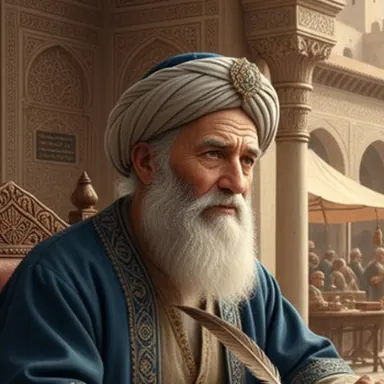
A distinction between the duties of the limbs and the duties of the heart: the deed matters – but intention and inner responsibility are the core of religious service.
Biography
The author of "Duties of the Heart" identifies a spiritual crisis: a religion of outward deeds without intention. He offers an orderly method of the service of the heart – faith, love, awe, trust and inner awareness.
Writings on Sefaria
The writings of Bachya ibn Pekudah can be read on Sefaria, a free library of Jewish texts. A title opens the text itself.
Content from Sefaria (sefaria.org) and Wikimedia projects, non-profit projects.
The Road to Sinai
The archive doesn’t yet record an unbroken road from Rabbenu Bachya ibn Paquda to the chain of transmission: the trail reaches back to Philo of Alexandria and stops there.
The Work, Thought and Torah Teaching of Rabbenu Bachya ibn Paquda: A Comprehensive Philosophical, Psychological and Historical Analysis
19 min read·3,897 words
Summary
This source surveys the life and teaching of Rabbenu Bachya ibn Paquda, a Jewish judge (dayan) and philosopher who was active in Muslim Spain in the 11th century, and emphasizes his unique contribution to establishing the wisdom of conscience in Judaism. His foundational work, "Chovot ha-Levavot" ("Duties of the Hearts"), was written to fill a gap in the practical halakhic literature by focusing on the intention of the heart and on the intellectual and emotional commandments incumbent upon the soul of the believer. The book is structured as a spiritual ladder of ten gates, guiding a person from the clarification of God's unity, through the development of the trait of trust, to the attainment of the highest level, the love of God. The text analyzes the influence of general philosophy and of the Sufi current on his thought, presents the theological polemic surrounding the investigation of faith, and discusses the tension between practical effort and total reliance on divine providence.
The Historical, Biographical and Social Background of the Author of Chovot ha-Levavot
Rabbi Bachya ben Yosef ibn Paquda (also known as "Ibn Bakuda"), called in the Jewish tradition "Rabbenu Bachya the Pious," was active in the second half of the 11th century and the early 12th century in the region of al-Andalus (Muslim Spain).[1] He was born around the year 4810 (1050) and died around the year 4880 (1120) in the city of Saragossa, which was at that time under the rule of the Muslim emirate of Saragossa.[1] This geographical and cultural environment, in the very midst of the Golden Age of Spanish Jewry, enabled him to be exposed in depth to the sciences, to general philosophy and to the rich Arabic literary creation.[1, 2] Rabbenu Bachya served as a dayan in his community in Saragossa, a position that gave him a realistic and profound psychological understanding of the human soul and its daily struggles.[1, 2]
On the family level, his cousin was the well-known poet David ibn Bakuda, author of the familiar liturgical poems "Ana Bekor'enu" and "Lema'ancha Elohai."[1] This connection attests to the deep family affinity with the world of piyyut and poetry in Spain in that period. The historical differences in the pronunciation of Rabbenu Bachya's name arouse considerable scholarly interest: whereas among the Sephardim it is customary to pronounce the name "Bachye" (בַּחְיֵי), among Ashkenazi Jewry the form "Bechayyei" (בְּחַיֵּי) or "Bechayai" (בְּחַיי) has been preserved, which in the opinion of the scholars David Kaufmann and Solomon Munk reflects the correct form "Bachyay" (בַּחְײַ) (on the pattern of the Arabic names Yachya (יַחְיָא) or Yachyay (יַחְיַי), or the Hebrew name Zakkai).[1]
In order to prevent a common chronological and conceptual confusion, a sharp and clear distinction must be drawn between the figure of Rabbenu Bachya ibn Paquda and Rabbenu Bachya ben Asher, who was active in a completely different period and setting:
✦
The Methodological Anatomy of the Book Torat Chovot ha-Levavot
Rabbenu Bachya's greatest intellectual contribution to the Jewish bookshelf is the book "Torat Chovot ha-Levavot" (its original title in Judeo-Arabic: Kitab al-Hidaya ila Fara'id al-Qulub – the Book of Guidance to the Duties of the Hearts), which was written in the year 4840 (1080).[1, 6] The motive for writing the work was a deep methodological deficiency that Rabbenu Bachya identified in the Torah literature after the closing of the Talmud.[5] In his introduction he notes that whereas the ancients devoted themselves to writing comprehensive books on the practical commandments (the "duties of the limbs") and on decided halakha, they did not leave behind a dedicated and structured book devoted entirely to the "wisdom of conscience" and to the inner duties incumbent upon the heart.[5] To this end, he set out to investigate the duties of the heart on the basis of three principal sources of authority: human reason, the verses of Scripture, and the tradition received from the Sages.[5]
Rabbenu Bachya drew an analytical boundary line between two kinds of duties incumbent upon a person:
Duties of the limbs: the practical physical commandments that can be externally observed and measured, such as keeping the Sabbath, eating kosher, giving charity and prayer.[7, 8, 9]
Duties of the hearts: the cognitive and emotional commandments that take place in the innermost recesses of a person's soul, such as belief in the unity of God, the development of trust in Him, submission, repentance and purity of intention.[5, 7, 8]
Rabbenu Bachya's revolutionary insight holds that "the duties of the limbs will not be complete except through the will of the heart and the desire of the soul to perform them."[5] That is to say, an external action lacking inner intention and concentration of the heart is devoid of true religious and moral value.[2, 5] The influence of the book extended beyond the boundaries of the Jewish religion and inspired general philosophy as well; thus, for example, the Yemenite sage Rabbi Netanel Berav Fayyumi composed his book "Gan ha-Sekhalim" under the direct inspiration of "Chovot ha-Levavot."[10]
In the modern research literature, scholars have pointed to the deep affinities between Rabbenu Bachya's ethical thought and the Muslim mystical current of Sufism.[4] Central concepts in his system, such as "tawakkul" (absolute trust in God that leads to liberation from concern for tomorrow), the likening of the heart to a mirror that requires constant cleansing of the rust of pride ("dhikr"), the aspiration to conceal one's spiritual level, and the aspiration to rise above the limitations of matter, show clear similarities to the spiritual practices and to the Sufi inner transformation.[4] Nevertheless, Rabbenu Bachya assimilated these influences into the conceptual world of halakha and Jewish monotheistic faith in an integral and harmonious manner.[2, 5]
✦
A Systematic Analysis of the Ten Gates of the Book: The Spiritual Ladder of Ascent
The book "Chovot ha-Levavot" is structured as a conceptual ladder of continuous ascent from stage to stage, with the head of the ladder reaching to heaven and its purpose being to lead the student step by step to the absolute love of God.[5] The following table details the systematic structure of the ten gates of the book according to the topics and chapters structured within them:
✦
The Polemic over the Gate of Unity and the Four Levels of Faith
Despite the enormous circulation of the book, the attitude toward the first gate—the Gate of Unity—stood at the center of a scathing theological polemic throughout the generations.[6, 10] In this gate, Rabbenu Bachya relies on cosmological and rationalist philosophical proofs influenced by Neoplatonic philosophy and by the school of the Muslim Kalam.[6, 10, 13]
Rabbenu Bachya divided those who affirm the unity of God into four distinct levels of understanding [13]:
One who affirms the unity with his tongue alone: one who repeats the declaration of unity as a result of hearing the words of others, without any understanding of the terms he utters.[13]
One who affirms the unity in his heart and with his tongue by way of tradition: one who accepts the belief in God's oneness as a tradition from his fathers, but has no independent intellectual understanding or inner clarification of the truth of the matter.[13]
One who affirms the unity by way of proofs but likens God to existing things: one who understands reality on the basis of proofs, but whose thought equates God's unity with the physical units familiar to him in the natural world, which leads him inevitably to the corporealization of the Creator, to likening Him to a form and shape and attributing physical attributes to Him.[13]
The perfect affirmer of unity: one who affirms God's unity in his heart and with his tongue after having deeply and sharply understood the difference between "the true One" (the absolutely abstract God) and "the transient one" (defined, material units in nature), and who knows how to bring solid rational and speculative proofs for the clarification of the Creator's existence and unity.[13]
The historical reservation of the great figures of Israel concerning this gate stemmed precisely from the fear of the third level: the danger that an attempt to investigate the Divinity with rational tools would lead the simple person to grave errors, to doubts in faith or to corporealist conceptions.[6, 10, 13] For this reason, the Vilna Gaon (the Gra), who greatly praised the book "Chovot ha-Levavot" and regarded it as a first-rate foundational ethical book, instructed his students unequivocally not to study the Gate of Unity.[6, 10] Other great authorities joined the Gra's position, and instead of the Gate of Unity it was recommended to study the Kuzari of Rabbi Yehuda Halevi, which presents a historical-experiential approach to faith that is not based on abstract metaphysical logical proofs.[6, 10]
✦
The Interplay between Trust and Practical Effort: The Story of the Horseman and the Magian and the Parable of the Alchemist
The Gate of Trust (the fourth gate) is considered one of the most influential and popular gates of the book, and over the generations a special efficacy was even attributed to its study for obtaining livelihood and health and for allaying fears, anger and existential anxieties.[8, 15, 22] The gate investigates the delicate and complex "point of balance" between the duty of absolute trust in God and the duty of a person's practical effort (hishtadlut) in the physical world.[23]
On the one hand, Rabbenu Bachya rejects complete passivity and fixity: the cessation of activity and total avoidance of practical effort (such as not turning to a physician in time of illness or not working for a livelihood) are regarded in his eyes as a sin and as a flaw in the conduct of the world.[23] On the other hand, excessive effort beyond the proper measure, out of the thought that it is a person's own strength and the might of his hand that bring him success, is defined by him as a denial of individual providence.[23]
In order to sharpen the superiority of one who trusts in God over any material dependence, Rabbenu Bachya presents the parable of the alchemist: a man capable of turning cheap metals such as copper and tin into pure silver and gold.[17] Rabbenu Bachya demonstrates that one who trusts in God has ten essential advantages over the alchemist [14, 17]: whereas the alchemist needs special materials that are sometimes unavailable, must conceal his craft out of fear of the authorities, and is constantly exposed to anxieties and the loss of wealth, one who trusts in God enjoys complete peace of mind, his livelihood is assured to him at all times and in every place, and he is entirely free of material worries.[14, 17]
To illustrate the demand for spiritual consistency in the matter of trust, the book relates the famous story of the ascetic (parush) and the Magian (amgushi) [17]: The ascetic left his home and traveled to a distant land in search of sources of livelihood.[17] There he met a Magian, who asked him about his occupation and the degree of his faith.[17] The ascetic answered him: "I serve the Creator, the Powerful, the One Sustainer, the Provider, who has no equal."[17] The Magian answered him mockingly: "Your deed contradicts your words! If what you said were true, He would provide for you in your own city, as He has provided for you here, and you would not have troubled yourself to come to such a distant land."[17] The Magian's claim struck the ascetic's heart; he understood that his journey beyond the borders of his city for the sake of economic effort expressed a deep inconsistency of faith.[17] He returned immediately to his land, took upon himself complete asceticism (perishut), and from then on never left his city again.[17]
The balance required between trust and practical effort is divided in the Gate of Trust into seven central areas of human life [9]:
Matters of the human body alone: health, illness, and the prevention of physical harm.[9, 14]
Matters of his wealth and the sources of his livelihood: sustenance, trade, commerce and the accumulation of property.[9, 14]
Matters of his family and social life: his relations with his wife, his sons, his relatives, his friends and his enemies.[9, 14]
The duties of the hearts and of the limbs that are unique to him: the observance of commandments between him and his Maker that do not directly affect others.[9, 14]
The duties of the limbs whose benefit and harm pass to others: social commandments, charity, the repair of the world (tikkun olam) and public leadership.[9, 14]
Reward in this world and in the World to Come: the recompense and punishment that are due a person according to his deeds.[9, 14]
God's kindness in the World to Come: the receipt of exalted spiritual abundance flowing from the Creator's infinite kindness toward His chosen ones, beyond the reward due to them according to strict law.[9, 14]
✦
The Unification of Action and the Psychology of the Inner Struggle
In the Gate of the Unification of Action (the fifth gate), Rabbenu Bachya penetrates the psychological and cognitive mechanisms that drive a person's decisions.[11, 18] This gate is devoted entirely to the duty of cleansing one's actions of any external consideration, and to the persistent struggle with the "thoughts of the inclination" (hirhurei ha-yetzer) that disrupt the intention of the heart.[11, 18]
Rabbenu Bachya divides the battle of the inclination within a person's mind into two principal channels [18]:
Thoughts that cast doubt and confuse: attempts by the inclination to arouse intellectual doubts about the truth of the Torah and the fundamental beliefs, thereby paralyzing the person's religious motivation from the outset.[18]
False claims of exemption and diversion: an inner persuasion that the spiritual deeds in which the person wishes to invest are not an obligation or a moral diligence, and the redirecting of all psychic and physical energy to occupation with the vanities of this world and the accumulation of material possessions.[18]
Addressing the student, Rabbenu Bachya warns against excessive reliance on one's private and personal intellect: "Beware lest you turn your step from the way of the fathers and the path of the early ones to inventions, and rely on your intellect, and isolate yourself in your counsel, and withdraw into your opinion."[18] He calls for reliance on the accumulated wisdom of the generations of the fathers and the prophets, out of an understanding that the private intellect can easily be biased by the inclinations of the heart and of the evil inclination.[18]
The clearest measure of success in the Gate of the Unification of Action is the trait of equanimity toward praise and disparagement (complete psychic indifference to the reactions of one's surroundings).[18] In this context, Rabbenu Bachya brings a conversation between two pious men, in which one asked his fellow: "Have you become equal?"[18] When the friend asked what he meant, the pious man explained: "Are praise and disparagement equal in your eyes?"[18] When the friend answered that it still pains him to hear disparagement and pleases him to hear praise, the pious man replied: "If so—you have not yet arrived."[18] This insight emphasizes that as long as a person is driven or influenced by a desire to receive social approval, his actions are not entirely for the sake of Heaven.[18]
✦
The Doctrine of the Soul and the Liturgical and Lost Works of Rabbenu Bachya
Beyond the masterpiece "Chovot ha-Levavot," Rabbenu Bachya left behind a varied literary and poetic legacy that complements his theological thought [1]:
The piyyut "Barchi Nafshi" and its admonitions: Rabbenu Bachya composed a famous and profound piyyut called "Barchi Nafshi" (drawing inspiration from the heading of Psalm 104).[1, 24] The piyyut, written in sublime biblical language, is a piercing monologue in which a person addresses his soul and urges it to awaken from its spiritual slumber, to recognize the nothingness of the temporary body and its own eternity, and to repent fully before the inevitable day of death.[25, 26, 27] This piyyut has been printed over the generations in various prayer collections (such as "Ma'on ha-Sho'alim," which was printed in Venice in 1601 in an Italian translation by Deborah Ascarelli) and was accepted in the communities of Spain and Ashkenaz as part of the order of prayers of the High Holy Days.[26]
The book "Torot ha-Nefesh" ("Matters of the Soul"): another philosophical book, originally written in Arabic and attributed to Rabbenu Bachya.[1] The book was first translated into Hebrew in the year 5656 (1896) by Yitzchak David Broyde in Paris, and was translated again by Rabbi Yitzchak Dayan under the name "Inyanei ha-Nefesh."[1] The work investigates the essence of the soul, its division, its functions and its fate in the World to Come, although over the generations there have been scholars who challenged the degree of authenticity of the book's attribution to Rabbenu Bachya.[1]
Lost works mentioned in his writings: in the book "Inyanei ha-Nefesh" three additional works written by Rabbenu Bachya are mentioned, which did not survive to our time, but whose titles attest to his broad areas of interest [1]:
Kitab al-Nasat wa-Antidham al-Khalq (the Book of Order and Assessment in Creation).[1]
✦
The Reception of the Book, Its Translations and Its Thought in the Teaching of Chabad Hasidism
The process of the reception of the book "Chovot ha-Levavot" among the communities of Israel was rapid and wide-ranging.[1, 6] Since the book was originally written in Judeo-Arabic, the key to its circulation in Christian Europe was its translation into Hebrew.[1, 6] The first monumental translation was carried out by the father of the translators, Rabbi Yehuda ibn Tibbon, in the year 4921 (1161).[1] This translation, despite its difficult language and the philosophical terms unique to it, became the classical and most widespread text of the book for hundreds of years.[6, 7, 8] In 1973 a new and accurate translation by Rabbi Yosef Qafih was published directly from the original Arabic manuscript, and in 2007 the book was also translated for the first time into the Russian language.[1, 6, 7]
The book attained a sacred and almost canonical status in all currents of Jewish thought, and especially among the great figures of Hasidism.[15, 19] The thought of our teachers, the leaders (nesi'im) of Chabad throughout the generations, is interwoven with deep references and quotations from "Chovot ha-Levavot" [15, 19]:
In the personal notes of the Lubavitcher Rebbe, which he wrote in the city of Nice in France in the month of Tevet 5701 (December 1940 / January 1941) in the midst of the Second World War, there appears an in-depth analysis of the definition of the service of God in the book.[19] The Rebbe notes (in a situation in which the book itself was not physically in his possession) the words of Rabbenu Bachya in the Gate of the Unification of Action (chapter 5): "The observance of the Torah and the commandments must not be for the sake of reward (...) and if his doing is for the sake of receiving the prize, he turns out to be serving himself and not the Holy One, blessed be He."[19] This insight emphasizes the ideal of service "for its own sake" (lishmah), which is untainted by selfishness.[19]
In addition, the Rebbe quotes the cosmological parable that appears in the Gate of Unity (chapter 7), which illustrates the unity and harmony that prevail in creation [19]: the entire world is composed of different parts that need one another for their existence and their repair, "like the need of the scales of armor and the part of the bed, and the limbs of the human body, and other things connected one to another for their fashioning and completion."[19] This analogy serves in Chabad Hasidism as a basis for understanding the concept of divine unity within a diverse reality, in which every small detail in creation constitutes an integral part of a complete and complementary divine puzzle.[19]
Regarding the view of the nations of the world, Chabad thought clarifies that whereas among the nations of the world the existence of the Creator is accepted chiefly as something necessary on the strength of the investigation of logical reason, among the people of Israel faith is founded on a deep experiential existential bond that goes beyond reason alone.[19] In relation to the gravity of the act of suicide, the Rebbe notes in his comments the determination of "Chovot ha-Levavot" in the Gate of Trust (chapter 4), according to which a person who takes his own life out of despair or lack of faith in individual providence has no share in the World to Come, since his act constitutes a direct denial of the sovereignty and goodness of the Creator.[19]
✦
Summary and Intellectual Assessment
The Torah teaching of Rabbenu Bachya ibn Paquda represents one of the most fascinating points of encounter among halakha, philosophy and moral psychology in Jewish history.[2, 7] His great work was not intended to replace the world of religious practice, but to infuse into it a soul, intention and emotional depth.[2, 5] Through his methodical division into ten gates, Rabbenu Bachya sketched a precise road map for the human soul, enabling it to navigate the storms of life, to develop firm trust in individual providence, to purify its intentions and to reach the highest level of cleaving to God and the love of God.[5, 10, 15] His enormous influence, extending from the rabbis of al-Andalus, through the great figures of Poland and Lithuania, to modern Hasidic thought, proves that the teaching of Chovot ha-Levavot is an eternal cornerstone in shaping the spiritual world of the believer.[1, 7, 15, 19]
This text is an in-depth analysis of the philosophical and ethical legacy of Rabbi Bachya ibn Paquda, who lived in 11th-century Spain and created the foundational work "Chovot ha-Levavot" (Duties of the Hearts). The author emphasizes that Bachya brought about a revolution in Jewish thought by shifting the emphasis from purely formal rituals to inner intention, conscious faith and the moral perfection of the individual. At the center of his system lies the harmony between the human intellect, acting in the role of an inner prophet, and feeling, which passes through ten hierarchical stages—from the recognition of God's unity to the highest love of the Creator. The study also illuminates the unique synthesis of the Jewish tradition with elements of Arabic philosophy and mysticism, which enabled Bachya to create a universal architecture of spiritual life, one that influenced subsequent generations and modern currents in Judaism.
The Spiritual Architecture of Chovot ha-Levavot: The Work and Torah Thought of Rabbenu Bachya ibn Paquda
The Historical Introduction: Muslim Spain as the Cradle of Ethical Thought
The rise of Rabbenu Bachya ben Yosef ibn Paquda onto the stage of Jewish history in the 11th century marks one of the decisive moments in shaping Jewish ethics and theology for all generations. He was active in Muslim Spain, most likely in the city of Saragossa, within the so-called "Golden Age," a period in which Jewish thought not only flourished internally but also maintained a fruitful and continuous dialogue with the Arab-Muslim intellectual environment.[1, 2] At that time, Spain was a center of translation and dissemination of the writings of Greek philosophy, alongside the flourishing of Muslim mystical currents (the Sufis) and profound theological discussions among the "Kalam" (the rationalist Muslim theology).[3, 4]
Rabbenu Bachya, who lived approximately between the years 1050 and 1120, served as a member of the community's court, a position that required him to be well versed in practical life and in decided halakha.[1, 2, 5] Nevertheless, his soul was not content with the four cubits of practical halakha. He identified a troubling gap between the external observance of the commandments and the inner intention and intellectual recognition of the believer. This insight moved him to compose his central work, "Kitab al-Hidaya ila Fara'id al-Qulub" (the Book of Guidance to the Duties of the Hearts), which was written in Judeo-Arabic and in time became one of the most influential foundational books in the Jewish world.[2, 5]
The realistic spirit in which Rabbenu sought to remedy the situation: external habit, "a commandment of men learned by rote." In his eyes, Judaism is not merely a system of "duties of the limbs"—practical commandments dependent on the body—but is first and foremost a system of "duties of the hearts," combining faith, unity, trust and the love of God.[1, 6] He was the second thinker in the people of Israel, after Rav Saadia Gaon, to build an orderly and comprehensive philosophical system on matters of faith, but his distinctiveness lay in turning philosophy into a handmaiden of ethics and piety.[5]
The Phenomenology of the Duties of the Hearts: The Conceptual Distinction between the Limbs and the Heart
At the basis of Rabbenu Bachya's teaching stands a categorical division that defines the totality of a person's religious obligations. He distinguishes between "duties of the limbs" and "duties of the hearts," which constitute the root and the purpose of the former.[6] An in-depth analysis of this distinction reveals that Rabbenu Bachya did not see two separate systems but an organic structure in which the heart is the engine that operates the body. Without the participation of the heart, the external act remains sterile and devoid of true religious meaning.[6]
He argues that the Torah obligates a person not only in deeds visible to the eye but also in the hidden recesses of his heart. The duties of the limbs are the commandments known to all, including prayer, charity and the performance of rituals, whereas the duties of the hearts are the hidden commandments: the recognition of the unity of the Creator, trust in Him, submission before Him and repentance.[6, 7] Rabbenu Bachya emphasizes that whereas the duties of the limbs are limited in time and place, the duties of the hearts are incumbent upon a person at every time and in every situation, without interruption.[6]
Rabbenu argues that his investigation of the books of the ancients revealed a significant lack: whereas the duties of the limbs were treated in detail in the Talmudic and Geonic literature, the duties of the hearts remained scattered reflections without an orderly system.[1, 6] His aim was to consolidate these reflections into a logical architectonic structure, in which each stage leads, of necessity, to the next stage.[6, 8]
The Intellect as an Inner Prophet: The Rationalist Foundation of Faith
One of the most fascinating features of Rabbenu Bachya's thought is the absolute trust that he places in the human intellect. For him, the intellect is not merely a tool for logical analysis but is the "inner prophet" that the Holy One, blessed be He, implanted in a person in order to guide him toward the truth.[5] Rabbenu Bachya opens the work with the "Gate of Unity," a distinctly philosophical gate, out of a conception that the emotional must be founded on clear rational recognition.[5, 8]
He takes a stand against the religious approach that relies solely on "kabbalah" (tradition) where one is able to exercise the power of inquiry. In his view, whoever has the intellectual discernment (binah) to investigate and understand the foundations of faith by himself, yet is content with blind faith out of habit, is considered negligent in his religious duty.[5, 9] The intellect is what enables a person to distinguish truth from falsehood and the Creator from the created. Nevertheless, Rabbenu Bachya is aware of the limits of the intellect; the intellect can prove the existence of the Creator and His unity, but it cannot attain God's absolute essence.[9]
The relationship between the intellect and the heart in his thought is dialectical. The intellect provides the proofs, but the heart is the place where knowledge becomes an experiential commitment. Rabbenu Bachya uses the expression "apprehension of the heart" (hasagat ha-lev) to describe the moment when intellectual inquiry is internalized and action becomes part of a person's being.[9] This is a process in which "knowledge" becomes "faith," and "faith" becomes "trust" and "love."
An Analysis of the Structure of the Ten Gates: The Journey toward the Peak of Perfection
The book Chovot ha-Levavot is built of ten gates arranged in a hierarchical and logical order. Each gate is a rung in a ladder whose top reaches toward heaven, the goal being absolute love.[6] The order of the gates is not accidental; it reflects the psychological and spiritual process that the believer undergoes from the moment he acknowledges the existence of God until he is united with Him at the level of love.[8]
The Theoretical Division: Knowing the Creator (Gates 1–2)
The journey begins with the Gate of Unity. Here Rabbenu Bachya acts as an investigating philosopher. He brings rational proofs of creation (chiddush) and of the existence of one simple and absolute Creator, and proofs for the negation of corporeality in God.[7, 9] He distinguishes between "the transient one" (such as one person within a group) and "the true One" (a unity that has no parts), and determines that only the Creator is the true One.[7, 9] This gate is intended to uproot mistaken opinions and to create a clean theological foundation for the service of God that is to follow.
After establishing the unity, a person proceeds to the Gate of Reflection (Bechinah). In this gate Rabbenu Bachya calls for careful contemplation of the natural world and of the human body.[7] He develops the "proof from design" (the teleological argument), arguing that the wondrous order in the universe attests to the wisdom of the Creator and to His goodness.[6] Contemplation of creation is not merely scientific activity but a means of arousing gratitude (hakarat ha-tov). The more a person understands how much kindness was invested in his creation and his existence, the more obligated he feels to repay the Creator with service and love.[8, 10]
The Practical-Inward Division: The Service of God and Trust (Gates 3–4)
In the Gate of the Service of God, the obligation that flows from gratitude is defined. Rabbenu Bachya describes how a person moves from being a "slave" to the world and its desires to being a "slave" of God.[6, 7] He discusses the motives for the service of God—from service stemming from fear of punishment or hope of reward, to the loftiest service stemming from recognition of God's exaltedness and infinite goodness.[5, 8] Here appears the famous discussion of the question of choice and foreknowledge, in which Rabbenu Bachya adopts a position that seeks to reconcile God's sovereignty and human responsibility.[7]
The Gate of Trust is perhaps the chapter with the greatest influence on the believer's daily life. Rabbenu Bachya defines trust as "the peace of mind of the one who trusts."[11, 12] He distinguishes between true trust and one who has false trust in material means. A central issue here is the relationship between trust and practical effort. Rabbenu argues that a person is obligated to act in the world (to find a livelihood, to be healed), but he must know that practical effort is only a "garment" for God's will, and has no independent power.[12] Full trust frees a person from existential anxiety and enables him inner freedom to engage in Torah and ethics.[10, 12]
Refinement of Personality and Character Traits (Gates 5–8)
The following levels deal with purifying the soul of the afflictions that separate it from God.
The Gate of the Unification of Action: deals with purity of intention. Rabbenu Bachya warns against "chonef" (hypocrisy)—performing commandments in order to win people's esteem.[7, 8] He calls on a person to concentrate all his psychic powers for the sake of God's name alone.[6]
The Gate of Submission: discusses the duty of humility and abasement before the Creator. Rabbenu Bachya sees pride as the main barrier.[6, 7] Submission stems from understanding the smallness of man before the infinity of the Creator.[6]
The Gate of Repentance: defines the way back to God after sin. Rabbenu Bachya details the conditions of repentance and its limits, and regards it as divine kindness that enables a person to open a new page at any time.[6, 7]
The Gate of Self-Accounting (Cheshbon ha-Nefesh): proposes a methodology of constant self-criticism.[6, 7] A person must examine his actions and thoughts every day, like a manager who keeps his account books, in order to ensure that he has not deviated from the spiritual path.[13]
The Ultimate Goal: Abstinence and Love (Gates 9–10)
The journey reaches its peak in the Gate of Abstinence and the Gate of the Love of God. Abstinence (perishut) in Rabbenu Bachya's eyes is not an end in itself, but a means of removing the physical partitions that distract the mind from God.[7, 13] He does not preach extreme monasticism that harms the body, but the restraint of desires and the reduction of preoccupation with the luxuries of this world.[13]
The last gate, the Gate of the Love of God, is the pinnacle of a person's aspirations.[6, 7] Here the mystical cleaving is described in which the soul yearns to unite with its divine source.[6] Love is the product of all the preceding levels: one who has affirmed the unity of the Creator, trusted in Him, submitted before Him and refined his deeds arrives naturally at pure love that depends on nothing.[8]
Rabbenu Bachya and the Influence of Muslim Thought: A Synthesis of East and West
Modern research has devoted considerable attention to the non-Jewish sources that influenced Rabbenu Bachya. In 11th-century Spain, the boundaries between cultures were permeable. Rabbenu Bachya did not hesitate to integrate insights from Neoplatonic philosophers and Sufi mystics into his Torah thought.[1, 3] He regarded moral wisdom as "the common inheritance" that should be restored to its Jewish source.
A prominent scholarly work, such as that of Diana Lobel, shows how Rabbenu Bachya adopted distinctly Sufi terms.[3, 14] The concept "jihad al-nafs" (the war of the soul), which describes a person's inner struggle with his inclinations, appears in his work as "the war of the inclination."[15] He even quotes stories from the Muslim tradition (hadith) attributed to pious men and even to the Prophet Muhammad, without naming them, with the intention of using their moral content as an aid to the believing Jew.[4, 15]
The Neoplatonic influence is especially evident in his conception of the soul: the soul is seen as a supreme spiritual entity that was trapped inside a material and lowly body, and its function in this life is to remember its divine source and to return to it.[13] This dualistic conception underlies his piyyut "Barchi Nafshi," in which he calls on the soul to shake itself free of "the vanities of the carcass."[13]
Nevertheless, Rabbenu Bachya remained entirely loyal to the halakhic and Torah framework. He used the philosophical tools of his time to give depth and new meaning to the commandments of the Torah, thereby effecting a revolution in which philosophy became "piety" (chasidut).[3, 5]
The Liturgical Piyyut as an Expression of Ethical Teaching: "Barchi Nafshi"
Rabbenu Bachya was not only a systematic philosopher but also a poet of deep religious feeling. His most famous piyyut, "Barchi Nafshi" (known as the "Tochachah"), constitutes a poetic distillation of the book Chovot ha-Levavot.[2, 13] The piyyut is sung in many communities on Yom Kippur, and it serves as a means of arousing the believer to self-examination and repentance.[13]
In this piyyut the address is directly to the soul: "My soul, awake from your slumber!"[13] The poet places a mirror before a person and reminds him of his transience: "Life and death are brothers... clinging to the two ends of a rickety bridge."[13] The image of this world as a narrow and rickety bridge, on which death is the exit and life is the entrance, echoes Rabbenu Bachya's ascetic worldview.
The piyyut emphasizes the sharp contrast between the noble source of the soul ("hewn from the source of understanding") and the lowliness of the body ("built from a putrid drop").[13] Rabbenu Bachya calls on a person to use his intellect as a "girdle of understanding" in order to rescue his soul from the vanities of matter.[13] At the end of the piyyut, he mentions the gratitude and divine kindness that accompany a person from the moment of his birth, a motif that links the poem to the "Gate of Reflection" in his book.[13]
The Question of the Attribution of the Book "Torot ha-Nefesh"
In addition to "Chovot ha-Levavot," another book was attributed to Rabbenu Bachya, called "Torot ha-Nefesh" (Kitab Ma'ani al-Nafs).[2, 16] The book was first translated into Hebrew in 1896 by Yitzchak David Broyde in Paris.[5, 17] This work deals with psychological and metaphysical questions about the essence of the soul, its existence before birth and its fate after death.[2, 16]
However, modern scholarly research has raised serious doubts about the identity of the author.[2] Those who challenge the attribution point to significant differences between "Chovot ha-Levavot" and "Torot ha-Nefesh":
Philosophical style: whereas "Chovot ha-Levavot" combines elements of the "Kalam" (religious rationalism) with Neoplatonism, "Torot ha-Nefesh" is a far more extreme Neoplatonic work.[2]
Religious approach: "Chovot ha-Levavot" is focused on ethical guidance and fear of Heaven, whereas "Torot ha-Nefesh" tends toward a more abstract preoccupation with the structure of the cosmos and the spiritual emanations.[2]
Absence of mentions: in "Chovot ha-Levavot" there is no clear mention of "Torot ha-Nefesh," and vice versa.[2]
Despite the doubts, the book "Torot ha-Nefesh" remains part of the corpus attributed to Rabbenu Bachya in the Jewish tradition, and it attests to the intellectual mood of a period in Spain.[2]
His Legacy and Influence on the Mussar and Hasidic Movements
It is hard to find a book that has left a greater mark on the Jewish world of ethics than "Chovot ha-Levavot." The book soon became an enduring possession, and was translated into many languages, including Yiddish and Ladino, in order to make it accessible to the broad public.[2, 18]
In the 19th century, when the Mussar movement was founded in Lithuania by Rabbi Israel Salanter, the book "Chovot ha-Levavot" served as one of the pillars of the yeshiva curriculum.[19, 20] Rabbenu Bachya's emphasis on daily "self-accounting" and on the refinement of character traits became a central methodology of the movement.[20] His influence is also evident in the Hasidic movement; the Baal Shem Tov and his disciples saw in Rabbenu Bachya a harbinger of Hasidism in his orientation to service of the heart and constant devotion to God.[15, 21]
Modern thinkers also find great interest in the book because of its psychological insights. Its preoccupation with anxiety, trust, purity of intention and the inner struggle with the inclination makes "Chovot ha-Levavot" a relevant book for modern man as well, who seeks spiritual meaning in a material world.[3, 10]
Summary and Conclusions
Rabbenu Bachya ibn Paquda was not only "the pious man of Saragossa" but an architect of a revolution of consciousness. He succeeded in turning dry philosophy into a living, motivating force for a life of holiness.[1, 5] In his work "Chovot ha-Levavot," he gave Judaism its inner language—a language of intention, of conscience and of infinite love for the Creator.[6]
The journey that the reader makes through the ten gates is a journey of spiritual maturation: from the cold intellectual recognition of the foundations of unity, through wonder at the beauty of creation, to the absolute self-dedication of the lover.[6, 8] His teaching shows that religion does not end with the observance of the practical commandments, but only begins there. The next stage, and the most difficult of all, is the conquest of the heart and its transformation into a sanctuary for God.[6]
Within cultural storms and interfaith dialogue, Rabbenu Bachya showed that it is possible to be open to the wisdom of the world and at the same time to hold fast to the deepest roots of the Jewish tradition.[3, 15] His figure and his work have remained like a pillar of cloud guiding all who seek the "wisdom of conscience" and the duties of the heart.[6, 22]
Rabbenu Bachya ibn Paquda: Between Rationalist Theology, Sufi Asceticism and the Purification of the Heart
19 min read·3,884 words
Summary
This text surveys the figure and teaching of Rabbenu Bachya ibn Paquda, author of the monumental book "Chovot ha-Levavot," who was active in Muslim Spain in the 11th century. The work emphasizes the "science of the inner" and the superiority of pure intention over the mere performance of practical commandments, in a unique combination of rationalist philosophy and Sufi asceticism. The source details the hierarchical structure of the book's ten gates, which lead the soul on a journey of refinement from rational proofs of God's unity to the peak of the love of God and cleaving to Him. Beyond the theological analysis, the text dwells on the work's enormous influence over the generations, from the Lithuanian Mussar movement to Chabad Hasidism, and establishes its status as an enduring possession that redefines the Jewish world of ethics and consciousness.
The Torah Teaching and Work of Rabbenu Bachya ibn Paquda: Between Rationalist Theology, Sufi Asceticism and the Purification of the Heart
The Historical Figure of Rabbenu Bachya and the Spatial Background in Muslim Spain
The figure of Rabbenu Bachya ben Yosef ibn Paquda (also known as Ibn Bakuda or by his epithet "the Pious") represents one of the most fascinating and classic phenomena in Jewish historiography.[1, 2, 3] Whereas his writings acquired an eternal standing and exerted an unprecedented influence on generations of thinkers, kabbalists, Hasidim and ethicists, his biographical figure itself has remained shrouded in mist, and the details of his personal life have almost entirely vanished from the pages of history.[1] Even the pronunciation of his given name is a matter of scholarly and communal dispute; alongside the common pronunciation "Bechayei," the accepted scholarly opinion, relying on the spelling of the name in Arabic with an alif maqsura, holds that the original pronunciation is "Bachyay" (like the name Yahya).[1]
Rabbenu Bachya was active in the second half of the 11th century, at the close of the Golden Age of Spanish Jewry, and spent most of his life in the city of Saragossa (Zaragoza), which was under Muslim rule.[2, 4, 5] There he held the official position of dayan on the court of the Jewish community.[2, 6] His tenure as a dayan attests that alongside his philosophical and ascetic inclination, Rabbenu Bachya was well versed in the practical halakhic life and the public needs of his community.[6] Alongside his immense expertise in Scripture, the Talmud and the midrashim of the Sages, he mastered without limit the scientific, philosophical and ascetic literature of the Arab-Muslim world of his time.[6]
Popular historiography linked his name with various sacred traditions, among them the existence of a burial cave attributed to him in the Galilee, which serves as a focus of pilgrimage, although according to the historical evidence he was active and died in Spain.[1] His great and most influential work, "Torat Chovot ha-Levavot," was originally written in Judeo-Arabic around the year 1080 under the title "Kitab al-Hidaya ila Fara'id al-Qulub" (the Book of Guidance to the Duties of the Hearts).[1, 2] The book was translated into Hebrew some sixty to eighty years later, between the years 1161–1180, by Rabbi Yehuda ben Shaul ibn Tibbon—the father of the translators of the Golden Age—at the express request of Rabbi Meshullam ben Jacob of Lunel.[1, 4] This translation gave the work its immortal Hebrew name and made it an enduring possession in all the dispersions of Israel.[1, 7]
Below is a chronological and structural survey of the work of Rabbenu Bachya and its translations over the generations:
✦
The Structural Relationship between the Revealed and the Hidden: The Conceptual Transition from the Zahir to the Batin
The central intellectual innovation of Rabbenu Bachya lies in the reorganization of the world of the commandments and Jewish religious existence.[9] He identified that the Torah literature that preceded him—and especially that written after the closing of the Talmud—focused almost exclusively on defining the "duties of the limbs" (fara'id al-jawarih), which are the practical and ritual commandments performed through the physical actions of the body.[9, 10] In his view, the sages of the generations had neglected the methodical and systematic treatment of the "duties of the hearts" (fara'id al-qulūb), which deal with the conscious, emotional realm and the inner intention of a person.[6, 9]
In order to carry out this spiritual transformation, Rabbenu Bachya used the central conceptual dichotomy of Islamic thought and Sufi mysticism: the distinction between the accessible, the revealed and the external (zahir) and the inner, the hidden and the profound (batin).[9] He argued that whereas practical halakha provides the outer shell of religious life, the true "wisdom of the hidden"—which he calls the "science of the inner" (ilm al-batin)—has remained neglected and has not been properly codified in the canonical sources of Judaism, including the Talmud.[9]
Rabbenu Bachya does not propose abolishing the external halakhic act, but rather grounding it in pure inner intention.[1, 6] He emphasizes that without the "duty of the heart," the bodily act becomes an empty ritual, an act of flattery or a mechanical action devoid of spiritual meaning.[1, 6, 11] External acts flow from the inner experience, and the physical limbs are nothing but servants of the heart that is directed toward God.[1] This unique combination of rationalist philosophy and practical mysticism paved the way for a profound influence on later thinkers, including Maimonides.[12]
Below is a conceptual and structural comparison between the two axes of religious existence according to the teaching of Rabbenu Bachya:
Rabbenu Bachya created a close affinity among intellect, tradition and revelation.[10] The union of the heart and the limbs constitutes for him the supreme religious perfection; the soul needs the body in order to express its love of God in the material world, but the body must be entirely subordinate to the guidance of conscience and inner reason.[10]
✦
A Systematic Analysis of the Ladder of the Ten Gates and the Process of the Soul's Ascent
Rabbenu Bachya's book is structured as a graded philosophical and educational treatise, designed as a ladder leading the student's soul from initial intellectual recognition to the peak of spiritual cleaving.[1] The ten gates of the book do not stand on their own, but constitute hierarchical and dynamic stages in the process of refining the soul.[1]
The Progressive Structure of the Ten Gates
The ladder opens with the Gate of Unity, which constitutes the intellectual and theological root of faith.[8, 11] In this gate Rabbenu Bachya proves the existence of God and His absolute unity on the basis of logical proofs drawn from the rationalist philosophy of the Kalam (Rav Saadia Gaon) and from Neoplatonism.[4] He makes use of Aristotle's physico-theological argument, showing how the wondrous order in nature attests to a single designer, just as a uniform handwriting attests to a single writer.[4]
From this intellectual conclusion the student proceeds to the Gate of Reflection, which instructs him to observe actively the physical world, human anatomy and the wisdom of creation as a whole.[8, 15] Observation of nature generates in a person's heart a deep recognition of God's kindness, which leads directly to the Gate of the Service of God.[1, 8, 11] Here Rabbenu Bachya grapples with the theological tension between God's knowledge and free choice ("necessity and justice"), and explains the rational duty to thank the Creator for His absolute goodness.[11]
The recognition of divine kindness creates the psychic foundation for the Gate of Trust, in which the believer is charged with the task of freeing himself from the worries of this world and casting his burden on God alone.[1, 8] This psychic freedom makes possible the Gate of the Unification of Action, whose subject is the purification of personal motives from any trace of flattery, pride or desire to please the social environment.[8, 11] This process necessarily gives rise to the Gate of Submission (absolute humility before God) [8, 11], which leads to the Gate of Repentance (the correction of deviations from the divine path).[1, 11] From there the student continues to the Gate of Self-Accounting (constant self-examination) [1, 8, 11], to the Gate of Abstinence (a moderate distancing from the pleasures of matter for the sake of concentrating on the spirit) [8, 10, 11], and up to the highest level, the Gate of the Love of God, in which the human soul is united with its Creator in absolute love and longing.[1, 8, 10]
Below is a systematic mapping of the ten gates, their contents and the spiritual mechanisms embedded in them:
The Inner Dynamics of the Gate of Trust
The Gate of Trust occupies a central place in the hearts of students throughout the generations because of its direct address to a person's existential distresses.[16, 17] In this gate Rabbenu Bachya presents a deep psychological analysis that sets trust in God as the only alternative to anxieties, angers and fears.[16, 17, 18] He draws an original comparison between the believer who trusts and the alchemist who seeks to create gold artificially.[16] Whereas the alchemist remains enslaved to his raw materials, constantly fearful lest his secret be exposed or his wealth stolen, one who trusts in God enjoys complete tranquility, economic and social independence, physical health, and the avoidance of exhausting journeys to distant places in search of livelihood.[16]
Nevertheless, Rabbenu Bachya avoids fleeing into complete passivity; he emphasizes that a person's duty is to act within nature and to labor for his livelihood ("tikkun olam") out of an understanding that this effort is an instrument in a physical world, but that the final outcome is entrusted solely to the Creator.[16, 20]
✦
The Piyyut "Nafshi Oz Tidrechi" as a Philosophical-Poetic Manifesto
Alongside his speculative writing, Rabbenu Bachya expressed his theological thought through poetry and piyyut.[2, 5] His most prominent poetic work is the monumental "tochachah" (admonition) known as "Nafshi Oz Tidrechi" (or the piyyut "Barchi Nafshi").[2, 21, 22] This piyyut is shaped as a dramatic, penetrating and piercing dialogue between a person's soul and his moral consciousness, and is meant to be recited during the days of mercy and Selichot and especially in the midst of Yom Kippur.[21]
The piyyut opens with a dramatic call to the soul to awaken from the slumber of materiality that degenerates it: "My soul, tread strength [underfoot], and bless your Rock, and set grace before Him... From where did you come, and where will you go?"[21, 22] Rabbenu Bachya uses intense, at times harsh images to describe the wretchedness of the material body, which he calls "a loathsome body and a vanquished carcass," whose foundation is of dust and whose end is maggot and worm.[21] In contrast to this physical wretchedness, he sets the noble spiritual source of the soul, which "was hewn from the source of understanding, taken from the wellspring of wisdom, and brought from a holy place."[21, 22]
One of the strongest and most influential images in the piyyut depicts the fragility of human life by means of the parable of the "rickety bridge":
"And life and death are brothers who dwelt together... clinging to the two ends of a rickety bridge, and all the creatures of the world cross over it; life is its entrance and death is its exit."[21, 22]
This parable presents transient life as a dangerous crossing of a narrow bridge suspended over the abyss, with death waiting at its other end.[21, 22] The poet warns his soul against the illusion of postponing the repair of its character traits to "tomorrow," for "the day has waned" and the day of death is concealed from every living being.[21, 22] The only existential solution that the piyyut offers is early spiritual provisioning: "My soul, prepare provisions in abundance, do not skimp... for the journey is too great for you."[21, 22]
This piyyut attained an iconic status and influenced not only the world of traditional prayer but also modern Hebrew culture through a wide variety of channels:
In liturgy and Hasidism: it received diverse melodies, the most famous of which is the heart-stirring rendition of Rabbi Shlomo Carlebach, who gave the piyyut a sublime musical interpretation that emphasizes the soul's longing for its source.[23]
In the field of dance and Hebrew song: in 1960 the choreographer Zeev Havatzelet created a folk dance based on the words of the piyyut to a melody by Sara Levi-Tanai, which attests to the penetration of Rabbenu Bachya's images into the heart of renewed Israeli creativity.[24]
In military and command literature: Brig. Gen. (res.) Elishiv Shimshi chose the line of the piyyut "Tidreki Nafshi Oz" as the title of his book analyzing exemplary battles of young commanders in the IDF, using the metaphor of drawing the bow of values and of the individual's spiritual courage in the face of danger.[25]
✦
The Question of Pseudo-Bachya and His Other Writings
A significant part of modern research on the work of Rabbenu Bachya is devoted to the question of the identification and attribution of additional writings that are presented under his name.[2] The most prominent work at the center of this polemic is the book "Torot ha-Nefesh" (in Arabic: Kitab Ma'ani al-Nafs – the Book of the Essence of the Soul).[2, 26, 27]
The book "Torot ha-Nefesh" was discovered and first printed in Paris in 1896 by the scholar Yitzchak David Broyde, who translated it into Hebrew.[2] Another translation was prepared later by Rabbi Yitzchak Dayan under the title "Inyanei ha-Nefesh."[2] This work presents a complex cosmological and psychological doctrine with a distinct Neoplatonic coloring, far more extreme than that which appears in "Chovot ha-Levavot."[2, 27] Within the book several other works are mentioned that were allegedly written by the same author: "Sefer ha-Dibbur," "Sefer ha-Shitah," and a book dealing with the order of creation called "The Order and Assessment in Creation" (Kitab al-Nasat wa-Antidham al-Khalq).[2]
In 1907 the renowned orientalist Yitzchak Goldziher published a scholarly edition of the work on the basis of the only manuscript found in the National Library of Paris, and raised serious doubts about the attribution of the book to Rabbenu Bachya ibn Paquda.[27, 28] Goldziher, and many other scholars after him, argued that the theological style, the philosophical terminology and the extreme ontological views that appear in "Torot ha-Nefesh" are not consistent with the methodical and cautious approach of the author of "Chovot ha-Levavot."[2] As a result, research began to refer to the author of this book as a separate figure called "Pseudo-Bachya" (Pseudo-Bahya), assigned to a mysterious Jewish philosopher who was active most probably in Spain in the late 11th or early 12th century.[27, 28]
Below is a detailed account of the literary corpus connected with the name of Rabbenu Bachya ibn Paquda:
✦
The History of Reception: The Polemic over the Gate of Unity, the Mussar Movement and Hasidism
The penetration of the book "Chovot ha-Levavot" into the Torah and communal corpus of the Jewry of Europe and the East was accompanied by warm adoption on the one hand and by sharp intellectual polemics on the other.[1, 8] The book was the subject of many commentaries that became an integral part of its traditional study, among them the commentaries "Pat Lechem," "Tov ha-Levanon," "Marpe la-Nefesh" (known in Chabad literature by the acronym Mem-Lamed), "Pitchei Lev," and the popular commentary in Yiddish and easy Hebrew "Lev Tov" by Rabbi Pinchas Yehuda Lieberman.[3, 17]
The Polemic over the "Gate of Unity" and the Reservation of the Acharonim
The first gate of the book, the "Gate of Unity," devoted entirely to complex rationalist proofs of the existence and unity of the Creator, aroused over the years fierce opposition in traditional rabbinic circles.[4, 8] With the decline of the philosophical trend in European Jewry and the rise of conceptions emphasizing simple and naive faith, a deep reluctance arose toward exposing students to rational inquiry on matters of faith.[8]
The most prominent expression of this reluctance appears in the famous instruction of the Vilna Gaon (the Gra).[8] The Gra, who exceptionally valued the ethical parts of the book, instructed his students and those who draw on his Torah to avoid completely the study of the first gate (the "Gate of Unity") and to study in its place the book "Kuzari" of Rabbi Yehuda Halevi, which presents a historical and faith-based experiential approach that does not rely on foreign logical tools.[8]
The Mussar Movement and the Shaping of the Student's Soul in Lithuania
In the 19th century the book "Chovot ha-Levavot" became one of the pillars of the Mussar movement that was founded in Lithuania by Rabbi Israel Salanter.[29, 30] Although Rabbi Israel is regarded as the practical founder of the movement, his teacher and revered guide, Rabbi Yosef Zundel of Salant, was its spiritual father.[29] Rabbi Zundel, who was characterized by an ascetic and modest way of life, instilled in his young student the need to set aside a fixed and defined time for the study and memorization of mussar books in order to achieve fear of Heaven and true refinement of character.[29, 31]
The Mussar movement adopted the threefold division of human activity in relation to halakha, as it formulated it:
Actions based on a clear halakhic requirement: actions in which the source of authority is entirely external to the person and does not depend on his judgment.[14] The role of these actions is to accustom a person to complete inner submission before the Creator.[14]
Actions that are left to a person's choice and judgment: the realm of the mundane (chol), in which a person is required to refine his intentions.[10, 14]
Actions that flow from an inner repair of the heart: a distillation of character traits that makes it possible to fulfill the commandments out of full psychic identification.[1, 6]
In the special order of study established in the Lithuanian Mussar yeshivas (such as Slobodka, Telz and Radin), the book "Chovot ha-Levavot" was placed in a place of honor alongside "Mesillat Yesharim" by the Ramchal and "Sha'arei Teshuvah" by Rabbenu Yonah.[30] The study was conducted in a special way: not in chavruta as is customary in the study of the Gemara, but individually, by repeatedly reading the sentences of the book aloud, in a heart-stirring melody and with deep emotional feeling, with the aim of instilling the ideas of the "batin" (the hearts) into the world of action and the daily conduct of the student.[9, 30]
The Teaching of Trust and Love in Chabad Hasidism
The Hasidic movement in general, and Chabad Hasidism in particular, found in "Chovot ha-Levavot" an immense source of inspiration for shaping its teaching of inner service.[3] The Tzemach Tzedek (the third Rebbe of Chabad), in his philosophical-research work "Derech Emunah," incorporates the words of Rabbenu Bachya as an agreed authority for clarifying the question of the creation of the world ex nihilo.[3] He relies regularly on the commentary "Marpe la-Nefesh" and on the commentary "Menuchat ha-Levavot" in order to deepen Rabbenu Bachya's theological definitions.[3]
The deepest connection of Chabad Hasidism to the work finds expression in the instructions of the Lubavitcher Rebbe (Rabbi Menachem Mendel Schneerson).[3] In his many letters addressed to Hasidim and to people who turned to him from every shade of the Jewish spectrum while suffering from livelihood worries, existential anxieties, inner fears or nervousness, the Rebbe consistently instructed them to study and review the "Gate of Trust" from Chovot ha-Levavot.[3, 17, 18] The Rebbe emphasized that in-depth and systematic study of this gate, and its repetition "from time to time," can bring about a real psychological change in a person's soul, grant him true peace of mind, and free him from emotional dependence on life's circumstances and on other people, out of an understanding that everything is under the beneficent and direct providence of the Creator.[3, 16, 18]
✦
Summary and Conclusions
The Torah teaching and work of Rabbenu Bachya ibn Paquda constitute one of the most important milestones in the development of the Jewish spiritual world in the Middle Ages and the modern era.[1, 6] Rabbenu Bachya succeeded in a historic task with two faces:
Codification of the heart: he extracted the duties of consciousness, intention and character traits from the amorphous and unformulated realm, and gave them an extremely rigorous halakhic, theoretical and methodical framework, equivalent to the halakhic codification of the practical commandments.[6, 9]
A perfect cultural synthesis: he created an unprecedented conceptual bridge between the world of thought and mysticism of Sufi Islam and the core of Jewish monotheistic faith, while stripping the concepts of their foreign shell and fully assimilating them into the world of the verses and sayings of the Sages.[6, 10, 12]
The fact that the book "Chovot ha-Levavot" was warmly adopted and became a binding spiritual guide among rationalist Lithuanian currents, among Hasidic communities and among philosophical thinkers attests to the universality of its appeal to the human soul.[3, 30] The work of Rabbenu Bachya reminds generations of educators, students and thinkers that religious and moral life cannot be confined to the mechanical actions of the body, and that the attainment of human perfection and cleaving to the Divinity depend, first and foremost, on the constant purification of the duties of the heart.[6, 9, 10]