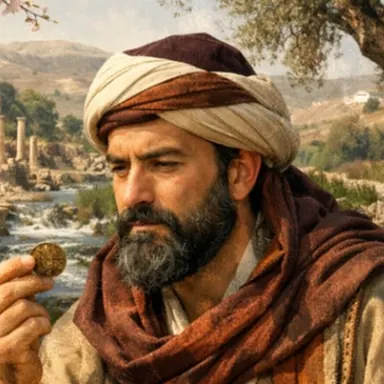
Rabbi Estori HaParchi: Pioneer of the Study of the Land of Israel
13 min read2,521 words
Summary
This article surveys the figure and unique contribution of Rabbi Estori HaParchi, the first explorer of the Land of Israel in the modern era, who composed the foundational work "Kaftor va-Ferach" in the 14th century. The text presents the story of his life as a refugee from the expulsion from France who settled in Beit She'an, highlighting the scientific-halakhic methodology he developed, which combines deep Torah scholarship with realistic field research including journeys on foot, botany and topography. The article details how the author worked to identify biblical sites and to determine the precise borders of the Land, with the aim of putting into practice the commandments dependent on the Land even in the time of exile. In conclusion, the work is described as an intellectual bridge merging Torah and science, which became a cornerstone for halakhic decisors and explorers of the Land through the generations.
The Torah Teaching and Scientific-Halakhic Work of Rabbi Estori HaParchi: Pioneer of the Study of the Land of Israel
The history of halakhic thought and of the geographical study of the Land of Israel cannot be written without the monumental figure of Rabbi Estori HaParchi. As the first explorer of the Holy Land in the early modern era, he founded a methodology combining deep Torah scholarship with realistic field research, and thereby brought about a revolution in the understanding of the commandments dependent on the Land.[1, 2] His main work, "Kaftor va-Ferach" ("Bulb and Flower"), is not merely a halakhic code but a broad documentary record reflecting the physical, botanical and topographical reality of the Land of Israel in the 14th century, bridging a gap of hundreds of years of exile and geographical disconnection.[3]
Chapter 1: The Foundations of His Life and the Shaping of His Spiritual Character
Rabbi Estori HaParchi was born in the second half of the 13th century, probably around 1280 (Hebrew year 5040), at a time when the Jewish world was undergoing violent upheavals between the centers of Torah in Spain, France and Ashkenaz.[1, 2] His real name, as emerges from historical analyses, was Rabbi Yitzchak HaKohen ben R. Moshe HaParchi, while the epithet "Estori" is considered a literary name with a double meaning: "Ish-Turi" (an explorer of lands, or a man of the Torah).[1] His family originated in the city of Florenza (Florenzia) in Spain, a fact that gave him the name "HaParchi," a Hebrew translation of the city's name alluding to flowering (perach).[2]
His Family Background and His Teachers
Rabbi Estori's education was multi-layered, drawing on all the major centers of Torah of his time. He grew up in Provence, a region characterized by a unique synergy between conservative halakha and philosophy and science.[2]
The combination of his various teachers made Rabbi Estori a "man of many talents." On the one hand, he was well versed in the seventy books of halakha composed after the sealing of the Talmud, and on the other he mastered the Latin language and the writings of the Greek and Arab sages such as Aristotle, Ibn Sina, Galen and Ptolemy.[2] This scientific training enabled him to examine the aggadot of the Sages with a rationalist approach; he did not hesitate to interpret certain aggadot as figurative or hyperbolic when they seemed to contradict the laws of nature or the science accepted in his time.[2]
The Expulsion and the Journey to the Land of Israel
In 1306 (Hebrew year 5066), with the expulsion of the Jews of France, Rabbi Estori was forced to leave Provence and moved to Barcelona and to Perpignan in the Crown of Aragon.[2] These wanderings strengthened in him the recognition that exile is a temporary state requiring spiritual and practical preparation for the return to the Land of Israel. In 1313 (Hebrew year 5073) he began his great journey eastward. He passed through Alexandria and Cairo, where he met Rabbi Shmuel HaNagid, a descendant of Maimonides (Rambam).[2] The encounter with the Maimonidean tradition at the height of its vitality in Egypt left a deep impression on him, but his longing for the Land of Israel prevailed and he went up to Jerusalem.[2]
In Jerusalem Rabbi Estori encountered a complex social reality: controversies over the thought of the Rambam had split the community. After a year in the holy city, in search of tranquility that would allow him to complete his comprehensive research, he moved to Beit She'an.[2] His choice of Beit She'an was strategic: the city abounded in water, its soil was extremely fertile, and it served as a living laboratory for studying the commandments dependent on the Land in real time.[2]
Chapter 2: "Kaftor va-Ferach": The Magnum Opus of the Study of the Land
The work "Kaftor va-Ferach," completed in Beit She'an in 1322, is considered the cornerstone of the literature of the Land of Israel. The purpose of the book was twofold: a halakhic clarification of the practical commandments applying in the Land, and the provision of a geographical and topographical infrastructure that would make their observance possible.[3]
The Research Method: Walking as a Halakhic Tool
Rabbi Estori did not content himself with theoretical knowledge. He devoted seven years to meticulous journeys on foot throughout the Land: two years in the Galilee and five years in the other parts of the land of the tribes.[2, 3, 4] In the course of these journeys he developed a unique method of identification based on three principles:
- Preservation of names: the assumption that the local Arabic names preserve within them the ancient Hebrew names from the Bible and the Mishnah.[2, 3]
- Comparative topography: examination of the distances and spatial relations between sites as they appear in the sources against the reality on the ground.[4]
- Archaeology and vegetation: identification of physical remains and of distinctive plant species mentioned in the descriptions of the borders and in the laws of kilayim (forbidden mixtures) and orla.[3, 4]
By this method he succeeded in identifying some 180 places, among them sites that were unknown at that time, such as Shiloh, Kfar Darom and the Waters of Merom.[2, 4]
The Structure of the Book and Its Chapter Contents
The book is organized in a thematic structure encompassing all the needs of a Jew living in the Land of Israel.
Rabbi Estori discusses at length the question whether the sanctity with which Ezra the Scribe sanctified the Land endures for the time to come. His unequivocal conclusion was that the sanctity of the Land endures, and therefore the commandments dependent on the Land are binding on those who dwell in it even in the period of exile and destruction.[3, 4]
Chapter 3: The Geography of Halakha: Determining the Borders of the Land
One of the brilliant achievements of "Kaftor va-Ferach" is the precise delineation of the borders of the Land of Israel for the purpose of observing the commandments. Rabbi Estori distinguished between the borders of "those who came up from Egypt" (the broad biblical border) and the borders of "those who came up from Babylonia" (the area sanctified by those who returned from the first exile), since the latter is what determines the obligation of the Sabbatical year and of the tithes by rabbinic law in certain regions.[3]
Identification of Major Sites
Rabbi Estori provided geographical descriptions that inspired scholars for hundreds of years:
- Acre: he determined emphatically that Acre is part of the Land of Israel. He relied on the Talmud, which tells of Rabbi Abba, who would kiss the "rocks of Acre" when he returned from the diaspora, and noted that this is the main gateway for those coming to the Land of Israel from the north.[3, 4]
- Mount Meron and Gush Halav: he identified the "Waters of Merom" mentioned in the Book of Joshua in the area of Meron, and linked the place to the study hall of Rabbi Shimon ben Yochai, a description that matches the traditions that exist to this day.[3, 4]
- Shiloh: Rabbi Estori described the location of Shiloh with great precision as lying south of Shechem, a three-hour journey away, inclining slightly to the east, on the road going up to Jerusalem.[4]
- Kfar Darom: he identified the settlement of "Darom" south of Gaza, called "Darun" in Arabic, as the home of the Tanna Rabbi Eliezer ben Yitzchak, the man of Kfar Darom.[3, 4]
These identifications of his were not merely an intellectual exercise; they were intended to enable Jews to settle in these regions with clear knowledge of which commandments they were obliged to observe. In Beit She'an itself, he labored to prove that its lands are considered part of the Land that was sanctified a second time, and thereby encouraged Jewish agricultural settlement in this fertile region.[2]
Chapter 4: Botany and Observations of Nature in the Service of the Torah
Rabbi Estori's research in the botany of the Land of Israel is considered groundbreaking. He understood that in order to observe the laws of kilayim (the prohibition of mixing species) and orla (the prohibition of eating fruit in the first three years), the species mentioned in the Mishnah must be identified precisely.[3]
Identification of the Species of Plants and Fruits
- His basic assumption was linguistic-historical: the Arabic language, being close to Hebrew and being the language of the local inhabitants who had not been exiled from the Land, preserved the names of the plants.[3] He brings dozens of examples of his identifications:
- The almond and the Menorah: he explains the connection between the almond blossom and the "almond-shaped cups" (gevi'im meshukkadim) of the Temple Menorah. The almond (shaked), in its diligence (shekida) in putting out the first blossoms already in winter, serves him as a symbol of spiritual awakening.[5]
- The olive: he studies the properties of olive oil and stresses its uniqueness for lighting, while ruling out the use of oils from nuts or radishes for the Temple Menorah.[5]
- Field plants and vegetables: Rabbi Estori identifies the species of seeds and grasses growing in the Land of Israel, which allows him to decide questions of "a species with its own kind" with regard to forbidden mixtures of seeds.[3]
His research also included treating nature as a living system. He observed the blooming of the red flowers of the Land of Israel (anemone, buttercup, poppy) and at times linked them to traditions and legends, while examining the life cycle of fruit trees such as the fig, the carob and the pomegranate in order to determine the years of orla.[3, 6, 7]
Chapter 5: The Temple, Jerusalem and Realistic Measurements
Another field in which Rabbi Estori excelled is the study of the Temple and its measurements. In days when Jerusalem was under Mamluk rule and access to the Temple Mount was restricted, he succeeded in carrying out observations and measurements that became a permanent asset for generations.[2, 4]
The Topography of the Temple Mount
In chapter 10 of his book, he discusses at length the structure of the Second Temple. He dealt with clarifying the "bounds of the camps": the areas into which those impure through contact with the dead are permitted to enter and the areas forbidden on pain of karet.[2] His research included:
Identification of the place of the altar and the Sanctuary: on the basis of remains of walls and local traditions.
- Measurements of coins and measures: he translated the "cubit" and the "handbreadth" into the values accepted in his time, and compared the ancient coins (such as the shekel and the dinar) with the coins of the 14th century.[4, 8]
- Jerusalem astronomy: owing to his expertise in "the science of astronomy" (chokhmat ha-tevuna), he calculated the "measure of the arc of visibility" on the horizon of Jerusalem for determining the times of day and night and the sanctification of the new month.[8]
The later Luncz edition of the book even included a "plate of the images of the ancient coins" and a diagram of the Second Temple, based on Rabbi Estori's precise descriptions.[4]
Chapter 6: The Influence of "Kaftor va-Ferach" on the World of Halakha and Research
Rabbi Estori HaParchi's book did not achieve wide circulation immediately upon its writing, but from the moment it was printed in Venice in 1548, it became the supreme authority on matters of the Land of Israel.[3]
Citations and Rulings
The great halakhic decisors through the generations stood on the shoulders of Rabbi Estori:
- Rabbi Yosef Karo: in his work "Beit Yosef," he quotes from the book not only on agricultural matters but also in the laws of tzitzit, which attests to the breadth of Rabbi Estori's knowledge in all the treasures of the Torah.[3]
- The old and the new Yishuv: in the course of the 19th and 20th centuries, with the beginning of the return to agricultural settlement, "Kaftor va-Ferach" became a practical guide for the rabbis of the moshavot who sought to know where the obligation of terumot and ma'asrot (priestly gifts and tithes) applies and where one may be lenient.[3]
The book has been published in several important editions, the most prominent of which is the edition of Avraham Moshe Luncz in Jerusalem (1897-1899), which appeared in two thick volumes and included scientific introductions and indexes.[2, 4] Today, institutes such as the "Beit Midrash Gavoha LeHalakha BeHityashvut" (Institute for Advanced Study of Halakha in Settlement) continue to publish detailed editions of the book as part of modern Torah-scientific research.[3]
Additional Works That Were Lost
Alongside "Kaftor va-Ferach," Rabbi Estori composed additional books that attest to the breadth of his horizons, although most of them have not survived in full:
- "Batei HaNefesh": apparently dealt with matters of ethics and thought.[1]
- "Shoshanat Melekh": dealt with the sciences.[1]
- "Sha'ar HaShamayim": a commentary on the Bible or on halakha.[1]
- Medical translations: a translation of two books of medicine, attesting to his work also as a scientist and physician in his community.[1]
Summary and Conclusions
The teaching of Rabbi Estori HaParchi is a living bridge between the world of Talmudic learning and the geographical reality of the Land of Israel. He was "the first of the explorers of the Holy Land" not only because of the time in which he was active, but above all because of the tools he employed: field research, mastery of languages, botany, astronomy and archaeology, all in the service of Jewish halakha.[2, 3] His work in Beit She'an and throughout the Land gave the Jews of the diaspora the spiritual and physical map needed for the return to their land, and made "Kaftor va-Ferach" one of the most influential books in shaping the face of the Torah-observant Land of Israel in recent generations.[3] His work proves that the combination of science and Torah is not only possible but essential for a full and practical understanding of the commandments of the Torah in their original land.
Sources8
- 1.אשתורי הפרחי - ויקיפדיה, he.wikipedia.org/wiki/אשתורי_הפרחי
- 2.רבי אשתורי הפרחי – ויקישיבה, yeshiva.org.il/wiki/index.php/רבי_אשתורי_הפרחי
- 3.כפתור ופרח – ויקיפדיה, he.wikipedia.org/wiki/כפתור_ופרח
- 4.כפתור ופרח – ויקישיבה, yeshiva.org.il/wiki/index.php/כפתור_ופרח
- 5.זית, מוריה ושקד מאמר - נאות קדומים, n-k.org.il/all-you-need-to-know/index-articels/the-plants-of-israeli-country-symbol/
- 6.אגדות פרחים, עצים ושאר צמחים: סודות הפריחה בטבע הישראלי - טיולים ואגדות, meny.co.il/agadot/אגדות-פרחים-עצים-פריחה-טבע-ישראלי/
- 7.מגדיר צמחים, פרחים, עצים ופטריות בתמונות לפי צבעים | מטיילים עם ענת, anattour.co.il/מגדיר-צמחים-ופרחים/
- 8.כפתור ופרח – ויקיטקסט, he.wikisource.org/wiki/כפתור_ופרח