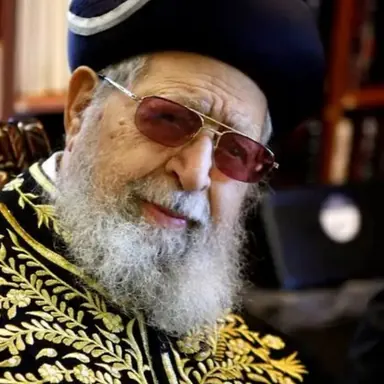
The Modern Sephardi Revolution: The Halakhic Thought and Public Work of Maran Rabbi Ovadia Yosef
13 min read2,684 words
Summary
This survey presents the multidimensional figure of Rabbi Ovadia Yosef as a halakhic decisor and social leader who brought about the modern "Sephardi revolution" in the State of Israel. The text traces the course of his life from his childhood in Baghdad to the founding of the Shas movement, emphasizing his central vision of "restoring the crown to its former glory," a move that sought to unite the Jews of the Eastern communities around the rulings of the Shulchan Arukh and to restore their religious and political pride. The author analyzes his distinctive halakhic approach, which combines phenomenal erudition with a tendency toward leniency and finding solutions to the problems of the hour, as reflected in his immense literary enterprise and in the educational institutions he established. Ultimately, the source seeks to explain how the Rabbi became the figure bridging the world of Torah and modern reality, and left an indelible mark on the identity of Israeli society as a whole.
The rise of Rabbi Ovadia Yosef as one of the most influential leaders in the history of the Jewish people in modern times is not merely the story of an extraordinary Torah genius but a journey of deep transformation of consciousness and society. His figure combines within it the halakhic depth of a decisor of the first rank, an unprecedented capacity for political and public leadership, and a revolutionary vision intended to restore pride and independence to Sephardi Jewry and the Eastern communities.[1, 2] Understanding his teaching requires a multidimensional examination of the stations of his life, of his principles of halakhic ruling and of the institutions he founded, which together created what is today called the "Sephardi Torah revolution."[3]
The Roots in Baghdad and the Rise in Mandatory Jerusalem
The biological and spiritual roots of Rabbi Ovadia Yosef are planted in the glorious tradition of Iraqi Jewry. He was born in Baghdad on the 11th of Tishrei 5681 (1920), the eldest son of Yaakov and Georgia.[4, 5] His original name, Ovadia Yosef, was given to him after two of the great sages of Babylon: Rabbi Ovadia Somekh, the teacher of the "Ben Ish Chai," and Rabbi Yosef Chaim himself, who was the supreme spiritual authority of Iraqi Jewry in recent generations.[4] The later transfer of his second given name, Yosef, to become his family name symbolizes to a large extent the transition from a traditional communal identity to an independent personal and leadership identity.[4]
When he was four years old, in 1924 (5685), the family immigrated to Israel and settled in the Beit Yisrael neighborhood of Jerusalem.[4, 5] The move to the Land of Israel was not simple; his family lived in great poverty, and his father opened a small grocery store for his livelihood. Despite the economic hardship, the signs of the young Rabbi's genius were evident already at the start of his path. At the age of nine he had already written his first literary work, and at the age of 12 he moved to study at the "Porat Yosef" yeshiva in the Old City, the most prestigious institution of learning of Sephardi Jewry at that time.[4]
The key figure in shaping Rabbi Ovadia Yosef in his youth was the head of the yeshiva, Rabbi Ezra Attia. Rabbi Attia recognized the potential in his student, and when Rabbi Ovadia's father asked to take him out of his studies so that he could help support the family in the store, Rabbi Attia appeared at the store and offered to work in his place so that the boy could continue his studies.[4] This gesture marked the total commitment of the Sephardi world of Torah to nurturing its prodigies. Under the guidance of Rabbi Attia, Rabbi Ovadia adopted the method of study based on broad erudition and practical halakhic inference, while distancing himself from the abstract pilpul that prevailed in the Ashkenazi yeshivot.[6]
His Mission to Egypt: A Laboratory for Halakhic Leadership
In 1944 Rabbi Ovadia married Rebbetzin Margalit, daughter of Rabbi Abraham HaLevi Patal.[4] Three years later, in 1947, the Rabbi was called to a mission that proved to be a formative event in his life: service as deputy to the Chief Rabbi of Egypt, Rabbi Nahum Effendi, and as a member of the rabbinical court (Av Beit Din) in Cairo.[5] His stay in Egypt, which lasted about two years until 1949, was a living laboratory for a traditional Sephardi halakhic decisor's encounter with a modern, partly secular community situated on the seam between tradition and Westernization.[4, 5]
In Egypt the Rabbi began to crystallize his intellectual independence. He did not hesitate to confront the local community committee on issues of kashrut and education, and insisted on issuing clear halakhic rulings without political compromises.[5] Alongside his work in the rabbinical court, he took care to deliver daily lessons in the study halls to the worshippers of the synagogues, from an understanding that the Torah revolution must begin with connecting the masses to the sources.[5] This period sharpened in him the understanding that the decisor cannot shut himself within the four cubits of halakha but must know the changing social and technological reality in order to give a living and relevant halakhic response.[6]
The Meta-Halakha: Restoring the Crown to Its Former Glory and the Centrality of the Shulchan Arukh
The Torah thought of Rabbi Ovadia Yosef is based on an overarching program (meta-halakha) embodied in his famous idiom: "to restore the crown to its former glory" (le-hachzir atara le-yoshna).[3, 7] The meaning of the concept is twofold: social and halakhic. On the halakhic plane, the vision was to establish the rulings of Rabbi Yosef Karo, author of the Shulchan Arukh, as the supreme and exclusive authority for all the Eastern communities in the Land of Israel.[3, 7]
Rabbi Ovadia saw in the Shulchan Arukh the "mara de-atra" (the rabbi of the place) of the Land of Israel.[3, 7] In his view, Jews of the Eastern communities who immigrated to Israel from Morocco, Tunisia, Iraq or Yemen should abandon their local customs if these contradict the ruling of the Shulchan Arukh, in order to create a single, unified halakhic front.[3] This approach sometimes stood in contradiction to the approach of Rabbi Yosef Chaim (the "Ben Ish Chai"), whose rulings integrated esoteric teaching (Kabbalah) and were stricter in certain cases than the Shulchan Arukh. Rabbi Ovadia, in his work "Halichot Olam," laid out his objections to the Ben Ish Chai, while adhering to the revealed and direct halakhic line of Maran Rabbi Yosef Karo.[8]
Koach de-Heteira and Dealing with the Questions of the Hour
One of the most prominent features of Rabbi Ovadia Yosef's rulings is the use of the rule "koach de-heteira adif," the power to permit is preferable to the power to prohibit.[7] The Rabbi held that a great decisor is one who succeeds in finding a way to permit what is permissible within the framework of halakha, especially in a generation of religious crisis, and not one who adopts stringencies and adds fences unnecessarily.[3, 7]
This lenient approach also stemmed from his conception of the Sephardi tradition of halakhic ruling as one connected to life and imbued with the "attribute of kindness," in contrast to the Ashkenazi ruling, which at times he perceived as too stringent because of environmental and ideological influences.[7] Prominent examples of this can be found in his rulings on matters of technology and society:
- Electrical devices and technology: permitting the use of a solar water heater on the Sabbath and brushing teeth with toothpaste, out of an understanding of modern reality.[6]
- The status of women: permitting the agunot of the casualties of the Yom Kippur War. The Rabbi invested enormous efforts in examining each and every case of some 900 casualties whose burial place was unknown, in order to allow their wives to remarry.[1, 6]
- Jewish identity: the historic determination that the "Beta Israel" (the Jews of Ethiopia) are Jews in every respect, a ruling that served as a halakhic and moral foundation for the great immigration operations.[6]
- Marriage with Karaites: permitting marriage with members of the Karaite community under certain conditions, out of a desire to prevent a rift in the people.[6]
His Literary Work: The Encyclopedia of Halakha
The Torah enterprise of Rabbi Ovadia Yosef has been immortalized in dozens of volumes, which today are foundational books in every study hall and rabbinical court. His flagship series is the responsa "Yabia Omer," comprising 11 volumes and an additional volume of indexes.[6] The title of the book, taken from Psalms, "Day to day utters speech," also contains the acronym of his name in reverse: Ovadia Yosef ben Yaakov.[6]
"Yabia Omer" is not merely a collection of halakhic responses; it is a virtuoso display of erudition encompassing all layers of Torah literature, from the Sages and the Rishonim to the latest of the Acharonim, Sephardim and Ashkenazim alike.[6] The Rabbi used his marvelous capacity for citation to show that Sephardi halakhic ruling is not inferior to the Ashkenazi, and that it has a firm and broad base of sources.[3, 6] For this work he won prestigious prizes such as the Rabbi Kook Prize (5714), the Israel Prize for Torah Literature (5730) and the Rabbi Toledano Prize (5738).[1, 6]
In parallel to "Yabia Omer," the Rabbi composed "Yechaveh Da'at," a shorter series of responsa (7 volumes) dealing with current questions that were asked in his halakha corner on the radio and in the yeshiva.[9] The aim of "Yechaveh Da'at" was to make halakha accessible to the general public in clear and precise language.[9] Another important series is "Chazon Ovadia," comprising 22 volumes and dealing with the laws of the festivals, the Sabbath, mourning, blessings and more.[10] In this series the Rabbi integrated not only halakhic rulings but also commentaries on the Megillot and the Passover Haggadah, which makes it a comprehensive work on the Jewish life cycle.[10]
Public Leadership and the Political Revolution: The Shas Movement
One cannot understand the work of Rabbi Ovadia Yosef without addressing the founding of the Shas movement (the World Sephardi Torah Guardians Association) in 1982.[11] Shas was not merely a political party; it was the executive instrument of the vision of "restoring the crown to its former glory" on the national and social level.[2] The Rabbi understood that in order to change the situation of the Jews of the Eastern communities, it is not enough to write books of halakha; rather, one must establish political, educational and economic power centers that would provide backing to the believers.[2, 11]
Under his leadership as president of the Council of Torah Sages, Shas became a significant force in Israeli politics. The Rabbi succeeded in connecting the Haredi-Sephardi public with the masses of the "traditionalists," Mizrahim who are not necessarily fully observant but have a warm affinity for religion and heritage.[11, 12] His sermons on Saturday nights at the "Yazdim" synagogue in Jerusalem became a media and spiritual event, in which he used popular, warm and at times sharpened language to convey messages of ethnic pride and adherence to the Torah.[1, 4]
One of the significant achievements of the movement was the founding of the "Ma'ayan HaChinuch HaTorani" (Bnei Yosef) network in 1984.[13] The network was established as an alternative to the Ashkenazi independent education system, in which many Sephardi parents felt discriminated against on ethnic grounds.[13] As of 2024, it is an educational powerhouse comprising hundreds of kindergartens, talmudei Torah and schools, with some 10,000 employees and a financial turnover of over 1.2 billion NIS.[14, 15] The network educates toward Torah excellence in the spirit of the heritage of Eastern Jewry, and it formed the basis for the rise of a new generation of Sephardi rabbis and men of action.[14, 16]
Questions of Peace, Security and Nationalism
The political positions of Rabbi Ovadia Yosef were based on a clear hierarchy of halakhic values, foremost among them the value of "pikuach nefesh" (saving a life). His famous ruling that it is permissible to return territories of the Land of Israel in exchange for true peace that prevents bloodshed ("territories for peace") aroused a great public storm.[3] The Rabbi held that the Land of Israel belongs to the people of Israel according to the Torah, but that human life takes precedence over sovereignty over land in a situation of existential danger.[3]
At the same time, the Rabbi set rigid conditions for this ruling: the peace must be genuine and demonstrated by professionals and security experts. For this reason, later in his career he opposed certain political processes, such as the Disengagement Plan, when he assessed that they would not lead to quiet but would intensify terror and endanger Jewish lives.[3] This approach illustrates his halakhic pragmatism, which is not bound to a classical right-wing or left-wing political ideology but is guided by a substantive halakhic judgment that changes in accordance with reality.[3]
Lasting Influence and Spiritual Leadership
Rabbi Ovadia Yosef was not merely a decisor of the past but a builder of the future. He left behind a glorious Torah dynasty that continues his path. His son, Rabbi Yitzhak Yosef, served as Rishon LeZion and Chief Rabbi of Israel and edited the series "Yalkut Yosef," which makes his father's rulings accessible to the general public.[1, 6] Another son, Rabbi David Yosef, was also chosen to serve as Rishon LeZion, and he heads the "Yechaveh Da'at" institute.[1] His grandson, Rabbi Ovadia Yosef (named after him, born in 1976), serves as a head of yeshiva and halakhic decisor, and continues the tradition of halakhic writing in the dynasty.[17]
The influence of Rabbi Ovadia is also evident in the change in the status of the Sephardi rabbi in the State of Israel. He transformed the figure of the Sephardi "Chacham" into a figure of national leadership, involved in all areas of life, from high politics to the most intimate details of halakha. He succeeded in bridging the gap between the Haredi world and the traditional and secular public, thanks to his charisma, his famous sense of humor and his ability to speak to every person at eye level.[1, 2]
Summary and Historical Perspective
From a historical perspective, Rabbi Ovadia Yosef is the figure who reshaped the face of Sephardi Judaism in the twentieth and twenty-first centuries. He succeeded in the almost impossible task of uniting dozens of diverse communities under a single halakhic and social vision.[3, 7] His death in 2013 left an immense void, but the institutions he founded, the books he wrote and the consciousness he planted in millions of people ensure that his legacy will continue to influence the character of the State of Israel and the Jewish people for many generations.[1]
His Torah teaching, which combines absolute adherence to halakha with social sensitivity and political pragmatism, constitutes a model of Jewish leadership connected to the roots on the one hand and to modern reality on the other. Rabbi Ovadia Yosef did not merely "restore the crown to its former glory," but created a new crown, combining the splendor of the past of the Jewry of Babylon and Spain with the challenges of renewed Jewish sovereignty in the Land of Israel.[2, 3]
Sources17
- 1.עובדיה יוסף – ויקיפדיה, he.wikipedia.org/wiki/עובדיה_יוסף
- 2.דיוקנה של תנועה - צריך עיון, iyun.org.il/article/דיוקנה-של-תנועה/
- 3.הרב עובדיה יוסף – ויקישיבה - אתר ישיבה, yeshiva.org.il/wiki/index.php/הרב_עובדיה_יוסף
- 4.הרב עובדיה יוסף - אביטה, abita.co.il/lessons/הרב-עובדיה-יוסף/
- 5.הרב עובדיה יוסף זצ"ל הרבנות הראשית לישראל - Gov.il, gov.il/he/departments/general/rab_ovadia
- 6.יביע אומר – ויקיפדיה, he.wikipedia.org/wiki/יביע_אומר
- 7.גישתו ההלכתית - מאור ישראל, maor-israel.com/גישתו-ההלכתית-והשקפת-עולמו/
- 8.הליכות עולם (עובדיה יוסף) – ויקיפדיה, he.wikipedia.org/wiki/הליכות_עולם_(עובדיה_יוסף)
- 9.יחוה דעת - ויקיפדיה, he.wikipedia.org/wiki/יחוה_דעת
- 10.חזון עובדיה (ספר) – ויקיפדיה, he.wikipedia.org/wiki/חזון_עובדיה_(ספר)
- 11.מפלגת ש"ס - ויקיפדיה, he.wikipedia.org/wiki/מפלגת_ש"ס
- 12.הלכה למעשה: הקמת ש"ס - עושים היסטוריה, osimhistoria.com/osim-politica/osimpolitica_ep36
- 13.בני יוסף - ויקיפדיה, he.wikipedia.org/wiki/בני_יוסף
- 14.רשת מעיין החינוך התורני בא"י בני יוסף (ע"ר) | גיידסטאר - אתר התאגידים של ישראל | משרד המשפטים, guidestar.org.il/organization/580121952
- 15.בכירי רשת החינוך של ש"ס קיבלו העלאות עתק בשכר. המורים לא - כלכליסט, calcalist.co.il/local_news/article/sjoclzmgel
- 16.אודותנו - רשת גני הילדים של מעיין החינוך התורני פתח תקווה, ganey-yeladim.com/אודותנו/
- 17.עובדיה יוסף (1976) - ויקיפדיה, he.wikipedia.org/wiki/עובדיה_יוסף_(1976)