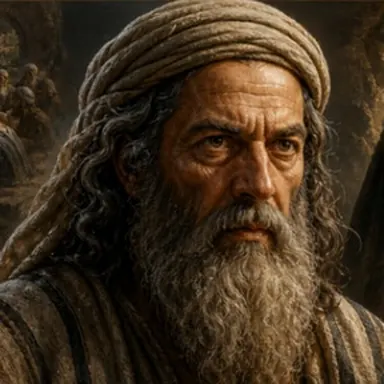
The Tanna Rabbi Shimon bar Yochai
19 min read3,829 words
Summary
The survey before us sketches the figure of the Tanna Rabbi Shimon bar Yochai as a central axis in the history of Jewish thought, combining historical biography, halakhic method and mystical depth. The text analyzes Rashbi's passage from destruction and Roman persecutions to spiritual summits, and emphasizes the concept "Torato umanuto" (Torah is his occupation) as an expression of total devotion in which the study of Torah becomes an existential way of life that sustains the world. On the halakhic plane, the source highlights Rashbi's innovation of giving decisive weight to inner intention and to the purpose of an act over the dry technical action. The climax of the survey is the disclosure of the legacy of the esoteric teaching attributed to Rashbi through the Book of the Zohar and the "Idra" gatherings, which to this day form the foundation of the world of Kabbalah, of Hasidism and of the customs of Lag BaOmer in Meron.
Being, Halakha and Mystery: The Comprehensive Teaching and Historical Work of the Tanna Rabbi Shimon bar Yochai
Introduction: The Figure of Rashbi as the Center of Gravity of Jewish Thought
The figure of Rabbi Shimon bar Yochai, known by the acronym Rashbi, stands as one of the most complex and influential spiritual phenomena in the history of the people of Israel. Rashbi is not merely a central Tanna whose words adorn hundreds of pages of the Mishnah and the Talmud, but he is perceived as a figure who brought about a revolution of consciousness in the relationship between man and his Creator through the disclosure of the inner dimension of the Torah and its placement at the center of existential being.[1, 2] His activity spans one of the stormiest and most decisive periods in Jewish history, the second century CE, a period in which the Jewish community tried to recover from the destruction of the Second Temple and from the failure of the Bar Kokhba revolt, under the yoke of the harsh Roman decrees of the emperor Hadrian.[1, 3]
In-depth analysis of his teaching reveals that Rashbi represents a total approach called "Torato umanuto," which sees the study of Torah not merely as an intellectual or religious occupation, but as an absolute state of being in which the Torah becomes the Creator's craftsman's tool within the world.[4, 5] This report will survey broadly and in depth the stations of his life, his revolutionary halakhic method, which emphasizes intention and purpose over the technical act, and the momentous mystical revolution attributed to him through the Book of the Zohar and the holy fellowship that surrounded him.[1, 6] Through understanding his figure, one can discern the processes that shaped rabbinic Judaism on the one hand, and the world of Kabbalah and Hasidism on the other, as both draw from the same primal wellspring of Rashbi in the cave.
Early Formation: In the Beit Midrash of Rabbi Akiva and the Tradition of Yavneh
Rabbi Shimon was born in the Land of Israel, apparently around 90 CE in the Galilee, to his parents Yochai and Sarah.[1, 7, 8] His formative period took place in the shadow of the great transition from the spiritual center at Yavneh, which had been established by Rabban Yochanan ben Zakkai, to the new centers in the Galilee and in Bnei Brak.[2] In his childhood he studied in the academy of the sages of Yavneh, but the figure who shaped his identity more than anyone was that of Rabbi Akiva, the greatest of the Tannaim at that time, who served as his principal teacher for thirteen years.[1, 3]
The bond between Rabbi Akiva and Rashbi was deep and unique. Rabbi Akiva recognized the immense spiritual potential of his disciple and expressed himself toward him in rare terms of esteem: "It is enough for you that I and your Creator know your power."[1, 2] Rashbi was so attached to his teacher that Rabbi Akiva called him "my son."[2] In this period, Rashbi not only acquired enormous halakhic knowledge but also absorbed Rabbi Akiva's interpretive method, which finds meaning in every thorn and crown of the letters of the Torah, a method that later formed the foundation of the mystical interpretations in the Zohar.[1]
The period in which Rashbi was active in his youth was a period of severe religious persecution. The Romans forbade the study of Torah and the ordination of rabbis on pain of death, with the aim of severing the chain of transmission of the tradition.[2] Rashbi witnessed the tragic death of 24,000 of Rabbi Akiva's disciples, and remained one of the five (or seven, according to certain sources) lone disciples on whom the future of the Torah in the Land of Israel rested.[1, 9] His ordination to the rabbinate was carried out with self-sacrifice by Rabbi Yehuda ben Bava, who shielded the disciples with his body in the face of the Roman soldiers and paid with his life for violating the decree.[1, 2] This heroism and life in the shadow of death shaped in Rashbi a conception of absolute self-sacrifice for the values of the spirit.
The Struggle against Roman Rule: The Ideological and Political Confrontation
Rashbi's activity was characterized by uncompromising opposition to Roman culture and to its presence in the Land of Israel. Whereas other sages, such as Rabbi Yehuda bar Ilai, tried to find ways of coexistence and to praise the material benefit that the Romans had brought (such as bridges, marketplaces and bathhouses), Rashbi saw in these deeds an expression of pure egoism and an absence of holiness.[10, 11]
In the famous discussion recorded in tractate Shabbat, Rabbi Yehuda opened in praise of the Romans: "How fine are the deeds of this nation." Rashbi responded sharply: "Everything they established, they established only for their own needs; they established marketplaces to place harlots in them, bathhouses to pamper themselves, bridges to levy tolls from them."[1, 10, 11] This response expresses Rashbi's outlook, which is not satisfied with the outward appearance of a deed but penetrates to its intention and its spiritual root. In his view, material progress that does not serve a divine purpose is empty of content and even dangerous.[3]
Rashbi's words were passed on to the authorities by Yehuda ben Gerim, and as a result a death sentence was decreed against him.[1, 11] This event forced Rashbi to flee and hide, first in the beit midrash, where food was provided to him by his wife, and afterwards in a cave in the Galilee together with his son Rabbi Elazar.[3, 10] The flight to the cave was not merely a physical escape but the beginning of a process of seclusion and refinement that became one of the cornerstones of the esoteric teaching.[3]
The Years in the Cave: A Transformation of Consciousness and Spirit
The thirteen years that Rashbi and his son spent in the cave (twelve first years and one further year afterwards) are described in the tradition as a time of complete withdrawal from this world and of life on the level of miracle.[3, 10] According to the Gemara, a carob tree grew for them and a spring of water flowed, which supplied their basic needs.[10, 11] They lived in extreme asceticism: they took off their clothes so that they would not wear out and covered themselves with sand up to their necks during study, and only at the time of prayer did they put on their clothes.[10, 11]
This process of "divestment of corporeality" enabled Rashbi to attain spiritual insights that are not possible amid the tumult of ordinary life. In the cave, according to the kabbalistic tradition, the principles of the Book of the Zohar and the secrets of being took shape.[3, 12] The emergence from the cave after twelve years exposed the tension between the absolute world of the spirit and the corporeal world of action. On seeing people plowing and sowing, Rashbi and his son wondered: "They abandon eternal life and engage in temporal life?"[10, 11] The force of their spiritual gaze was so strong that every place on which they set their eyes was immediately burned.[10, 13]
This response of Heaven, which called on them to return to the cave for a further year, teaches the need for balance between absolute truth and human reality.[10, 11] Only after the 13th year, when they saw the old man running on the eve of the Sabbath with two myrtle branches in honor of "Remember" (Zakhor) and "Keep" (Shamor), were their minds set at ease. Rashbi understood that the practical commandments are the way in which the Jewish people connects temporal life with eternal life.[10, 11] This insight forms the basis of his later teaching, which combines esoteric depth with broad halakhic commitment.
His Halakhic Teaching: Ruling in Light of Intention and Purpose
Rashbi's method in halakha is unique and based on an understanding of the inner essence of an action. Whereas other sages focused on the technical act and the objective result, Rashbi gave decisive weight to the intention and thought standing behind the act.[14, 15]
The Principle of "Davar she-Eino Mitkaven" (an Unintended Act)
One of the most famous disputes in the Talmud is between Rabbi Yehuda and Rabbi Shimon on the matter of "davar she-eino mitkaven."[14] Rashbi established the rule that an unintended act is permitted. That is, if a person performs a permitted action on the Sabbath, and as an undesired side effect a forbidden labor is caused, he does not transgress the prohibition.[14, 15, 16] A classic example is dragging a heavy chair across the ground: the action is moving a piece of furniture (permitted), but the result may be plowing the ground (forbidden). According to Rashbi, if the person does not intend to plow, the thing is permitted from the outset.[14, 16]
Nevertheless, Rashbi concedes in the case of "pesik reisha," a situation in which the forbidden result is certain and unavoidable as a consequence of the permitted act.[14, 17] In such a case, even without explicit intention, the act is regarded as done intentionally because of the certainty inherent in it. This principle reflects his conception that one cannot separate the act from the result when it is self-evident, but when there is doubt or an absence of intention, the mental dimension is what determines the character of the act.[15]
"Melakha she-Einah Tzerikha le-Gufah" (A Labor Not Needed for Its Own Sake)
Another central concept is "melakha she-einah tzerikha le-gufah."[17] According to Rashbi, a person who is exempt for such a labor (for example, one who digs a pit and needs only its earth, or who carries out a corpse to bury it) is not regarded as having transgressed a Torah prohibition, since the labor was not performed for its essential purpose (as it was in the Tabernacle).[17] Rashbi requires "melekhet machshevet" (purposeful labor), an action in which there is full correspondence between thought, act and purpose.[17]
Torato Umanuto: The Ideal of Spiritual Totality
Rashbi is identified more than anything with the concept "Torato umanuto."[4, 5] The meaning of the concept is that a person's craft and profession is the study of Torah, to the extent that he has no other occupation in the world at all.[4] In his view, such a person is exempt from labor and from worries about livelihood, since "when Israel does the will of the Omnipresent, their work is done by others."[11]
This conception stood in contrast to the position of Rabbi Yishmael, who held that Torah should be combined with "derekh eretz" (worldly occupation).[11] Rashbi asked with fervor: "A man plows at the time of plowing and sows at the time of sowing... what will become of the Torah?"[11] He saw in the study of Torah a tool for drawing the light of the Ein Sof into the world, an action that gives meaning and existence to all of creation.[4, 18] In Hasidism it was explained that "Torato umanuto" means that the Torah became his working tool for the rectification of the worlds, and he is united with it in a degree of inner "hitkashrut" (bonding) that cannot be separated.[4, 18]
The modern use of the concept "Torato umanuto" (for example, in connection with the exemption of yeshiva students from military service) draws on the figure of Rashbi, although the decisors stress that one must distinguish between the absolute level of Rashbi and his companions and the broader definition of diligence in study that is accepted today.[5]
The Disclosure of the Esoteric Teaching: The Book of the Zohar and the Holy Fellowship
The center of Rashbi's activity in the hidden realm is the composition of the Book of the Zohar, called "the holy Zohar."[1, 19, 20] Despite the scholarly debates over the date of its redaction (the scholar Gershom Scholem attributed the writing to Moses de León in the 13th century), the kabbalistic tradition sees Rashbi as the source and creator of the contents that were transmitted to him and to his fellowship at the gatherings of the "Idrot."[7, 19]
The Chevraya Kadisha
Rashbi surrounded himself with a select fellowship of disciples, called "the Chevraya Kadisha" (the holy fellowship), who were partners in the great secrets.[6, 21] The fellowship comprised ten members (including Rashbi), each of whom represented a different spiritual power.
The list of the members of the "Chevraya Kadisha" as it appears in the Zohar:
- Rabbi Elazar (Rashbi's son) [6]
- Rabbi Abba (who served as scribe and wrote down Rashbi's words) [6]
- Rabbi Yehuda [6]
- Rabbi Yosei bar Yaakov [6]
- Rabbi Yitzchak [6]
- Rabbi Chizkiya bar Rav [6]
- Rabbi Chiya [6]
- Rabbi Yosei [6]
- Rabbi Yeisa [6]
- [6, 9]
The Structure and Content of the Book of the Zohar
The Book of the Zohar is not a single uniform work but a collection of discourses and homilies on the Torah, which combine stories about the fellowship with profound cosmological and theological revelations.[12, 20] It presents the doctrine of the sefirot (the ten sefirot), which are the ten emanations through which the Creator governs His world.[12]
One of Rashbi's foundational statements regarding the book is: "Be-hai chibura dilakh de-ihu Sefer ha-Zohar, yifkun bei min galuta be-rachamei" (By this composition of yours, which is the Book of the Zohar, they will go out of exile through it with mercy).[1, 22] This quotation expresses the belief that the study of the inner dimension of the Torah has a messianic and redemptive power capable of changing historical reality.
The "Idra" Gatherings: Summits of the Disclosure of the Secret
Within the Book of the Zohar there are two central discourses called "Idra" (from the word for threshing floor or assembly), in which the fellowship gathered for special revelations.[6, 23]
- Idra Rabba (the Great Assembly): it took place in a "Ginunita" (garden), and ten companions participated in it. At this gathering Rashbi revealed the structure of the upper worlds and the partzufim (countenances) of the Godhead.[6, 23] In the course of the gathering three of the companions died from the sheer intensity of the revelation and of their cleaving.[23]
- Idra Zuta (the Small Assembly): it took place on the day of Rashbi's death, and only seven companions participated in it. At this gathering Rashbi summed up the principles of his teaching and revealed the most hidden secrets, which had not been revealed in the Idra Rabba.[23, 24] This is the climactic moment of his life, in which he speaks of the "Atika Kadisha" (the Holy Ancient One), the highest and most hidden level of the Godhead.[24]
The Idra Zuta describes a quivering mystical scene: fire surrounded the house, Rashbi sat and instructed his disciples in their roles: "Rabbi Abba shall write, Rabbi Elazar my son shall teach orally, and the rest of the companions shall murmur in their hearts."[23, 24] He ended his words with the word "life," and at that moment his soul departed, completely united with the Holy One, blessed be He.[18, 23, 25]
His Passing and the Legacy of Lag BaOmer and Meron
The day of Rashbi's death, the 18th of Iyar, known as Lag BaOmer, became a day of festival and joy for the generations, "Yoma de-Hilula" (the day of the celebration) of Rashbi.[1, 26, 27] Unlike the death anniversaries of other righteous men, which are marked by fasting, this day is celebrated with enormous joy, since on it the hidden teaching was completed and the spiritual fire was revealed to the world.[18, 26, 28]
The History of the Pilgrimage to Meron
The grave site in Meron has become a focus of pilgrimage that draws hundreds of thousands every year.[1, 29] Originally, in the Middle Ages, the pilgrimage to Meron was connected with the graves of Hillel and Shammai, and was accompanied by prayers for "the miracle of the water."[29, 30] However, from the 15th century, and even more so in the 16th century with the rise of the kabbalists of Safed (headed by the holy Ari), the custom of going up to Rashbi's grave on Lag BaOmer became established.[26, 29, 30]
The holy Ari gave this day a profound kabbalistic meaning, and noted that Rashbi stands at his grave and blesses all who come to rejoice in his joy.[27] The main customs that developed include:
- Lighting bonfires: in remembrance of the fire that enveloped Rashbi's house on the day of his death.[26, 29]
- Chalaka: a first haircut for three-year-old boys, a custom that the Ari performed for his son in Meron.[28, 29, 30]
- Chai Rotel: distributing drink and food to the pilgrims as a segula (spiritual remedy) for salvation.[29]
- The Torah scroll procession: setting out from the Abbo house in Safed to Meron, a tradition that began in 1833.[29]
Further Works Attributed to Rashbi
Although the Book of the Zohar is the work most identified with him, Rashbi also left a deep imprint on the world of classical Midrash and halakha through other works that came out of his beit midrash (the school of Rabbi Akiva).[31, 32]
Mekhilta de-Rabbi Shimon bar Yochai
This is a halakhic Midrash on the Book of Exodus, belonging to the school of Rabbi Akiva (as opposed to the Mekhilta de-Rabbi Yishmael).[31, 32] The work did not survive in its entirety but was reconstructed in the 20th century from Genizah fragments and from quotations in later books such as "Midrash ha-Gadol."[32] The Midrash is characterized by homilies that scrutinize every letter and by the attempt to find a halakhic source for every detail, in the spirit of Rashbi's method.[32]
Sifrei Zuta
A further midrashic work attributed to Rashbi's school is "Sifrei Zuta" on the books of Numbers and Deuteronomy.[32] These Midrashim are characterized by a distinctive language and by halakhic rulings that sometimes disagree with the accepted Mishnah, which attests to the intellectual independence of Rashbi's beit midrash.[31, 32]
The Figure of Rashbi in Hasidic Teaching
Hasidism, which sees itself as a direct continuation of the teaching of Kabbalah, magnified the figure of Rashbi and made him a model for every Jew to emulate.[4, 18] In Chabad Hasidism, for example, it is explained that Rashbi is "like Moses our teacher": just as Moses gave the revealed Torah, so Rashbi gave the hidden Torah.[18]
His special virtue was the ability to connect the highest levels of Godliness with this world.[4] Whereas other righteous men engaged in "birur birurim" (rectifying the world by separating good from evil), Rashbi acted on the level of "hamshakhat Elokut" (drawing down Godliness), revealing the divine light within reality itself, so that the world is not perceived as separate from the Creator.[4, 18] This is the secret of the power of the Zohar: it is not merely a book of study but a "segula" that purifies the soul and connects it to its root.[12]
Conclusions and Summary: The Hidden Light of the Galilee
Rabbi Shimon bar Yochai represents the rare meeting between the national-political struggle and absolute spiritual transcendence. Against the Roman attempt to erase Jewish identity, Rashbi set up a Torah that does not depend on the Temple or on a political structure, but dwells within the inner depths of the soul and in the secrets of creation.[1, 12]
His momentous achievement is making the Torah the "occupation" of the Jewish people, not merely as a system of laws but as a reality of life in which "all is one."[24] From his halakhic teaching, which emphasizes intention ("an unintended act is permitted"), to the disclosure of the secrets of the Idra Zuta, Rashbi left a legacy that teaches that this world is only an envelope for a deep and radiant inner reality.[14, 24]
The Lag BaOmer bonfires that light up the peaks of the Galilee mountains are living testimony that the fire Rashbi kindled in the cave some two thousand years ago continues to burn in the heart of the people, and symbolize the hope for redemption at whose foundation stands the disclosure of the inner dimension of the Torah: "By this composition of yours... they will go out of exile through it with mercy."[1, 22, 26] Rashbi's work remains like the pillar of fire that goes before the camp, connecting heaven and earth and the revealed and the hidden.
Sources32
- 1.רבי שמעון בר יוחאי - מצגת, שיעור, וחומרי למידה - אביטה, abita.co.il/lessons/רבי-שמעון-בר-יוחאי/
- 2.Rabbi Shimon Bar Yochai - Chabad.org, chabad.org/library/article_cdo/aid/112515/jewish/Rabbi-Shimon-Bar-Yochai.htm
- 3.סיפור חייו של רבי שמעון בר יוחאי - BeitChabad.com - בית חב"ד, he.chabad.org/library/article_cdo/aid/689242
- 4.מעלת רשב"י קטעים מופלאים מאדמו"ר חב"ד - מעיינותיך, toratchabad.com/מעלת-רשבי-קטעים-מופלאים-מאדמור-חבד
- 5."תורתו אומנותו" - מלשון חז"ל ועד לשון ימינו - מכון שלמה אומן, machonso.org/hamaayan/?gilayon=20&id=821
- 6.גילוי ספר הזוהר - אור הרשב"י, miron.org.il/גילוי-ספר-הזוהר/
- 7.Shimon bar Yochai - Wikipedia, en.wikipedia.org/wiki/Shimon_bar_Yochai
- 8.רבי שמעון בר יוחאי – ויקיפדיה, he.wikipedia.org/wiki/רבי_שמעון_בר_יוחאי
- 9.תחנות חייו של הרשב"י, miron.org.il/תחנות-חייו-של-הרשבי/
- 10.רבי שמעון במערה - סיפור מתקופת התלמוד - BeitChabad.com - בית חב"ד, he.chabad.org/library/article_cdo/aid/506462
- 11.ל"ג בעומר - שבחי רשב"י • אתר הרב מרדכי אליהו, harav.org/books/divrey-mordechay3-10/
- 12.The Greatness of Rabbi Shimon Bar Yochai, the Zohar and Lag Baomer - Kabbalah Empowerment, kabbalahempowerment.com/rabbi-shimon-bar-yochai-lag-baomer/
- 13.רשב"י במערה | חיבורים בספריא, sefaria.org.il/sheets/217318
- 14.דבר שאינו מתכוון – ויקיפדיה, he.wikipedia.org/wiki/דבר_שאינו_מתכוון
- 15.ה - דבר שאינו מתכוון ופסיק רישא - הרחבות לפניני הלכה - ישיבת הר ברכה, ph.yhb.org.il/plus/01-09-05/
- 16.דבר שאין מתכוין ופסיק רישא (תשע"ח) - מנחת אשר, minchasasher.com/he/shiur/פרשה-שיעורים/דבר-שאין-מתכוין-ופסיק-רישא-תשעח/
- 17.ו - מלאכה שאינה צריכה לגופה - הרחבות לפניני הלכה, ph.yhb.org.il/plus/01-09-06/
- 18.רבי שמעון בר יוחאי - חב"דפדיה, chabadpedia.co.il/index.php/רבי_שמעון_בר_יוחאי
- 19.Rabbi Shimon Bar Yochai – Rashbi – Breslev, breslev.com/265171/
- 20.ספר הזוהר - שערי רחמים רמלה, shaarei-rachamim.org/ספר-הזוהר/
- 21.ספר הזוהר הקדוש - הכנסת אורחים רשב"י, harashbi.org.il/ספר-הזוהר-הקדוש/
- 22.א ָשׁי ִּד ַק א ָטוּז א ָר ְדּ ִא - Daily Zohar, dailyzohar.com/wp-content/uploads/2014/09/IdraZuta-meir.pdf
- 23.אדרא זוטא - זוהר הסולם, orpnimi.org/post/אדרא-זוטא
- 24.אדרא זוטא לקריאה בל''ג בעומר: קטעים מתוך הזוהר הקדוש - הגירסה הקצרה ..., tehillim-center.co.il/article/7478
- 25.ל"ג בעומר- יום שמחת רבי שמעון בר יוחאי - ספריא, sefaria.org.il/sheets/312806
- 26.מסורת העליה למירון בלג בעומר - הכנסת אורחים רשב"י, harashbi.org.il/מסורת-העליה-למירון-בלג-בעומר/
- 27.ל"ג בעומר - אור הרשב"י, miron.org.il/לג-בעומר/
- 28.ל"ג בעומר, מה הקשר בין ל"ג בעומר לרבי שמעון בר יוחאי? - מכון שיטים, chagim.org.il/STUDY/מה-הקשר-בין-ל"ג-בעומר-לרבי-שמעון-בר-יוחאי%3F
- 29.הילולת רבי שמעון בר יוחאי – ויקיפדיה, he.wikipedia.org/wiki/הילולת_רבי_שמעון_בר_יוחאי
- 30.ל"ג בעומר - ויקיפדיה, he.wikipedia.org/wiki/ל"ג_בעומר
- 31.מכילתא דרבי שמעון בן יוחאי | ספריית ספריא, sefaria.org.il/Mekhilta_DeRabbi_Shimon_Ben_Yochai
- 32.מכילתא דרשב"י – ויקיפדיה, he.wikipedia.org/wiki/מכילתא_דרשב"י