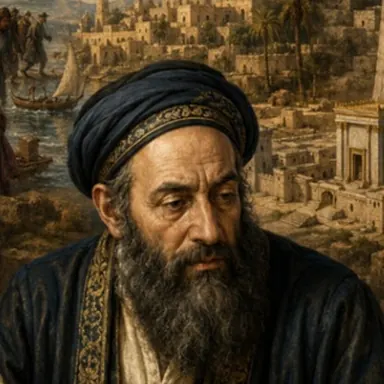
Rabbi Yosef Corcos (Mahari Corcos)
11 min read2,228 words
Summary
This article surveys the figure and the monumental contribution of Rabbi Yosef Corcos (Mahari Corcos), one of the sages of Spain after the expulsion, who was active in Egypt and Jerusalem during the 16th century. His principal work is a systematic commentary on Maimonides' (Rambam's) "Mishneh Torah," focusing uniquely on subjects neglected by earlier commentators, such as the commandments dependent on the Land, the Temple service and the laws of purity. The text emphasizes how Mahari Corcos served as a critical connecting link between the scholarly tradition of Spain and modern codification, chiefly thanks to his decisive influence on the rulings of Rabbi Yosef Karo and on the foundational books of halakha. By means of a methodology that adheres to the plain meaning and to the Talmudic sources, Mahari Corcos succeeded in providing a logical and textual foundation for the most difficult parts of Maimonides (Rambam), and thereby became a guide for the generations that followed in applying the Torah in all areas of life.
The Teaching and Thought of Mahari Corcos: An Analysis of His Figure, His Exegetical Enterprise and His Influence on the Codification of Halakha in the 16th Century
Rabbi Yosef Corcos, known by his literary appellation Mahari Corcos, represents one of the most fascinating and influential figures in the world of halakha and commentary at the beginning of the modern era. His work, which took place at the meeting point between the destruction of the Torah center in Spain and the rise of the new centers in Egypt and the Land of Israel, forms an essential connecting link for understanding the development of the Maimonidean literature (commentary on Maimonides (Rambam)) and the consolidation of halakhic ruling. This study seeks to survey his life, to analyze his methodology of writing, and to examine the depth of his influence on the giants of the following generations, foremost among them Maran Rabbi Yosef Karo.
Historical and Social Background: The 16th Century as a Turning Point
The 16th century was marked by the "golden age" of the sages of Spain after the expulsion. Waves of emigration of the Jews of Spain and Portugal swept across the basins of the Mediterranean, bringing with them an immense cultural, scholarly and spiritual heritage to the cities of the Ottoman Empire. Rabbi Yosef Corcos was born in Spain around the year 5250 (1490), a few years before the final expulsion.[1] His childhood and youth were spent in the shadow of wandering, a process that shaped his personality as a multicultural sage who combined the precise Spanish tradition with the dynamism of the new centers in the East.
His arrival in Egypt was not accidental. Egypt of that period, under Mamluk rule that passed to Ottoman rule, served as a refuge for a flourishing Spanish community, which found there an old and well-established community.[1] In Egypt Mahari Corcos was active alongside figures such as the Radbaz, and together they laid the foundations for a method of study that focused on a return to the primary sources and on systematic analysis of Maimonides' (Rambam's) "Mishneh Torah."
His Exegetical Enterprise: Filling the Gap in the Commentary on the "Mishneh Torah"
Mahari Corcos's principal and most significant work is his commentary on Maimonides' (Rambam's) "Mishneh Torah." To appreciate the magnitude of the achievement, one must understand the map of commentary on Maimonides (Rambam) in the 16th century. Until the days of Mahari Corcos, the most comprehensive and accepted commentary was the "Maggid Mishneh" by Rabbi Vidal of Tolosa, written in the 14th century. However, the "Maggid Mishneh" explained only those parts of Maimonides (Rambam) dealing with laws that apply in the present time, such as the laws of the Sabbath, festivals, women and damages.[1]
The laws dealing with the commandments dependent on the Land, with the Temple and with the laws of impurity and purity were left without a systematic and comprehensive commentary pointing out their sources in the two Talmuds. Mahari Corcos identified this lacuna and devoted his life to commenting on four principal books:
- Sefer Zera'im (Book of Seeds): which includes the laws of terumot, tithes, the Sabbatical year and the Jubilee—subjects that became more relevant than ever with the growth of the Jewish settlement in the Land of Israel.[1]
- Sefer Avodah (Book of Temple Service): which deals with the structure of the Temple and the service of the public sacrifices.
- Sefer Korbanot (Book of Offerings): which deals with the laws of private sacrifices.
- Sefer Taharah (Book of Purity): which deals with the complex system of the laws of impurity, renowned for their enormous difficulty of study.[1]
Mahari Corcos's choice to focus precisely on these areas attests to a broad view of the entire Torah as a single unit, even in those parts that seem at first sight to be "halakha for the messianic era." He refused to accept a situation in which extensive parts of Maimonides (Rambam) were studied without a clear foundation in the sources, and he acted as a "halakhic detective" to locate the sources in the Babylonian Talmud, the Jerusalem Talmud, the Tosefta and the halakhic midrashim.[1]
The Methodology of Research and Writing
Mahari Corcos's exegetical method is marked by philological precision and by adherence to the plain meaning. He avoided the pilpul characteristic of the yeshivot of Ashkenaz and Poland at that time, and instead adopted the classical Spanish approach, which seeks to understand the words of Maimonides (Rambam) from his own words and from his direct sources.[1]
His work can be divided into several methodological stages:
- Identifying the source: For every law in Maimonides (Rambam), Mahari Corcos searches for the Tannaitic or Amoraic source. In cases where Maimonides (Rambam) ruled against the unattributed view in the Gemara, he investigates whether the source is in the Jerusalem Talmud or in the Tosefta.
- Establishing the text: He uses accurate manuscripts of Maimonides (Rambam) in order to ascertain that the difficulty the commentators encountered does not stem from a scribal error.[1]
- Resolving the objections of the Raavad: Mahari Corcos acts as a "defense counsel" for Maimonides (Rambam) against the sharp objections of the Raavad of Posquières, showing how the words of Maimonides (Rambam) rest on solid foundations that at first glance escaped the notice of the critic.
- Use of the Jerusalem Talmud: Mahari Corcos's uniqueness is evident in his extensive and in-depth use of the Jerusalem Talmud, especially in the order of Zera'im, where the Babylonian Talmud is relatively sparse.
The Connection with Maran Rabbi Yosef Karo: Hidden and Open Influence
One of the central insights in the study of Mahari Corcos's work is the extent of his enormous influence on Rabbi Yosef Karo. The author of the "Beit Yosef," when he came to write his commentary "Kesef Mishneh" on Maimonides (Rambam), saw in Mahari Corcos's commentary the fundamental basis for his work.[1]
Rabbi Yosef Karo quotes Mahari Corcos in more than two hundred places in his works, usually with reverence and with explicit mention of his name. However, scholars point out that Rabbi Yosef Karo often cites the words of Mahari Corcos without mentioning his name, on the assumption that these explanations are so basic and agreed upon that there is no need to attribute them.[1] This fact attests that Mahari Corcos was not just "another commentator," but the teacher and guide of the author of the "Shulchan Arukh" in all that concerns the orders of Zera'im, Avodah and Korbanot.
This influence created a "chain of transmission" through which the novel insights of Mahari Corcos reached all students of Torah. Whereas Mahari Corcos's original work remained in rare manuscripts and did not achieve wide circulation in print until recent centuries, the hard core of his commentaries was absorbed into the "Kesef Mishneh," printed in the margins of Maimonides (Rambam) in all editions.[1]
His Teaching on the Commandments Dependent on the Land: Pioneering in Jerusalem
At the end of his life Mahari Corcos went up to Jerusalem, a step that had both declarative and halakhic significance.[1] The Jerusalem of the early 16th century was a focus of stormy halakhic debates, including the famous controversy over the renewal of ordination (semikhah), in which his colleagues and contemporaries were involved. Mahari Corcos's work on the order of Zera'im gained added force with his residence in the Land of Israel.
He was not content with a theoretical commentary on the laws of terumot and tithes, but sought to examine the practical application of Maimonides' (Rambam's) approach in the renewed reality of the Land of Israel. His discussion of the obligation of the commandments in the present time, of the definition of the boundaries of the Land and of its holiness, forms the foundation of all halakhic discussion of these issues to this day. His leadership was marked by a broad vision that does not separate sacred study from the day-to-day leadership of the public.[2, 3]
The Realistic Conception of Redemption
Mahari Corcos belonged to the school that regarded engagement with the laws of the Temple and the sacrifices as part of an active process of preparation for redemption. Unlike mystical approaches that waited for a miracle from Heaven, Mahari Corcos believed that halakhic clarity is the key to the return to Zion. If the public understands the details of the Temple service (Sefer Avodah) and the ways of purification (Sefer Taharah), the transition from life in exile to life in a kingdom will be smooth and possible.
The Fate of the Manuscripts and the Late Printing
Despite its decisive importance, Mahari Corcos's work went through a complex historical journey before it reached the modern Jewish bookshelf. The commentary on Sefer Zera'im was first printed in Izmir only in the year 5517 (1757), more than two hundred years after his death.[1] The remaining parts of the commentary, on Sefer Avodah and Sefer Korbanot, remained in manuscript in various libraries around the world (such as the Oxford library and the National Library in Jerusalem) and were printed in full only in recent generations.[1]
One of the great losses is the commentary on Sefer Taharah. Although it is known that Mahari Corcos wrote a comprehensive commentary on this book, the vast majority of it was lost in the turmoil of time. Only a few fragments survived and were printed in the new editions (such as the Frankel edition), and they attest to the depth and precision that characterized the complete work.[1]
Comparison with Commentators of His Generation
To understand the uniqueness of Mahari Corcos, he must be compared with other sages who were active in the Ottoman sphere at that time. The Radbaz (Rabbi David ben Zimra), who was his close colleague in Egypt, also wrote a commentary on Maimonides (Rambam), but his commentary had a different character: it focused more on resolving local difficulties and less on building a systematic foundation of sources for each and every law.[1]
On the other hand, Rabbi Avraham de Boton, the author of the "Lechem Mishneh," was active a generation later in Salonika.[4] The "Lechem Mishneh" focused on pilpul and on resolving internal contradictions within the words of Maimonides (Rambam), whereas Mahari Corcos remained faithful to the method of sources and plain meaning. It may be said that Mahari Corcos laid the "bricks" (the sources), and later commentators built the logical stories above them.
Insights into His Leadership and His Public Teaching
From the introductions to his works and from the references of his contemporaries emerges the figure of a leader connected to the needs of the hour. He stressed the importance of study in a "fellowship" and in close attachment to companions, as reflected in the descriptions of the life of Torah in Jerusalem and in Egypt.[2, 3] His teaching was not shut away within the walls of the study hall; he saw Torah study as a tool for shaping the national identity of the refugees who had come from Spain.
He stressed the need to understand the "order of the generations" and the school of each author, out of the understanding that every halakhic authority represents a particular school.[3] For him, Maimonides (Rambam) was the embodiment of the distillation of the Oral Torah, and his commentary was intended to make this distillation accessible to the generations to come.
Summary and Implications for the Future
The work of Mahari Corcos is a testimony to the power of creative commentary to rebuild a spiritual world that had been destroyed. Within the fifty years of his life, he succeeded in establishing a literary enterprise that filled the greatest gap in the commentary on Maimonides (Rambam). His influence on Rabbi Yosef Karo fixed his words as an inseparable part of the Jewish halakhic canon.
Today, with the return of the Jewish people to its Land and the growing engagement with the commandments dependent on the Land and with studies of the Temple, Mahari Corcos's commentary is experiencing a "renewed flowering." It is no longer a hidden manuscript, but a foundational book studied in all the yeshivot and study halls that deal with these orders. His legacy teaches that precisely out of wandering and destruction it is possible to grow toward a solid Torah edifice that encompasses all the spheres of Jewish life—from the agricultural field in the Land of Israel to the Holy of Holies.
Sources4
- 1.יוסף קורקוס - ויקיפדיה, he.wikipedia.org/wiki/יוסף_קורקוס
- 2.בתוכן: - מכון שלמה אומן, machonso.org/uploads/images/242A.pdf
- 3.לספרי הרמב"ם, files.anash.org/uploads/2021/12/המבוא-לספרי-הרמבם.pdf
- 4.מחברים | מקורות מתוך ספריית ספריא, sefaria.org.il/topics/category/authors