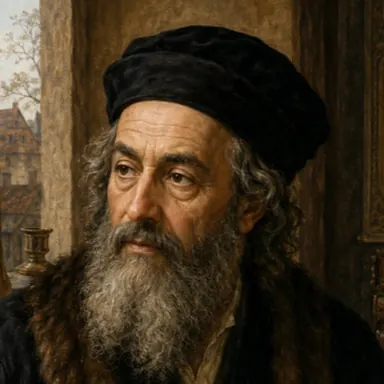
Rabbi Yaakov Molin and the Shaping of the Character of Ashkenazi Jewry
15 min read2,966 words
Summary
This text surveys the life and teaching of Rabbi Yaakov Molin (the Maharil), a key figure who rehabilitated Ashkenazi Jewry after the crises of the 14th century and shaped its halakhic identity for generations. The survey highlights the institutionalization of rabbinic authority through the title "Morenu" and the establishment of local custom as a central tool for preserving cultural and religious continuity in the face of harsh historical upheavals. The author describes how the Maharil combined communal leadership in times of distress, broad scientific learning and the meticulous preservation of the liturgical and musical tradition of the synagogue. Ultimately, the article makes clear that the Maharil's influence extends beyond the bounds of his time, since his rulings and practices became the binding foundation of the rulings of the Rema and, through them, the cornerstones of the Ashkenazi custom familiar to us today.
The Work and Torah Teaching of the Maharil: Rabbi Yaakov Molin and the Shaping of the Character of Ashkenazi Jewry
The history of Jewish halakha in the late Middle Ages is marked by one central figure whose influence extends beyond the bounds of the time and place in which he was active. Rabbi Yaakov ben Moshe ha-Levi Molin, known by the acronym Maharil (Morenu ha-Rav Yaakov Levi, "our teacher Rabbi Yaakov Levi"), represents one of the most challenging and fruitful periods in the history of European Jewry.[1, 2] The Maharil, who was active in the 14th and 15th centuries, was not only a halakhic decisor of great authority but a spiritual architect who rebuilt the ruins of Ashkenazi Jewry after the persecutions of the "Black Death" and shaped the backbone of Ashkenazi custom as it is known today.[3, 4] His work spans many fields: from communal leadership in times of war, through the setting of the order of study in the yeshivot, to the liturgical and musical tradition of the synagogue.[4, 5, 6]
The Historical and Social Background to the Rise of the Maharil's Leadership
To understand the force of the Maharil's influence, one must examine the complex geopolitical and religious reality of Central Europe in the 14th century. Ashkenazi Jewry experienced a series of demographic and cultural disasters, from the Crusades to the "Black Death" massacres (1348–1350), which brought about the destruction of entire communities and the undermining of ancient traditions that had been transmitted orally.[3, 4] The splendid communal structure of the Shum communities (Speyer, Worms and Mainz) faced the danger of disintegration, and an urgent need arose for a leadership capable of uniting the remnants and creating a sense of continuity.[4, 7]
The Maharil was born in Mainz around 1360 (or 1365 according to some opinions), to a distinguished rabbinic family.[2, 8, 9] His father, Rabbi Moshe ha-Levi Molin, was the rabbi of the community and a leading figure in the communal ordinances of the time.[1, 6] From a young age Yaakov stood out for his talents, and he was sent to study in the Torah centers of Austria, which at that time had become a refuge and a growing Torah center for the refugees of the massacres in Germany.[8, 10] His studies in Austria, under the guidance of Rabbi Shalom of Wiener Neustadt and Rabbi Meir ha-Levi, instilled in him the Austrian method of study, which was characterized by precision and by the preservation of ancient customs.[6, 10]
The Institutional Revolution: The Title "Morenu" and the Regulation of the Ashkenazi Rabbinate
One of the Maharil's most decisive contributions to the communal structure was the institutionalization of rabbinic authority. In a period in which wanderings multiplied and Torah centers were destroyed, a situation arose in which people who had not been properly ordained took upon themselves judicial and halakhic powers, especially in matters of personal status (divorce and betrothal).[6, 10] The Maharil, together with his teacher Rabbi Shalom of Austria, began to confer the title "Morenu" ("our teacher") on distinguished Torah scholars only.[6, 10]
This step was not merely a matter of personal prestige but a regulatory tool intended to protect the purity of the Jewish family. The ordinance laid down that one who does not hold the title "Morenu" may not deal with matters of divorce and marriage, and thus halakhic control was returned to a central and authorized leadership.[6] This revolution created the familiar structure of the communal rabbinate in Ashkenaz, in which the rabbi is the supreme authority not only in matters of halakhic instruction but also in the institutional and legal administration of the community.[6, 10]
The Yeshiva of Mainz and the Maharil's Method of Study
After his return to Mainz in 1387, the Maharil founded a great yeshiva that became a center of attraction for students from all over Europe.[4, 10] The yeshiva was a unique institution in which the students lived in the Maharil's home and were supported by the community and the leadership of the state, which attests to his high public standing and to the importance of education in his eyes.[8, 10]
The Maharil's method of study emphasized the connection between theoretical study and practical ruling. He rejected "futile pilpul" – sharp-witted study that has no real halakhic benefit – and urged his students to strive to clarify the words of the Rishonim in order to arrive at the truth of the Torah.[11, 12] At the same time, he encouraged in-depth pilpul (Torah debate) as a tool for the fine understanding of the Talmudic discussions.[13] From his yeshiva came the great sages of the next generation, first among them Mahari Weil (the Maharyu), whose rulings became a cornerstone of later Ashkenazi halakha.[4, 5, 10]
His Halakhic Teaching: "The Father of the Customs of Ashkenaz" and the Sanctification of Tradition
The Maharil's most famous contribution is undoubtedly in the field of custom. The Maharil lived and worked in a period in which many traditions faced extinction, and he took upon himself the task of documenting, fixing and sanctifying the customs practiced in the communities of Ashkenaz.[1, 2] His halakhic approach was based on the principle of "the custom of our fathers is in our hands," and he saw communal custom as a source of authority no less than the written halakha.[14]
In his book "Minhagei Maharil" ("The Customs of the Maharil"), which was compiled by his student Zalman of St. Goar, the ways of life of the Jews of Germany are described in minute detail: from the laws of tzitzit and prayer to the customs of weddings, mourning and the order of the festivals.[2, 6, 9] The Maharil refused to change customs even when they seemed puzzling, out of an understanding that custom is the living expression of the bond between the nation and its Creator.[14, 15] His influence was so great that the Rema (Rabbi Moshe Isserles) based a considerable part of his glosses to the Shulchan Arukh on the rulings of the Maharil, and thereby made them the common heritage of all Ashkenazi Jewry.[1, 2, 16]
The Philosophy of Custom and Its Inner Logic
The Maharil did not see custom as merely a ceremonial act, but as an entire system of religious knowledge and understanding. He argued that a local custom should not be changed even for the sake of a "logical reason," since custom represents the accumulated wisdom of the generations.[14] He sought to find a halakhic basis for existing customs rather than abolish them, and thereby created harmony between the oral tradition and the written sources.[14] This conception gave the communities spiritual security and the ability to withstand external social changes.[3]
He was particularly strict in matters of liturgy (the wording of the prayers). The Maharil, who also served as a cantor, fixed set texts for certain prayers, such as "Kol Nidrei" and the orders of the Selichot, and warned against any change in them.[2, 4, 17] He saw the melodies of prayer as an inseparable part of the sanctified tradition, and coined the term "melodies from Sinai" to describe ancient tunes from which one may not deviate.[2, 17]
The Maharil as Cantor and Composer of Melodies: The Connection between Sound and Holiness
The Maharil's figure as a cantor (shaliach tzibbur, prayer leader) is unique among the halakhic decisors of the Middle Ages. He did not see the cantorate as a secondary or aesthetic role, but as a supreme spiritual mission.[4, 8] The Maharil had a beautiful voice, and he invested great effort in shaping the experience of the congregation in the synagogue, especially on the High Holy Days.[8] He believed that the right melody can stir the heart to repentance and deepen the intention in prayer.[8]
Many melodies attributed to him were preserved in the community of Mainz until the modern period (before the Second World War).[2, 4, 17] The Maharil emphasized the importance of the fixed melodies (the "traditional" melodies), and argued that they are an inseparable part of the identity of the community.[2, 17] His insistence on preserving the melody as part of custom became a cornerstone of Ashkenazi cantorial practice, and it is mentioned by the Rema in the laws of prayer as a binding halakhic requirement: "A person should not deviate from custom, even in melodies."[16, 17]
Leadership in Time of Distress: The Maharil and the Hussite Wars
The Maharil's public leadership faced its greatest test during the Hussite Wars in Bohemia (around 1420–1421).[8, 9] These wars, which were wars of religion within the Christian world, brought with them a wave of persecutions against the Jews in Bavaria and along the banks of the Rhine.[5, 9] The Jewish communities were in real physical danger as a result of the advance of the armies and of the change in the attitude of the authorities.[5, 6]
When the communities turned to the Maharil for help, he led a combined spiritual and organizational response. He decreed a severe fast of three consecutive days (day and night) on the entire community, including children and infants (with a certain degree of stringency), in order to arouse heavenly mercy.[6, 8, 10] At the same time, he acted on the political level before the governing authorities to secure protection for the Jews.[8, 10] It is related that following the prayers and fasts, the threatening armies dispersed and the danger passed.[5, 6] This event strengthened the Maharil's standing as a protector of the people and as one whose prayer is heard in time of trouble.[6, 8]
Broad Learning: Astronomy and Science in the Service of Halakha
Although the Maharil was focused on the world of the Torah, he did not ignore the scientific knowledge of his time. He showed great interest in astronomy, a field that was essential for fixing the dates of the Hebrew calendar and for understanding halakhic questions concerning the times of day and night.[2, 10] The Maharil used scientific instruments to solve astronomical problems and was well versed in the book "Shesh Kenafayim" ("Six Wings") by the composer and astronomer Immanuel ben Yaakov Bonfils.[10, 18]
The book "Shesh Kenafayim" contained tables for calculating solar and lunar eclipses, and it is considered one of the important scientific works of the 14th century.[18] The fact that the Maharil engaged in this field attests to a broad approach that sees science as an essential auxiliary tool for understanding the Torah and observing it precisely.[2, 18] In addition, he mastered various German dialects and had a capacity for poetic and measured writing, which helped him in communicating with the various communities and with the intellectual world of his time.[10]
The Maharil's Attitude to Questions of Faith and Halakhic Tolerance
The Maharil worked within a very conservative framework, but he showed a deep understanding of human complexity. Although he rejected engagement in abstract philosophy as a way of life, he showed tolerance toward those who deviated somewhat in their opinions as long as they remained loyal to the practice of the commandments.[10]
A prominent example of this is his ruling concerning a man who denied the biblical basis of the resurrection of the dead but accepted it as part of the received tradition.[10] The Maharil ruled that this man's ritual slaughter was valid, out of an understanding that his sin stemmed from an intellectual error and not from a desire to rebel against the Torah.[10] This approach reflects a responsible leadership that seeks to preserve the cohesion of the community even in the face of challenges to faith.[10]
The Maharil's Influence on Later Halakhic Ruling and on the Rema
It is impossible to exaggerate the importance of the Maharil for the shaping of the Ashkenazi "Shulchan Arukh." When Rabbi Moshe Isserles (the Rema) wrote his glosses on the Shulchan Arukh of Rabbi Yosef Karo, he sought to bring the tradition of Ashkenaz as a counterweight to the Sephardi tradition.[14, 16] The central and most authoritative source that stood before his eyes was the Maharil.[1, 2, 16]
The Rema quotes the Maharil hundreds of times, and in many cases he rules that the halakha follows him against other decisors, solely because Ashkenazi custom was accepted according to his view.[16] The Maharil's rulings in the areas of prayer, the Sabbath, the festivals and kashrut became binding on all the communities of Ashkenaz and Poland, and they shape the face of Orthodox Judaism to this very day.[1, 4, 16]
Influence in Specific Areas
His Books and Writings: The Maharil's Literary Enterprise
The Maharil himself did not publish his books in his lifetime, but his students invested enormous effort in documenting his teaching.[2, 6, 10] The most famous work is the "Sefer ha-Minhagim" ("Book of Customs," or "Minhagei Maharil"), which was first printed in Sabbioneta in 1556.[1, 9, 10] The book includes a vivid and fascinating description of Jewish life in Ashkenaz, and it is considered the most important historical and halakhic source for its period.[2, 5]
In addition to the Book of Customs, there are the "Responsa of the Maharil" (She'elot u-Teshuvot), which contain hundreds of halakhic responses sent to the rabbis of the generation from all over Europe.[1, 8] These responsa deal with the problems of the hour, monetary law, marital law and questions of communal leadership.[2] In recent years annotated and accurate editions of his writings have been published by Machon Yerushalayim, which make it possible to study his teaching from the original manuscripts and to ascertain the precise form of the customs.[2, 19]
The Maharil's Personal Leadership and Character
Alongside his genius in Torah, the Maharil was known for his great humility and his sincere concern for every Jew. It is related of him that when he walked in the street, he used to carry a small Chumash with him, so that whoever rose in his honor would be giving the honor to the Torah and not to him personally.[1] He was very careful about the honor of Torah scholars and demanded of the householders of the community that they hold the students of the yeshiva dear and help them.[1]
His concern for the poor and the needy was renowned, and in his sermons he placed great emphasis on the commandment of charity and on the respectful attitude that must be shown toward the poor of the community.[10] The Maharil saw leadership as a matter of personal example, and he did not hesitate to apologize if he felt that he had been excessively strict in his ruling or had behaved improperly toward a certain person.[10]
His Death and His Legacy for the Generations
Rabbi Yaakov Molin died on the 22nd of Elul 5187 (1427) in the city of Worms.[2, 4, 9] He was buried in the city's ancient Jewish cemetery, near the grave of the Maharam of Rothenburg, a figure who served for him as a model and a source of inspiration.[2, 4] His grave became a site of pilgrimage, and his memory was preserved with reverence among German Jewry for hundreds of years.[2]
The Maharil's legacy continues to live in every Ashkenazi synagogue and in every Jewish home that follows the tradition of its forefathers.[4] He was the man who succeeded in taking the remnants of the Torah of the Middle Ages and casting them into a stable and fixed mold that would endure even through the upheavals of the generations to come.[3] To a great extent, the Maharil is the bridge that connected the world of the early sages of Ashkenaz (the Tosafists) with the institutionalized halakhic world of the "Acharonim."[1, 16]
The Book of the Customs of the Maharil remains to this day one of the most frequently quoted books in halakhic literature, and it serves as a primary source for understanding the Jewish way of life in late medieval Europe.[1, 2] The figure of the Maharil, combining outstanding scholarship, musical creativity, public responsibility and uncompromising halakhic authority, remains one of the shining beacons of Jewish history.[3] His work proves that even out of destruction and massacres, a mighty spiritual edifice can be built that will stand for days and years.[3]
Sources20
- 1.COL מרכז התקשורת החב״די - אבי המנהגים האשכנזיים: סיפור חייו המרתק של המהרי"ל - חב״ד און ליין, col.org.il/news/137727
- 2.מהרי"ל – ויקיפדיה, he.wikipedia.org/wiki/מהרי"ל
- 3.המהרי"ל: על גדולי חכמי אשכנז בתקופת המגיפה השחורה - BeitChabad.com - בית חב"ד, he.chabad.org/library/article_cdo/aid/3428369
- 4.רבי יעקב מולין – ויקישיבה, yeshiva.org.il/wiki/index.php/רבי_יעקב_מולין
- 5.Yaakov ben Moshe Levi Moelin (Maharil) | jewishmusic - Jewish Music Research Centre, jewish-music.huji.ac.il/en/content/yaakov-ben-moshe-levi-moelin-maharil
- 6.MÖLLN (MOLIN) - JewishEncyclopedia.com, jewishencyclopedia.com/articles/10935-molln-molin
- 7.קהילות שו"ם - ויקיפדיה, he.wikipedia.org/wiki/קהילות_שו"ם
- 8.Rabbi Jacob Halevi Moelin (Maharil) - (5120-5187 - 1360-1427 ) - Chabad.org, chabad.org/library/article_cdo/aid/112354/jewish/Rabbi-Jacob-Halevi-Moelin-Maharil.htm
- 9.Yaakov ben Moshe Levi Moelin - Wikipedia, en.wikipedia.org/wiki/Yaakov_ben_Moshe_Levi_Moelin
- 10.Jacob ben Moses Moellin - Jewish Virtual Library, jewishvirtuallibrary.org/moellin-jacob-ben-moses
- 11.פלפול - ויקיפדיה, he.wikipedia.org/wiki/פלפול
- 12.ואין למו מכשול – הלכות תלמוד תורה - תורת אמת, toratemetfreeware.com/online/f_01603.html
- 13.פלפול - חב"דפדיה, chabadpedia.co.il/index.php/פלפול
- 14.HBreader - בני בנים - חלק א, beta.hebrewbooks.org/reader/reader.aspx?sfid=21434
- 15.Untitled, thetorah.com/article/the-maharil-and-the-sanctification-of-custom
- 16.hamichlol.org.il,
- 17.hamichlol.org.il/מהרי"ל
- 18.ניגוני סיני - ויקיפדיה, he.wikipedia.org/wiki/ניגוני_סיני
- 19.Moellin, Jacob ben Moses | Encyclopedia.com, encyclopedia.com/religion/encyclopedias-almanacs-transcripts-and-maps/moellin-jacob-ben-moses
- 20.בין ראשונים לאחרונים - ישיבת הר ברכה, yhb.org.il/shiurim/ravzeev5158/