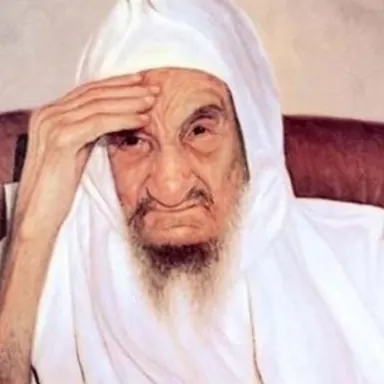
Holiness and asceticism as a tool of public leadership – personal devotion that radiates onto a whole people.
Biography
A kabbalist and tzaddik of the Abuhatzeira family, grandson of the "Abir Yaakov". He came from Morocco and settled in Netivot, which became a centre of pilgrimage. He was known for his asceticism, his prayers and his blessings.
Migration
MoroccoJerusalemYavne
The Road to Sinai
The archive doesn’t yet record an unbroken road from Rabbi Israel Abuhatzeira to the chain of transmission: the trail reaches back to Rabbi Yaakov Abuhatzeira and stops there.
The Figure, Work and Torah Teaching of Rabbi Israel Abuhatzeira (the Baba Sali)
13 min read·2,517 words
Summary
This text surveys the life and thought of Rabbi Israel Abuhatzeira, known by his epithet the Baba Sali, presenting him as an exemplary figure who combined extreme asceticism, profound Torah knowledge and charismatic public leadership. The source details his roots in the illustrious Abuhatzeira dynasty in Morocco, the special historical bond he formed with Chabad Hasidism, and his decisive influence on the spiritual and cultural sphere in the State of Israel, and in particular in the town of Netivot. Alongside a description of his ascetic practices, the article highlights his moral teaching in his book "Ahavat Yisrael" and deals with the process by which his burial site became a national pilgrimage center characterized by religious and economic institutionalization. In sum, the work seeks to illuminate the figure of the tzaddik as a bridge between the tradition of North African Jewry and modern society, while examining the spiritual and family legacy that remained after his death.
Introduction: The Roots of the Dynasty and the Growth of Leadership
Rabbi Israel Abuhatzeira, known in modern Jewish history by his epithet "the Baba Sali," represents a unique model of charismatic leadership that combines a halakhic decisor, a divine kabbalist and a highly influential public leader.[1] He was born on 1 Tishrei 5650 (September 26, 1889) in the town of Rissani (Moulay Ali Cherif) in the Tafilalt province of Morocco, into a family that had shaped the spiritual world of North African Jewry for generations.[1, 2, 3] His father, Rabbi Masoud Abuhatzeira, was the eldest son of Rabbi Yaakov Abuhatzeira, author of the famous kabbalistic work "Abir Yaakov."[1, 4] From his earliest childhood, the native language and living environment of Rabbi Israel were made up of Arabic and Berber, the languages characteristic of the geographical region of southern Morocco.[2]
His spiritual growth took place within a strict family framework, in which its sons were required to devote their lives totally to the service of God.[4, 5] Already in his youth he stood out for his extreme diligence of some 18 hours a day, while completely withdrawing from worldly affairs and pleasures.[4] Alongside profound theoretical study of the revealed and hidden Torah, Rabbi Israel trained in practical sacred skills that demand precision and particular holiness, among them the writing of STaM (Torah scrolls, tefillin and mezuzot), the laws of ritual slaughter and circumcision.[4] This depth laid the foundation for his becoming a halakhic and meta-halakhic authority for the Jews of Morocco, and later for diverse communities in the State of Israel.[1, 6]
The Family Structure and the Continuity of the Dynasty
Rabbi Israel's personal and family life was interwoven with a deep commitment to the continuity of the Torah dynasty, with his close family members holding central public and spiritual roles.[3, 7] From his marriage to his wife, Rabbanit Freha née Amsalem, nine children were born, but only three of them reached adulthood.[3] This continuity, with its family and public ties, is described in the following table:
The early death of his eldest son, Rabbi Meir, in 5743 (1983), was perceived as a deep family and public tragedy, since Rabbi Israel saw in him the most direct and qualified successor to his spiritual path.[3, 7]
Divine Service, Asceticism and Charismatic Leadership
The inner spiritual world of Rabbi Israel Abuhatzeira was founded on exceptional practices of abstinence and asceticism, which went beyond what was customary in his generation and served as the basis on which his mystical authority rested.[5, 8] For fifty years he resolved to abstain entirely from eating meat, and he barred himself from the pleasures of the material world.[8] On weekdays he refrained even from eating fish and restricted his diet in the extreme, while practicing prolonged fasts of speech and continuous fasts from one Sabbath to the next.[4, 5] Only at the end of his life, when his body had weakened significantly and his physical strength had waned, was he forced to have his vow annulled for reasons of health.[8] This renunciation of asceticism was made out of a clearly altruistic motive – the wish to prolong his days so that he could continue to help and bless those who turned to him.[8]
The epithet "Baba Sali," which means "the praying father" in Judeo-Arabic, derived directly from this way of life.[6] The crowds who came to his home sought to receive his blessing and to merit salvation, out of the perception that his extreme asceticism had refined his personality and made him a direct spiritual channel for conveying prayers.[6, 8] Rabbi Israel used to pray and plead for mercy for those who turned to him for long hours, until he felt that his prayer had been accepted and that his blessing would indeed be fulfilled in reality.[6]
The Turning Point in Erfoud and the Historical Bond with Chabad Hasidism
The public turning point in Rabbi Israel's life came in the wake of the murder of his elder brother, Rabbi David Abuhatzeira, may God avenge his blood.[1] This tragic event forced him to take upon himself the yoke of official leadership, and he was appointed to serve as rabbi and head of the rabbinic court in the town of Erfoud in Morocco.[1] In Erfoud his educational and national influence began to take shape, especially in light of the spiritual struggle he waged against the trends of modernization and secularization that had penetrated the Jewish communities.[1]
In the month of Iyar 5711 (1951), the Chabad emissary to Morocco, Rabbi Shlomo Matusof, arrived in Erfoud.[1] This meeting laid the foundation for a historic alliance between the Abuhatzeira dynasty and the Chabad movement and its leader, the Lubavitcher Rebbe.[1] Rabbi Israel worked together with Rabbi Matusof to establish a local Talmud Torah in Erfoud, and was a full and active partner in its expansion.[1] Their joint activity was intended to save Jewish children from studying at the local French school (the "Alliance" network), where only secular subjects were taught, with no religious content.[1] This bond became deeply personal and intellectual; Rabbi Matusof regularly stayed as a guest in the Baba Sali's home, and there, through long nights, the Baba Sali, his son the Baba Meir and Rabbi Matusof sat together and conversed about words of Torah, halakha, the Kabbalah of the Arizal and the Tanya.[1] In these conversations, differences of custom between Sephardim and Ashkenazim grounded in the esoteric teaching were clarified, with a display of deep mutual esteem.[1]
Immigration to the Land of Israel and the Intervention of the Lubavitcher Rebbe
In 5711 Rabbi Israel immigrated to the Land of Israel for the first time, but his encounter with the spiritual and social reality of the lives of the new immigrants from North Africa led him into a deep spiritual crisis.[1] Out of despair at the low spiritual state that prevailed in the transit camps and in the immigrants' settlements, and at the influence of secular state education, he considered leaving the country and emigrating to the United States.[1] He hoped that there he would be able to devote himself to his Torah study and his spiritual service in tranquility, without the public burdens that had accompanied him.[1]
This plan was halted following the direct intervention of the Lubavitcher Rebbe, who sent him letters of historical importance [1]:
A communal man and a leader in Israel: In a famous letter dated 9 Nisan 5712, the Rebbe analyzed the essence of the Baba Sali's role.[1] The Rebbe explained that Heaven had granted him unique powers and the standing of a leader whose voice thousands heed, and that he is therefore defined as an "ish klali" (a communal man) who is not permitted to concern himself with his private tranquility.[1] The Rebbe urged him to remain in the Land of Israel, to fight for the preservation of the faith of the Sephardic immigrants and to prevent their spiritual downfall.[1] Rabbi Israel accepted the Rebbe's words and immediately canceled the emigration plan.[1]
One of the elite: In an earlier letter of 26 Tevet 5712, the Rebbe addressed him with rare titles and called him "chad mi-bnei aliyah" ("one of the elite") – a concept that defines a completely righteous person in the Tanya.[1] The Rebbe encouraged him to establish educational institutions of pure holiness for the immigrants' children and to preserve the tradition of their fathers.[1]
Afterwards, Rabbi Israel returned periodically to Morocco and to France, where he used to stay at the Chabad yeshiva in Brunoy.[1] In 5724 (1964) he returned to the Land for good and settled at first in the town of Yavne.[1] However, he left the town and moved to Netivot because of a symbolic incident – a disparaging expression that the head of a local Lithuanian kollel uttered about the founder of Hasidism, the Baal Shem Tov.[1] This swift departure underscored his uncompromising commitment to the honor of the great masters of Hasidism and their teaching.[1]
His Torah Teaching and the Book Ahavat Yisrael
Although his figure was engraved in the public mind as a miracle worker, Rabbi Israel was a towering Torah genius, versed in all parts of PaRDeS.[1, 9] Throughout his life he wrote and composed several precious books containing deep commentaries and novellae, but these manuscripts were taken from his home under obscure circumstances.[9] The Baba Sali knew who had taken the writings and where they were being held, and whenever the painful subject came up in his home, he used to say to his son, Rabbi Baruch: "I know, my son, I know who took my writings, and I also know where they are."[9]
The principal work in his own hand that survived and was published is "Sefer Ahavat Yisrael."[10, 11] The book was reprinted from his holy autograph manuscript itself and contains wonderful explanations and commentaries, in a concise manner, on 127 commandments of the Torah alluded to in the verse "You shall love your neighbor as yourself."[11, 12] The author's original intention was to go on to allude to all 613 commandments of the Torah, but it is unclear whether the manuscript available to the printers was partial or whether the work was in fact never completed.[12]
In chapter 1 of the book, Rabbi Israel deals at length and systematically with the gravity of the sin of baseless hatred, which in his view is the main cause of the prolongation of the exile.[13] He analyzes human psychology and maps out four main factors that lead to this hatred [13]:
Rabbi Israel concludes this homily with a sharp call to rectify this bitter social sin, and stresses that only the removal of jealousy and hatred from the heart will allow the coming of the Messiah and the building of the Temple.[13] Alongside this exposition, the book includes profound homilies on the Giving of the Torah, the festival of Shavuot, Shabbat HaGadol, Shabbat Zakhor, and the virtue of charity.[11]
Several major biographical works have been written about his life and teaching, documented in the following table:
His Passing, the Establishment of the Grave Site in Netivot and the Succession Struggles
Rabbi Israel Abuhatzeira passed away in Netivot on 4 Shevat 5744 (January 8, 1984), at the age of 94.[1, 2, 18] His death marked the beginning of a fascinating sociological process of the institutionalization of holiness and pilgrimage in Israeli society.[18]
The development of the Baba Sali's grave in Netivot as a national center of religious worship went through several significant stages [18]:
The struggle over the succession to the Baba Sali's seat exposed deep family and religious tensions.[18] His son, Rabbi Baruch Abuhatzeira, declared himself the official successor, but most of the family members, as well as the Haredi newspaper "HaModia," sided rather with the grandson, Rabbi Elazar Abuhatzeira (the son of the Baba Meir), who enjoyed a cleaner public image in comparison with his uncle.[7, 18] In the end, physical control of the grave site remained in the hands of Rabbi Baruch's court, which manages the place through the association "Keren LeHantzachat Baba Sali" (the Fund for Commemorating the Baba Sali).[18]
Today the site draws some quarter of a million visitors each year on 4 Shevat, as well as crowds on Lag BaOmer.[18] Around the site a thriving industry of selling amulets and souvenirs has developed, in which stones taken from the courtyard of the grave are sold for hundreds of shekels to obtain protection and blessing.[18]
Long-Term Cultural Influence and Summary
The influence of Rabbi Israel Abuhatzeira extended beyond the direct family and communal boundaries of his community.[1, 18] He became a national symbol of holiness and of connection to tradition, accepted across different factions of Jewish society in Israel and in the Diaspora.[1] The power of this charisma left a deep imprint on the structure of spiritual leadership in the south of the country.[18, 20]
A prominent example of this cultural influence is the figure of Rabbi Yisrael Abergel, one of the senior Torah leaders in Netivot today and head of the "HaMeir LaAretz" institutions, who was named at birth after the Baba Sali.[20] Rabbi Abergel, the son and successor of Rabbi Yoram Abergel, works in Netivot inspired by the same halakhic and kabbalistic teaching that combines the rulings of the Shulchan Arukh with the world of Hasidism and the esoteric, as printed in his books "Chalev HaAretz" and "Mesilot El HaNefesh."[20]
In sum, the figure of Rabbi Israel Abuhatzeira represents a unique synthesis of immense Torah diligence, extreme ascetic abstinence, courageous social leadership in times of crisis in Morocco and in Israel, and a penetrating moral teaching reflected in his work "Sefer Ahavat Yisrael."[1, 5, 11] His work served as a vital bridge between the communities of Moroccan Jewry and the new Israeli reality, and left a spiritual, institutional and architectural legacy that continues to shape the religious and cultural character of the State of Israel.[1, 18]
This article surveys the life and teaching of Rabbi Israel Abuhatzeira, known as the "Baba Sali," presenting him as a key figure who connected the Moroccan kabbalistic tradition with modern Israeli society. The text outlines the hierarchical structure of the illustrious Abuhatzeira dynasty and highlights the tzaddik's way of life, which was characterized by extreme abstinence, holiness and self-mortification alongside a profound mastery of the revealed and hidden Torah. Beyond describing his wanderings between Morocco and Israel, the source brings out his social teaching based on love of Israel, his unique bond with Chabad Hasidism, and the transformation of the town of Netivot into a bustling spiritual center. The aim of the writing is to clarify how the Baba Sali's leadership combined the power of prayer and wonders with halakhic authority and profound theology, which left an indelible mark on the Jewish public sphere in the twentieth century.
The Work and Torah Teaching of Rabbi Israel Abuhatzeira - the Baba Sali: His Figure, His Leadership and His Influence on Jewish Thought and the Public Sphere in the Twentieth Century
During the twentieth century, the Sephardic Torah world underwent enormous transformations, from the disintegration of the traditional communities in the lands of Islam to their renewed taking root in the Land of Israel. At the center of this historical and spiritual process stands the figure of Rabbi Israel Abuhatzeira, known by his epithet "the Baba Sali." His figure represents not only communal leadership or halakhic decision-making, but constitutes a living bridge between the ancient world of Moroccan Kabbalah and modern Israeli reality. The Baba Sali was born on 1 Tishrei, Rosh Hashanah 5650 (1889), in the town of Rissani in the Tafilalt province, Morocco, and died on 4 Shevat 5744 (1984) in Netivot.[1, 2, 3] His name, "Baba Sali," which in Aramaic and Moroccan Arabic means "the praying father" or "the sage of Israel," reflects the central essence of his work: his being a channel of prayer and of pleading for mercy on behalf of the community and the individual.[2, 4, 5, 6]
The Roots of the Dynasty and the Family Background: The Legacy of the "Abir Yaakov"
Understanding the figure of Rabbi Israel requires a dive into the depths of the history of the Abuhatzeira family, a family of sages, kabbalists and wonder-workers who served as the pillars of Moroccan Jewry for generations. The roots of the family are traced to Rabbi Shmuel Elbaz, who was a disciple of Rabbi Chaim Vital, the disciple of the holy Arizal.[2, 6, 7] The name "Abuhatzeira" (or Abihatzeira) arose, according to tradition, from a miracle story in which the father of the family sailed across the sea on a mat.[7] The key figure who shaped the spiritual legacy into which Rabbi Israel was born was his grandfather, Rabbi Yaakov Abuhatzeira, author of the "Abir Yaakov," who was one of the greatest kabbalists and halakhic decisors in Morocco in the 19th century.[1, 2, 6]
Rabbi Israel was born to Rabbi Masoud Abuhatzeira, the eldest son of the "Abir Yaakov," who served as head of the rabbinic court in Tafilalt.[1, 2, 3] This environment was saturated with holiness and unceasing Torah study. The family lived on a spacious estate that included a yeshiva in which Torah scholars studied day and night, and the father's rabbinic court was the center of the legal and spiritual life of the region.[2, 8] The atmosphere of the home was not only one of learning, but of extreme abstinence and a constant striving for cleaving to God. His father, Rabbi Masoud, was known for his asceticism and used to cover his eyes with his cloak when he left his home in order to avoid inappropriate sights.[2]
Table 1: The Line of Leadership of the Abuhatzeira Family up to the Baba Sali
His Spiritual Growth: The Tafilalt Period and the Practices of His Youth
Already in his youth Rabbi Israel displayed an inclination toward asceticism and deep study. From the age of six, his parents took care to protect the holiness of his sight, and his face was covered with a veil when he went out into the street.[8] At the age of only 12 he began to fast during the weeks of "Shovavim" (the Torah portions from Shemot to Terumah), hiding this from his parents so that they would not prevent him from the self-mortification.[2] His elder brother, Rabbi David, noticed his physical weakness and tried to dissuade him, but to no avail.[2] His way of life included rising at midnight for Tikkun Chatzot (the midnight lament), studying books of Kabbalah until dawn, immersing in the mikveh and praying the morning prayer at sunrise.[2, 3]
Rabbi Israel's development as a leader was accelerated by tragic events. In 5680 (1919), following tensions between the local population and the French authorities in Morocco, his elder brother, Rabbi David Abuhatzeira ("Ateret Rosheinu," "the crown of our head"), was executed by a local leader.[2, 6, 9] This event shook the community and caused the family to flee to the village of Boudenib. At the age of only 18 Rabbi Israel was appointed head of the yeshiva in Rissani, and after his brother's murder he became, at the age of 30, head of the rabbinic court and the supreme spiritual authority in the Tafilalt province and its surroundings.[1, 6, 8]
Abstinence and Personal Conduct: Refining the Body as a Spiritual Vessel
The Baba Sali's practices became renowned throughout the Jewish world. He was extremely strict about "guarding the eyes," and did not allow clean-shaven men to pray in his small minyan after his immersions.[8] In his adulthood he refrained from looking at unholy sights, and his home was closed to outside sights. He was careful to immerse in the mikveh every day, both in summer and in winter, and would even break ice in order to immerse in frozen water when necessary.[5, 8]
His daily schedule included frequent fasts and little sleep, only two to three hours a day.[8] In certain periods he practiced a "ta'anit hafsakah" – a continuous fast from the end of the Sabbath until the eve of the next Sabbath.[10] This way of life did not stem merely from an inclination to asceticism, but from a deep theological conception of refining matter in order to make the body a chariot for the Shekhinah.[11, 12] He believed that personal holiness is a necessary condition for the tzaddik's prayer to be accepted and to bring about salvations for the community.[5, 12]
The Moves Between Morocco and the Land of Israel: Exile and Redemption
Rabbi Israel's life was marked by ceaseless wanderings, which stemmed from the constant tension between his intense love for the Land of Israel and his deep commitment to his community in Morocco. He immigrated to Israel three times before he finally settled there, and each such move was accompanied by difficult spiritual dilemmas.[6, 8, 12]
The Stages of Immigration and Settlement
The first immigration (1920/1922): After the murder of his brother David, Rabbi Israel came to Jerusalem and was received with great honor. He studied at the "Beit El" yeshiva of kabbalists, which was a world center for the study of the teaching of the Rashash.[2, 6, 8] However, the spiritual and communal distress in Morocco, which had been left without stable spiritual leadership, forced him to return to lead his community.[8, 12]
The second immigration (1951): After the establishment of the State, he immigrated again and lived in Lod and in Jerusalem (the Baka neighborhood).[1, 2, 6, 12] During this period he tried to conceal his identity and to live as a simple Jew, but his identity was quickly revealed. After the death of Chief Rabbi Ben-Zion Meir Hai Uziel in 1953, he was offered the post of Sephardic Chief Rabbi of Israel (the Rishon LeZion), but he firmly refused any official position.[2] Because of the deterioration of the spiritual and educational situation among the immigrants from Morocco, he returned once more to the land of his birth in order to strengthen the community and prevent its assimilation into Western values.[2, 12]
The final immigration (1964): In this year he immigrated to Israel permanently. At first he lived in Yavne, where his son-in-law Rabbi Avraham Abuhatzeira (the Baba Hana) lived, and afterwards in Ashkelon.[1, 5, 8, 9] In 5730 (1970) he made his home in the town of Netivot, which thanks to him became a center of Torah and prayer that draws crowds.[1, 5, 8]
Table 2: A Chronology of the Stations of the Baba Sali's Life and Wanderings
His Torah Teaching: Combining the Revealed and the Hidden
Although Rabbi Israel was known to the wider public mainly as a wonder-worker and as a tzaddik whose blessings come true, he was an immense genius in both the revealed and the hidden Torah.[1, 3] He concealed his deep knowledge, but it was revealed in his conversations with great Torah scholars and in the few writings of his that were published. His figure represents the Sephardic ideal of the "comprehensive sage" – a person who masters all parts of PaRDeS (peshat, remez, derash, sod) and combines them in his daily conduct.[5]
The Work "Ahavat Yisrael": The Theology of the Commandment
The principal work attributed to him in manuscript is the book "Ahavat Yisrael," which was published after his death (5758) by his son, Rabbi Baruch Abuhatzeira. The book is based on an early manuscript of Rabbi Israel and deals with deep interpretations of the commandment "You shall love your neighbor as yourself."[13] In his work Rabbi Israel shows how 127 of the 613 commandments of the Torah are alluded to in this verse.[13, 14] The number 127 is not accidental and alludes to the connection between the years of the life of our matriarch Sarah and the spiritual structure of the people of Israel.
According to the testimony of his grandson, Rabbi Moshe Eliyahu Abuhatzeira, the Baba Sali's original intention was to allude to all 613 commandments within the commandment of love of Israel, but it is unclear whether the writing was lost or whether it was in fact never completed.[13] The choice to focus on "love of Israel" reflects the essence of his teaching: love for every Jew wherever he may be, without distinction of community or religious level, is the key to redemption and to doing the will of God. He saw love of Israel not only as a moral virtue, but as a kabbalistic and halakhic foundation through which all spiritual influx passes into the world.[1, 14]
Piyyutim and Religious Poetry: Longings for Redemption
Rabbi Israel continued the illustrious family tradition of writing piyyutim (liturgical poems) that combine longings for redemption, love of God and esoteric teaching. The most famous piyyut he composed is "Yodu Lekha Ra'ayonai – El Mibeten Yotzri."[13] This piyyut is sung in Moroccan communities and has received many performances. It expresses the submission of the soul before the Creator and the striving for cleaving to God. Unlike the piyyut "A'ufa Eshkona," which was written by his uncle, Rabbi Yitzhak Abuhatzeira [15, 16], Rabbi Israel's piyyutim bear a personal stamp of inner joy in the service of the Creator accompanied by suffering and abstinence.
In the Baba Sali's home in Netivot, song was an inseparable part of spiritual service. During the "hillulot" that he held in honor of tzaddikim, he was careful that every glass of drink be accompanied by a piyyut, and that only after the singing could one bless and drink.[10] Song was perceived as an instrument of spiritual elevation and of the joy of a commandment, which sweetens harsh judgments and allows salvation to descend into the world.[12]
The Affinity for the Teaching of Hasidism and the Bond with Chabad Hasidism
One of the most fascinating and unique aspects of the Baba Sali's teaching is the deep and special bond he maintained with Chabad Hasidism and with the Lubavitcher Rebbe. This bond, which began already in Morocco through the emissary Rabbi Shlomo Matusof, deepened over the years and became one of the pillars of his leadership.[1, 3]
The Study of the Teaching of the Baal Shem Tov
Rabbi Israel testified about himself that from the age of 15 he did not open a book that does not follow the path of the Baal Shem Tov.[12] He saw Hasidism as a direct continuation and an essential interpretation of the teaching of Sephardic Kabbalah. During his stay in France, he used to stay as a guest at the Chabad yeshiva in Brunoy and would study there with immense diligence, sometimes on a low chair almost on the ground throughout the night.[1, 6] He studied the Tanya and the discourses of Hasidism in depth and combined the kabbalistic intentions (kavanot) of Sephardic Kabbalah with the Hasidic service of the heart.
His esteem for Hasidism was so great that he left the town of Yavne and moved to Netivot because of a disparaging expression that a Torah figure in the town uttered about the founder of Hasidism, the Baal Shem Tov.[1] He also held immense respect for Rabbi Nachman of Breslov, used to study "Likutei Moharan," and stated that Rabbi Nachman and his disciple Rabbi Natan are the tzaddikim who will bring the Shekhinah out of exile.[4]
The Correspondence and the Bond with the Lubavitcher Rebbe
An extensive correspondence took place between the Baba Sali and the Rebbe, in which the Rebbe addressed Rabbi Israel with rare and extraordinary titles.[1, 3] The Rebbe encouraged him to act among Moroccan Jewry in the Land and abroad, and prevented him from emigrating to the United States in 1952, arguing that he was an "ish klali and a leader in Israel" who must remain close to his flock in the Holy Land.[1, 12]
The Baba Sali, for his part, saw the Rebbe as the leader of the generation and as the successor of the Baal Shem Tov in our generation.[12] He actively supported the Rebbe's "mitzvah campaigns" and encouraged his followers to join Chabad activities.[1] The bond between the two also included an exchange of books; the Rebbe sent the Baba Sali books of Hasidism, and the Baba Sali sent the Rebbe the books of his grandfather, the "Abir Yaakov."[1]
Table 3: Points of Contact and Ties with Chabad Hasidism
Despite his abstinence and his engagement with the esoteric teaching, the Baba Sali was deeply involved in public life and was an address for halakhic rulings and for counsel on current affairs. He was regarded as head of the rabbinic court and the supreme halakhic authority for all the Jews of Morocco, and many saw him as the successor of his grandfather in halakhic decision-making.[5, 8]
His Relations with Other Great Figures of the Generation
Rabbi Israel held immense respect for the great Torah scholars in the Land of Israel, and they for their part saw him as a holy and exalted figure. His relations with Rabbi Ovadia Yosef were warm and special. It is told that when Rabbi Ovadia Yosef would enter his room, the Baba Sali would recite, with God's name and kingship, the blessing "Blessed is He who has given of His wisdom to those who fear Him."[17] Rabbi Ovadia, for his part, used to say in jest that the Baba Sali fulfills the verse "Now Israel loved Joseph."[17]
With Rabbi Mordechai Eliyahu, too, he had a deep and discreet bond. The Baba Sali would send complex halakhic questions for Rabbi Eliyahu to decide, and said that whatever Rabbi Eliyahu ruled was acceptable to him.[18] He saw Rabbi Eliyahu as the successor of the Sephardic Torah world and even instructed him to run for the post of Rishon LeZion, arguing that this had been decided in Heaven.[18]
The Struggle over Education and Modesty
One of the most burning issues for the Baba Sali was the struggle over the education of the children of Israel and over the boundaries of modesty. He firmly opposed the establishment of mixed schools (boys and girls) and published a joint proclamation with Rabbi Ovadia Yosef forbidding it.[17] He saw the mixing of the sexes in educational institutions as an enormous spiritual danger that could lead to the collapse of generations of tradition.[17] His strictness about modesty was so great that he refrained from receiving women visitors directly, and even men who did not observe practices of holiness and purity found it difficult to enter his residence.[8]
Wonders and Salvations: The Mechanism Behind the Miracle
The epithet "Baba Sali" became synonymous with miracles beyond the course of nature. The stories of wonders around him are countless, from miraculous recoveries of the sick to salvations in matters of livelihood and matchmaking.[1, 5, 8, 11] Nevertheless, it is important to understand that for Rabbi Israel the wonder was not the goal but a means of bringing hearts closer to their Father in Heaven.[12]
The Case of the Soldier in the Wheelchair
A famous story describes a soldier who was seriously wounded in the Yom Kippur War and was left paralyzed in a wheelchair.[12] When he came to the Baba Sali, the tzaddik did not hurry to bless him but asked him about his observance of the commandments. When the soldier answered that he did not put on tefillin and did not keep the Sabbath, the Baba Sali explained to him that the body receives its vitality from the soul, and the soul is nourished by the Torah and the commandments.[12] After the soldier promised to strengthen his observance of the commandments, the Baba Sali blessed him and told him to try to stand. To the astonishment of those present, the soldier rose and began to walk.[12] This story illustrates the Baba Sali's method: physical salvation is bound up with spiritual rectification.[12]
The Symbols of Blessing: Water and Arak
The Baba Sali used to bless bottles of water or arak and distribute them to those in need of salvation. The blessed water became a symbol of blessing and protection in many homes in Israel.[10] In his conversations he stressed that the blessing is not found in the liquid itself, but in the power of the prayer and cleaving to God invested in it.[5, 11] He was careful to recite Psalms daily and saw the Book of Psalms as a key to all the gates.[5, 19]
Life in Netivot: The Development of the Negev and the Public Sphere
The Baba Sali's decision to settle in Netivot in 1970 had far-reaching sociological and spiritual significance. Netivot, which was then a small and remote development town, became a focus of pilgrimage and a spiritual center that changed the face of the entire region.[1, 5, 8]
His leadership in Netivot was not political but spiritual and fatherly. He received people from all strata of the population – Hasidim, Lithuanians, Sephardim and secular Jews – and gave each of them personal and warm attention.[4, 8] His presence gave a sense of security and pride to the residents of the Negev and the periphery, who saw him as their spiritual "father." His picture hangs to this day in many homes and businesses as a symbol of blessing and protection.[8, 14]
Table 4: Central Figures of the Abuhatzeira Dynasty in the Present Generation
Rabbi Israel Abuhatzeira died on a Sunday, 4 Shevat 5744 (1984), at the age of 94.[1, 2, 8] His funeral was one of the largest the State of Israel has known, attended by some 100,000 people from all circles of the public.[2, 8] He was buried in Netivot, and his burial place became the most popular pilgrimage site in Israel after the Western Wall and the grave of the Rashbi in Meron.[2]
In his last days, Rabbi Israel expressed sincere concern for the fate of the people of Israel and called for strengthening in baseless love and in the anticipation of redemption.[8, 14] He left behind him a legacy of holiness, abstinence and unconditional love of Israel, which continues to resonate even decades after his death through his descendants and his many disciples.
Cultural and Spiritual Legacy: "Yesod Olam" (Foundation of the World)
The figure of the Baba Sali became a cultural-religious icon that combines the world of Kabbalah with modern Israeliness. He proved that it is possible to live a life of abstinence and supreme holiness and still be involved in and sensitive to the needs of the simple person.[4, 8] His Torah teaching, as expressed in his book "Ahavat Yisrael" and in his practices, places the human being at the center of spiritual service – love of one's fellow is the gate through which one truly enters the service of God.
His influence is also evident in the realm of poetry and piyyut, as his piyyutim continue to be sung in synagogues and at cultural events, connecting the young generation to the illustrious ancestral tradition of Moroccan Jewry.[13, 15] His grave in Netivot is not only a place of prayer, but a symbol of the connection between heaven and earth, and between the ancient tradition and the renewed Israeli reality.
Summary of the Teaching of Rabbi Israel Abuhatzeira
The teaching and work of the Baba Sali can be summed up in three central pillars:
The pillar of holiness and abstinence: refining the body and guarding the eyes as a condition for attaining the holy spirit and bringing about salvations.[5, 8, 11]
The pillar of Torah and halakha: complete mastery of the revealed and the hidden, while concealing his knowledge and focusing on the practical application of the commandments.[1, 3, 13]
The pillar of love of Israel: seeing every Jew as part of one whole, concern for the material and spiritual needs of the community, and constant anticipation of the complete redemption.[1, 12, 14]
The figure of the Baba Sali will continue to illuminate the skies of the Sephardic and the wider Torah world, as a model of spiritual leadership that combines the power of prayer with depth of thought, and monastic abstinence with a burning love of humanity.