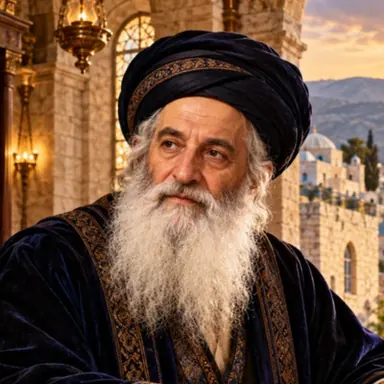
The Work, Torah Teaching and Halakhic-Kabbalistic Activity of Rabbi Moshe Alshich (the Holy Alshich)
23 min read4,520 words
His Historical Figure and the Chapters of His Life in the Golden Age of Safed
Rabbi Moshe Alshich, known by the epithet "the Holy Alshich," is one of the central and most influential figures in the pantheon of the sages of the Land of Israel and of the Diaspora in the 16th century [cite: 1]. He was born in 5268 (1508) in the city of Adrianople (Edirne) in the Ottoman Empire to his father, Rabbi Chaim Alshich [cite: 1, 2, 3]. In his youth he devoted himself to his studies in the great centers of Torah in the Balkans, and studied in the yeshivas of the famous sages of the Expulsion from Spain: in Constantinople and Adrianople under Maran Rabbi Yosef Karo, and in Salonika under the Kabbalist and halakhic decisor Rabbi Yosef Taitatzak [cite: 1, 3, 4]. The bond between Rabbi Moshe Alshich and his foremost master, Rabbi Yosef Karo, was especially deep, and Alshich even sometimes referred to him by the title "my father" [cite: 4].
When Rabbi Yosef Karo went up to the Land of Israel and the spiritual center was established in Safed, Rabbi Moshe Alshich went up with him and settled in the Galilean city, which was then at the peak of its "Golden Age" [cite: 4, 5, 6]. In Safed, Alshich was ordained by his master within the framework of the renewal of ordination (semikhah) undertaken by Rabbi Yaakov Berab, and was crowned with the title "the ordained rabbi" [cite: 2, 3, 7]. He served as a central judge in the Great Beit Din of Safed alongside Maran, the author of the Shulchan Arukh, headed two important yeshivas and taught Torah to many students [cite: 4, 7]. Among his foremost students in the revealed Torah (nigleh) was the Kabbalist Rabbi Chaim Vital, who was ordained by him to render halakhic rulings in 5350 (1590), as well as the halakhic decisor Rabbi Yom Tov Tzahalon (the Maharitz) and Rabbi Yitzchak Gershon [cite: 3, 4, 5, 8].
In the last years of his life, in the face of the plagues, famine and severe economic distress that weighed on the Jewish community of Safed from 1587, Rabbi Moshe Alshich set out on a series of journeys as a shadar (shaliach derabbanan, an emissary of the rabbis) [cite: 3, 9]. He went into exile to Damascus, and from there wandered among the communities of Syria, Turkey and Persia in order to raise funds for the maintenance of the yeshivas and the community in Safed [cite: 1, 2, 3]. During these journeys he also devoted himself to the printing of his books, among other places at the printing house of Doña Reyna (the widow of Don Joseph Nasi) in Belvedere near Constantinople, and at the printing house of the Mendes family in Istanbul [cite: 1, 3, 8].
The date of Alshich's death is a matter of historiographical dispute: whereas the date 13 Nisan 5360 (1600) is engraved on his tombstone in the ancient cemetery of Safed, the historian and halakhic decisor Rabbi Yosef Mitrani (the Maharit) noted that Alshich died in 5353 (1593) [cite: 1, 3, 9, 10]. The place of his burial is divided between the prominent marker above the cave and the interior of the cave attributed to the "elders of Safed," beside Rabbi Yaakov Berab [cite: 5]. Rabbi Moshe Alshich merited to be sanctified in historical memory as one of only four in the history of Israel to whose names the exalted title "the Holy" has traditionally been attached, alongside the Holy Ari, the Holy Shelah and the Holy Or HaChaim [cite: 3].
The Methodology of Derash and Biblical Commentary
Rabbi Moshe Alshich's worldwide fame stems chiefly from the power of his sermons and from his original method of biblical interpretation [cite: 1, 2, 11]. Alshich was considered the greatest and most popular preacher of the 16th century [cite: 2]. His comprehensive commentary on the Torah and on most of the books of the Tanakh grew organically out of the weekly sermons he delivered in his synagogue in Safed every Shabbat [cite: 2, 3, 9, 12]. These sermons drew crowds, among them the greatest Kabbalists and halakhic decisors of the generation, including Maran Rabbi Yosef Karo and the Holy Ari [cite: 9]. On his tombstone in Safed was engraved the title "preacher and decisor for the generations," with the title of preacher placed before the title of decisor, as an expression of the centrality of homiletic creativity in his life [cite: 9].
Alshich's method of interpretation produces a harmonious synthesis of peshat, remez, derush and sod, with a central focus on drawing moral lessons (musar) and guidance in faith [cite: 2, 13]. The analytical methodology of his derash is based on a structured and orderly process. The commentary on each Torah portion or biblical unit opens by raising a detailed series of textual difficulties and close readings, with a meticulous analysis of every linguistic duplication, syntactic change, superfluous letter, puzzling order of verses or structural detail [cite: 2, 9]. After presenting the difficulties, Alshich builds a broad conceptual, moral or theological foundation, which serves as a conceptual key to understanding the matter [cite: 13]. From this foundation he returns to the verses and resolves all the questions about the language of Scripture in a continuous manner, demonstrating how every word in the text is precise and necessary to the construction of the moral homily [cite: 2, 9].
He applies this methodology with special brilliance in his commentaries on the Five Megillot [cite: 1, 11]. In his commentary Shoshanat HaAmakim ("The Lily of the Valleys") on the Song of Songs — the first of his works to see print, in 1591 — Alshich sets out a comprehensive allegorical interpretation that presents the Song of Songs as a continuing dialogue between the Holy One, blessed be He, and the Congregation of Israel immersed in exile, while clarifying its spiritual destiny [cite: 1]. In his commentary Devarim Nichumim ("Words of Comfort") on the Book of Lamentations, he shows how the Shechinah never moved from the Western Wall and that the sufferings of exile are meant to refine the people in preparation for redemption [cite: 1, 14]. In his commentary Devarim Tovim ("Good Words") on Ecclesiastes, Alshich presents the view that all the vanities of this world are void compared with the fear of the Lord [cite: 1]. In his commentary Einei Moshe ("The Eyes of Moses") on the Book of Ruth, he charts the path to the service of God and to acts of loving-kindness [cite: 1], and in his commentary Masat Moshe ("The Portion of Moses") on the Book of Esther, he lays out the mechanism of hidden divine providence [cite: 1, 11].
The Theological and Kabbalistic System in Alshich's Teaching
Although Rabbi Moshe Alshich belonged to the circle of the Kabbalists of Safed and breathed the hidden atmosphere of the city, his biblical writing makes Kabbalistic ideas accessible in a homiletic and moral wrapping that can be understood even by those who do not delve deeply into the esoteric (sod) [cite: 1, 13]. His thought presents an orderly and comprehensive theological system that encompasses the structure of the universe, the purpose of man, providence, free will and redemption [cite: 13].
The Structure of the Worlds and the Cascade of the Divine Abundance
According to Alshich, existence consists of four graded worlds: the Upper World (the world of Divinity and of souls), the world of angels (the world of separate intellects), the world of the spheres (the astronomical world, endowed with motion), and the Lower World (the physical, material world) [cite: 13]. Because the Lower World is made of coarse matter, it cannot receive spiritual abundance directly from the Upper World [cite: 13]. Therefore the Creator instituted a process of gradual thickening, in which the divine abundance descends through the world of angels and the world of the spheres until it is adapted to be received in the lower world [cite: 13]. The purpose of all creation lies precisely in the Lower World; the intermediate worlds were created solely to serve as channels and intermediaries for bringing the abundance down to man [cite: 13].
Man as Microcosm and as a Channel for the Indwelling of the Shechinah
The structure of man corresponds exactly to the four worlds: his body is hewn from the Lower World, his moving soul (nefesh) from the world of the spheres, his spirit (ruach) from the world of angels, and his higher soul (neshamah) from the Upper World [cite: 13]. Because of this structure, man is not merely a passive recipient of the abundance but an active engine that operates the cosmic system [cite: 13]. When man sanctifies his deeds and fulfils the Torah and the commandments, he arouses the supernal roots of his soul, and this arousal "from below" moves the upper worlds to pour blessing and abundance back down upon the Lower World [cite: 13]. Alshich emphasizes the principle of spiritual non-separation: the soul of man, which descended to this world, remains connected by a continuous spiritual thread to its root beneath the wings of the Shechinah, and if man guards his purity, he turns his body and soul into a "chariot for the Shechinah" and realizes the purpose of making a dwelling place for God in the lower realms [cite: 13].
The Conception of Matter, Sin and Refinement
Matter in itself is not a negative essence with an inherent hostility to spirituality, but a product of the thickening of spirituality at the time of creation [cite: 13]. Before the sin of Adam, the first man, the matter of the body was pure and transparent, and was directly influenced by the spiritual quality of the Garden of Eden [cite: 13]. It was the primordial sin that clouded the matter and introduced into it turbidity and impurity [cite: 13]. The role of the commandments — whose number (613) corresponds to the limbs and sinews of man — is to cleanse and refine the body and the soul [cite: 13]. Every commandment performed properly sanctifies a particular limb, removes from it the enclosure of impurity and allows the soul to cleave to its upper root without barriers [cite: 13]. The sufferings that befall the righteous in this world are regarded by Alshich as a divine cleansing instrument, scouring away the residues of the turbidity of matter in order to bring the soul to the reward of perfect "cleaving" (devekut) in the World to Come [cite: 13, 14].
Providence, Fortune (Mazal), Free Will and Redemption
On the question of providence and fortune (mazal), Alshich sets out a harmonious conception that reconciles the decree of Heaven with free will [cite: 13]. Mazal is conceived as a servant instrument operating within the system of nature, lacking independent moral judgment [cite: 13]. The Holy One, blessed be He, who foresees man's free choice or takes into account his obligations from a previous incarnation (gilgul), brings man into the world at exactly the time and hour at which a mazal rules that matches the deeds man is destined to choose [cite: 13]. In this way a complete correspondence is achieved between the physical decree of mazal and divine justice and the recompense due to man [cite: 13]. Regarding the process of redemption, Alshich explains that the delay of the present redemption stems from the fact that the sins of the people strengthen the prince of Edom (Samael), and that refinement through repentance and through shared suffering is what unites the people and makes possible the subjugation of the forces of impurity and the bringing of the Messiah [cite: 15].
Love, Fear, Devekut and the Unity of Israel
At the summit of the service of God, Alshich places the concept of devekut [cite: 13]. Devekut is attained through a combination of fear, love and likeness to the attributes of the Creator [cite: 13]. Basic fear serves as protection against sin, but above it exists "superior fear" (the fear of exaltation), which flows from deep love and does not cease even when man is free of transgression [cite: 13]. A critical component in attaining devekut and in raising the abundance is the unity of Israel [cite: 13]. The souls of Israel are all hewn as a single block from beneath the Throne of Glory [cite: 13]. When love, peace and mutual responsibility prevail among the people of Israel below, a "supernal union" takes place in the upper worlds of the sefirot, enabling the Shechinah to dwell and to bestow blessing and redemption [cite: 13].
Alshich in the Circle of the Kabbalists of Safed: His Relationship to the Ramak and the Ari
The presence of Rabbi Moshe Alshich at the heart of the hidden community of Safed created a fascinating web of relations with the greatest Kabbalists of his generation, headed by Rabbi Moshe Cordovero (the Ramak) and Rabbi Yitzchak Luria Ashkenazi (the Holy Ari) [cite: 9, 16, 17].
Alshich was very close to the Ramak and drew from him much hidden wisdom [cite: 9]. The influence of the Ramak is clearly evident in Alshich's Kabbalistic concepts and in the structure of the worlds that he describes in his commentaries [cite: 13, 18]. After the death of the Ramak in 5330 (1570), Alshich was among the signatories on the deeds of sale of the manuscripts of the Ramak's monumental book, "Or Yakar" ("Precious Light"), to the greatest Kabbalist of Italy, Rabbi Menachem Azariah (the Rama) of Fano [cite: 18].
With the arrival of the Holy Ari in Egypt and his emergence in Safed, Alshich was exposed to the depth of his teaching [cite: 6, 7, 16, 17]. The Ari lavishly praised Alshich's sermons, and testified of them that they are "directed to the truth" [cite: 8]. A well-known Kabbalistic tale, cited in works such as "Shevet Musar" ("The Rod of Discipline") and in the Chida's book "Shem HaGedolim" ("Names of the Great Ones"), tells that Rabbi Moshe Alshich asked the Ari to teach him the hidden wisdom of Kabbalah in the profound way of sod [cite: 9, 19, 20]. The Ari refused and told him that his soul had descended into this world specifically to complete and illuminate the wisdom of derush and peshat, since he had already completed his share in the wisdom of sod entirely in a previous incarnation [cite: 9, 19, 20]. As a sign of this, whenever Alshich tried to sit and study the secrets of the Ari's teaching, he fell deeply asleep and the hidden comprehension was withheld from him [cite: 19].
Alshich's foremost student in the revealed Torah and in halakhic ruling, Rabbi Chaim Vital, became, as is well known, the Ari's senior disciple and the publisher of the Ari's teaching in Kabbalah [cite: 4, 6, 21]. Rabbi Chaim Vital revered his master Alshich and defined him as the supreme halakhic authority of his generation after the death of Maran Rabbi Yosef Karo [cite: 4]. In Sefer HaChezyonot ("The Book of Visions"), Rabbi Chaim Vital even disclosed spiritual revelations about the stature of Alshich's soul, and wrote that the soul of the Amora Ravina (the redactor of the Babylonian Talmud) was reincarnated in his master Alshich, and that at times the soul of the Tanna Rabbi Shmuel bar Nachmani was also impregnated (ibbur) in him [cite: 4].
A further tradition connected with the Ari and with the essence of Alshich's soul concerns a personal tragedy that befell his household [cite: 1, 22]. According to the documentation in Kabbalistic writings (such as in "Pri Etz Chaim" — "Fruit of the Tree of Life"), Alshich's son was taken captive or converted from Judaism in his youth [cite: 1, 22]. Alshich turned to the Ari with a request for rectification, and the Ari composed for him a prayer text and a special unifying intention (kavvanat yichud), incorporated into the blessing "Hashiveinu" in the Amidah prayer, whose purpose is to open a gateway of repentance beneath the Throne of Glory and to return the son to the bosom of Judaism [cite: 22].
Halakhic Rulings, Public Service and the Architectural Legacy
Alongside his genius as a preacher and as a rebuker in the gate, Rabbi Moshe Alshich was a first-rate decisor of halakha and a senior judge in the Beit Din of Safed [cite: 2, 4, 7]. His halakhic responsa were collected in the book "Sheelot uTeshuvot Maharam Alshich" ("Responsa of the Maharam Alshich"), comprising 140 complex sections on the laws of Yoreh Deah, Even HaEzer and Choshen Mishpat [cite: 7]. The book was first published in Venice in 5365 (1605) by his son, Rabbi Chaim Alshich [cite: 7]. In addition, Alshich composed an extensive halakhic work called "Me'ah She'arim" ("One Hundred Gates"), which was lost over the years and has not reached us [cite: 23].
Alshich's rulings are characterized by theoretical depth, vast mastery of the topics of the Talmud and of the Rishonim, and great authoritativeness [cite: 1, 2]. The Responsa of the Maharam Alshich is today not only a foundational halakhic source but also a first-rate research and historical tool for reconstructing the economic, social and legal life of Safed and of the communities of the Middle East in the 16th century [cite: 7]. In his responsa he reflects the reality of the community, commercial law, agunot, relations with the Ottoman authorities, and he refers to Safed with holy awe by the title "the city of our God" [cite: 7].
Alshich's physical legacy stands to this day in the heart of the Old City of Safed — the "Holy Alshich Synagogue" [cite: 5, 6]. This synagogue, built under Alshich's direct supervision in the 16th century, is considered one of the oldest and most magnificent synagogues in the city [cite: 5, 9]. The building was constructed in the classic Sephardic architectural style, with pointed arches supporting an impressive domed ceiling, and within it a prayer hall and an ancient Holy Ark [cite: 9]. According to local tradition, Alshich's synagogue is the only structure in Safed that survived almost unscathed the two destructive earthquakes that struck the city, in 1759 and 1837 [cite: 5]. The Hasidim of Safed attribute this wonder to Alshich's precedent-setting and exacting instruction at the time of construction: Alshich insisted that no women's section or toilets be built within the synagogue compound, in order to preserve the sanctity of the place to the maximal degree, and thereby prevented any trace of levity or impurity in the place of prayer [cite: 5, 9].
The Literary Corpus of Rabbi Moshe Alshich
The Torah creativity of Rabbi Moshe Alshich extends over almost the entire range of the books of the Bible, alongside halakhic responsa and commentaries on aggadah and on the words of the Sages [cite: 1, 2, 11, 20].
| Book Title | Field / Biblical Book | Year and Place of First Printing | Main Content and Central Idea |
|---|---|---|---|
| Torat Moshe ("The Teaching of Moses") | The Five Books of the Torah | 5353, Belvedere (near Constantinople) [cite: 1, 8] | His central book. Detailed and in-depth sermons on the order of the weekly portions, combining peshat, musar and sod [cite: 2, 8]. |
| Marot HaTzovot | The Former and Latter Prophets | 5363-5367, Venice [cite: 1, 11] | A comprehensive commentary on the books of the Prophets (except Ezekiel), emphasizing the visions of prophecy and national guidance [cite: 1, 3]. |
| Romemot El ("The Exaltations of God") | The Book of Psalms | 5365, Venice [cite: 1, 11] | Exposition of the psalms, delving into the human soul, repentance, devekut and prayer [cite: 1, 13]. |
| Rav Peninim ("Abundance of Pearls") | The Book of Proverbs | 5352, Venice [cite: 1, 3, 11] | Development of the doctrine of musar, the rectification of character traits, wisdom versus folly, and guidance for an upright life [cite: 1, 13]. |
| Chelkat Mechokek ("The Portion of the Lawgiver") | The Book of Job | 5363, Venice [cite: 1, 11] | An in-depth clarification of the issue of "the righteous man who suffers," individual providence, suffering and the justification of the divine judgment [cite: 1, 13]. |
| Shoshanat HaAmakim | The Song of Songs | 5351, Venice [cite: 1, 3, 11] | An allegorical-Kabbalistic commentary: a dialogue of love and longing between the Holy One, blessed be He, and the Congregation of Israel in exile [cite: 1]. |
| Einei Moshe | The Book of Ruth | 5361, Venice [cite: 1, 11, 24] | Moral instruction in the service of God, acts of loving-kindness, and the descent of the soul of the Messiah son of David [cite: 1]. |
| Devarim Nichumim | The Book of Lamentations | 5361, Venice [cite: 1, 11] | Consolation amid the destruction, the indwelling of the Shechinah at the Western Wall, and clarification of the process of redemption [cite: 1]. |
| Devarim Tovim | The Book of Ecclesiastes | 5361, Venice [cite: 1, 11] | A demonstration of the nothingness of the vanities of this world compared with the eternity of the fear of the Lord and of Torah [cite: 1]. |
| Masat Moshe | The Book of Esther | 5361, Venice [cite: 1, 11] | A broad commentary offered as "portions for Purim," disclosing the hidden miracle and individual providence [cite: 1]. |
| Chavatzelet HaSharon ("The Rose of Sharon") | The Book of Daniel | 5323, Safed (another edition: 5352, Venice) [cite: 1, 11] | A Kabbalistic-historiosophical commentary on the end of days, the exilic kingdoms and the calculations of the redemption [cite: 1, 13]. |
| Responsa of the Maharam Alshich | Halakha (Yoreh Deah, Even HaEzer, Choshen Mishpat) | 5365, Venice [cite: 7] | 140 practical halakhic responsa, a valuable historical source for the life of Safed in the 16th century [cite: 7]. |
| Yarim Moshe | Tractate Avot | 5524, Fürth [cite: 1] | A compilation drawn from his various works that expounds the mishnayot of Avot in a moral manner [cite: 1]. |
| Romemot El (Haggadah) | The Passover Haggadah | Various printings [cite: 20] | Exposition of the Exodus from Egypt, the miracles of the nation, and the duty of thanksgiving and faith [cite: 13, 20]. |
Reception and Influence on Torah Learners and on the Hasidic Movement
The reception of Rabbi Moshe Alshich's works throughout the world of Torah was immediate and widespread [cite: 1, 2, 11]. His book "Torat Moshe" became a foundational work in the study halls of the East and of Europe, and was published in countless editions [cite: 1, 8, 11]. Because of the comprehensive and lengthy nature of his commentaries, students and sages in later generations arose who abridged his writings in order to make them accessible to all strata of the people [cite: 1, 8]. The most famous abridgment, "Kitzur Alshich," was prepared by Rabbi Yosef HaDayan of Lublin and published in Amsterdam in 5507 (1747) [cite: 1, 8].
A phenomenon of exceptional uniqueness is the enormous admiration that the Hasidic movement acquired for the Holy Alshich [cite: 8, 9]. Although he lived about two hundred years before the rise of the Baal Shem Tov and his disciples, Alshich's books were defined among the leaders of Hasidism as foundational books of Hasidic thought, devekut and musar [cite: 8, 9]. The great luminaries of Hasidism cited him constantly in their works and used his foundations to build their sermons. Rabbi Yaakov Yosef of Polonne, author of "Toldot Yaakov Yosef" ("The Generations of Yaakov Yosef"), makes extensive use of Alshich's foundations regarding the cascade of the abundance and the influence of the leader's soul on the public [cite: 8, 9, 14]. Rabbi Levi Yitzchak of Berditchev, author of "Kedushat Levi" ("The Holiness of Levi"), based many conceptions of love of Israel and of seeking merit for others on Alshich's statements [cite: 8, 9]. The Seer of Lublin defined this well, marveling at the degree of the holiness of Alshich and even testifying of Rabbi Moshe of Kshbarsk that he was at such a high spiritual level that the spirit of the Holy Alshich would be revealed to him and teach him Torah [cite: 9]. Likewise, Rabbi Chaim Elazar Shapira of Munkatch (author of "Minchat Elazar" — "The Offering of Elazar") preserved Hasidic traditions that the Holy Ari would go out with his entire retinue of disciples to listen with holy awe to Alshich's sermons on Shabbat nights in Safed [cite: 8].
The Chida (Rabbi Chaim Yosef David Azulai) summed up Alshich's central place in the history of Jewish commentary when he defined him by the title "the great commentator among the Acharonim," and added about his commentaries that they are "a sweet and true commentary" [cite: 8].
Summary
Rabbi Moshe Alshich — the Holy Alshich — stands in the annals of the Torah of Israel as a rare and exemplary figure who united within himself, beyond all measure, the crown of halakha, the crown of derash and the crown of the hidden [cite: 1, 2]. As a central judge and decisor in the Safed of the Golden Age, he shaped the halakhic and public character of the community [cite: 4, 7]. As a preacher and thinker, he created a systematic and comprehensive method of interpretation that turned the Scriptures into a flowing source of musar, faith, devekut and expectation of redemption [cite: 1, 2, 13]. His Kabbalistic-homiletic teaching, which combines the structure of the upper worlds with the practical service of God by the individual and the community, transcended the boundaries of its time and continues to nourish the Jewish study hall, analytical and Hasidic alike, to this very day [cite: 8, 9, 13].
Sources24
- 1.Moshe Alshich - Wikipedia, en.wikipedia.org/wiki/Moshe_Alshich
- 2.MIDRASH OF RABBI MOSHE ALSHICH ON THE TORAH, 3 vols. - Urim Publications, urimpublications.com/midrash-of-rabbi-moshe-alshich-on-the-torah-3-vols.html
- 3.Moshe Alshich HaKadosh — Sila Tehilim, silatehilim.com/en/моше-альшейх-а-кадош/
- 4.Rabbi Moshe Alshich - Chabad.org, chabad.org/kabbalah/article_cdo/aid/380688/jewish/Rabbi-Moshe-Alshich.htm
- 5.Rabbi Moshe Alshich - Zissil, zissil.com/topics/Rabbi-Moshe-Alshich
- 6.A Man of the People in the City of Mystics - Chabad Lubavitch World Headquarters, lubavitch.com/a-man-of-the-people-in-the-city-of-mystics/
- 7.שו"ת מהר"ם אלשיך, דפוס ראשון – ויניציאה שס"ה [1605] שאלות ותשובות להלכה - Genazym Auctions, genazym.com/auction/620-grand-winter-event-he/lot-74-20/
- 8.תורת משה (אלשיך) - ויקיפדיה, he.wikipedia.org/wiki/תורת_משה_(אלשיך)
- 9.Biography: His Life and Legacy - The Alshich, thealshich.com/alshich.html
- 10.רבי משה אלשיך - חב"דפדיה, chabadpedia.co.il/wiki/רבי_משה_אלשיך
- 11.Rabbi Moshe Alshich: Works - The Alshich's teachings on the weekly Torah portion earned him much acclaim - Chabad.org, chabad.org/kabbalah/article_cdo/aid/380706/jewish/Rabbi-Moshe-Alshich-Works.htm
- 12.תורת משה - אלשיך | האוסף של ספריא, sefaria.org.il/Alshekh_on_Torah
- 13.שמעון שלם - מחשבה ומוסר בפירושיו של רבי משה אלשיך - פרויקט בן־יהודה, benyehuda.org/read/66573
- 14.באורי אגדות סנהדרין - מכון הלכה ברורה, halachabrura.org/agada/sanhedrin.htm
- 15.פסח, tora-forum.co.il/attachments/הרב-צבי-שורץ-שיעורי-פסח-pdf.193142/
- 16.This week in Jewish history: Ha'Ari, Ramban, and the Messiah - The Jerusalem Post, jpost.com/diaspora/article-813829
- 17.סיפור מן ההפטרה - בראשית - תורת אמת, toratemetfreeware.com/online/f_01889.html
- 18.שם הגדולים, מערכת ספרים, מערכת א נ״ז | האוסף של ספריא, sefaria.org.il/Shem_HaGedolim,_Maarekhet_Sefarim,_Letter_Alef.57
- 19.על הספר תולדות האר"י / דוד תמר - פרויקט בן־יהודה, benyehuda.org/read/36646
- 20.רבי משה אלשיך – ויקישיבה, yeshiva.org.il/wiki/index.php/רבי_משה_אלשיך
- 21.שבחי מהרח"ו | נהר שלום, naharshalom.co.il/מאמר/1222/שבחי-מהרח"ו
- 22.איש האלוקים ׀ רבנו יצחק לוריא אשכנזי - זכותו תגן עלינו ׀ האר"י הקדוש ׀ ה' אב | פורום לתורה, tora-forum.co.il/threads/איש-האלוקים-׀-רבנו-יצחק-לוריא-אשכנזי-זכותו-תגן-עלינו-׀-האר-י-הקדוש-׀-ה-אב.68964/
- 23.שם הגדולים (קרענגיל)/חלק ב/מ - ויקיטקסט, he.wikisource.org/wiki/שם_הגדולים_(קרענגיל)/חלק_ב/מ
- 24.יסוד! - מהדורה ראשונה של ספר עיני משה על מגלת רות - מאת רבי משה אלשיך, il.bidspirit.com/ui/lotPage/taglit2/source/catalog/auction/48954/lot/29739/יסוד-מהדורה-ראשונה-של-ספר-עיני?lang=he