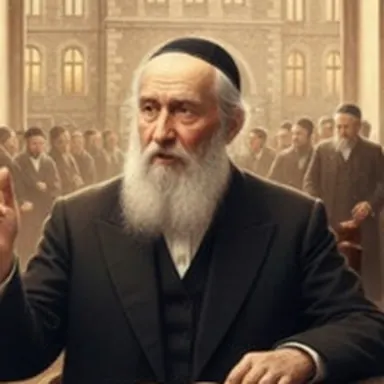
Torah study as the force that sustains reality; devotion through study, and the institutional system of the modern yeshiva.
Biography
A student of the Vilna Gaon and founder of the Volozhin yeshiva. In "Nefesh HaChaim" he presents a theology of Torah as a cosmic engine and a model of devotion.
Writings on Wikisource
Hebrew Wikisource, Wikipedia's free library, collects the texts of Rabbi Chaim of Volozhin on one author page.
includes 3 inspiration linksThe generations follow the Rambam’s introduction to the Mishneh Torah. A dashed line is inspiration, not direct transmission.
The Theological and Educational Legacy of Rabbi Chaim of Volozhin: Nefesh HaChaim, the Yeshiva Movement, and the Mitnagdic-Hasidic Dialectic
15 min read·2,912 words
Summary
This source surveys the work of Rabbi Chaim of Volozhin, the key figure who shaped the Lithuanian yeshiva world and served as a theological and structural bridge in an era of spiritual upheaval. The text presents his metaphysical teaching as it appears in the book "Nefesh HaChaim," in which he defines Torah study as a central axis that affects the upper worlds and offers a distinctive solution to the question of God's presence in reality, one that sanctifies halakha. Alongside his thought, the article details the institutional revolution he brought about, above all through the founding of the Volozhin Yeshiva, which became the prototype for independent and professional Torah academies that raise generations of leaders. Finally, the source examines his moderate approach in the conflict with Hasidism and his halakhic and educational legacy, which continues to resonate and to define the face of contemporary Orthodox Judaism.
Rabbi Chaim of Volozhin (1749–1821), born Chaim Itzkovich, stands as the principal intellectual and structural architect of the Lithuanian yeshiva world.[1, 2] Over a prolific life of seventy-two years, he fundamentally altered the course of Eastern European Jewish history.[1, 3] Trained by some of the greatest rabbinic minds of his era—including Rabbi Raphael Ziskind Hakohen of Hamburg, Rabbi Aryeh Leib Gunzberg (the Sha'agat Aryeh), and his ultimate mentor, the Vilna Gaon (the Gra)—Rabbi Chaim synthesized elite rabbinic scholarship with a highly organized institutional framework.[2] Operating during a period of deep communal and spiritual crisis, marked by the rapid expansion of the Hasidic movement, Rabbi Chaim developed a sophisticated response that was both intellectually robust and practically constructive.[2, 4] Rather than relying solely on the fierce excommunications championed by his teacher, he formulated a grand theological system in his masterpiece, Nefesh HaChaim, written between 1780 and 1820, which re-established classical Talmud study as the ultimate channel of divine communion and cosmic preservation.[2, 5, 6] His monumental life's work culminated in the founding of the Volozhin Yeshiva in 1802, a revolutionary institution that redefined Jewish education and served as the prototype for all subsequent Lithuanian academies.[4, 7, 8]
The Cosmological Metaphysics of Nefesh HaChaim
In Nefesh HaChaim, Rabbi Chaim outlines a highly complex cosmological system that synthesizes Lurianic Kabbalah with classic rabbinic thought.[5, 6] Central to this system is the role of the human being as a potent cosmic actor.[9] Rejecting any notion of human insignificance, Rabbi Chaim posits that every thought, word, and physical deed of a Jew reverberates throughout the celestial hierarchy.[9] Human behavior serves as the ultimate regulator of the flow of divine abundance; constructive actions fortify the spiritual worlds, while transgression damages the cosmic channels.[9]
This cosmological framework is vividly illustrated in his exposition on the metaphysics of sorcery (keshafim) in Gate III, Chapter 12 of Nefesh HaChaim.[10] According to Rabbi Chaim, God established a parallel hierarchy of impure spiritual forces, referred to as the "impure chariot" (merkava tameiah), which possesses the ability to override natural laws and the astrological arrangements (mazalot) set at the time of creation.[10] The Sanhedrin was historically required to study these arts to recognize and counteract their influence.[10]
Rabbi Chaim analyzes the talmudic narrative of Rabbi Hanina, who remained entirely immune to a sorceress attempting to cast a spell on him.[10] When the sorceress attempted to gather soil from beneath his feet, Rabbi Hanina encouraged her, declaring that her efforts would fail because "it is written: 'There is none else besides Him' (Ain Od Milvado)".[10] The Talmud objects that sorcery is named such because it "denies the heavenly retinue" (makhchishin pamalia shel ma'alah), and suggests that Rabbi Hanina was only safe because "his merit was great".[10] Rabbi Chaim refines this by providing a profound psychological interpretation: Rabbi Hanina did not arrogantly rely on his own righteous deeds.[10] Rather, Rabbi Hanina had achieved such an absolute, unshakeable internal alignment with the truth of divine unity that, in his mind, the impure forces were completely nullified.[10] Because he recognized that these forces possess no independent power outside of the divine will, his consciousness physically dissolved their influence.[10]
The Dialectic of Tzimtzum and the Nature of Divine Presence
This metaphysical structure rests upon a delicate resolution of the kabbalistic concept of Tzimtzum (the divine contraction).[11, 12] Since the revelation of the teachings of the Ari (Rabbi Isaac Luria) by Rabbi Hayyim Vital, Jewish thinkers grappled with whether this contraction was literal (kifshuto)—implying a physical withdrawal of God's essence to make space for the universe—or metaphorical (lo kifshuto)—implying a concealment of divine light from the perspective of creation.[12, 13, 14]
To resolve the philosophical contradictions of this stance, Rabbi Chaim introduced a dual-perspective framework distinguishing between the divine reality "from His side" (Mitzado), where God's presence remains a simple, absolute, and unchanged unity, and "from our side" (Mitzadenu), where the material world appears real and divided.[11, 16]
Within this framework, Rabbi Chaim introduces the concept of the Kav (the divine line of light).[11, 16] According to Rabbi Chaim, the Kav is the breakthrough of the divine perspective (Mitzado) directly into our bounded consciousness (Mitzadenu).[16] This breakthrough is nothing other than the Torah itself.[16] The Torah is the direct manifestation of God's simple, unified reality within the fragmented human mind.[16] This theological position allowed Rabbi Chaim to validate the Hasidic claim that "there is no place empty of Him" (leit atar panui minei) [13, 14], while simultaneously defending the strictures of Halakha.[2] Since the material world and its impurities exist "from our side," the halakhic prohibitions against praying in physically unclean spaces remain fully binding.[12]
This view creates a sharp contrast with Chabad: Rabbi Shneur Zalman of Liadi viewed Torah study as a means to achieve bittul (nullification of the self) to reveal the divinity within the physical world.[16, 17] By contrast, Rabbi Chaim of Volozhin used the Torah to nullify the physical world itself, exposing the divine reality already residing within the human soul.[16]
Torah Lishmah and the Economy of Fear
The most prominent ideological battleground between Lithuanian Mitnagdim and Hasidism centered on the definition of Torah Lishmah (Torah study for its own sake).[2, 4] Norman Lamm's landmark study, Torah Lishmah in the Thought of Rabbi Chaim of Volozhin and the Thought of the Generation (1972), highlights how Rabbi Chaim redefined "Torah Lishmah" as an intellectual, cognitive discipline.[18] To Rabbi Chaim, studying "for its own sake" does not mean studying to achieve a warm, emotional state of mystical attachment (devekut).[17, 19] Instead, it means studying "for the sake of the Torah itself"—with the singular cognitive goal of understanding, clarifying, and mastering the text and its laws.[17, 19] For Rabbi Chaim, the intellectual act of understanding a page of the Talmud is, in itself, the highest form of devekut.[17] Because the Torah and the Divine Will are ontologically one, a student who grasps the intellectual mechanics of a law literally incorporates the divine wisdom within their mind.[17] This academic focus was not limited to legal codes (Shas and Poskim); Rabbi Chaim integrated all theological fields, including Kabbalah and Jewish philosophy, into his intellectual framework, seeking to expand study beyond the narrow four cubits of practical Halakha.[20]
Rabbi Chaim recognized that studying with pure, selfless intent is a high spiritual rung that cannot be forced at the outset.[21] Citing the talmudic dictum that "from [learning] shelo lishmah (not for its own sake), one arrives at lishmah," he explained that starting with ulterior motives—such as intellectual pleasure, social prestige, or peace of mind—is not only acceptable but is the necessary starting point.[21] One must climb this ladder sequentially rather than attempting to skip essential developmental stages.[21]
While Rabbi Chaim agreed that the fear of God (Yir'ah) is an essential container to preserve Torah knowledge [19], quoting classical sources such as Yoma 72b, Shemot Rabbah 40:1, and the Zohar to establish that fear is the essential gate and container for wisdom, he cautioned against spending excessive time reading ethical or devotional treatises.[19] A student who is fully immersed in Torah study does not need to spend valuable time reading ethical manuals (sifrei yirah).[19] The intellectual sweetness of the Torah itself naturally implants the fear of God in the heart, acting as its own moral and spiritual preservative.[19]
Mitnagdic Moderation and the Hasidic Dispute
Unlike the fierce excommunications and absolute opposition to Hasidism demonstrated by the Vilna Gaon, Rabbi Chaim adopted a highly moderate and constructive stance.[2, 3] He recognized that a purely negative campaign would fail, choosing instead to establish a positive intellectual alternative.[2, 3] When a relative of his showed inclinations toward Hasidism, Rabbi Chaim did not excommunicate him but gave him three strict boundaries:
Gemara study must remain his absolute primary focus.[2]
He must never transgress any halakhic rulings derived from the Gemara.[2]
He must never speak disparagingly of Torah scholars, particularly the Vilna Gaon.[2]
This moderate attitude is highlighted by a historical anecdote involving Rabbi Chaim's great-grandson, Rabbi Chaim Halevi Soloveitchik, and the fifth Lubavitcher Rebbe, Rabbi Sholom Dovber (the Rashab).[17] During a Shavuot festival meal, the Rashab asked Rabbi Chaim Halevi to share a Torah teaching.[17] He expounded on Psalm 19:8, "The Torah of Hashem is perfect (temimah), restoring the soul (meshivat nefesh)".[17] Citing a midrashic debate on whether the Torah is perfect because it restores the soul or vice versa, he explained that the Torah's capacity to restore the soul—drawing the student back to spiritual health—depends entirely on the Torah being studied in its "perfection" (temimah).[17] This perfection requires that the study is unblemished by foreign motivations and that the student carries no yoke other than the yoke of Heaven and the commandments.[17]
The Architectural and Educational Model of Etz Chaim
To ground his theological vision of Torah study as the cosmic engine of creation, Rabbi Chaim established the Volozhin Yeshiva (known as Etz Chaim) in 1802.[7, 8, 19] In his founding circular, he lamented the contemporary decline in Torah study and the physical hardships faced by young scholars.[8] Prior to Volozhin, advanced Jewish education was highly decentralized; local communities hosted small groups of students who relied on the charity of local householders for daily meals (a practice known as "eating days" or teg essen).[8] The testimonies of his students noted that before Volozhin was founded, the yeshiva system was virtually nonexistent, and the Jewish educational world lay in desolation and chaos.[8]
Rabbi Chaim introduced a series of revolutionary reforms that transformed the yeshiva from a local academy into a national, and eventually global, institution.[8] He established a centralized fundraising network modeled after the collections for the Jewish community in the Land of Israel, allowing the yeshiva to remain financially independent of the town of Volozhin.[8] The degrading practice of "eating days" was abolished, and the yeshiva provided students with a reliable weekly stipend, allowing them to lease private rooms and buy hot meals, thereby fostering a sense of professional dignity.[8] Embodying the belief that constant study prevents the universe from collapsing into chaos, the yeshiva operated without formal semesters (zmanim) or vacations, and study continued day and night.[8, 19]
Micha Josef Berdyczewski's vivid account describes the physical space of the yeshiva as a grand, multi-story brick palace with a vast study hall resting on four massive central pillars.[8] It contained a Gemach room, an office for distributing tractates, and a dedicated smoking room to enforce a strict ban on smoking in the sacred study hall.[8] Under the leadership of the Netziv (Rabbi Naftali Zvi Yehuda Berlin), a structured daily lecture on the Pentateuch was introduced immediately after morning prayers, which laid the foundation for his classic commentary, Ha'amek Davar.[8]
The yeshiva faced a tragic closure in 1892.[7] The Tsarist Ministry of Education demanded that more than half of the study hours (from 9 AM to 3 PM) be dedicated to secular subjects, that evening studies be banned, that total study hours be limited to ten, and that all staff possess official state diplomas.[7] Refusing to compromise the purity of the yeshiva's spiritual mandate, the directors chose to close the institution rather than yield to state coercion.[7] Although the building was vacated and no Jewish community remains in Volozhin today, the structure is still preserved as a monument of Jewish national heritage.[8]
Halakhic Authority and Liturgical Praxis in Chut HaMeshulash and Keter Rosh
Beyond his metaphysical and educational achievements, Rabbi Chaim's daily practices and legal rulings were meticulously documented by his disciples, providing a comprehensive framework for Mitnagdic religious life.[22, 23] This practical guidance is preserved in texts such as Keter Rosh (also known as Orchot Chaim) [22, 24] and the responsa volume Chut HaMeshulash ("The Threefold Cord").[25, 26]
The responsa in Chut HaMeshulash focus almost entirely on Yoreh Deah, Even HaEzer, and Choshen Mishpat, containing almost no discussion of Orach Chaim.[25] This indicates that the questions sent to Volozhin from all over Europe were not about basic daily rituals, but about highly complex communal, financial, and family law, reflecting the yeshiva's status as a global supreme court of halakhic authority.[25]
Conversely, the ritual guidance in Keter Rosh details Rabbi Chaim's daily liturgical practices and personal stringencies.[22, 24] He maintained a strict adherence to congregational prayer (b'Tzibbur), never praying alone from the moment he reached intellectual maturity, even hiring villagers to travel to his inn while on journeys to ensure a minyan.[24]
This liturgical precision is illustrated by a narrative from his son Rabbi Yosef's wedding in Radashkovich.[24] When a Torah scroll was unavailable for the weekly reading, Rabbi Chaim insisted on traveling to find one.[24] An older rabbi dismissed the need, and Rabbi Chaim reluctantly deferred to his seniority.[24] Upon returning to Volozhin, Rabbi Chaim discovered that his personal Torah scroll was missing a sheet—specifically, the exact weekly reading that had been skipped during the wedding.[24] Viewing this as a measure-for-measure divine punishment (mida knegad mida), he isolated himself in prayer and confession, subsequently finding that while the scroll had been recovered, that specific sheet was indeed physically lost.[24]
In his liturgical philosophy, Rabbi Chaim compared prayer without concentration (kavanah) to a minchah (meal) offering, which lacks a living soul, while prayer with concentration was compared to the tamid (continual) animal offering.[24] He stressed that when reciting "Amen," one must fully concentrate on its meaning ("may it be so"), and warned that an "Amen" muttered without focus possesses no spiritual merit.[24]
He dismissed swaying during prayer (nenu'im) as a tool originally intended only to prevent sleep (as cited in the Shelah), though spontaneous swaying born of genuine spiritual ecstasy was praised.[24] He preferred praying directly facing a wall, though praying behind another person was acceptable if space was limited.[24] He clarified that the talmudic instruction to evaluate one's concentration before praying applies only when a person has already prayed once without concentration and is considering a second, voluntary prayer, but it should not be used to delay or skip the primary, obligatory prayer.[24]
Institutional Progeny and the Continuity of the Volozhin Tradition
The intellectual environment created by Rabbi Chaim of Volozhin served as the breeding ground for the most influential figures of modern Orthodox Judaism, religious Zionism, and the Lithuanian yeshiva movement.[7]
Theoretical Synthesis and Modern Echoes
The synthesis achieved by Rabbi Chaim of Volozhin represents one of the most resilient structures in modern Jewish history. By constructing a sophisticated metaphysical system in Nefesh HaChaim, he elevated the study of the Talmud from an intellectual exercise into a cosmic, redemptive act.[5, 16] By grounding this theology in the physical reality of the Volozhin Yeshiva, he created an institutional blueprint that preserved rabbinic Judaism through the storms of modernity, secularization, and political upheaval.[7, 8]
His balanced approach—incorporating deep kabbalistic insights while maintaining strict fidelity to classic halakhic frameworks, and choosing moderation over hostile excommunication in his dealings with Hasidism—cemented his status as the true father of the modern yeshiva world.[2, 3, 5] The ripples of his educational and theological revolution continue to define the parameters of traditional Jewish thought and practice to this day.[8]
The Torah Teaching and Institutional Enterprise of Rabbi Chaim of Volozhin: The Shaping of Scholarly Consciousness and the Metaphysics of "Mitnagdism"
23 min read·4,525 words
Summary
The present work surveys the highly influential figure of Rabbi Chaim of Volozhin, who was the father of the modern yeshiva world and the chief theoretician of the "Mitnagdim" camp. The text traces the path from his study with the Vilna Gaon to the founding of the Volozhin Yeshiva, a revolutionary institution that established Torah as a supreme and independent value, detached from the local community. The heart of the work deals with his metaphysical book "Nefesh HaChaim," in which he redefined divine service as an intellectual pursuit and set forth a profound intellectual alternative to the Hasidic movement. Through an analysis of the conception of "Torah lishmah" and of the cosmic structure of human influence, the article highlights how Rabbi Chaim succeeded in restoring the world of Torah scholarship and in laying the spiritual and institutional foundation for the generations to come.
Biographical Foundations and the Network of Spiritual Influences
Rabbi Chaim of Volozhin (official name: Chaim Itzkovich) was born on the second festival day of Shavuot, 7 Sivan 5509 (May 24, 1749), in the town of Volozhin in Belarus, which at that time was part of the Polish-Lithuanian Commonwealth and later passed under the rule of the Russian Empire.[1, 2] His father, Rabbi Yitzchak, served as parnas (lay leader) of the local community, and the family's official surname was derived from his name; his mother, Rivka, came from a distinguished rabbinic family, the daughter of Rabbi Yosef Rapoport and granddaughter of Rabbi Simcha HaKohen Rapoport.[1, 2, 3] From his early youth his exceptional talents were evident, and he had the privilege of studying with two of the most prominent Torah giants of the generation: first he studied for two years with Rabbi Raphael ben Yekutiel Ziskind HaKohen Katz (rabbi of Minsk and later rabbi of the AHU communities, Altona, Hamburg and Wandsbek, and author of "Torat Yekutiel"), and afterwards he studied with Rabbi Aryeh Leib Gunzberg, author of the "Sha'agat Aryeh," who at that time served as rabbi of the town of Volozhin.[1, 2, 3]
A dramatic and highly significant turning point in the shaping of his personality came at around the age of nineteen, when he began traveling to Vilna to study under the Vilna Gaon (the Gra).[1, 3] Under his guidance Rabbi Chaim became his most faithful and most prominent disciple.[1, 3] His veneration for his teacher was so extreme that even after the Gra's death in the year 5558, Rabbi Chaim firmly refused to be regarded as his official successor or to take his place, out of the deep respect and reverential awe he felt toward the wondrous figure of his teacher.[3]
After his years of apprenticeship with the Gra, Rabbi Chaim returned to his native town of Volozhin and served there as rabbi of the community, apparently from 5534 (1774).[1] This tenure was interrupted for a short period of about a year, during which he moved to serve as rabbi in Vilkomir, but following internal opposition that arose in the community there, he returned to Volozhin and continued to lead its community as rabbi and teacher until the day of his death on 14 Sivan 5581 (June 14, 1821), at the age of 72.[1, 3]
Alongside his local leadership, Rabbi Chaim held wide-ranging influence over the immigration of the Gra's disciples (the Perushim) to the Land of Israel, which began in 1808.[1] Although he did not immigrate himself, he served as the supreme rabbinic authority of the "Rozenei Vilna" (Officers of Vilna) organization, managed the fundraising system and the Halukka funds intended for the economic support of the immigrants, and had a decisive influence on charting the spiritual and public policy of the Old Yishuv in Jerusalem.[1]
✦
The Volozhin Yeshiva Revolution: An Independent Supra-Communal Institution and Its Pedagogical Methods
The founding of the "Etz Chaim" Yeshiva in Volozhin at the beginning of the 19th century was not merely the establishment of yet another institution of learning, but a structural revolution that completely changed the face of the Torah world in the modern era.[1, 4] During the 18th century the institutional frameworks of study in Lithuania had seriously weakened: many study halls had emptied, there was a chronic shortage of complete sets of the Talmud, and the students who remained were forced to rely on the meager and humiliating support of their local communities.[4] Yeshiva students at that time were treated with contempt by society, derisively called "batlanim" (idlers), and were forced to be the guests of local residents for daily meals ("eating days").[4] At the same time, the meteoric rise of the Hasidic movement drew to it young, fresh forces seeking an emotional spiritual experience, which further weakened the standing of dry, analytical study.[4]
Rabbi Chaim discerned the structural crisis and decided to establish a radical institutional alternative.[4] At first he established in his town a small yeshiva in which only ten local students studied, and he financed all its expenses from his private funds.[4] As the number of students grew, he understood that a broad, countrywide solution was required.[4] During the Ten Days of Repentance in 5563 (1803) he published a famous open letter to the "lovers of Torah" in Lithuania, in which he called for the establishment of yeshivot throughout the country and for the encouragement of financial support for Torah scholars, and announced the founding of the central yeshiva in Volozhin.[1, 4] This call was joined by the prominent rabbis of Vilna, headed by Rabbi Avraham, son of the Gra, who called for support of the new institution.[4] Within a short time the number of students grew to about a hundred, and Rabbi Chaim built for them a dedicated building, the first of its kind.[4]
The yeshiva presented an innovative and revolutionary model based on complete economic and organizational independence from the local community, and thereby served as the prototype for the Lithuanian yeshivot that arose after it.[4] Rabbi Chaim saw to the welfare of his students both personally and institutionally, employed a cook who prepared hot food for them, and later (mainly in the period of the Netziv) monthly cash stipends were distributed to the students according to their excellence, with which they rented rooms in local lodgings furnished with a bed, a table and a bench.[4] The yeshiva instituted stringent admission requirements and careful screening: only students who had mastered the independent study of a page of Gemara with Rashi and Tosafot ("Gefet") and passed a rigorous entrance examination were accepted into its ranks.[4]
The succession of leadership and the development of the Volozhin Yeshiva reflect the gradual transition from a local institution to a world Torah center attracting students from every corner of the globe [4]:
The method of study that Rabbi Chaim shaped rested on three fundamental pedagogical principles: first, complete freedom for the student to choose the Talmudic tractate his heart desires; second, a methodological preference for the study of monetary law and the order of Nezikin as a foremost tool for developing reasoning and sound logic (sevara); and third, the determination that no vessel holds blessing and endures in a person more than proficiency (bekiut) and a broad range of knowledge.[4] These principles derived directly from the method of his teacher the Gra, which championed straightforward and comprehensive study and rejected artificial pilpul.[1, 3, 6] Alongside academic excellence, the yeshiva was careful to cultivate fear of Heaven, noble character traits and derekh eretz (proper conduct), out of the understanding that a Torah scholar lacking derekh eretz desecrates God's name and the Torah.[4, 7] Rabbi Chaim made a point of keeping a warm personal relationship with his students, used to invite outstanding ones to his table on Sabbaths, and on the eve of Passover hosted all the yeshiva's students at a festive public seder in his home.[4]
One of the yeshiva's central innovations, which aroused enormous public interest and drew many merchants and visitors to Volozhin, was the institution of fixed study shifts throughout all the hours of the day and night, including Sabbaths and festivals, to ensure a constant and unceasing voice of Torah.[4] The yeshiva's meteoric success led to the establishment of similar yeshivot in Lithuania, raised the prestige of Torah learners, and even led to the printing of many new editions of the Talmud to meet the growing demand.[4] A graduate of the yeshiva, Rabbi Meir Bar-Ilan, described the institution by saying that every lecture and novel insight that came out of Volozhin bore the stamp of truth and profound understanding, and defined the yeshiva as "a light illuminating all of Judaism".[4]
✦
The Theological Outline of "Nefesh HaChaim": Cosmic Metaphysics and the Relationship between God and Man
Rabbi Chaim's monumental book, "Nefesh HaChaim," written approximately between 1780 and 1820, constitutes the most profound theological and metaphysical foundation of the "Mitnagdim" camp.[1, 8] The work consists of four main gates intended to redefine the place of man in the cosmic system and the nature of the relationship between the created and the Creator [1]:
Gate One: The Standing of Man and Cosmic Responsibility
In this gate Rabbi Chaim explains the concept of the "image of God" in which man was created.[1] In his view, man is endowed with an enormous power of creation and influence that acts directly on the upper worlds.[1] He compares the human soul to a long rope stretched out and rooted in its source above ("truly a portion of God, as it were") and hanging down to his physical body below; when a person acts or speaks below, he moves and shakes the lower end of the rope, and thereby stirs and shakes its upper end and brings about dramatic changes in the upper worlds.[9]
This is the depth of the meaning of the verse "Know what is above you": know that everything that takes place above, in the highest worlds, is all determined and shaped according to your deeds and your words.[9] In this context Rabbi Chaim analyzes the fall of Adam and explains that his expulsion from the Garden of Eden was for his own good: had he eaten from the Tree of Life and lived forever in his corrupted state, he would have remained unrectified forever, and he was therefore expelled so that physical death and decomposition in the grave would separate from him the evil that had clung to him and allow him to reach complete rectification.[10] Rabbi Chaim adds that the human soul does not enter the body at all but only shines upon it from above.[11] He emphasizes that even the perfectly righteous person is not immune to minor flaws in his deeds, for "there is not a righteous man upon earth that does good and sins not": even in the best deed some deficiency is always mixed in.[10]
Gate Two: The Essence of Prayer and the Mechanism of Its Action
This gate is devoted to an analysis of the mechanism of prayer and of its cosmic role in channeling the divine abundance through the upper worlds.[1] Prayer is not seen merely as a private request for one's needs, but as a metaphysical service intended to repair the spiritual channels and to make blessing flow to all of creation.[1, 12]
Gate Three: The Question of Tzimtzum and the Unity of God
This gate is the theoretical and kabbalistic heart of the book, and deals with the ten sefirot and the question of tzimtzum.[1, 12] Rabbi Chaim resolves the apparent contradiction between the simple and absolute unity of the Creator and the existence of a material and separate world by distinguishing between two fundamental aspects: "from His side, blessed be He" (Yichuda Ila'ah, the higher unity) and "from our side" (Yichuda Tata'ah, the lower unity) [12]:
From His side, blessed be He: there is no change, partition or division in His essence, either before the creation of the world or after it.[12, 13] He fills all the worlds in complete equality and simple unity, and "there is none besides Him, in the most literal sense," since all the forces and created beings are utterly nullified before Him.[1, 12, 13] The foundation of faith is to fix in one's heart that He alone, blessed be He, is the true master of all power, the soul, the life and the root of all created beings and of all the worlds.[9, 12]
From our side: according to our sensory perception and as we were commanded in the Torah, the Holy One, blessed be He, conceals His glory, and the world is perceived in our eyes as an existing and separate reality.[12, 13] This distinction is vital for the existence of the Torah and the commandments; without the existence of a separate world in our consciousness, there would be no room for the halakhic law that distinguishes between pure and impure and between permitted and forbidden.[12] Therefore, in filthy places we are forbidden to think or speak words of Torah, even though from His side, blessed be He, He is present there too, since we must act according to the laws of the aspect "from our side," which defines changes of place and clear halakhic boundaries.[12]
Gate Four: The Virtue of Torah Study and of Those Who Study It
This gate, the most famous of all, presents Torah study as the supreme and absolute value of Jewish life, and constitutes the direct intellectual response to the spirit of Hasidism.[1, 14]
✦
The Controversy with Hasidism and the Clarification of the Concept of Tzimtzum
The ideological and personal relationship between Rabbi Chaim of Volozhin and the Hasidic movement was far more complex and sophisticated than that of his teacher the Gra.[1, 15] Unlike the Gra, who took a militant line that included the imposition of bans and severe excommunications, Rabbi Chaim acted with great moderation and did not take part in the bans.[1, 3, 15] He expressed his principled opposition to Hasidism not through coercion or persecution but by writing his book "Nefesh HaChaim," in which he set forth analytical Torah study as a structured, well-founded and profound substitute for experiential Hasidic devekut.[1, 15]
Alongside the evident controversy, a deep and hidden influence of Hasidic literature can be discerned in his writings, in particular that of the book "Tanya" by Rabbi Shneur Zalman of Liadi (the Baal HaTanya).[13, 15] There is a close conceptual overlap, a use of identical turns of phrase and parallel ideational structures between "Nefesh HaChaim" and the "Sha'ar HaYichud VeHa'emunah" (Gate of Unity and Faith) of the Tanya, which corroborates old Hasidic traditions according to which Chabad Hasidim visited Rabbi Chaim and presented him with holy writings and discourses of the Alter Rebbe, and he was even exposed to Hasidic manuscripts that had not yet been printed.[13, 15]
However, there is a deep interpretive dispute over the extent of Rabbi Chaim's agreement with the Hasidic system: in Chabad Hasidism it is commonly held that Rabbi Chaim saw the book of Tanya and accepted the position of the Alter Rebbe according to which "the tzimtzum is not literal".[1, 15] By contrast, prominent scholars and rabbis (among them Rabbi Yosef Leib Sussman, Rabbi Tzvi Einfeld and Rabbi Yosef Avivi) argue that his kabbalistic system is entirely based on the tradition of his teacher the Gra and is fundamentally opposed to Hasidism; in their view, whereas Hasidism holds that physical reality itself is nullified and void before the Divine, Rabbi Chaim held that only the forces that move reality are nullified before Him, while the world itself preserves the objective existence with which the Creator created it, with the explicit intention of preserving the ontological validity of halakhic law.[1, 15]
The differences and mutual influences between the systems are detailed below:
✦
The Definition of "Torah Lishmah" and the Scholarly Alternative to Emotional Devekut
One of Rabbi Chaim's most revolutionary contributions to the world of Jewish thought was his original redefinition of the concept of "Torah lishmah" (Torah for its own sake) in the fourth gate of his book "Nefesh HaChaim".[1, 16] Whereas in previous generations, and all the more so in the Hasidic movement, the concept "lishmah" was understood as study carried out with mystical intention, purity of heart and sublime emotional attachment (devekut) to the Holy One, blessed be He, Rabbi Chaim made a statement striking in its simplicity: "The clear truth is that lishmah does not mean devekut, as most people now hold... but rather for the sake of the Torah".[16, 17] In his view, study lishmah means study whose purpose is to understand, to know and to clarify the words of the Torah and the halakhic ruling in their truth, without any need for emotional arousal or accompanying kabbalistic intentions during the study itself.[16, 17]
He explained that when a person engages in Torah below, the words he utters are at that very moment spoken, as it were, also by the mouth of the Holy One, blessed be He, since the Torah and He are one.[13, 17] Hence the very intellectual engagement with the Talmudic text constitutes the most complete and profound devekut with God, even if the learner feels no emotional experience whatsoever during his study.[14, 17] Rabbi Chaim grounded this conception in a series of complementary principles:
The light within the Torah as a tool of moral rectification: one who studies Torah, even if he was at first soiled with grave sins and sunk in the mire of evil, is assured that the inner light of the Torah will bring him back to the good, and the good within him will gradually prevail over the evil until it rules completely.[9]
Reservations about an addiction to mussar books: Rabbi Chaim warned against a tendency among the learners of his generation, who devoted most of their time to reading books of piety and mussar in order to stir the heart, while leaving the crown of Torah in a corner.[14, 18] He made clear that mussar books are vital only as a preservative ("salt") for keeping the grain, but the main fixed study must be in the core of the Torah, in extensive halakhot and in Gefet.[14, 18]
An assurance of inner fear of Heaven: a Torah scholar who is fixed in the pursuit of Torah lishmah does not need great toil and long hours with mussar books in order to establish fear of Heaven in his heart, since the Torah itself instills in those who study it wisdom, understanding and a natural fear of sin.[17]
A practical expression of Rabbi Chaim's moderation is revealed in his famous instruction to one of his relatives who had inclined toward Hasidism contrary to his wishes.[1] Instead of excommunicating him, Rabbi Chaim chose to have him take an oath before a beit din to three restrictions only, which reflected what he saw as the chief shortcomings of Hasidism: first, that he make sure that the study of Gemara would always be the main element of his fixed spiritual routine; second, that he would not in any way transgress the laws of the Gemara and the poskim (halakhic decisors); and third, that he would not disparage Torah scholars, and in particular not the Gra.[1]
✦
Halakhic Methodology and Ethical Writing: The Responsa Chut HaMeshulash and the Book Ruach Chaim
His method of ruling and his way of study were held in high esteem in his generation and afterward. Clear testimony to his analytical and lucid style of study has been preserved in his novellae on the Talmud cited in the book "Nachalat David" on tractate Bava Metzia (folio 4a).[6] In the analysis of Rabbi Shlomo Yosef Zevin in the book "Ishim VeShitot" (Personalities and Methods), it is emphasized that this novella clearly attests to Rabbi Chaim's halakhic approach, whose essence is to explain the depth of the plain meaning in a simple, clear and straightforward manner, while completely abstaining from convoluted and artificial pilpul.[6] This method, a direct continuation of the halakhic methodology of his teacher the Gra, was established as the pedagogical pillar of his yeshiva.[6]
Alongside his works of thought, Rabbi Chaim left a few halakhic responsa, which were later collected in the book of questions and answers "Chut HaMeshulash," first printed in Vilna in 5642 (1882) under the editorship of Chaim Hillel Fried.[1, 5] The first part of the book contains the responsa of Rabbi Chaim himself, many of which remained obscure and enigmatic.[5] The two other parts of the responsa include the responsa of his son-in-law, Rabbi Hillel Fried, and of his grandson, Rabbi Eliezer Yitzchak Fried.[1, 5] Most of the questions and sections in this collection deal with matters of Even HaEzer, Choshen Mishpat and Yoreh Deah, while matters of Orach Chaim hardly appear in it.[5] The very fact that the three respondents received complex halakhic queries from every corner of Europe attests to the central and unchallenged standing of the Volozhin Yeshiva as the principal Torah center of the 19th century.[5]
In his book "Ruach Chaim," a profound and original commentary on tractate Avot, Rabbi Chaim combined the teaching of his brother, the kabbalist Rabbi Zalman, with a series of ethical and existential insights that illuminate his educational conception.[1, 15] Among other things, Rabbi Chaim warns that the pursuit of honor and the behavior of the masses who admire a person, even if he himself maintains inner humility, constitute a serious disturbance and a complete obstacle to the attainment of wisdom and of true divine service, because of the distractions and hindrances involved.[9] Regarding the pace of a person's progress, he determined that "a person cannot stand in one place, and if he does not ascend, he will necessarily fall," a view that emphasizes the dynamic need for constant spiritual ascent.[9] In addition, he gave sanctifying meaning to the most basic mundane activities, noting that one who eats with true intention, in order to sustain his body and soul for the service of the Creator, is regarded as if he had actually offered a sacrifice upon the altar.[9] This thought places strong emphasis on the importance of "derekh eretz" and on the moral conduct of Torah scholars, since a Torah scholar devoid of derekh eretz desecrates God's name and the Torah.[7]
The yeshiva continued to flourish under the leadership of Rabbi Chaim's descendants and family until its dramatic closure by the Russian authorities in 5652 (1892).[3, 4] The reason for the closure was the stubborn refusal of the yeshiva's leadership, headed by the Netziv, to introduce secular studies into the formal curriculum, despite heavy pressure from the government.[3, 19] Although the Netziv (the last head of the yeshiva in this period, and the son-in-law of Rabbi Chaim's son) agreed in principle to the study of the Russian language outside the walls of the yeshiva, and even wrote in his book of responsa "Meshiv Davar" that should the government decree the study of secular subjects, it should be done under the supervision of the rabbis of Israel and of God-fearing teachers, in practice the unilateral government demands met fierce opposition, which led to the closure of the yeshiva in 5652 (1892).[3, 19]
✦
The Network of Influence across the Generations: From the Salant Link to the Mussar Movement
Rabbi Chaim raised thousands of Torah scholars who spread his teaching and method throughout Eastern Europe, among them his son and successor Rabbi Yitzchak of Volozhin, Rabbi Aryeh Leib Shapira, Rabbi David Tevele of Minsk (author of "Nachalat David"), Rabbi Yechiel Michel of Minsk, Rabbi Eliyahu Ragoler, Rabbi Yaakov Bruchin and Rabbi Avraham Simcha of Amstislav (author of "Binyan shel Simcha").[1]
One of the most important bridges through which Rabbi Chaim's influence passed to the following generations is the figure of his foremost disciple, Rabbi Yosef Zundel of Salant.[1, 20] Rabbi Yosef Zundel used to travel frequently to Volozhin to receive from his teacher detailed guidance in the ways of study and the ways of piety.[20] Although he was an outstanding scholar and greatly versed in the ways of the world, Rabbi Yosef Zundel chose a modest and ascetic way of life, engaged in trade for only an hour or two a day to earn a living, and kept away from any rabbinic post or position of authority.[20] He refused to benefit from the Halukka funds in Jerusalem (where he later served as one of the leaders of the Ashkenazi community), dressed like one of the common people, and devoted all his time to Torah study in seclusion and to acts of loving-kindness.[20]
The unique figure of Rabbi Yosef Zundel, which combined dry Lithuanian scholarship with deep asceticism and regular engagement with mussar books, served as a direct inspiration for his foremost disciple, Rabbi Israel Salanter, who later founded the "Mussar movement".[20] This historical connection reveals how Rabbi Chaim of Volozhin's conceptions of piety and study gave rise, through this intermediary link, to one of the most influential spiritual movements in Eastern European Jewry.[20]
✦
Summary
The work and teaching of Rabbi Chaim of Volozhin are the fulcrum on which the Lithuanian Torah world of the modern era rests. Through an ingenious combination of institutional revolution (the founding of the Volozhin Yeshiva as an independent, supra-communal institution) with a rigorous and well-reasoned theology in his book "Nefesh HaChaim," Rabbi Chaim succeeded in rescuing the world of Torah scholarship from its deep crisis and in offering a worthy alternative to Hasidism.
Rabbi Chaim redefined religious devekut, turning straightforward intellectual study into the most direct and sublime channel of connection to the Divine. His public moderation, which included the rejection of bans and the acceptance of certain metaphysical foundations from Hasidic literature (while restricting them in practice by halakha), allowed his teaching to be accepted by a broad consensus. His halakhic approach, which strives for the plain meaning and the clarification of the truth, together with his moral influence, which passed through his disciple Rabbi Yosef Zundel of Salant to the Mussar movement, establish him as the chief architect of the figure of the modern yeshiva and the modern learner, whose imprint is powerfully evident in the Torah world to this very day.