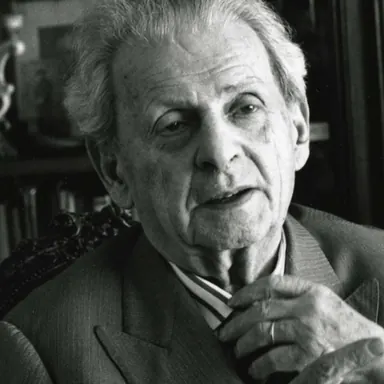
עמנואל לוינס
19 דק׳ קריאה3,732 מילים
תקציר
טקסט זה מציע סקירה מעמיקה על חייו והגותו של עמנואל לוינס, תוך הצגת המעבר שלו מלימוד פנומנולוגיה קלאסית לעבר פיתוח אתיקה כפילוסופיה ראשונית. החיבור בוחן כיצד חוויות השואה והשבי עיצבו את תפיסתו בדבר האחריות האינסופית כלפי הזולת, המגולמת בהתגלות הפנים, ומתאר את הדיאלוג המורכב שניהל עם הוגים כמו היידגר ודרידה. לצד הפן האקדמי, מודגש פועלו בפרשנות תלמודית מודרנית ובשיקום החינוך היהודי בצרפת, משימה שנועדה לתרגם את חוכמת המקרא לשפה פילוסופית אוניברסלית. בסופו של דבר, המקור מבקש להבהיר כי עבור לוינס, האנושיות אינה נמדדת ביכולת החשיבה המופשטת אלא בהתייצבות המוסרית למען האחר, המהווה את "חוכמת האהבה" האמיתית.
The Ethical Horizon: A Comprehensive Analysis of the Life, Philosophical Innovation, and Jewish Hermeneutics of Emmanuel Levinas
The intellectual corpus of Emmanuel Levinas represents one of the most profound reconciliations of Western phenomenological rigor and the ethical imperatives of the Jewish tradition in the history of modern thought. Levinas did not merely contribute to the field of ethics; he fundamentally repositioned it as "first philosophy," arguing that the encounter with the other person is the primary event from which all meaning, logic, and consciousness emerge.[1, 2, 3] His work is characterized by a dual loyalty: a "professional" philosophical output that engaged with the giants of the Continental tradition—Husserl and Heidegger—and a "confessional" Jewish output that revitalized Talmudic study for the post-Holocaust world.[4, 5, 6] This report provides an exhaustive examination of his life, his radical philosophical concepts, his institutional leadership, and his unique "Toranic" or religious worldview.
The Formative Landscape: From Lithuania to the French Academy
The origins of Levinas’s thought are inextricably linked to the cultural and spiritual geography of Kaunas (Kovno), Lithuania, where he was born on January 12, 1906.[1, 2, 3] Lithuania at the turn of the century was a bastion of "Mitnagdic" or rationalist Jewish scholarship, a tradition that emphasized intellectual rigor and the study of the legalistic Talmud over mystical or emotionalist approaches.[5, 7] Growing up in a home that was modern yet traditional, Levinas was polyglot from childhood, speaking Yiddish, Russian, and Lithuanian.[7] His early education in the Hebrew Bible, provided by a private tutor, instilled in him a "biblical humanism" that would later serve as the counter-model to the abstract ontologies of Western philosophy.[1, 7]
The instability of the Russian Empire forced his family to relocate to Kharkov during the First World War, where he experienced the Russian Revolution of 1917 as a young boy.[2, 7] This period was marked by his immersion in the great Russian novelists—Dostoevsky, Tolstoy, and Pushkin—whose explorations of universal guilt, suffering, and the human soul deeply colored his later ethical reflections.[7, 8] Dostoevsky’s famous line from The Brothers Karamazov, stating that "we are all responsible for all and for everything, and I more than all the others," became a foundational motif in Levinas’s mature philosophy of infinite responsibility.[7, 8]
The Philosophical Apprenticeship in Strasbourg and Freiburg
In 1923, Levinas migrated to France to study at the University of Strasbourg.[1, 2, 7] His choice was driven by a desire for the "light" of French culture and a refuge from the anti-Semitic quotas of Eastern Europe.[7] At Strasbourg, he formed a lifelong friendship with Maurice Blanchot and studied under thinkers like Maurice Pradines and Henri Carteron.[7] However, the most decisive move of his early career was his journey to the University of Freiburg in 1928–1929.[1, 2]
At Freiburg, Levinas encountered the two figures who would define his philosophical trajectory: Edmund Husserl, the founder of phenomenology, and Martin Heidegger, the author of Being and Time.[1, 2, 3] Levinas was initially an ardent disciple of both. He was one of the first French intellectuals to introduce phenomenology to France, translating Husserl's Cartesian Meditations in 1931 and publishing his own doctoral thesis on Husserl’s theory of intuition in 1930.[1, 3] However, the rise of National Socialism and Heidegger's subsequent affiliation with the Nazi party in 1933 shattered Levinas’s initial admiration, leading him to believe that Heidegger's "Fundamental Ontology"—which prioritized the question of Being over the question of the Good—was philosophically complicit in the totalizing violence of the era.[1, 3, 8]
The Rupture of War and the Shadow of the "Il y a"
The Second World War was the crucible that transformed Levinas from a commentator on German philosophy into an original thinker of the first rank.[1, 8] Mobilized into the French army as an interpreter, he was captured by the Germans in 1940.[2, 3, 11] As a French officer of Jewish descent, he was held in Stalag XI-B at Fallingbostel, where he was assigned to a special commando unit for Jewish prisoners.[2, 8, 12] While his status as a prisoner of war afforded him a "miraculous protection" by the uniform, his family in Lithuania—his parents and brothers—were murdered by the Nazis.[1, 2, 8]
During his five years of captivity, Levinas wrote in secret notebooks, which were published decades later.[8, 13] These notebooks reveal a mind grappling with the "horror" of impersonal existence.[14] He developed the concept of the il y a (there is)—the presence of Being that remains when all entities and meanings are stripped away.[1, 8, 14] Unlike the Heideggerian Ereignis (event of Being) which Levinas came to see as a "neutral" power, the il y a is a "weight" or an "insomnia" that the subject cannot escape.[8, 15] The war convinced Levinas that the only exit from the neutrality of Being was through the ethical rupture—the encounter with the other person that transcends the self.[1, 3, 8]
The Ethical Witness: Bobby the Dog
A celebrated story from this period, detailed in the essay "The Name of a Dog, or Natural Rights," involves a stray dog named "Bobby" that entered the camp.[12, 16] While the German guards and even the local townspeople viewed the Jewish prisoners as "non-persons" or "apes," Bobby greeted them with joy and recognition.[8, 12, 16] Levinas ironically called Bobby "the last Kantian in Nazi Germany," noting that the dog’s "straightforward canine thoughts" recognized the human dignity of the prisoners when human logic had failed to do so.[16, 17, 18]
This narrative serves as a profound critique of Western reason.[16, 17] If an animal, "without ethics and without logos," can bear witness to the humanity of the marginalized, then the traditional definition of the human based on rational autonomy (Kant) or the understanding of Being (Heidegger) is insufficient.[16, 17] For Levinas, Bobby was a "trace" of the infinite within the closed totality of the camp, a signal that ethics precedes and survives the collapse of civilization.[3, 12]
First Philosophy: Totality and Infinity
In 1961, Levinas published his magnum opus, Totality and Infinity: An Essay on Exteriority.[1, 7, 19] This work is an all-out assault on Western metaphysics, which Levinas labels as "Ontology"—the philosophy of the "Same".[1, 3, 20] He argues that Western thought from Plato onward has sought to "totalize" the world, bringing everything under the mastery of the knowing ego.[3, 15] In this framework, the "Other" is only accepted if it can be understood, categorized, or assimilated into the self’s own categories.[3, 21, 22]
Against this "imperialism of the Same," Levinas proposes "Infinity".[3, 20] Infinity is not a mathematical concept or a mystical state; it is the "exteriority" of the other person that cannot be contained by the mind.[3, 15, 20] This encounter occurs through the "Face" (le visage).[3, 7, 20]
The Epiphany of the Face
For Levinas, the Face is not a physical object or a set of features that can be grasped by vision.[3, 20] Rather, the Face is an "epiphany" and a "command".[3] It is that which "signifies without context".[20] When I look at the Face of the Other, I am met with a vulnerability that commands: "Thou shalt not kill".[3, 15] This encounter is characterized by:
- Asymmetry: The Other is not my equal or my mirror; the Other comes from a "height" and speaks as a master.[3, 15, 22]
- Irreducibility: No matter how much I know about the Other, they remain an infinite mystery that I can never fully possess or understand.[3, 22, 23]
- Ethical Priority: My responsibility for the Other precedes my own freedom.[3] I am "called" into being by the Other’s need.[3, 20]
Otherwise than Being: The Ethics of Substitution
In 1974, Levinas published his second major work, Otherwise than Being or Beyond Essence.[1, 2, 19] While Totality and Infinity focused on the external encounter with the Face, Otherwise than Being turns inward to explore the structure of subjectivity itself.[2, 19, 21] In this later work, Levinas deepens his claim that the human subject is "formed in and through responsibility".[3, 19, 24]
The central concept here is "Substitution".[2, 21] Levinas argues that my responsibility for the other is so absolute that I am essentially a "hostage" to the other.[2, 3, 20] I am responsible not only for my own actions but for the suffering and even the crimes of the other.[2, 3] This is not a choice made by a free will; it is an "accusing" responsibility that occurs at a "pre-conscious" level of our physical, embodied sensibility.[2]
The Saying and the Said
To articulate this pre-original ethics, Levinas introduces the linguistic distinction between "the Saying" (le Dire) and "the Said" (le Dit).[2]
- The Said: This is the realm of history, facts, philosophy, and institutions. It is the world of essence where meanings are fixed and categorized.[2]
- The Saying: This is the act of communication itself, the "exposure" of the self to the other. It is a "sincerity" that precedes the information conveyed.[2, 25]
Levinas posits that "the Saying" is the true locus of the ethical, but it is always "betrayed" when it is frozen into a "Said".[2] The task of philosophy, then, is to "unsay" the Said—to constantly return to the living, ethical urgency of the encounter that lies beneath our laws and our language.[2, 3]
The "Torah" Dimension: Judaism as Biblical Humanism
While Levinas was a prominent figure in the French academy, he was equally dedicated to the "reawakening" of Jewish thought in the post-war era.[1, 6] He viewed Judaism not as a private faith or an aesthetic ritual, but as a "category of being" and an "understanding of the world".[2, 8, 13] For Levinas, the "wisdom of ethics" found in the Jewish sources was the only force capable of resisting the nihilism of modern ontology.[1, 26]
He famously described his work as an attempt to translate the "Hebraic" insights of the Bible and the Talmud into the "Greek" language of philosophy.[4, 5, 6] This was not a reduction of Judaism to philosophy, but a claim that Jewish wisdom holds the key to a "universal" humanism that the West had forgotten.[1, 27, 28]
The Influence of Mr. Shushani
The catalyst for Levinas’s deep engagement with the Talmud was his post-war study with the legendary and enigmatic "Mr. Shushani".[7, 29] A nomadic, unkempt genius with a photographic memory of the entire Jewish canon, Shushani treated the Talmud as a "merciless" intellectual exercise in moral philosophy.[29] He taught Levinas a method of "destruction and reconstruction," showing that the archaic legal debates of the Babylonian sages were actually sophisticated inquiries into human rights, political justice, and the nature of the "Other".[29]
Shushani’s influence is evident in the "Talmudic Readings" that Levinas delivered annually at the Colloquium of French Jewish Intellectuals.[1, 6] In these lectures, Levinas would take a legalistic "sugya" (Talmudic passage) and use it to address contemporary crises, such as the student protests of 1968, the Cold War, or the failure of modern education.[6, 27]
Difficult Freedom: The Ethics of Justice and Politics
In his collection of essays Difficult Freedom (1963), Levinas argues for a Judaism that is intellectually "difficult"—meaning it demands the suspension of egoistic spontaneity in favor of the law.[1, 30] He rejects the "soft" humanism of the Enlightenment, which begins with the free individual, and instead proposes a humanism of "the other man".[1]
For Levinas, the "legalism" of the Torah is not an obstacle to spirituality but its very essence.[4] The 613 commandments (mitzvot) are a "liturgy" of responsibility that trains the subject to turn away from the "Same" and toward the "Other".[2, 4, 33]
The Third Party and the State of Israel
A persistent challenge to Levinas’s ethics is how it functions in the real world of politics and states. If the encounter is "face-to-face" and "asymmetrical," how do we achieve justice for all? [20] Levinas answers this through the concept of "the Third Party" (le tiers).[2, 3, 20]
The "Third" is the rest of humanity who is always present "in the trace" of the other person.[3, 20] The presence of the Third necessitates "Justice," which Levinas defines as the "comparison of the incomparable".[2, 20] While I am infinitely responsible for you, I must also be responsible for the neighbor of you. This requires:
- Laws and Institutions: To ensure that one person is not favored over another.[2, 20]
- The State: Which Levinas viewed as necessary but always in need of "ethical interruption" by the conscience of individuals.[2]
- Zionism: Levinas had a complex but supportive relationship with the State of Israel, which he saw as a laboratory for "Talmudic justice" on a national scale, though he warned against the state becoming a "totality" in itself.[8, 31, 32]
Comparative Intellectual Contexts: Rosenzweig, Buber, and Derrida
Levinas’s work must be understood as a series of profound dialogues with his contemporaries. He was heavily influenced by Franz Rosenzweig’s Star of Redemption, particularly Rosenzweig’s critique of "Totality".[3, 13, 25] Levinas credited Rosenzweig with discovering that "revelation" is not the transmission of information but the "happening" of an ethical relationship through language.[13, 25, 34]
He was more critical of Martin Buber’s "I-Thou" philosophy.[7, 22] While Buber emphasized the "reciprocity" of the relationship, Levinas insisted on its "asymmetry".[22] For Levinas, the "I-Thou" was too symmetrical, a "warm companionship" that risked forgetting the radical height and authority of the Other.[22, 23]
The Engagement with Jacques Derrida
The most significant philosophical challenge to Levinas came from Jacques Derrida’s 1964 essay "Violence and Metaphysics".[35, 36] Derrida argued that Levinas was attempting the impossible: to speak "outside" of Greek philosophy while using the very categories of Greek logic.[35, 37] Derrida claimed that any attempt to describe "the Other" as "Other" was itself a form of "violence" because it brought the Other into the realm of the "Said".[15, 35]
This critique was formative for Levinas’s second major work, Otherwise than Being, where he developed the distinction between the "Saying" and the "Said" to account for how ethics "interrupts" the closure of language.[2, 21] Despite their intellectual rivalry, Derrida became a leading advocate for Levinas’s work, expanding his influence into the realms of deconstruction and literary theory.[3, 36]
Institutional Stewardship: The ENIO and the Mission of the AIU
For thirty-four years, from 1947 to 1979, Levinas served as the Director of the École Normale Israélite Orientale (ENIO) in Paris.[2, 6, 9, 10] This was the teacher-training college of the Alliance Israélite Universelle (AIU), an organization dedicated to the emancipation and education of Jews across the Mediterranean and Middle East.[2, 6]
Levinas saw this role as a "historic calling".[6] Following the Holocaust, he believed that the rebuilding of Jewish life required a "new style of learning" that was both rooted in tradition and open to the modern world.[6, 28] He held Saturday morning Bible and Talmud classes that became legendary in the Parisian intellectual scene, where he would demonstrate how the ancient texts could provide a "culture" that was missing in the secularized world.[9, 11]
The Pedagogical Philosophy of Levinas
In his reflections on education, Levinas argued that the teacher-student relationship is the model for the ethical encounter.[9, 28] He rejected the idea of the student as an "empty vessel" to be filled with knowledge.[28] Instead, education is a form of "teaching" where the Other (the teacher or the text) "breaks" the self-sufficiency of the ego and introduces the "idea of the Infinite".[3, 25, 28]
He was particularly concerned with the "failure of Jewish education," a topic he discussed with Israeli Prime Minister David Ben-Gurion in 1953.[9] Levinas argued that Jewish education must go beyond "folklore" and "nationalism" to recover the "rigor of the text" and the "uncompromising ethics" of the Talmud.[1, 6, 9]
The Critique of Theodicy and the Post-Holocaust Divine
One of Levinas’s most radical "Toranic" contributions is his essay "Useless Suffering," in which he proclaims "the end of theodicy".[4] After the Holocaust, he argues, it is no longer possible—or ethical—to justify God by claiming that suffering has a purpose or a divine plan.[4] Any attempt to explain the suffering of the Other is "the source of all immorality".[4]
This does not lead to atheism, but to a "difficult" faith.[30] For Levinas, God is not a "super-being" who intervenes in history, but a "trace" that is found in the Face of the Other.[3, 5, 33] The divine command is heard not from the heavens, but from the mouth of the poor and the stranger.[3, 4] Religion is thus entirely "human-oriented," where our only access to the infinite is through the practice of justice on earth.[2, 4]
God "on God's Side" and God "on Our Side"
Drawing on the 18th-century scholar Rabbi Hayyim of Volozhin, Levinas distinguishes between God "on God's own side" (the infinite and unknowable) and God "on our side" (the God of relation and commandment).[5, 33] He argues that humans can only gain access to the former through the "piercing" of our reality by Revelation, which occurs as a "new possibility of signifying" through the human subject.[5] This preserves the "transcendence" of God while ensuring that religious life is grounded in the "concrete and compelling knowing" of virtue.[1, 5]
Legacy and Contemporary Influence
Emmanuel Levinas died in late 1995, but his influence continues to grow across multiple disciplines.[3, 10, 19] In the field of Jewish Studies, he is regarded as one of the greatest philosophers since Maimonides, having created a synthesis of Judaism and philosophy that avoids both the "arbitrariness of faith" and the "abstractions of positivism".[1, 4]
His concepts have been applied to:
- Political Theory: Analyzing the relationship between the state, justice, and the "face" of the refugee or the marginalized.[15, 20]
- Educational Theory: Developing a "Levinasian" pedagogy centered on subjectification and responsibility.[24, 38]
- Clinical Psychology: Exploring the "face-to-face" relationship in psychotherapy as a site of healing and ethical demand.[19]
- Art and Aesthetics: Understanding the artwork not as an object of beauty, but as an "event of obscuring" that points to what lies beyond the visible.[3, 14]
The Ongoing Debate
Scholars like Hanoch Ben-Pazi and Ephraim Meir continue to evaluate the "ethical hermeneutics" of Levinas, particularly his relevance to the modern State of Israel and the "crisis of humanism" in the 21st century.[3, 38, 39] While some critics argue that his focus on "asymmetry" is impractical or that his views on the "theodicy" are too bleak, others find in his work the only sustainable foundation for a world plagued by the return of "totalizing" ideologies.[4, 21]
Conclusion: The Wisdom of Love
Emmanuel Levinas fundamentally transformed the landscape of modern thought by suggesting that philosophy is not the "love of wisdom" but the "wisdom of love".[3] His "activity" was a lifelong testimony to the idea that the human being is defined not by their capacity to think or to be, but by their capacity to respond.[1, 3, 12] In his "Toranic" worldview, the study of the Talmud and the encounter with the neighbor are one and the same: a search for the "Infinity" that disrupts our complacency and calls us to justice.[1, 3, 30] As he demonstrated from the barracks of Stalag XI-B to the lecture halls of the Sorbonne, the "trace of God" is always found in the "gentleness" of the face that says: "After you, sir".[3, 33] This infinite responsibility is the difficult freedom that constitutes the true glory of the human person.[3, 12, 30]
מקורות39
- 1.Emmanuel Levinas - Jewish Studies - Oxford Bibliographies, oxfordbibliographies.com/abstract/document/obo-9780199840731/obo-9780199840731-0245.xml
- 2.Emmanuel Levinas (Stanford Encyclopedia of Philosophy), plato.stanford.edu/entries/levinas/
- 3.Emmanuel Levinas - Wikipedia, en.wikipedia.org/wiki/Emmanuel_Levinas
- 4.Levinas's Jewish Thought: Between Jerusalem and Athens | Jewish Book Council, jewishbookcouncil.org/book/levinass-jewish-thought-between-jerusalem-and-athens
- 5.Emmanuel Levinas's Talmudic Turn: Introduction | Stanford University Press, sup.org/books/religious-studies/emmanuel-levinass-talmudic-turn/excerpt/introduction
- 6.Introducing “The Temptation of Temptation”: Levinas and Europe, jsr.shanti.virginia.edu/back-issues/volume-11-no-2-december-2012-levinas-and-philosophy/introducing-the-temptation-of-temptation-levinas-and-europe/
- 7.Emmanuel Levinas - Wikipédia, fr.wikipedia.org/wiki/Emmanuel_Levinas
- 8.A Loving Levinas on War - The Forward, forward.com/culture/125385/a-loving-levinas-on-war/
- 9.Analysis and Reading of Il nous manque une culture. Réflexions sur l'enseignement hébraïque, by Emmanuel Levinas - Cairn, shs.cairn.info/journal-le-telemaque-2011-2-page-105?lang=en
- 10.Lévinas Emmanuel - Academy of Europe, ae-info.org/ae/User/Lévinas_Emmanuel
- 11.Emmanuel Levinas | AIU - Alliance israélite universelle, aiu.org/fr/emmanuel-levinas
- 12.A Dog at the Seder? Lessons from philosopher Emmanuel Levinas - Rabbi Laura Duhan-Kaplan, sophiastreet.com/2014/04/13/dog-seder-levinas/
- 13.“Jewish Existence as a Category of Being”: Revisiting Franz Rosenzweig's Influence on Levinas's Work - Philosophy Documentation Center, pdcnet.org/collection-anonymous/pdf2image?pdfname=levinas_2021_0015_0013_0036.pdf&file_type=pdf
- 14.Emmanuel Levinas: Hermeneutics, Ethics, and Art - David Publishing, davidpublisher.com/Public/uploads/Contribute/55d19d3160346.pdf
- 15.On Violence, Justice and Deconstruction - Concentric: Literary and Cultural Studies, concentric-literature.url.tw/issues/Violence/2.pdf
- 16.Emmanuel Levinas 'A Name of a Dog' | Black Shed Shul - WordPress.com, blackshedshul.wordpress.com/exodus/
- 17.Dog and Philosophy - ResearchGate, researchgate.net/profile/Peter_Atterton/publication/340284159_Dog_and_Philosophy_Does_Bobby_Have_What_It_Takes_to_be_Moral/links/5e822b57458515efa0bbf2a6/Dog-and-Philosophy-Does-Bobby-Have-What-It-Takes-to-be-Moral.pdf
- 18.Le flair animal: Levinas and the Possibility of Animal Friendship - Semantic Scholar, pdfs.semanticscholar.org/a974/06772d51129fc5cc8b8932a03beb3f608b7c.pdf
- 19.Otherwise than Being, or Beyond Essence Emmanuel Levinas | Translated by Alphonso Lingis | Duquesne University Press, dupress.duq.edu/products/philosophy6-paper
- 20.THE OTHER, THE THIRD, THE JUSTICE - UniTS, sites.units.it/etica/2021_1/SCORALICK.pdf
- 21.Levinas's Substitution – Otherwise than Otherness - Radboud Educational Repository, theses.ubn.ru.nl/items/14452715-9e60-41f1-afce-01216f408a78
- 22.Alterity and Asymmetry in Levinas's Ethical Phenomenology | The Journal of Scriptural Reasoning, jsr.shanti.virginia.edu/back-issues/vol-13-no-1-june-2014-phenomenology-and-scripture/alterity-and-asymmetry-in-levinass-ethical-phenomenology/
- 23.An Almost Unheard-of Analogy': Derrida Reading Levinas - The University of Memphis, memphis.edu/philosophy/people/pdfs/saghafi-analogy.pdf
- 24.BEING OTHERWISE: GENERATING LEVINAS'S ETHICAL SUBJECT - Quest University Canada, questu.ca/wp-content/uploads/2019/10/Genereux_final.report.2019.pdf
- 25.(PDF) Is There a "Correlation" between Rosenzweig and Levinas? - ResearchGate, researchgate.net/publication/236757904_Is_There_a_Correlation_between_Rosenzweig_and_Levinas
- 26.Thinking and Learning with Emmanuel Lévinas - Germantown Jewish Centre, germantownjewishcentre.org/levinas/
- 27.תשע קריאות תלמודיות / עמנואל לוינס ; [מצרפתית - דניאל אפשטיין] | ספר - הספרייה הלאומית, nli.org.il/he/books/NNL_ALEPH990022026370205171/NLI
- 28.Reading between the Lines: Form and Content in Levinas's Talmudic Readings - Project MUSE, muse.jhu.edu/book/43464
- 29.תלמיד של הרב קוק ומורה של לוינס: מי אתה מר שושני?, blog.nli.org.il/chouchani/
- 30.הקריאות התלמודיות של לוינס - בית אבי חי, cdn.bac.org.il/warehouse/content/files/file_19760.pdf?v=1712405252746
- 31.מעבר לפסוק / עמנואל לוינס ; [מצרפתית - אליזבט גולדוין ; עריכה - דניאל אפשטיין] - הספרייה הלאומית, nli.org.il/he/books/NNL_ALEPH990025679180205171/NLI
- 32.חדש על המדף, www3.openu.ac.il/ouweb/owal/new_books1.book_desc?in_mis_cat=112090
- 33.Maagalim8 191-221, asif.co.il/wp-content/uploads/2021/04/Maagalim8-191-221.pdf
- 34.The Unconscious in Rosenzweig's The Star of Redemption: On the Threshold of a Possible Revelation - SciSpace, scispace.com/pdf/the-unconscious-in-rosenzweigs-the-star-of-redemption-on-the-vvi9ql5q.pdf
- 35.The divine and the problem of violence - AUC Knowledge Fountain, fount.aucegypt.edu/cgi/viewcontent.cgi?article=1697&context=etds
- 36.Jacques Derrida - Stanford Encyclopedia of Philosophy, plato.stanford.edu/entries/derrida/
- 37.'The discipline of the question': Rereading Derrida's 'Violence and Metaphysics', euppublishing.com/doi/10.3366/drt.2010.0009?widget=journaleditorialboard
- 38.עמנואל לוינס – האמנה החינוכית: אחריות, תקווה וברית - פורטל מס"ע, portal.macam.ac.il/article/עמנואל-לוינס-האמנה-החינוכית-אחריות-ת/
- 39.עמנואל לוינס - האמנה החינוכית - חנוך בן-פזי | עברית - חנות ספרים, e-vrit.co.il/Product/12712/עמנואל_לוינס_האמנה_החינוכית