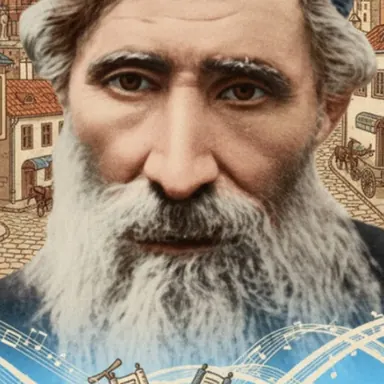
Rabbi Shmuel Mohliver
17 min read3,333 words
Summary
The text surveys the many-faceted figure of Rabbi Shmuel Mohliver, one of the founding fathers of religious Zionism, outlining his work, which combined Lithuanian Torah scholarship with groundbreaking national activism. The article opens with his biographical background as a Torah prodigy and details the stations of his life as a communal rabbi, which equipped him to bridge social gaps and to develop the vision of settling the Land of Israel by natural means. A central axis of the text focuses on his practical initiatives, from enlisting Baron Rothschild for the settlement enterprise and the founding of the moshava of Mazkeret Batya, to the formulation of the sale permit in the sabbatical year of 5649 as a halakhic solution ensuring the survival of Hebrew agriculture. In addition, it explains his leadership role in the founding of the Mizrachi movement and in establishing a theology of partnership with the secular public for the sake of the national goal. The text concludes with a historiographical survey of his Torah writings that were lost in pogroms and fires, and stresses how his legacy continues to shape the modern Jewish identity that unites fidelity to halakha with national revival.
Halakhic Leadership, National Diplomacy and Zionist Teaching: The Life's Work and Torah Thought of Rabbi Shmuel Mohliver
Biographical Background and the Development of a Torah Leader
Rabbi Shmuel Mohliver, who was born in the town of Glubokoye near Vilna in 5584 (1824) and died on 19 Sivan 5658 (1898), represents one of the most influential junctures in modern Jewish history.[1, 2] His figure powerfully combines the distinguished Torah scholarship of the Lithuanian "Mitnagdim" school with a deep attachment to the idea of redemption, whose roots lie partly in his family lineage.[1] Rabbi Mohliver was born into a distinguished family of Torah giants spanning twenty-two generations; his father, Rabbi Yehuda Leib, was a "Mitnaged" rabbi and merchant, while his mother belonged to a renowned Hasidic family.[1] This cultural and spiritual fusion of rational Lithuanian scholarship and Hasidic fervor formed a critical psychological and intellectual foundation in shaping his personality as a leader capable of bridging deep social and ideological gaps among the Jewish people.[1, 2] His original family name was Mohilever, after the city of Mohilev, but the name was garbled by those who found it hard to pronounce and became Mohliver.[2]
Already in his youth he was known as an exceptional prodigy and was called "the prodigy of Glubokoye," and he independently acquired broad knowledge of the history of the Jewish people and of the general sciences.[1] After his marriage at the age of fifteen, he taught Gefet (Gemara, Rashi's commentary and Tosafot) to the young men of his town for some three years.[1] At an age of no more than eighteen he turned to formal studies at the illustrious Volozhin yeshiva, where he was ordained as a rabbi within only half a year.[1] Like his forefathers, he initially refused to earn his living from the rabbinate and engaged in the flax trade, but following an epidemic in which his wife's parents perished in 5608 (1848), when his business began to collapse, he acceded to the entreaties of the members of his community and took upon himself the yoke of the rabbinate.[1]
The various rabbinic posts he held throughout his life served as fertile ground for developing his public outlook and the social cohesion he preached, as detailed in the following table:
This process of moving between communities of varied character gave Rabbi Mohliver a profound understanding of the Jewish social mosaic in Eastern Europe, and prepared him to become one of the founding fathers of religious Zionism.[1, 2]
The National Turn, the Pavlovka Initiative and the Founding of Mazkeret Batya
Rabbi Mohliver's active national awakening began in 1874, with the founding of the "Mazkeret Moshe" fund in honor of the ninetieth birthday of Sir Moses Montefiore.[2, 4] Rabbi Mohliver enthusiastically enlisted in raising money for the fund, and from then on the idea of settling the Land of Israel became the central axis of his life and occupation.[2, 4] With the outbreak of the "Storms in the South" pogroms (1881–1882), he became one of the founders and prominent leaders of the "Hovevei Zion" movement.[2, 5] He took an active part in the historic Kattowitz Conference of 1884, which laid the practical and organizational foundations of the movement.[3]
One of the historic breakthroughs attributed to his diplomatic work is his direct and personal approach to Baron Edmond James de Rothschild in Paris.[3, 6] The formative meeting took place on the first festival day of Sukkot 5643 (1882), when Rabbi Mohliver, out of strictness regarding the sanctity of the festival, walked on foot for some two hours to the Baron's home.[6] At this meeting the Rabbi succeeded in stirring the Baron's heart and presenting to him a well-founded vision of Jewish agricultural settlement in the land of the forefathers, and thereby enlisted him to assist the immigrants of the First Aliyah.[3, 4] The Baron agreed to the initiative, on condition that families with real agricultural experience be found who would be willing to immigrate to the Land of Israel of their own free will and at their own expense.[5]
Following this agreement, Rabbi Mohliver located ten families of Jewish farmers in the village of Pavlovka in Poland, who had worked the land since their youth.[5] The men immigrated to the Land, underwent rigorous agricultural training at the "Mikveh Israel" agricultural school, and after they had proven their skill as farmers, the Baron established a moshava for them and they brought over their families.[5] The moshava was founded at the end of 1883 under the name Ekron, and was later called "Mazkeret Batya" after the Baron's mother.[3, 5, 7] The Mazkeret Batya museum today displays a reconstruction of a living room, kitchen utensils and items from this period that commemorate the Rabbi's work.[8]
Rabbi Mohliver's practical activity was not confined to the European arena; in 1890 he visited the Land of Israel, actively assisted in founding the moshava of Rehovot [3], and even presented an early and bold vision for Jewish settlement in the region of Beirut and in the north of the country.[9] His long-term influence was commemorated, among other things, at Kibbutz Gan Shmuel, which began as an etrog orchard planted in his honor in 5656 as an expression of the spiritual and agricultural bond between the Diaspora and the Land of Israel.[3, 10] The etrogim of the Land of Israel were regarded among Diaspora Jews as choice in terms of their inner and spiritual value, but the orchard became diseased, and later orange trees were planted in its place, and nearby the kibbutz that bears his name was established.[10]
His Torah Thought and Halakhic Legacy
The teaching of Rabbi Shmuel Mohliver is based on a unique synthesis between pure halakha and a modern historical-national conception. He saw the Torah of Israel as the source of life and the moral foundation of the nation, but held that the revival of the people in its land must be carried out by practical and natural means.[2]
The Beginning of Redemption by Natural Means and the Settlement of the Land
Like other heralds of Zionism of his generation, such as Rabbi Zvi Hirsch Kalischer, Rabbi Mohliver held the conception that the future redemption would not occur in a miraculous and sudden way, but in a gradual and natural process ("little by little").[2] According to this approach, the historical duty of the Jewish people is to take an active initiative in returning to the Land, to purchase land, to build houses, to plant vineyards and to sow fields.[2] Relying on the position of Nahmanides (Ramban) in his Sefer ha-Mitzvot, Rabbi Mohliver ruled that the commandment of settling the Land of Israel is a positive commandment for all generations, equal in weight to the whole Torah, and that it constitutes the foundation of the physical and spiritual existence of the nation.[2, 11]
At the same time, the Rabbi presented a complex and graded halakhic teaching on the question of living in the Land of Israel as opposed to the Diaspora, founded on the observance of the Torah:
One who is able to live in the Land of Israel and to observe the Torah and the commandments there – is obligated to live in the Land of Israel.[12]
One who fears that in the Land of Israel he will not be able to observe the Torah and the commandments properly, but outside the Land he will be able to observe them without fear – it is preferable that he live outside the Land.[12]
One who cannot observe the Torah and the commandments anywhere, neither in the Land nor abroad – should live outside the Land and sit alone in his house.[12]
This equation makes clear that despite his Zionist fervor, the observance of the Torah and the commandments remained the supreme criterion and the basis of all national building in the land of the forefathers.[2, 12]
The Theology of Partnership with the Secular
One of the most complex challenges Rabbi Mohliver faced was the controversy over national partnership.[2] Various Haredi and rabbinic circles refused to cooperate with the pioneers of the First Aliyah and the maskilim, a large part of whom did not observe the Torah and the commandments devoutly.[2] Rabbi Mohliver developed a bold and tolerant theological teaching, based on deep midrashic sources:
The principle of the primacy of the Land: the Rabbi relied on the midrash in Sifrei Devarim and in Eikhah Rabbah, which cites the words of the Holy One, blessed be He: "Would that My children were in the Land of Israel, even though they defile it."[12] From this he concluded that dwelling in the Land of Israel and its physical building are preferable in the eyes of the Creator to the meticulous observance of commandments in exile.[12]
Not refraining from performing a commandment because of transgressors: he stressed that a sacred national commandment such as building the Land must not be cancelled or boycotted merely because non-religious people take part in it.[12] He compared this to the mixed multitude (erev rav) that went up with Moses in the wilderness and did not prevent the people from reaching the Land.[12]
Accepting every Jew without condition: the Rabbi supported the admission of every Jew into the ranks of the "Hovevei Zion" movement, without any halakhic reservation regarding the observance of the commandments.[2] He worked in two parallel channels: defending the status of religion and of the religious pioneers in the moshavot, and on the other hand – bringing hearts closer and explaining among the maskil and secular leadership.[2]
This conception enabled him to develop a close and warm relationship with Binyamin Ze'ev (Theodor) Herzl.[2] Rabbi Mohliver greatly valued his book "The Jewish State" and called Herzl in his letters "the excellent and most exalted man," while Herzl for his part saw the Rabbi as a first-rate strategic partner and defined himself as continuing his path.[2]
The Controversy over the Sabbatical Year of 5649 and the Halakhic Arrangement
The greatest halakhic test of the practical religious-Zionist approach came toward the sabbatical (shmita) year of 5649 (1888–1889).[13] This was the first sabbatical year in which the new agricultural moshavot faced the challenge of a complete cessation of work.[13, 14] The communities of the Old Yishuv in Jerusalem regarded the observance of the sabbatical year in its plain sense as a condition for redemption and as a way of drawing down divine blessing, and opposed any compromise.[13, 15]
Rabbi Mohliver, together with a handful of rabbis who supported settlement, recognized that a complete cessation of agricultural work would inevitably bring about the total economic collapse of the young moshavot and a real danger to the lives of the pioneers.[13, 14] Out of a dynamic halakhic outlook combining classical rulings with national responsibility, Rabbi Mohliver, together with his colleagues, formulated the foundations of the "sale permit" (heter mechira), whose roots rest on early rulings of the sages of Safed from some five hundred years earlier.[13, 15] The permit is based on a temporary sale of the lands of the Land of Israel to a gentile, whereby the sanctity of the land is temporarily removed and it is permitted to perform certain labors on it (mainly by non-Jewish workers).[13, 14]
The halakhic and public controversy was extremely stormy, and divided the Torah world into two clear camps:
This permit, despite the fierce criticism it received, was the cornerstone that enabled Hebrew agriculture to survive its first years, and became an inseparable part of the map of halakhic rulings of religious Zionism throughout its generations.[13, 14]
This controversy has been the subject of comprehensive historical studies over the years, which analyze the variety of religious and social aspects of the affair:
In a broad historical view, the debate around the permit continues to this day, with modern decisors such as Rabbi Mordechai Eliyahu and Rabbi Shlomo Zalman Auerbach permitting its use after the fact.[17] On the other hand, rabbis such as Rabbi Yaakov Ariel and Rabbi Ze'ev Weitman expressed concern that turning the permit into a permanent matter could abolish the sanctity of the Land, while Rabbi Meir Mazuz determined that one should be lenient and permit it from the outset in situations where the prices of vegetables through alternative channels such as otzar beit din are too high for the public.[17]
The Founding of the "Merkaz Ruchani" (Mizrachi) and Coping with the Movement's Crises
In 5653 (1893) the "Hovevei Zion" movement fell into a deep crisis: several of the settlement attempts had failed, the Ottoman authorities imposed harsh decrees on immigration and on the purchase of land, and the movement's leader, Dr. Yehuda Leib Pinsker, died.[2] At the same time, the publication of the incisive articles of Ahad Ha'am ("Truth from the Land of Israel") undermined the confidence of many in the rightness of the path, and opposition to the national vision grew both from extreme Haredi circles and from secular maskilim.[2]
In response to this crisis, Rabbi Mohliver initiated a special assembly of the movement's leaders in the spa town of Druskieniki in the month of Elul 5653.[2] At this assembly it was decided to establish a new center for outreach and leadership headed by Rabbi Mohliver, which was called "Merkaz Ruchani" (Spiritual Center), abbreviated as Mizrachi.[2, 3] This movement formed the historical and ideological foundation on which Rabbi Yitzchak Yaakov Reines later founded the world "Mizrachi" movement within the Zionist Organization.[2, 3]
The main fields of activity of the Spiritual Center, which were intended to consolidate the settlement enterprise and restore public confidence, are detailed in the following table:
The Fate of His Torah Writings and the Efforts to Reconstruct Them
One of the most complex aspects of the historiography of Rabbi Mohliver is the fate of his Torah writings.[18] Throughout his life the Rabbi composed dozens of extensive halakhic and philosophical works, reflecting his immense scholarship and his innovative approach.[18, 19]
The First Loss of the Writings (1906) and the Extent of the Loss
After the Rabbi's death, his confidant and disciple Rabbi Yitzchak Nissenbaum worked to print his halakhic writings.[18] The public aim was clear: to prove publicly the unchallengeable Torah greatness of Rabbi Mohliver, and thereby to repel the claims of the opponents of "Hibbat Zion" who tried to present him as a public activist lacking halakhic stature.[18] Rabbi Nissenbaum asked the Executive Committee of the Zionist movement for funding of one thousand rubles (by purchasing a thousand pictures of the Rabbi that remained in their possession), but the request was rejected.[18] As a result, the writings remained in manuscript and were completely burned during the cruel pogrom carried out against the Jews of Bialystok in 5666 (1906).[18]
The extent of the Torah treasure that was lost was enormous, and according to the testimony of Rabbi Nissenbaum from 5680 (1920) it included more than two hundred printer's sheets of questions and answers on the four parts of the Shulchan Arukh, novellae and explanations on almost the entire Babylonian Talmud and on Choshen Mishpat, profound homilies on topics of Talmudic ethics and Jewish philosophy, complex halakhic responsa on the laws of pe'ah and kilayim based on complex geometric and engineering calculations, a long and comprehensive halakhic responsum detailing the foundations of the sabbatical-year permit, and a long-range Hebrew calendar parallel with mathematical precision to the civil calendar.[18]
The Rescue of the Remnants and the Second Loss
A few remnants of the manuscripts were saved and passed by inheritance to his grandson, Dr. Yosef Mohliver, who before his death handed them over to Rabbi Yehuda Leib HaKohen Maimon for publication.[18, 19] The history of the publication, reconstruction and second loss of these remnants is described in the following table:
Commemorative Institutions and Long-Term Influence
The memory and work of Rabbi Shmuel Mohliver have been widely commemorated among educational institutions, public organizations and government bodies in Israel.[2] The Bnei Akiva yeshiva in Hadera is named "Beit Shmuel" after him, and in the city of Bnei Brak the "Noam Mohliver" school operates today.[2] The Rabbi's personal archive, which brings together unique documents, photographs, letters and official certificates from his public and private life, is preserved and catalogued in the Central Zionist Archives in Jerusalem, and continues to serve researchers and historians of religious Zionism.[2]
His commemoration in space finds expression not only in educational institutions, but also in the names of settlements such as the local council of Mazkeret Batya, which was founded on his direct initiative and became a local council in 1952, and in Kibbutz Gan Shmuel, which preserves a historical connection to the national etrog enterprise established in his honor.[3, 7, 10]
Synthesis and Historical Assessment
The legacy of Rabbi Shmuel Mohliver marks the historical transition of Orthodox Judaism from a position of defensiveness and passivity to a position of national activism and historical initiative. He did not see the contradiction between the traditional world and modernity and nationalism as a decree of fate, but as a religious challenge to be resolved by means of courageous and dynamic halakhic tools.
An analysis of his work shows how rigorous and rational Lithuanian scholarship, combined with a deeply emotional worldview, enabled him to rule on halakha with exceptional breadth of mind. From raising contributions from the communities for national enterprises, through the struggle for the "sale permit" that saved the agriculture of the moshavot, to the establishment of a political institutional infrastructure such as the Mizrachi – Rabbi Mohliver shaped the ideological framework that enabled thousands of observant Jews to take part in building the Land shoulder to shoulder with freethinking pioneers. The research and Torah efforts that continue to this day to reconstruct and publish his writings testify to the vitality of his teaching and to its unchallengeable centrality in understanding the growth of modern religious Zionism.[18]
Sources19
- 1.01 ילדותו ופעילותו של הרב מוהליבר (עד שנת תרמ"א), museum-mohaliver.org.il/01-ילדותו-ופעילותו-של-הרב-מוהליבר-עד-שנת/
- 2.שמואל מוהליבר - ויקיפדיה, he.wikipedia.org/wiki/שמואל_מוהליבר
- 3.מוהליבר שמואל (1824 - 1898) - תולדוט - מטח, historynet.cet.ac.il/pages/item.asp?item=15433
- 4.מוזיאון הרב מוהליבר / מזכרת בתיה - - אבני מורשת, makom.hamoreshet.org.il/landmark/rabbi-muhliber-museum-mazkeret-batya/
- 5.מזכרת בתיה - תורה מציון - Torah Mitzion, torahmitzion.org/he/learn/mzkhrth-bthyh/
- 6.01 הפגישה ההיסטורית - ציוני דרך, מרכז סיור ולימוד מזכרת בתיה, midrasha-m-b.org.il/01history/
- 7.מזכרת בתיה - ויקיפדיה, he.wikipedia.org/wiki/מזכרת_בתיה
- 8.ביקור במוזיאון המושבה מזכרת בתיה | במסגרת מיזם ויקיפדיה אוהבת אתרי מורשת - היסטוריה על המפה, mapah.co.il/wikipedia-loves-heritage-sites-and-this-time-mazkeret-batya-museum/
- 9.הרב שמואל מוהליבר וביירות: חזון מוקדם להתיישבות יהודית בצפון - עורי צפון, uritsafon.com/ramb-mohilever-bayrut-settlement/
- 10.אסופת המאה // אתרוגי "גן שמואל" - הארכיון הציוני המרכזי, zionistarchives.org.il/ATTHECZA/Pages/Etrogim.aspx
- 11.מסירת חלקי ארץ ישראל - Mercaz Harav | מרכז הרב, mercazharav.org.il/2019/07/05/מסירת-חלקי-ארץ-ישראל/
- 12.'הלוואי יהיו בָּנַי עִמִי בארץ ישראל אע"פ שמטמאין אותה' - עלייה ..., machonso.org/hamaayan/?gilayon=55&id=1639
- 13.08 א הרב מוהליבר ופולמוס שמיטת תרמ"ט, היתר המכירה - מוזאון הרב מוהליבר, museum-mohaliver.org.il/08-הרב-מוהליבר-ופולמוס-השמיטה-תרמט-הרקע/
- 14.היתר המכירה – ויקישיבה, yeshiva.org.il/wiki/index.php/היתר_המכירה
- 15.פולמוס השמיטה במושבה פתח תקוה, ptarchive.wordpress.com/2021/09/05/פולמוס-השמיטה-במושבה-פתח-תקוה/
- 16.פרק ז - היתר המכירה - פניני הלכה, ph.yhb.org.il/category/שביעית-ויובל/07-היתר-המכירה/
- 17.היתר מכירה - ויקיפדיה, he.wikipedia.org/wiki/היתר_מכירה
- 18."רק עלים בודדים וקרועים": אובדן כתביו של הרב מוהליבר ופרסום שרידיהם ..., yhb.org.il/shiurim/beerot-01-09/
- 19.מפרי עטו - מוזאון הרב מוהליבר, museum-mohaliver.org.il/articals-he-php/