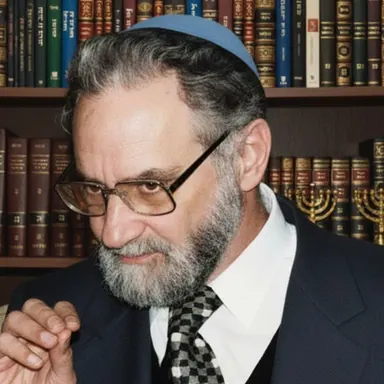
The Secret of the Hebrew: The Work, Torah Teaching and Doctrine of Identities of Rabbi Yehuda Léon Askénazi (Manitou)
17 min read3,488 words
Summary
This text surveys the work and thought of Rabbi Yehuda Léon Askénazi, known by the nickname "Manitou," and presents him as one of the most influential figures in modern Jewish thought. The source traces the course of his life from his roots in Algeria, through his experiences as a fighter and educator in post-Holocaust France, to his settling in Israel, with emphasis on his unique ability to blend Sephardic Lurianic Kabbalah with Western philosophy and anthropology. The core of his teaching deals with the rehabilitation of Jewish identity by moving from an identity of exile and defensiveness to the establishment of the "Hebrew identity," which sees in the return of the people of Israel to its land and in the founding of the State the realization of a universal moral and national message. Finally, the text details the theological tools that Manitou developed to cope with the rupture of the Holocaust and his extensive literary legacy, which strives to heal the breach between the sacred and the secular and to offer a living Torah relevant to the modern sovereign reality.
Introduction: The Phenomenology of the Great Spirit
Rabbi Yehuda Léon Askénazi (1922-1996), known by the nickname "Manitou" (Manitou—"the Great Spirit" in the mythology of the Algonquian Indian tribes), is counted among the great figures of Jewish and intellectual thought in the twentieth century [cite: 1, 2, 3]. His spiritual work, which spanned Algeria, France and the State of Israel, represents a monumental attempt to rehabilitate the Jewish identity that was shattered after the Holocaust [cite: 1, 4, 5]. He developed an original methodology that integrally combines the tradition of Sephardic Kabbalah with modern Western philosophy, and set forth a teaching that rejects the accepted dichotomies between religion and secularism, and between the sacred and the profane [cite: 6, 7, 8].
His teaching, which was transmitted mainly orally and has enjoyed a renewed flourishing in recent decades thanks to an extensive project of documentation and writing by his disciples, places at its center the "doctrine of history" (Mishnat HaToldot) [cite: 3, 7, 9]. This is a historiosophical conception that sees in the biblical narrative a phenomenological map of the history of humanity, directed toward the establishment of a collective identity based on fraternity and on the necessary transition from an identity of exile and defensiveness to an identity of national sovereignty in the Land of Israel [cite: 1, 4, 9].
Spiritual Biography and Formative Life Stations
Family Roots and Intellectual Formation in Algeria
Rabbi Yehuda Léon Askénazi was born in Oran, in French Algeria, on 25 Sivan 5682 (21 June 1922), to a family that merged within itself two mighty spiritual lineages [cite: 3]. His father, Rabbi David Askénazi, served as the last Chief Rabbi of Algeria at the end of the French period, and was a descendant of Rabbeinu Asher (the Rosh), representing the world of halakha and the established Ashkenazi-Sephardic tradition [cite: 2, 3]. His mother, Rachel, was the daughter of the kabbalist and dayan Rabbi Chaim Toubol of Oran, who was a direct descendant of the kabbalist Rabbi Yosef ibn Tabul al-Maghrebi, one of the foremost and leading disciples of the holy Ari in Safed [cite: 2, 3]. This double genetic and spiritual endowment—the established Ashkenazi halakha on the one hand and Sephardic-Lurianic Kabbalah on the other—shaped Manitou's integrative personality [cite: 2, 3, 6].
In his youth Manitou studied at the "Etz Chaim" Talmud Torah in Oran and in French government schools [cite: 5]. In parallel with his high-school studies, he deepened his study of the Talmud with Rabbi Moshe Fingerhut, Chief Rabbi of Algiers, and acquired a broad academic education in philosophy and psychology at the University of Algiers [cite: 2, 5]. He received his training in Kabbalah both in his family circle and during a focused period of study lasting several months in the city of Marrakesh in Morocco, with the local masters of Kabbalah [cite: 2, 3].
[Rabbi Yosef ibn Tabul (disciple of the Ari)]
|
[Rabbi Chaim Toubol the kabbalist]
|
[Rabbi David Askénazi (Chief Rabbi of Algeria)] + [Rachel Toubol]
|
| Rabbi Yehuda Léon Askénazi (Manitou) |
| A fusion of the halakha of the Rosh with the Kabbalah of the Ari |
The War Years and the Destruction as a Theological Turning Point
Between 1939 and 1945 Manitou joined the movement "the Jewish Scouts of France" (Eclaireurs Israélites de France – EIF), which later also operated as an active underground against the Nazi occupation and the Vichy regime [cite: 2, 5]. In this movement he received his scout totem, "Manitou," which became his best-known spiritual name [cite: 2, 3, 5]. In 1943, with the repeal of the Vichy laws in North Africa, he was drafted into the French Foreign Legion [cite: 3]. He served as an infantry soldier and was severely wounded in the battles for the liberation of the Alsace region [cite: 3, 5, 9].
The encounter with the scars of the German Holocaust and the Vichy regime—during which he discovered that the French authorities in Algeria had prepared deportation lists of Jews and that his name, as the son of the Chief Rabbi, appeared at the top of them—produced in his world a profound consciousness of destruction [cite: 10]. His personal fate was finally bound to this trauma when he married Esther (Bambi) Pfefferman, a Holocaust survivor whose entire family had perished in Auschwitz [cite: 5, 10, 11]. The daily existential encounter with the rupture of European Jewry shaped his educational path and led him to the conclusion that the old theological tools were no longer capable of explaining the magnitude of the rupture, and that a renewed definition of the moral and national covenant was needed [cite: 8, 10, 11].
The Paris Period and the School at Orsay: Spiritual and Universal Rehabilitation
After the end of the war, in 1945, Manitou emigrated to France and devoted himself to the spiritual and social rehabilitation of the local Jewish community [cite: 1, 5]. Together with Robert Gamzon (known as "Castor"), he established in 1946 the school for Jewish leadership at Orsay (École Gilbert-Bloch d'Orsay) in the suburbs of Paris [cite: 3, 5, 12]. The institution was named after Gilbert Bloch, a French-Jewish officer and member of the Scout movement who fell in August 1944 during the partisan battles against the German army in the Tarn district [cite: 12].
Orsay was not a conventional study hall; it was designed as a boarding school for students and intellectuals, in which the study of Scripture, Talmud, Hebrew and Jewish thought was combined with applied psychology, sociology and anthropology [cite: 1, 9, 12]. Manitou, who began as a lecturer at the institution and was appointed its spiritual director in 1950, turned Orsay into the intellectual hothouse from which prominent leaders and thinkers grew, such as the philosopher Stéphane Mosès, the scientist Henri Atlan, the playwright Liliane Atlan, and the thinkers Armand Abécassis and Gérard Israël [cite: 1, 12, 13].
In parallel with leading Orsay, Manitou studied philosophy and anthropology at the Sorbonne, and was one of the heads of the "Paris School of Jewish Thought" alongside Emmanuel Levinas, Prof. André Neher, and Prof. Eliane Amado Lévi-Valensi [cite: 1, 9, 14]. The main aim of this school was to present the Torah of Israel by means of a modern philosophical language that conducts an equal dialogue with Western and universal culture [cite: 1].
Formative and Influential Spiritual Encounters
Manitou's spiritual development was decisively influenced by three key figures, who represented three distinct approaches and together created the unique synthesis of his teaching:
- [Manitou's intellectual synthesis]
- |
| | |
[Jacob Gordin] [Mr. Shoshani] [Rabbi Zvi Yehuda Kook]
Connection to philosophy Intellectual sharpness Torah of the Land of Israel
and to the teaching of the Maharal [cite: 15]. and the reading of "Nefesh HaChayim" [cite: 3, 16]. and physical redemption [cite: 3, 13].
1. Prof. Jacob Gordin: The Connection Between East and West
Jacob Gordin (1896-1947), a philosopher and distinguished scholar of Eastern European origin, was Manitou's "first Ashkenazi teacher" in post-war Paris [cite: 9, 15]. Gordin demonstrated for Manitou how it is possible to maintain a harmonious and profound unity between general European culture and the Torah tradition, while making inner use of the conceptual world of the wisdom of the Torah [cite: 15]. It was Gordin who exposed Manitou to the depth of the teaching of the Maharal of Prague, which became one of the central sources in his interpretations of the Midrashim of the Sages [cite: 15, 17].
2. Mr. Shoshani: Radical Sharpness and the Removal of Pathos
The mysterious genius "Mr. Shoshani" caused a sharp upheaval at Orsay [cite: 15, 16]. Manitou, who was introduced to him on the recommendation of Robert Gamzon and Emmanuel Levinas, opened the gates of the institution to Shoshani and was deeply influenced by him, especially in joint study of the book "Nefesh HaChayim" by Rabbi Chaim of Volozhin [cite: 3, 16]. Manitou defined Shoshani as a phenomenal figure—"100% genius and 100% madman"—representing a sharp Lithuanian methodology that places everything on the intellect and completely removes "naive and pathetic faith" [cite: 16].
Nevertheless, in the 1980s Manitou expressed a profound educational reservation about Shoshani, noting that Shoshani's method had been destructive; in every lesson he would shatter his students' conceptions and leave them broken, without solutions or positive content, which is contrary to the essence of a true educational act [cite: 15].
3. Rabbi Zvi Yehuda HaKohen Kook: Bringing the Torah Down to the Land
Manitou's meeting in 1955 with Rabbi Zvi Yehuda Kook in Jerusalem changed his Zionist worldview [cite: 3, 9, 13]. Manitou abandoned the theoretical conception of redemption and understood that Zionism and the State of Israel are the historical and concrete realization of the Torah of the Land of Israel [cite: 3]. As he expressed it in the program "Chayim Shekaele" in 1992: "I did not learn Torah from him, but rather how the Torah I had learned was the Torah of the Land of Israel" [cite: 13].
Alongside Rabbi Zvi Yehuda, Manitou maintained close ties with the kabbalists of Jerusalem, among them Rabbi Yehuda Leib HaLevi Ashlag (the "Baal HaSulam"), Rabbi Mordechai Attia and Rabbi Levi Saadia Nehemani [cite: 3].
The Doctrine of History and Hebrew Identity: Theory and Practice
"Hebrew Identity" Versus "Jewish Identity" and the Exilic Separation
Manitou's Torah teaching deals with an ontological change in the concept of "identity" [cite: 3, 18]. He argued that exile imposed upon the people of Israel a narrow "Jewish" identity, which is a survival response of a religious minority in the Diaspora [cite: 1, 8]. This self-definition, which reduces Judaism to a private religion and a purely halakhic system, misses the original destiny of the nation as it was formulated in the days of the Patriarchs—the stage of "Hebrewness" [cite: 3, 8]. Hebrewness is an all-encompassing national identity, in which the Torah and the commandments are not merely a "religion" intended to secure the individual's World to Come, but a moral, social and political code meant to establish a just society in the Land of Israel [cite: 7, 8].
Manitou used to illustrate the tragedy of this rift by means of a famous anecdote from the period of the founding of the State [cite: 19]:
A haredi Jew was walking in Jerusalem on the Sabbath and saw a young pioneer working his land. The haredi shouted at him in exilic rage: "Shabbes!" (Sabbath!). The pioneer answered him sharply: "Speak Hebrew, goy!" [cite: 19].
In this story Manitou saw the tragedy of modern fragmentation: the haredi represents the exilic "Jew" who kept the Sabbath but lost the connection to the language, the land and the pioneering national identity, whereas the pioneer represents the "Hebrew" returning to his land and his language but who lost his connection to the commandments [cite: 19]. The task of the present generation is to heal this rift and to establish a whole and normal "Israeli" identity [cite: 1, 8].
Post-Holocaust Theology and Causal Independence
Manitou's thought is shaped as thought situated at the heart of the "post-Holocaust" era, setting new markers in the hierarchy of Jewish thought [cite: 10, 11]. Manitou firmly refused to use the accepted justification of the divine judgment (theodicy) in explaining the Holocaust [cite: 11]. He utterly rejected the prevailing religious and secular explanations [cite: 20]:
- Opposition to the haredi conception: he rejected the claim that the Holocaust was a punishment for Zionism or for the attempt to establish a state before the coming of the Messiah [cite: 20].
- Opposition to the simplistic Zionist-secular conception: he rejected the claim that the Holocaust was the required "price" that the Jewish people paid in order to merit a state, stating: "If that was the price, we could have waited millions of years more" [cite: 20].
Manitou stressed that there is no causal relationship of cause and effect between the Holocaust and the establishment of the State [cite: 20]. These are two separate events that took place in history, between which there is a mutual dependence only in the structure of the "diptych" (Diptych)—two separate pictures that make up one whole: the picture of destruction and total exile on the one hand, and the picture of revival and sovereignty in Jerusalem on the other [cite: 11].
Manitou also resolved this tension by educational means, as expressed in his treatment of a young boy who had survived the Holocaust in a Christian monastery and suffered from depression and severe identity confusion between the festival of Passover and the festival of Easter [cite: 1]. Manitou helped the boy free himself from the shackles of his traumatic past not by erasing memory, but by setting Passover as a festival of collective and national freedom, which separates the passive Christian approach that sanctifies suffering from the active Hebrew approach that strives for real freedom [cite: 1].
The Metaphysical and Geopolitical Structure: Jacob, Esau and Ishmael
Rabbi Askénazi offered an original and unusual analysis of modern geopolitical and religious reality, using biblical archetypes that represent the three great monotheistic religions [cite: 3, 21]:
Manitou explains that the biblical covenant that Esau made through his marriage to the daughters of Ishmael reveals their deep historical intention to cooperate against Jacob [cite: 21]. Ishmael claims dominion over the land of Canaan (in the territorial-material dimension), while Esau (Christianity) tries to appropriate to himself the blessing of Jacob and the status of the "chosen" (the spiritual-theological dimension) [cite: 21]. The return of the people of Israel to its land requires a frontal confrontation with both of these claims together, and a moral demonstration that the people of Israel is capable of uniting heaven and earth [cite: 21].
On this inner axis, Manitou stressed the metaphysical and psychological struggle of the human being against the "sexual drive," which he called "the hardest drive in the world" [cite: 22]. In contrast to the culture of Esau that preaches total abstinence and loathing of the body, or other cultures that sanctify matter and the drive without limit, the Hebrew Torah demands the sanctification of matter and its transformation into an integral part of the realization of the Divine Presence in the Land, with the family sphere being the central place for realizing the purpose of human aspiration [cite: 3, 21, 22].
Halakhic Ruling and Existential Philosophy
Manitou's halakhic and educational positions were deeply influenced by the Sephardic-pragmatic worldview, which places life and national belonging at the top of the order of priorities [cite: 1]:
1. Conversion with the Approach of "Essence Precedes Existence"
On the question of conversion, Manitou held the revolutionary position that "essence precedes existence" [cite: 1]. Conversion is first and foremost a process of national joining of the people of Israel and entry into the shared identity [cite: 1]. Therefore, he supported a lenient and inclusive conversion policy, which allows a person to convert even if he does not immediately commit to observing all 613 commandments, out of an understanding that belonging to the collective and entering the historical essence are what will ultimately bring about the practical change in his life [cite: 1].
2. "You Shall Love Your Neighbor as Yourself"—The Sanctity of the Actual Neighbor
Manitou sharply criticized the abstract Christian and humanistic concept of "love of humanity" [cite: 5]. In his view, it is very easy to love the whole world, the blacks in Africa or the enemy from afar, but it is far harder and more challenging to love the "bad" that is near and everyday—the noisy neighbor, the rude bank clerk or the irritating mother-in-law [cite: 5]. The real moral test of the Torah is the ability to reduce the self for the sake of the actual other who is beside you in daily reality [cite: 5, 8].
3. The Pedagogy of Humor and Seriousness
In his educational teaching Manitou used to combine rigorous philosophical depth with subtle, liberating humor [cite: 7]. He used to speak with complete seriousness about the importance of a sense of humor, and with humor and irony about the concept of "seriousness" [cite: 1]. Humor served him as an essential pedagogical tool for shattering rigid conventions and fixed exilic conceptions, and for opening the heart to understanding the dynamic essence of the Torah [cite: 1, 7].
The Literary Project of Preserving the Legacy and the Teaching
Manitou saw himself mainly as an educator and oral teacher, and wrote and formulated his method in orderly books only sparingly during his life [cite: 13]. The main part of his literary and intellectual legacy was preserved and published after his death thanks to a devoted project of recording, transcription and editing by his many disciples, among them Rabbi Uri Sherki, Rabbi Shlomo Aviner, Haim Rotenberg, Itai Askénazi, and his son-in-law Israel Pivko [cite: 3, 9, 19, 23].
Conclusion
Rabbi Yehuda Léon Askénazi (Manitou) established an entire intellectual and social teaching that constitutes a necessary layer for understanding the identity processes of the people of Israel in the modern age [cite: 1, 4]. His unique path—combining authentic Sephardic-Lurianic Kabbalah, French anthropological and philosophical education, and a Zionist-messianic worldview from the study hall of Rabbi Kook—offered a complete and empowering alternative for coping with the challenges of modernity and secularization [cite: 1, 2, 3].
Manitou refused to reduce Judaism to a private religious category of formal observance of the commandments, and called incessantly to return to the national and universal message of the "Hebrew identity" [cite: 4, 8]. His work, his educational institutions such as the school at Orsay and the Maayanot Institute in Jerusalem, and his many books that appeared after his death, constitute living testimony to the power of the influence of a leader who succeeded in leading an entire generation of thinkers and educators, and in healing the tragic rift between the Torah and the Land of Israel and the modern world [cite: 1, 13].
Sources24
- 1.סיפורים על הרב יהודא ליאון אשכנזי, מניטו - אגדה - בית סיפורי העם היהודי, agadah.org.il/person/הרב-יהודא-ליאון-אשכנזי-מניטו/
- 2.יהודא ליאון אשכנזי (מניטו) - קורות חיים - מטח, kotar.cet.ac.il/kotarapp/index/Chapter.aspx?nBookID=97190187&nTocEntryID=97191811
- 3.יהודא ליאון אשכנזי - ויקיפדיה, he.wikipedia.org/wiki/יהודא_ליאון_אשכנזי
- 4.ליאון אשכנזי מניטו | שיעור 1 – מיהודי לעברי ולישראלי | ד׳׳ר ז׳ואל הנסל - YouTube, youtube.com/watch?v=eG_dBoawOmY
- 5.חכם יהודה ליאון אשכנזי - החכם היומי, hyomi.org.il/חכם-יהודה-ליאון-אשכנזי
- 6.שערים למשנתו של הרב יהודא לאון אשכנזי, מניטו - הוצאת קורן, korenpub.co.il/products/gates-to-manito-doctrine
- 7.מדרש בסוד ההפכים : זהות מוסרית עברית - מטח, kotar.cet.ac.il/kotarapp/index/Book.aspx?nBookID=97190187
- 8."לתת מקום לאחר להתקיים": על תחיית הגותו של הרב יהודה ליאון אשכנזי (מניטו) - בית אבי חי, bac.org.il/blog/?postID=14659
- 9.אנציקלופדיה יהודית דעת - הרב יהודה ליאון אשכנזי - מניטו ;, daat.ac.il/encyclopedia/value.asp?id1=3901
- 10.הקב"ה מתיר בשרם כהפקר | אלדד וייל | מוסף "שבת" - לתורה, הגות ספרות ואמנות, musaf-shabbat.com/2017/01/08/הקבה-מתיר-בשרם-כהפקר-אלדד-וייל/
- 11.The Thought of Rabbi Yehuda Leon Ashkenazi (Manitou) as Post-Holocaust Thought - קונגרס העולמי ה-18 למדעי היהדות, program.eventact.com/Agenda/Lecture/242389?code=5485169
- 12.בית הספר ז'ילבר בלוך באורסה - ויקיפדיה, he.wikipedia.org/wiki/בית_הספר_ז'ילבר_בלוך_באורסה
- 13.ביקורת ספרים | עבריות ומעבר לה - סגולה, segulamag.com/manitou-book-review-alain-michel/
- 14.הפילוסופית שהלכה נגד הזרם - מקור ראשון, makorrishon.co.il/magazine/local-magazine/article/264371
- 15.סוד מדרש התולדות 5: מבוא - הפוסטמודרניזם - מכון מניטו - הרב יהודא לאון אשכנזי ז"ל, manitou.org.il/arcive/sfarim/sodtoladot5/1448-mavopostmodernizem
- 16.הדיבור והכתב - מר שושני - מכון מניטו - הרב יהודא לאון אשכנזי ז"ל, manitou.org.il/arcive/sfarim/diburktav/1801-shushani
- 17.ספרים מקוונים - מכון מניטו - הרב יהודא לאון אשכנזי ז"ל, manitou.org.il/arcive/sfarim
- 18.זהות ותולדות: מורשתו התרבותית של הרב יהודה לאון אשכנזי ("מניטו") - Bar-Ilan University, cris.biu.ac.il/en/publications/זהות-ותולדות-מורשתו-התרבותית-של-הרב-יהודה-לאון-אשכנזי-מניטו/
- 19.ספרים - מכון מניטו - הרב יהודא לאון אשכנזי ז"ל, manitou.org.il/component/hikashop/category/12-ספרים
- 20.מניטו בוידאו בעברית: סיפורה של הזהות העברית - המפתח להבנת ההיסטוריה (ת), manitou.org.il/arcive/video/manitouvideo-2/1716-ivrit-batyam-sipurzeheut
- 21.קווים לאפיון זהותו של ישמעאל במשנת מניטו - מכון מניטו - הרב יהודא לאון אשכנזי ז"ל, manitou.org.il/arcive/sfarim/kolhamoed/3115-ishmael-kolhamoed
- 22.מניטו - וידאו בעברית: סיפורה של הזהות העברית - המפתח להבנת ההיסטוריה - הרב יהודא אשכנזי, youtube.com/watch?v=1kNK5CJSr9I
- 23.הוצאת משנת הרב יהודא ליאון אשכנזי מניטו, zolsefer.co.il/Catalog.asp?T1=1&T2=46
- 24.ספרי הרב אשכנזי מניטו - ספריית דרך חיים, derechaimss.co.il/product-category/רבנים-ואישים/הרב-אשכזנימניטו/