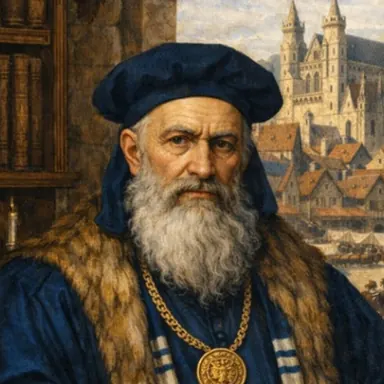
The Torah and Leadership Legacy of Rabbi Avigdor ben Eliyahu Kohen Tzedek of Vienna: The Shift of Centers and the Consolidation of Halakha in Ashkenaz in the 13th Century
15 min read2,908 words
Summary
This survey presents the figure of Rabbi Avigdor ben Eliyahu Kohen Tzedek, one of the pioneers of halakhic ruling and leadership in Ashkenazi Jewry in the 13th century, who brought about a spiritual revolution with the transfer of the center of Torah from northern Italy and the Rhineland to Austria. The text details how the rabbi succeeded in combining diverse traditions of study with the method of the Tosafists, thereby shaping Vienna into an influential halakhic capital that radiated across all of Europe. Beyond his Torah works in biblical and Talmudic commentary, his importance is stressed as a public leader and a central halakhic decisor who raised outstanding disciples such as the Maharam of Rothenburg. The purpose of the article is to shed light on Rabbi Avigdor's decisive contribution to the consolidation of Ashkenazi halakhic identity and to the strengthening of communal institutions in a period of significant geopolitical change.
The 13th century in the history of European Jewry is considered one of the formative periods in the shaping of the world of Ashkenazi halakha and in the reorganization of the communal and Torah structure in the region. At the heart of these changes stands the many-sided figure of Rabbi Avigdor ben Eliyahu Kohen Tzedek, also known as Rabbi Avigdor Katz or Rabbi Avigdor HaKohen of Vienna.[1, 2] The work of this sage is not confined to writing commentaries or ad hoc halakhic rulings; he represents the geographical and spiritual shift of the Torah center of gravity from northern Italy and the cities of the Rhineland toward Austria, which under his leadership became one of the most important and influential centers of Ashkenazi Jewry in the Middle Ages.[3] As one who lived and worked at the height of the flowering of the period of the Tosafists, Rabbi Avigdor served as a living bridge between the early Italian traditions of study and sophisticated Ashkenazi scholarship, and shaped with his own hands the face of the community of Vienna as a spiritual capital.[1, 3]
Biographical Background and the Torah Journey: From Italy to the Danube Basin
Rabbi Avigdor was born in Italy at the end of the 12th century or the beginning of the 13th century.[3] His early Torah education took place in the splendid study halls of northern Italy, which were known for a distinctive method of study combining ancient halakhic traditions from the Geonic period with profound Talmudic dialectic influenced by constant contact with the centers in France and Germany. His principal teachers in this period were among the most important sages of Italy: Rabbi Elazar ben Shmuel of Verona and Rabbi Yitzchak of Verona.[3] The influence of these sages on Rabbi Avigdor was decisive, for they gave him the scholarly foundation on which his lofty Torah stature was built, with an emphasis on a thorough understanding of the sources and on the use of the early method of pilpul.
After completing his studies in Italy, Rabbi Avigdor moved to Germany, a step that symbolized his wish to perfect himself in the methods of study of the Ashkenazi Pietists and the later Tosafists. He had the privilege of studying with Rabbi Simcha ben Shmuel of Speyer, who was a key figure in the circle of disciples of the Ra'avia and one of the sages who influenced the shaping of Ashkenazi custom.[1, 4] In addition, he was in Torah contact with Rabbi Yoel HaLevi of Bonn, the father of the Ra'avia, which places him at the heart of the leadership and scholarly dynasty of German Jewry in the 12th and 13th centuries.[1, 4] This combination of Italian and German influences created in Rabbi Avigdor a broad Torah outlook, which later enabled him to serve as a supreme authority accepted by many and diverse communities.
Rabbi Avigdor's movement between the various centers was not accidental, but an expression of a broader process of the migration of Torah scholars in that period. After working in northern Italy in the cities of Ferrara and Mantua, he founded his own study hall in Verona, which attracted many students, among them members of the famous Anav family of Rome.[3] The presence among his students of Rabbi Tzidkiyahu ben Avraham Anav, author of the book "Shibbolei ha-Leket," attests that Rabbi Avigdor was one of the sages who transmitted the Torah of Ashkenaz to Italy and back, creating a distinctive halakhic synthesis.[3]
At a later stage, Rabbi Avigdor settled in the city of Halle in Germany.[3] In this period he was already regarded as a recognized halakhic authority, as emerges from his exchange of letters with Rabbi Chizkiyahu ben Yaakov of Magdeburg (the Maharih) concerning complex divorce cases.[3] This correspondence reveals his standing as a decisor whose opinion was heeded even among the foremost sages of Germany, who sought his consent and guidance on sensitive matters of personal status.
The Leadership of the Vienna Community: Strengthening the Torah Center in Austria
The peak of Rabbi Avigdor's work came with his invitation to serve as rabbi of Vienna, following the death of Rabbi Yitzchak ben Moshe, author of the "Or Zarua."[3] This invitation was not only a recognition of his personal greatness, but a strategic move by the Jewish community of Austria, which sought to preserve its standing as a leading Torah center after the passing of the greatest sage of the previous generation. Rabbi Avigdor served as the rabbinic center of gravity in Austria for about 25 years, a period in which Vienna became a focus of spiritual and halakhic creativity that radiated over the whole of European Jewry.[3]
In this period Rabbi Avigdor was not only a head of a yeshiva teaching students, but a leadership figure who managed the religious affairs of the whole of Austrian Jewry.[1, 4] Under his authority, matters of personal status, kashrut, the order of prayer and the community's relations with the authorities were regulated. His influence was so great that the sages of his generation, such as Rabbi Avraham of Pesaro and Rabbi Yitzchak Or Zarua himself, called him "one of the greatest sages of our generation."[3]
The transformation of Vienna into a Torah center in this period was part of a historical process of the eastward expansion of Jewish settlement. While the western communities in France and Germany suffered from persecutions and economic hardships, Austria offered a period of relative stability under the dukes of the House of Babenberg. Rabbi Avigdor wisely made use of this stability to build stable Torah institutions, which formed the foundation for the development of the famous "wisdom of Austria" in later generations.
His Torah Work: Between Talmud and Scripture
Rabbi Avigdor's spiritual world found expression in a wide range of works encompassing the Talmud, halakha and biblical commentary. Although many of his writings were lost or absorbed into the works of later sages, the remnants that have reached us attest to his profound scholarly method.
Tosafot and Novellae on the Talmud
As an inseparable part of the movement of the Tosafists, Rabbi Avigdor engaged in the dialectical analysis of Talmudic discussions. His best-known work in this field is the "Tosafot" on tractate Ketubbot.[1, 3, 4] References to these Tosafot are found in the "Masoret ha-Shas" on folio 63b of tractate Ketubbot, where his words are cited as a central interpretive authority.[1, 5] In addition, Tosafot of his on tractate Eruvin have been preserved, attesting to his intensive engagement with the laws of the Sabbath domains and with the engineering-halakhic structure of these discussions.[3]
Rabbi Avigdor's scholarly method was marked by an attempt to reconcile contradictions between distant discussions in the Talmud, using sources from the Yerushalmi and the literature of the Geonim, which were more widespread in the Italian study hall from which he came. His ability to combine French analytical analysis with the Italian textual tradition made his Tosafot an important source for the decisors who came after him.
Biblical Commentary and the Five Megillot
Another field in which Rabbi Avigdor excelled is biblical commentary. He composed a commentary on the Five Books of the Torah and on the Five Megillot, which exist to this day in manuscripts.[1, 3, 4] His commentaries on Scripture are not confined to explaining the words, but integrate halakhic insights, allusions and midrashim. An interesting example of his interpretive approach can be found in his treatment of the structure of the book of Psalms and of the psalms written by Moses our teacher, a subject he discusses in comparison with the opinions of sages such as Rabbi Yehuda HeChasid.[6]
Rabbi Avigdor's commentary reflects the character of the Tosafists on Scripture (such as the "Da'at Zekenim"), who sought to find in the biblical text allusions to the laws and customs prevalent in their day. His engagement with the Five Megillot also attests to a close connection with communal liturgy, since the Megillot were read in public on the festivals of the year, and the need for a clear and authoritative commentary on them was great.
Halakhic Ruling and Responsa
Rabbi Avigdor's centrality as a decisor is reflected in the enormous number of citations of his rulings in the central books of the Rishonim. He did not compose an independent halakhic code (such as the later "Tur" or "Beit Yosef"), but his responsa are scattered throughout the length and breadth of the halakhic literature of the 13th and 14th centuries.[3] The sages of the generation saw his decisions as a supreme authority, and his responsa became cornerstones in the shaping of Ashkenazi law.
The Network of Connections and the Raising of Disciples: Influence for Generations
Rabbi Avigdor's strength lay not only in his writings, but in the figures who surrounded him and in the leaders who grew up in his study hall. He was a central figure in a network of Torah scholars who connected the various parts of Europe, and his influence passed through many channels into the future of the world of halakha.
The Maharam of Rothenburg: The Principal Disciple
Perhaps the strongest testimony to Rabbi Avigdor's greatness is the fact that he was one of the principal teachers of Rabbi Meir ben Baruch of Rothenburg (the Maharam), the undisputed leader of Ashkenazi Jewry in the second half of the 13th century.[1, 3, 7] The Maharam cites his teacher, Rabbi Avigdor, with reverence and brings his rulings as a final decision on difficult questions.[1] The connection between the two symbolizes the passing of the sceptre from the center in Vienna to the pan-Ashkenazi leadership of the Maharam. Through the Maharam, Rabbi Avigdor's teaching found its way into the "Tur" and the Shulchan Arukh, and thereby became an inseparable part of the halakha accepted to this day.
The Anav Family and Italian Jewry
As mentioned, in his youth Rabbi Avigdor raised disciples from the Anav family in Rome, foremost among them Rabbi Tzidkiyahu ben Avraham Anav.[3] Rabbi Tzidkiyahu's book, "Shibbolei ha-Leket," is one of the most important sources documenting the prayer customs and halakha of Italian Jewry, and it abounds in references to the teaching of his teacher, Rabbi Avigdor.[3] This fact attests that Rabbi Avigdor succeeded in leaving an indelible mark on the Italian halakhic world as well, and served as a vital connecting link between the local traditions and the new Ashkenazi scholarship.
The Correspondence with the Sages of Germany
Rabbi Avigdor maintained close contact with the sages of Germany even after he moved to Vienna. His correspondence with Rabbi Chizkiyahu of Magdeburg is only one example of his involvement in the lively halakhic discourse of the period.[3, 8] His ability to bridge gaps of distance and custom attests to his broad moral and Torah authority. Sages from all over Germany turned to him seeking advice on complicated ceremonial and ritual problems, attaching enormous importance to his decisions.[1, 4]
Analysis of the Leadership Method: "Administration of Religious Affairs" in Austria
The expression appearing in the sources, according to which Rabbi Avigdor "managed the religious affairs of the Jewish population in Austria" [1, 4], hints at a role much broader than mere halakhic ruling. In the 13th century the Jewish communities in Austria were in stages of organization vis-à-vis the ducal government, which granted them certain rights (privileges) in return for taxes and economic contribution.
Rabbi Avigdor's role probably included:
- Regulating the communal structure: laying down communal ordinances on matters of taxes, trade and support for the poor.
- Adjudication and arbitration: resolving internal disputes within the community and in dealings with neighbouring communities.
- Supervision of educational institutions: seeing to the maintenance of yeshivot and Talmud Torah schools.
- Representation before the authorities: securing freedom of worship and protecting the rights of the Jews against the Church and the nobility.
Rabbi Avigdor's leadership was marked by a systemic view. He did not see Vienna as an isolated island, but as the capital of an entire region that had to be conducted according to the principles of the Torah. His success in this task is reflected in the fact that Austria became the most stable Torah center in those years, a stability that made possible the continuation of creative work even in the more difficult periods that came afterward.[3]
His Halakhic Teaching in the Mirror of Later Sources
To understand the depth of Rabbi Avigdor's influence, one must examine the way in which his words were cited by later generations. Sages such as Rabbi Asher ben Yechiel (the Rosh) and Rabbi Chaim ben Yitzchak (the son of the "Or Zarua") treated his rulings as a binding tradition.[3]
In the book "Mordechai," written by Rabbi Mordechai ben Hillel (a disciple of the Maharam), many rulings of Rabbi Avigdor are brought, especially on matters of torts and monetary law. The incorporation of his teaching into the "Mordechai" ensured that his words would be accessible to every student of Torah in Ashkenaz and Poland in the following centuries. Similarly, the "Hagahot Maimoniyot" (a commentary on Maimonides written by Rabbi Meir HaKohen of Rothenburg) incorporates Rabbi Avigdor's words as part of the Ashkenazi supplements to Maimonides' Sephardic halakhic ruling.[3] This is an impressive expression of the fact that Rabbi Avigdor was perceived as a distinguished representative of the original Ashkenazi tradition, able to stand up to the other methods of halakhic ruling and to offer a well-founded alternative.
The Historical Context: Vienna in the 13th Century as an Arena of Renewal
To understand Rabbi Avigdor's work, one must look at the reality of Vienna in that period. The city was in a process of rapid growth, and its Jewish community was among the wealthiest and most influential in Europe. Duke Frederick II "the Belligerent" granted the Jews a famous charter of rights in 1244, which regulated their legal status and protected them from blood libels and harassment.[9]
In this atmosphere of growth, Rabbi Avigdor served as a spiritual compass. He had to deal with challenges created as a result of economic prosperity, such as foreign cultural influences and the need to regulate trade relations between Jews and gentiles. His work in the "administration of religious affairs" probably also included dealing with questions of interest, banking and international trade, which were the lifeblood of Jewish Vienna.
Likewise, the 13th century was a period of religious ferment in Christianity, with the rise of the Franciscan and Dominican orders and the intensification of missionary pressure. Rabbi Avigdor's leadership provided the community with inner resilience, stressing the values of Torah study and the preservation of tradition in the face of a changing environment.
Conclusion: The Legacy of "the Greatest Decisor of His Generation in Austria"
Rabbi Avigdor ben Eliyahu Kohen Tzedek died around 1275.[3] He left behind him a consolidated Torah world, a strong community and a generation of disciples who continued to lead Ashkenazi Jewry for many decades. His figure represents the type of the "comprehensive sage" of the Middle Ages: a keen scholar, a profound biblical commentator and a public leader of many achievements.
His historical importance lies on several levels:
- Transfer of the center: he was the main factor that made Vienna and Austria the successors of the Rhineland cities that had declined.
- Scholarly synthesis: he united the Torah of Italy, Germany and France (through the Tosafists) to create a single halakhic method.
- Raising the Maharam: through his principal disciple, he influenced the entire course of Ashkenazi halakha to this day.
- Preservation of the text: his commentaries on Scripture and the Talmud that have survived in manuscripts constitute an inexhaustible treasure for the Torah and historical research of our day.[6]
Rabbi Avigdor Kohen Tzedek of Vienna remains in historical consciousness as the one who breathed new life into Austrian Jewry and shaped its identity as a central station on the eternal path of the Torah. His work is a living testimony to the power of spiritual leadership to build worlds even in periods of profound geopolitical and social change.[1, 3]
Sources9
- 1.Avigdor Cohen of Vienna - Wikipedia, en.wikipedia.org/wiki/Avigdor_Cohen_of_Vienna
- 2.אביגדור הכהן - ויקיפדיה, he.wikipedia.org/wiki/אביגדור_הכהן
- 3.Avigdor ben Elijah Ha-Kohen | Encyclopedia.com, encyclopedia.com/religion/encyclopedias-almanacs-transcripts-and-maps/avigdor-ben-elijah-ha-kohen
- 4.ABIGDOR BEN ELIJAH HA-KOHEN - JewishEncyclopedia.com, jewishencyclopedia.com/articles/283-abigdor-ben-elijah-ha-kohen
- 5.List of Tosafists - Wikipedia, en.wikipedia.org/wiki/List_of_Tosafists
- 6.Post-Mosaic Additions to the Torah? - The Seforim Blog, seforimblog.com/2020/07/post-mosaic-additions-to-the-torah/
- 7.מהר"ם מרוטנבורג - ויקיפדיה, he.wikipedia.org/wiki/מהר"ם_מרוטנבורג
- 8.יחזקיה ממגדבורג - ויקיפדיה, he.wikipedia.org/wiki/יחזקיה_ממגדבורג
- 9.8nH fr,.JJ, library.huc.edu/pdf/theses/Goldberg David J-CN-Rab-1991 rdf.pdf