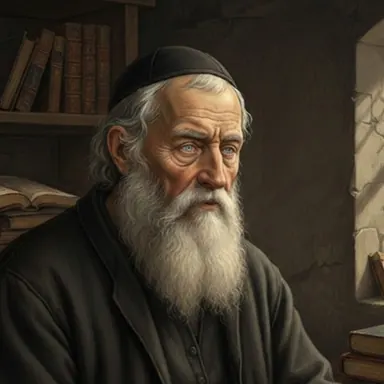
Rabbi Eliezer ben Yoel HaLevi (the Ra'avia)
18 min read3,641 words
Summary
The text surveys the highly influential figure of Rabbi Eliezer ben Yoel HaLevi (the Ra'avia), who served as a decisive cultural and halakhic crossroads in the Ashkenazi Jewry of the 12th and 13th centuries. Through an analysis of his life and his distinguished family, the article highlights the unique methodological synthesis he created between the conservative traditions of the sages of the Rhineland and the innovative pilpul methods of the Tosafists in France. A further centre of gravity in the work is devoted to his encyclopaedic literary enterprise, headed by the book "Avi ha-Ezri", which is characterised by a realistic and pragmatic approach that gives halakhic validity to ancient customs while taking account of the changing circumstances of life. Finally, the text traces the chain of transmission of the Ra'avia's teaching, which became one of the pillars of the Tur and the Shulchan Arukh, and describes the modern scholarly revival of his writings that saved his legacy from oblivion.
The Work and Torah Teaching of Rabbi Eliezer ben Yoel HaLevi (the Ra'avia): A Historical, Methodological and Halakhic Analysis of a Pillar of the Ashkenazi Tradition
The historiography of medieval Ashkenazi Jewry identifies the twelfth and thirteenth centuries as a critical period of transition, in which the halakhic and social identity of the communities on the banks of the Rhine took shape. At the heart of this process stands the monumental figure of Rabbi Eliezer ben Yoel HaLevi, known as the Ra'avia, who lived and worked approximately between 1140 and 1225.[1, 2] The Ra'avia is not only an influential halakhic decisor; he is the central crossroads through which the ancient Ashkenazi tradition passed, absorbing and processing the intellectual revolution of the Tosafists in France.[3, 4] His work extends over the writing of encyclopaedic halakhic works, public leadership in times of crisis and pogroms, and the shaping of customs that in the course of time became foundations of halakhic ruling in the Tur and the Shulchan Arukh.[5, 6]
Family Background and Intellectual Environment in His Early Life
The birth of Rabbi Eliezer ben Yoel HaLevi in Mainz or in Bonn around the year 4940 (or 4900 according to other opinions) placed him within the spiritual aristocracy of Ashkenazi Jewry.[1, 7] His family lineage is a key to understanding his later public and rabbinic authority, since he was a scion of a dynasty of sages who had shaped the character of German Jewry since the days of the first sages of Mainz.
The Ra'avia's father, Rabbi Yoel HaLevi, served as rabbi of Cologne and was a dominant figure in his own right among the sages of Ashkenaz in his generation.[7] His maternal grandfather was Rabbi Eliezer ben Natan, known by his acronym the Ra'avan, author of the book "Even ha-Ezer" and one of the greatest halakhic decisors and liturgical poets of the twelfth century.[1] This connection gave the Ra'avia direct access to ancient traditions of halakhic ruling and to methods of study that preceded the massive influence of the yeshivot of France. His extended family included further prominent figures such as Rabbi Elyakim ben Yosef of Mainz, his grandmother's father, and his uncle Rabbi Shmuel bar Natronai.[7]
This family foundation created in the Ra'avia a sense of mission to preserve what existed alongside developing it. He saw himself as a link in a continuous chain of transmission, which explains his adherence to the customs of his forefathers even when these stood in apparent contradiction to the new logical analyses of the Tosafists.[3, 8]
The education the Ra'avia received combined the important Torah centres of his time. He studied in Mainz with two of the prominent students of Rabbenu Tam: Rabbi Eliezer ben Shmuel and Rabbi Moshe ben Shlomo HaKohen.[1] This study exposed him to the French method of pilpul, essentially different from the traditional Ashkenazi style in which he had grown up. Later he continued his studies in the yeshiva of Rabbi Yitzchak bar Asher (the Riva) in Speyer, where he absorbed the original teaching of the sages of ShUM (Speyer, Worms, Mainz).[1]
The Period of Wandering and Its Influence on His Work
The Ra'avia's life was not spent peacefully in study halls alone. He lived in a period of profound political and religious upheaval in Europe, at the height of the Crusades and of the religious persecutions against the Jewish communities. His wanderings among the cities of Ashkenaz and France – Bonn, Cologne, Mainz, Metz, Würzburg, Bingen and Speyer – were not always a choice to change yeshivot, but many times the result of flight from persecution.[2]
The most significant turning point in his personal and rabbinic life occurred in the year 4957 (1197). During the pogroms of the persecution of 4957, the Ra'avia was forced to flee with his family from his city of Bonn to the city of Bingen.[1] During this flight the Ra'avia lost all his personal wealth, but the heaviest loss for him was the loss of his books and manuscripts.[1] This event deeply influenced the character of his later works. Scholars point out that extensive parts of his books were reconstructed from his phenomenal memory or from short notes that survived, which explains the unique structure of his book, which at times combines short responsa and decisive rulings alongside long Talmudic discussions.[7, 9]
At the beginning of his career, the Ra'avia deliberately avoided accepting an official rabbinic post, out of a desire for economic independence not dependent on the community.[10] However, after he was utterly impoverished as a result of the pogroms, he was forced in the year 1200 to take upon himself the yoke of the rabbinate in Cologne, the place where his father had served before him.[1, 2] There he served as head of a yeshiva and attained the status of "Resh Metivta" (head of the academy), becoming one of the greatest halakhic authorities by whose word matters were decided throughout Germany.[1]
The Literary Enterprise: The Book "Avi ha-Ezri" and the Book "Aviasaf"
The Ra'avia's works form a bridge between the literature of commentary and the literature of halakhic ruling. His main work, usually called "Sefer Ra'avia" but whose original name is "Avi ha-Ezri", is a wide-ranging halakhic compilation that follows the order of the tractates of the Talmud.[1, 11]
The Structure and Contents of the Book
The book "Avi ha-Ezri" includes 1,154 or 1,155 sections, and it covers most of the laws applicable in the present time, mainly in the areas of Orach Chayim and Yoreh De'ah and parts of the orders of Nashim and Nezikin.[1, 7] The Ra'avia's style is characterised by clear, lucid and systematic language. Unlike the Tosafists, whose works focused on clarifying the Talmudic passage, the Ra'avia always strives towards the practical conclusion, integrating into the Talmudic discussion halakhic responsa he gave to his questioners over the years.[3, 7]
The modern edition of the book, as printed by Avigdor Aptowitzer and later by Rabbi David Deblitzky, divides the work into four main volumes that reflect the Ra'avia's thematic range.[1, 12]
Alongside "Avi ha-Ezri", the Ra'avia wrote the book "Aviasaf". This book has not survived as a complete independent manuscript, but it is quoted hundreds of times in the writings of the Rishonim, and especially in the "Or Zarua" of his student Rabbi Yitzchak of Vienna.[1, 7] It seems that "Aviasaf" was a complement to "Avi ha-Ezri", and focused mainly on tractates of the orders of Nashim and Nezikin that were not included in the first work.[1, 7] Scholars point out that the halakhic decisors often used the names "Avi ha-Ezri" and "Aviasaf" interchangeably, but the author himself was careful to distinguish between them.[9]
The Names of the Books and Their Identification
The appellation "Ra'avia" (Rabbi Eliezer ben Yoel HaLevi) is an acronym that became the name of the book in the mouths of later generations, but in the early manuscripts and among his contemporaries it is mentioned by various names.[9]
- Sefer Avia: An abbreviation of "Avi ha-Ezri", sometimes called "the Great Avia" to distinguish it from shorter works.[9]
- Ra'ah: An acronym of "Rabbenu Eliezer HaLevi", a name found frequently in the Hagahot Maimoniyot.[1, 9]
- Avi ha-Ezri: The name the author chose for his book, after the verse "And the name of the other was Eliezer: for the God of my father (Elohei avi) was my help (be-ezri)", alluding to his own name and to his father's name.[9, 11]
The Ra'avia's Methodology: A Synthesis between Ashkenaz and France
The methodological importance of the Ra'avia lies in his ability to bridge clashing halakhic worlds. In the 12th century, the study method of the Tosafists in France, based on sharp dialectics and the comparison of distant Talmudic passages, began to penetrate the yeshivot of Ashkenaz.[4, 13] The early sages of Ashkenaz tended towards conservatism and adherence to local customs transmitted by oral tradition, whereas the teaching of the Tosafot tended at times to abolish customs if no logical basis was found for them in the Talmud.[3, 8]
The Ra'avia, as a student of the students of Rabbenu Tam and as one who grew up on the tradition of the Ra'avan, developed an approach combining the two methods. He adopted the analytical tools of the Tosafot – examination of textual variants, precision in Rashi's wording, and comparison between the Bavli and the Yerushalmi – but used them to find a Talmudic basis for the customs of Ashkenaz.[1, 4, 8] This contribution was critical to the survival of the Ashkenazi custom; without the Ra'avia, many customs might have been pushed aside by French incisiveness.[3]
A prominent example of his scholarly-halakhic approach is his attitude to the Jerusalem Talmud. The Ra'avia quoted the Yerushalmi frequently, at times even from sources that were unknown to other decisors, and used it to decide in places where the Babylonian Talmud had left a doubt.[14] He was among the first to establish that in places where there is no explicit contradiction, one should follow the Yerushalmi, especially in matters of the Land of Israel and customs of prayer.[14]
His Halakhic Teaching: Realism, Pragmatism and the Power of Custom
The Ra'avia's rulings are characterised by a large measure of realism and sensitivity to the changing circumstances of life in the Diaspora. He did not see halakha as an abstract system detached from reality, but as a living tool meant to make proper Jewish life possible even in difficult circumstances.[14, 15]
Social Sensitivity and Concern about External Factors
One of the Ra'avia's famous rulings, demonstrating his pragmatic approach, concerns the law of overturning the bed during mourning. According to the Talmud, a mourner must overturn his bed as a sign of grief. The Ra'avia ruled that in his days this custom should be abolished.[14] His reason was not only personal convenience, but a social and security concern: he explained that non-Jewish servants used to enter the homes of Jews in Ashkenaz, and these might interpret the overturning of the bed as an act of sorcery or black magic.[14] This understanding of the dynamics between the Jewish minority and the Christian majority shows that the Ra'avia weighed "extra-halakhic" considerations as an inseparable part of the process of halakhic ruling.
The Attitude to the Ancient Ashkenazi Custom
The Ra'avia is considered one of the great defenders of custom. In the famous dispute over the blessing on the Sabbath candles, the Ra'avia is the main source for the custom of reciting a blessing over the candles, although some wondered at this since it is a matter of personal enjoyment.[14] He found support for it in the "Sefer Yerushalmi" and thereby gave halakhic sanction to a custom that was widespread among women.[14]
Similarly, his ruling on drinking wine on Purim represents a balanced position. Whereas many interpreted the words of Rava in the Talmud as an absolute obligation to become drunk "until he cannot tell" (ad de-lo yada), the Ra'avia held that it is merely optional, and that the essence is heartfelt joy and not loss of one's senses.[16] This position was later accepted by many decisors who sought to moderate the phenomenon of drunkenness on Purim.
Laws of the Forbidden and the Permitted, and Monetary Law
In the sphere of the Jewish kitchen, the Ra'avia left an indelible mark. His most famous ruling concerns glass vessels. Whereas many of the sages of France and Ashkenaz tended to be stringent and to equate glass vessels with earthenware vessels (which never lose what they have absorbed), the Ra'avia held that glass is a smooth and hard material that does not absorb.[17] Therefore, in his view, the same glass vessels may be used for meat and for milk after washing alone.[17] This ruling, combining knowledge of the properties of the material with interpretation of the sources, is cited in the Tur and by the Rema and serves as the basis for many customs to this day.[17]
His Public Activity and Leadership of the Communities
The Ra'avia did not shut himself up in the ivory tower of study. He was deeply involved in managing community life in an especially stormy period. His connections with men of the government and the Church enabled him to act on behalf of the Jews on diplomatic levels.[2]
The Takkanot of Mainz and the Redemption of Captives
In the year 4980 (1220), the Ra'avia took part in the great assembly of the rabbis of Ashkenaz in Mainz. He is a signatory to the famous "Takkanot ha-Kehillot" (Enactments of the Communities), which appear at the end of the responsa of the Maharam of Rothenburg.[1] These enactments regulated burning issues such as the authority of the rabbinic courts, the protection of the status of women, and the distribution of the tax burden within the community. His signature after that of his colleague Rabbi Baruch ben Shmuel attests to his status as one of the senior leaders of German Jewry.[1]
Beyond this, the Ra'avia devoted great efforts to the commandment of redeeming captives.[2] In his time, many Jews were taken captive during the wars and pogroms, and the Ra'avia used his personal wealth (before he lost his property) and his authority to raise funds and free them. He was considered a firm leader against transgressors of the commandments of the Torah and those who breached its fences, but at the same time he was known for his kindness towards the needy.[2]
The Connection with the Hasidei Ashkenaz
The Ra'avia maintained close ties with the circle of the "Hasidei Ashkenaz" (Ashkenazi Pietists), and especially with Rabbi Elazar of Worms, author of the "Rokeach".[2] Although the Ra'avia focused on formal halakha and the "Rokeach" on mysticism and esoteric teaching, there was deep mutual esteem between them. The "Rokeach" quotes the Ra'avia in his work "Ma'aseh Rokeach", and the Ra'avia for his part incorporated in his books many of the pietistic and ascetic practices of this circle.[9] This combination of the logical world of the Tosafot and the world of Ashkenazi pietism is what gave the Ra'avia his strength as a leader accepted by all factions of the public.
His Influence on Later Generations and the Chain of Transmission
The Ra'avia's influence on the world of halakha stems not only from the number of his rulings, but mainly from the fact that his teaching became the foundation for the great decisors who came after him. His books were an inexhaustible source of information on the customs of Ashkenaz and on the interpretations of the Rishonim.
From Students to Commentators: The Or Zarua and the Mordechai
The main channel through which the Ra'avia's teaching was transmitted is his foremost student, Rabbi Yitzchak ben Moshe of Vienna, author of the book "Or Zarua".[1] The "Or Zarua" cites his teacher's words hundreds of times, and often it is the only source we have for the Ra'avia's rulings on tractates whose manuscript has been lost.[1, 9] Rabbi Yitzchak writes of his teacher that he was "mighty in Torah and a master of rulings, and fit to be relied upon".[1]
A further channel is Rabbi Mordechai ben Hillel, author of the "Mordechai". The Mordechai was a member of the Ra'avia's family (Hillel, the Mordechai's father, was the son of the Ra'avia's daughter), and he incorporated his ancestor's teaching as a fundamental component of his encyclopaedic work.[1] Through the Mordechai, the Ra'avia's rulings reached the Shulchan Arukh and the Rema directly.[18]
The Rosh and the Transition to Spain
When Rabbi Asher ben Yechiel (the Rosh) fled from Ashkenaz to Spain at the beginning of the 14th century, he brought with him the Ra'avia's teaching. The Rosh saw the Ra'avia as one of the pillars of halakhic ruling, and he quotes him frequently, in abbreviated form and with changes of wording, in his work on the Talmud.[1] Since the Rosh is one of the three "pillars of instruction" on whom Rabbi Yosef Karo relied in the Shulchan Arukh, the Ra'avia's ruling became an integral part of the halakha accepted by all the Jewish diasporas.[5, 6]
The Decline and Revival of the Ra'avia's Teaching in Scholarship and Publishing
Despite its decisive importance, the book of the Ra'avia remained in manuscript for hundreds of years and did not achieve wide circulation in print until the 19th and 20th centuries. This situation created a gap in knowledge about many sources of halakhic ruling, until the scholars of "Chokhmat Yisrael" (the Science of Judaism) and modern scholarship began the work of reconstruction.
The Revolution of Avigdor Aptowitzer
The figure most identified with the revival of the Ra'avia in the modern era is Avigdor Aptowitzer. Aptowitzer devoted decades to preparing a scholarly edition of the book of the Ra'avia, which was published on the initiative of the "Mekitzei Nirdamim" society.[1, 19] The edition included a monumental introduction ("Mavo la-Ra'avia") analysing his life, his family relations, and the identification of all the sages mentioned in his books.[20, 21]
Aptowitzer saw this work as his life's mission, to the point that he asked in his will that only this be written on his tombstone: that he was "the editor of the book of the Ra'avia".[19] His work enabled students of Torah and scholars to approach the Ra'avia's original text in a clean and accurate form, and to discover the depth and systematic character of his teaching.[11]
Contemporary Research: Simcha Emanuel and Israel Ta-Shma
In recent decades, the studies of Prof. Israel Ta-Shma and Prof. Simcha Emanuel have added new layers to the understanding of his figure. Ta-Shma studied the connection between the Ra'avia and the ancient Ashkenazi custom, and showed how the Ra'avia acted as a cultural mediator who saved ancient traditions from extinction.[8] Simcha Emanuel, in his studies of the sages of Ashkenaz in the 13th century, made important corrections in the identification of the Ra'avia's students. He showed that the traditional lists of students at times included figures who did not study with him directly, but copied from his books, which attests to his enormous influence as a "teacher through books" more than as a personal teacher in the narrow sense.[14]
Epilogue: The Enduring Legacy of Rabbi Eliezer ben Yoel HaLevi
The figure of the Ra'avia emerges as one of the brightest beacons of the period of the Rishonim. He succeeded in combining within himself qualities that seem contradictory: a sharp dialectician in the method of the Tosafot on the one hand, and a meticulous guardian of his forefathers' customs on the other; a firm and politically involved community leader, alongside a Torah scholar toiling at the writing of encyclopaedic works amid poverty and wandering.
His Torah teaching is what gave Ashkenazi halakha its intellectual legitimacy vis-à-vis the Torah centres in France and Spain. His rulings, characterised by comprehensive realism and love of custom, became an inseparable part of the "table" (Shulchan) of the people of Israel. The Ra'avia was not only a decisor of his generation, but an architect of the tradition of halakhic ruling for generations, one whose memory and deeds continue to resonate on every page of Gemara and in every paragraph of the Shulchan Arukh studied today in the study halls.[3, 5, 18]
His steadfastness in the face of the vicissitudes of his personal fate – the loss of his property and his books and his becoming a refugee – expresses the strength of spirit of the sages of Ashkenaz in the period of the Crusades. The Ra'avia's teaching, which rose from the ashes of the pogroms of the year 1197, is living testimony to the power of the Jewish tradition to renew itself and to develop even out of severe crises, and to serve as a pillar of cloud guiding the people along the paths of halakha and of life.
Sources21
- 1.אנציקלופדיה יהודית דעת - אליעזר בן יואל הלוי ;, daat.ac.il/encyclopedia/value.asp?id1=2115
- 2.אליעזר בן יואל – ויקיפדיה, he.wikipedia.org/wiki/אליעזר_בן_יואל
- 3.נתקבלו במערכת - מכון שלמה אומן, machonso.org/hamaayan/?gilayon=17&id=775
- 4.בעלי התוספות - ויקיפדיה, he.wikipedia.org/wiki/בעלי_התוספות
- 5.שיחה:רא"ש - חב"דפדיה, chabadpedia.co.il/index.php?title=שיחה:רא"ש&mobileaction=toggle_view_desktop
- 6.שולחן ערוך – כל מה שרציתם לדעת על ספר ההלכה היסודי, שהתקבל בכל תפוצות ישראל - הידברות, hidabroot.org/article/236431
- 7.רבי אליעזר ב"ר יואל הלוי – ויקישיבה, yeshiva.org.il/wiki/index.php/רבי_אליעזר_ב"ר_יואל_הלוי
- 8.מנהג אשכנז הקדמון : חקר ועיון : ישראל מ' תא-שמע : 965-223-787-6 : magnespress.co.il - מאגנס, magnespress.co.il/book/מנהג_אשכנז_הקדמון-3252
- 9.ספר ראבי"ה - אליעזר בן יואל, הלוי - HebrewBooks.org ID# 49535 page 13, beta.hebrewbooks.org/pagefeed/hebrewbooks_org_49535_13.pdf
- 10.ראבי"ה | טקסטים ודפי מקורות מן התורה, התלמוד וספריית המקורות של ספריא., sefaria.org.il/topics/raavyah
- 11.אבי העזרי – ויקישיבה, yeshiva.org.il/wiki/index.php/אבי_העזרי
- 12.Sefer Raavyah 4 Volume Set - ספר ראבי"ה 4 כרכים - Judaica Plaza, judaicaplaza.com/products/308323
- 13.רבי חזקיה בן יעקב ממגדבורג יצירתו הספרותית והשפעתו ההלכתית בספרו "פסקי מהרי - Yeshiva University, repository.yu.edu/bitstreams/4cb7b646-c20e-44b6-90d2-7f868728a434/download
- 14.אליעזר בן יואל – ויקיפדיה, he.wikipedia.org/wiki/אליעזר_בן_יואל#משנתו_ההלכתית
- 15.הלכה, מציאות ושיקולי הדעת בפסיקת ההלכה - מכון הרטמן, heb.hartman.org.il/halakhah-reality-deliberation-in-halakhic-decision-making/
- 16.1שכרות בפורים2, asif.co.il/wp-content/uploads/2023/12/7.-36-48.pdf
- 17.כוסות חלביות שהודחו יחד עם כלים בשריים במדיח בשרי - Sefaria, sefaria.org/sheets/372899
- 18.שולחן ערוך - הלכה - ספריא, sefaria.org.il/texts/Halakhah/Shulchan Arukh
- 19.אביגדור אפטוביצר – ויקיפדיה, he.wikipedia.org/wiki/אביגדור_אפטוביצר
- 20.ספר ראבי"ה - מבוא -- אפטוביצר, אביגדור - (אליעזר בן יואל, הלוי) - HebrewBooks.org Sefer Detail, hebrewbooks.org/21884
- 21.מבוא לספר ראבי"ה / מאת אביגדור אפטוביצר | ספר - הספרייה הלאומית, nli.org.il/he/books/NNL_ALEPH990009939730205171/NLI